Here is an example of the first message sent 9 minutes after 2011 Tōhoku earthquake https://imgur.com/a/1mwAKqc.
There are many steep canyons on the Pacific coast, and here is just one example of mass casualties from a tsunami resulting from a submarine landslide triggered by a strike-slip fault earthquake:
Caltech, 2018[1]: "Contrary to Previous Belief, Strike-Slip Faults Can Generate Large Tsunamis"
[1] https://www.caltech.edu/about/news/contrary-to-previous-beli...
The reason that the Palu event is so notable is precisely because it's uncommon. It's also a very different system: the causative fault is running along the axis of a shallow bay that is only a few km across, so even if the landslide did occur, rapid movement of the steep, shallow coastlines would surely have generated a smaller tsunami. It's a geographical and tectonic situation in which at least a minor tsunami is expected a priori conditional upon an earthquake, so a warning system would account for that in principle. (In practice there isn't time enough to mobilize because the tsunami hits while the ground is still shaking). The bay at Palu is like a somewhat larger Tomales bay--an earthquake right there is going to make some waves. Very different situation than one far off shore.
There is a tiered system, its calibrated based on a combination of magnitude and warning time for the initial alerts (updated notices are based on other measurements and observations, but if gathering and analyzing observations before an initial warning doesn't leave time to act on it, it doesn't matter how accurate the warning is.)
It's a complication that will never happen, but sometimes I think it would be cool if HN had a way of authenticating experts and giving them flair. So many legit smart people here.
https://www.tsunami.gov/events/PAAQ/2024/12/05/so1aq0/1/WEAK...
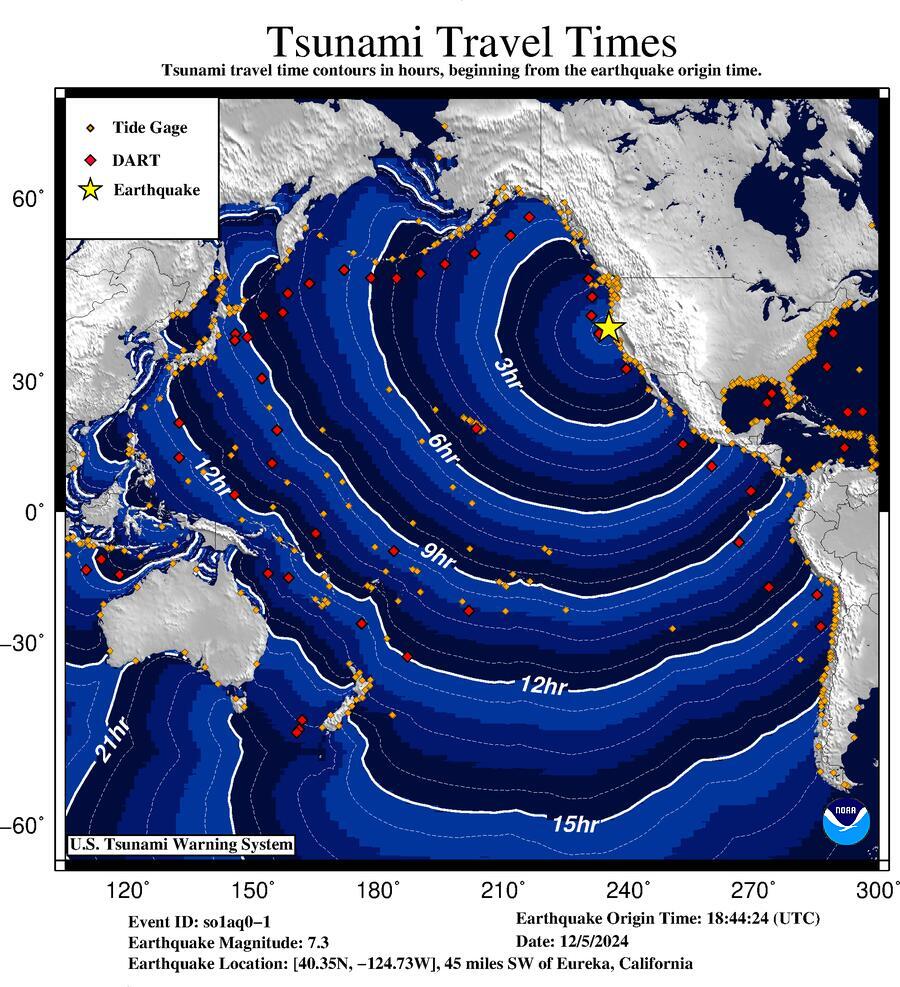
(Some of my job requires me to deal with natural disaster public warnings; but not tsunami specifically)
(I'm late to the party. The warning has since been cancelled: https://www.nbcbayarea.com/news/california-earthquakes-tsuna...)
According to a USGS guy on the news just now, this isn't true. They know the location, and the magnitude, but the moment tensor takes time. Therefore any ocean earthquake 7.0 or above triggers an immediate tsunami warning.
And then there’s this tsunami alert today.
There was a ton of flooding on flat roads and highways during the last week+ long storm session. I saw several lanes impassable on 101, and several spots in SF where a car could easily have gotten flooded.
All the alerts I got were basically "please don't drive" and not "you're gonna die!", which I think is totally reasonable.
I've gotten the warning and my street is perfectly fine... and then I look at social media and cars on the street are half-submerged just 20 blocks away.
You might not even be aware of elevation differences when they're gradual.
I guess people can go on twitter and read some random posts.
Of course, when I tap on the notification and open the app, I see that it's actually driven by an air quality alert because the AQI will be 112 (which isn't even that high.)
Come on guys - the dictionary defines weather as, "the state of the atmosphere with respect to heat or cold, wetness or dryness, calm or storm, clearness or cloudiness."
The USGS's automated systems calculate the location and focal mechanism/moment tensor pretty much instantly from the seismic network. The system should know that a significant tsunami is unlikely based on the parameters of the earthquake. On the one hand, it's good to be cautious, but on the other hand, a system designed to cry wolf is also self-undermining. Maybe they should have a tiered warning system?