The explanation is great for a toy network bu in today's Internet the vast majority of routes are going to be asymmetrical and that requires running traceroutes from both ends and interpreting the results to find the faulty hop.
The author also doesn't cover equal cost multipath (ECMP) which is everywhere. With ECMP you have multiple ports that lead to the same. Next hop and packets are hashed based on some part of the fourtuple, sometimes five tuple including the input Port. In order to track down the faulty link, you need to pro each and every one of the ports which requires that you use a higher level protocol like UDP. Using icmp in this case will not show you an issue some percent of time, providing false negatives which makes it less useful.
Traceroute is what we have, and its mostly enough as you can say at which hop things went wrong, then its up the ISP to figure out what devices they need to look at.
You're a single consumer, or a small business? Your dialog is limited to "Yes, I switched the router on and off. Yes, my local network works. No, I can reach the website over my phone, this is your problem".
Repeat three times, then get the inevitable reply of "it'll be up again in the next 24 hours".
Unless you're a network engineer, this really doesn't matter.
You don't think about the life of the electrons going through your processors when you code.
Traceroute is a view at a certain level of abstraction. It also doesn't tell you if your packet was delivered using ethernet, wifi or a token ring. It just doesn't matter.
There's an analogy to networking there, too. You don't necessarily need to know how wave-division multiplexing, BGP, or DNS work to communicate over the Internet. For some categories of problems, though, a little bit of knowledge allows you to punch just a bit above your level.
I don't know if it's missing in people's course work or what, but I've had to use http://www.tcpipguide.com/free/diagrams/ipencap.png many a times to explain how stuff like VPNs work, correct statements like "firewalls don't have a routing table, firewalling is layer 4", explain things like MTU and payload size, or why certain traffic doesn't go beyond a broadcast segment normally.
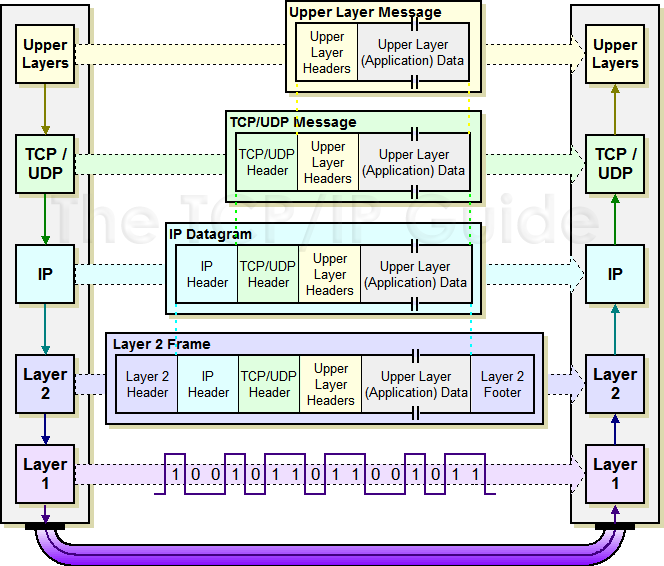
Personally I think this is one of the better visualizations.
Both asymmetric routing and ECMP routing are visible from L3. In the latter case, the routing decision can utilize some L4 data, so some L4 frobbing to get useful data points in practice is necessary for useful real-world diagnosis.
I agree with others that the OSI model is a good metaphor and a framework for reasoning about networking, but it is far from perfect, and the reality for those designing and operating network protocols and devices is messy.
MPLS is admittedly invisible and there isn't a thing you can do about it in the same way that you can't expect traceroute to give you a view of the switch ports it went through on a LAN. Of course it is useful to understand and keep in mind the fact that there may be, sometimes huge, gaps in your traceroutes. A sudden huge jump in RTT from one hop to the next can be confusing when trying to understand and troubleshoot a network issue.
we get by fairly well assuming l1 is working as designed when the light is on and not throwing errors.. at least on day-to-day ops. planning/sourcing is a bit of a different thing.
one note to your point though, back when people were still regularly picking up OC3s or doing frame relay or whatever, it was certainly more day-to-day to understand these things, but cant really fault anyone since most of that junk has gone away and we’re left with the happy ethernet handoff. especially in small scale DC/enterprise. cloud, too, made us care less.
There’s a reason the network layer abstraction is so strong, and an analogy to CPU ISAs here that have a similar strength.
TCP, similarly, doesn’t tell you when packets are deduplicated/resent/reordered/etc. — that’s just not part of the presented abstraction. Want that? Use UDP.
"Is the digital loop carrier doing any IP-level routing?"
"No, but..."
What's wrong with that? Certainly, someone with a complete picture is "better", but it is effectively two different types of problems. Do they need to be combined?
For example, I think it behooves every software engineer to have a general grasp of how CPUs work, what speculative execution is, how CPU caching and invalidation works, etc, but the average webdev doesn't really need to know this, and might run into some abstraction breaking implications only a few times in their career, while debugging a tricky bug or performance regression.
I imagine something similar is true for network engineers. Likely many can work for years at a time without worrying about fiber signal repeaters, other than that one weird packet loss issue that ends up getting traced back to a marginal optic in a cable vault somewhere.
Of course, none of this applies to the compiler engineers or the people who build the physical network layer. They are in the "second type" of engineer that actually needs to understand this stuff in depth in order to do their jobs on a day to day basis.
I am reading the connotation into this and asking about it. 4 paragraphs of talking only about tech and then it diverged into a personal statement at the end.
I guess to engage with this a bit more, one reason you might find a negative connotation towards engineers who are ignorant of the underlying details is that it is the larger set. After all, most engineers do not need to understand the physical layer in depth, so there are fewer who do. People love to feel like they're part of a smaller "higher" class, for complex social reasons. This sometimes comes with a bit of a distaste towards those who are part of the "regular" class.
But overall, I think you're taking this further than it really needs to be taken. The GP was just saying that not all network engineers are wizards in the technical details of lower layers, just like not all software engineers can write a compiler. Does that make them "worse" in some way? Well it makes them a worse fit for that few specific jobs that require that extra knowledge, but in general, I don't think so, and I doubt most people do either.
That's why we have abstractions.
But when something is broken, troubleshooting is a different animal. When people make assumptions based on their abstractions, they can waste a lot of time chasing a problem that can't exist, because the abstraction hides several more layers of complexity. Their mental model of the problem relies on a fantasy which they may not even realize is a fantasy.
It's unlikely for someone to accurately diagnose a fault that's several layers below where they're operating. Understanding that their abstractions are abstractions, and knowing when to hand things off to another layer of engineer, is critically important.
I mention it here because people aren't generally tracerouting things unless they suspect breakage somewhere. It's a troubleshooting tool. But people whose mental model of the network _only_ goes as low as the IP layer, are unlikely to do anything useful with traceroute unless the fault also happens to be at the IP layer.
You should write up a blog post where you had to debug some weird gnarly issues. A lot of us higher up the tech stack are pretty far removed from the signals level issues you're talking about but would love to hear about a low level debug session!
It is human stacking of the OSI model. The person in the ditch repairing the line probably doesn't care about traceroute, but the person with traceroute probably should care about what happens in the ditch.
Traceroute also doesn't show VPNs or other transports.
But it shows the TCP hops and the timing, thus gives me the tools to see who to call or which routing table or wore to analyse or fix. When doing that I got to lok at that connection.
DWDM protected waves, MPLS, etc, are all out of scope when someone does a traceroute, finds their traffic is going to Europe asks me about it, and then I see a local upstream has picked up Cogent as a transit provider, and Cogent is preferring their customer routes over routes from their Tier 1 settlement free peers.
But this article is very much a primer, it's using the unix format of traceroute and talking about ICMP.
When your packet leaves a router at some-pop-some-port-wherever, that fiber isn't usually the same piece of glass that plugs into the next hop. There's a whole chain of amplifiers and possibly multiplexers that handle it between here and there.
Some of those provide reliable transport service, giving you the illusion of a fiber that never breaks, despite backhoes doing what backhoes do. Some of those shift the wavelength of your signal, letting you use cheap optics without troubling in the nuances of DWDM that packs your signal alongside dozens of others onto the same long-haul fiber. Some of those just boost the signal, along with all those others on the same fiber.
But what all those machines have in common, is that none of them speak IP. None of them touch the payload. None of them are capable of decrementing a hop count. They're "part of the wire" as far as the packet is concerned.
In my experience, this leads to two types of network engineers, separated by their understanding of these underlying realities.