For a moment I thought they had futuristic CV covering the whole store.
Also in Germany. It confused me the first time I saw it because it looks so different, but it worked well.
RFID makes sense for mid to higher value items that have limited SKUs.
1. Cost of RFID tags, they’re very cheap, but still an order of magnitude more expensive than barcodes and have a meaningful impact on item costs in some markets (notably groceries).
2. Supply chain problems. This is actually a much bigger issue than the cost. RFID based checkouts require a store of have every single one of their suppliers integrated the tags into their products. Most shops simply don’t have enough control of their supply chains to make that happen in a reasonable timeframe. Until every product on the shelves has tags, you can’t deploy new checkouts, but you still need to pay for RFID tags you can’t use during the migration.
Decathlon have RFID based checkouts because they mostly sell their own products they’ve designed and had manufactured. For the vast majority of their products the RFID tag is stitched directly into the product, so it’s not a label that can be easily peeled off, or fall off. For the small number of 3rd party products they sell, they’ve got enough volume to get other suppliers to integrate RFID tags, or they can use removable labels because the risk of lost labels is acceptable if it only applies to 1% of your stock.
So don’t expect to see this type of tech deployed elsewhere anytime soon. Decathlon’s extremely strong vertical integration makes it substantially cheaper and easier for them to deploy RFID, compared to most other ships.
I'm sure the same was said about the introduction of barcodes in the 1970's. How can every single manufacturer be expected to adopt a uniformed standard, where there are not clashes between standards and adoption? Well, they managed it by collaboration: https://en.wikipedia.org/wiki/GS1
The same was also said about chip-and-pin payments, and further with online payments. This was largely implemented through regulation by the EU.
Chip-and-pin is very poor comparison, there’s realistically only 3 major card networks in Europe. If they mandate Chip-and-PIN, then chip-and-PIN happens. They only need to update card readers, of which there is only a small number of manufacturers, and they all already are used to following strict standards, and cards can be replaced as they expire, and again only a small number of manufacturers.
Simply put RFID requires a huge number of manufacturers to correctly implement RFID tags on all their products, just so a single store can implement better checkouts. Why would manufacturers voluntarily pay for that cost when there’s no clear benefit for them? For stores, why would want to cover the cost of their suppliers adding RFID infrastructure to their supply chain, when the benefits are fairly limited compared to barcodes?
That’s completely to Chip-and-PIN, where only the stores need to update their readers, and they can easily change to which ever manufacturer is willing to make them.
Companies like Decathlon and Uniqlo have a huge advantage, because they get huge supply and stock control benefits from RFID due to their vertical integration. Better self checkout are just the cherry on top, but won’t be the primary reason for adopting RFID tech.
Further, loss prevention is reduced as accidental scanning errors, and ease of intentional theft is reduced. The issue you raise of containing metal is a historic problem, but has been solved for many years through RAIN RFID tags, where a metal surface itself actually becomes part of the antenna, making it even stronger. Are you aware of any further current issues?
I agree, the cost is higher than a barcode, but when the barcode was introduced the same argument was valid. What is the benefit to the manufacturer to get involved in stock management, when the shop was previously responsible for "pricing-up" the item themselves. Wrigley's gum was the first to do it, but how did it benefit them?
With more adoption, the price will decrease, and this will become standard. Or, what is the alternative? That we use barcodes for the next 100 years?
Regarding chip-and-pin, I was responsible for writing some of the middleware in ~2004 that interfaced between chip-and-pin machines and terminals (& other devices), for what was then the largest provider in this space. It's wild that you state it was as simple as you claim, it was a massive effort across the industry, requiring lots of revisions to standards, collaboration, conferences etc. You feeling it was just a case of swapping the machine over, my former colleagues and I should take as a complement that we did it so well to give that impression.
Which is a shame, because it is better for the consumer and nearly always cheaper for us to choose-our-own.
Yes I know it’s solved. But it’s not as simple as barcodes. Each product needs to be evaluated to decide if you’re gonna put a tag on it that works well on metal surfaces, because those tags tend to be marginally more expensive than the alternatives.
> I agree, the cost is higher than a barcode, but when the barcode was introduced the same argument was valid. What is the benefit to the manufacturer to get involved in stock management, when the shop was previously responsible for "pricing-up" the item themselves.
Simple, there’s an obvious cost reduction for shops, no more need for labels or hours of pricing up, makes it easier for a store to eat the costs for their manufacturers. For manufacturers, the improved stock management at stores would allow this store to carry a large variety of brands, which makes it easier for manufacturers to get their products onto shelves.
> With more adoption, the price will decrease, and this will become standard. Or, what is the alternative? That we use barcodes for the next 100 years?
The price of RFID tags isn’t expected to get any lower. General consensus is that there’s already enough demand for RFID tags that they’ve more or less hit their lower possible price, and any further reduction are not going to be meaningful.
What’s wrong with using barcodes? It’s a well proven technology, you could update them to 2D barcodes if you want more encoded data. There’s no reason to get rid of technology that works perfectly well just for the sake of using a “newer” technology. Most retailers are looking at Amazon fresh stores and wondering if that can be made to scale to grocery stores.
> Further, loss prevention is reduced as accidental scanning errors, and ease of intentional theft is reduced.
The types of thefts you’re referring to aren’t meaningful compared to theft carried out by organised crime, and by the staff themselves. RFID tags aren’t going to stop people walking into stores and simply picking up and entire rack of clothes, or sweeping all stakes in the meat section, and walking out. That kind of theft is a real problem, and store staff deliberately don’t stop those thieves because the risk of violence is far too high.
> Regarding chip-and-pin, I was responsible for writing some of the middleware in ~2004 that interfaced between chip-and-pin machines and terminals (& other devices), for what was then the largest provider in this space.
I’m very aware of the complexities involved in any kind of change to the EMV standards, or simple changes in payment network rules. I’ve been involved in both the negotiations and technical implementation of those changes. The difference is the number of parties and teams involved. A single grocer will have hundreds of suppliers each, and likely thousands of manufacturers. The number of parties involved is substantially greater than the number of issuers and acquirers in the world. So yes, I do think stuff like Chip-and-PIN was simpler to implement than RFID. It’s all relative.
[1] https://i1.wp.com/www.savingthecrumbs.com/wp-content/uploads...
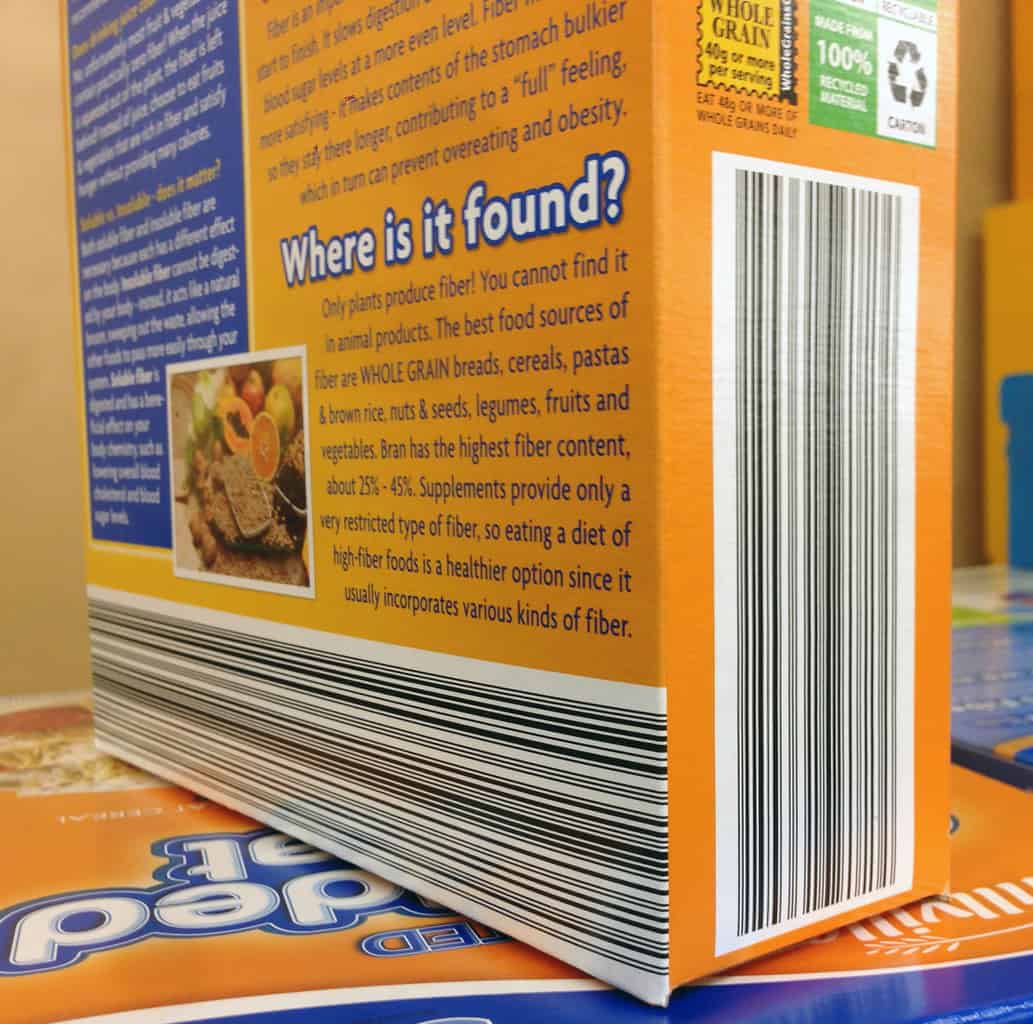
You have not know humiliation if you have not experienced a line of slightly elderly shoppers mildly frowning and tutting as you hurl your items into a bag, whilst the cashier looks at you with overt disapproval. The only accepted bagging speed is “Superhuman” and the best day of my life was when the cashier at my regular Edeka nodded approvingly at the fact that I was practically ripping the groceries out of their hand as soon as the cash register beeped.
Supermarket staff here in Italy, where I now reside, think I am insane, and I work hard to contain my impatience with those lesser-trained people in front of me at the cash register.
Target and Walmart both use EPC tags now as part of the inventory journey and it wouldn't surprise me to see more and more integration down the line. Look for the GS1 EPC logo on stickers on things at Walmart...
https://www.gs1jp.org/form/standard/epc/logo/EPC-Tag-Notific...
Target also leverages Zebra's Transition Point Readers as well near entrances and backrooms to track movement of items. https://www.zebra.com/us/en/products/rfid/rfid-readers/st500...
But how do you do that with blueberries. Does each blueberry have to have its own unique non-removable RFID tag?
There's all sorts of items at a grocery store where it's hard to guarantee the tags can't get removed from the items. That's part of why Amazon doesn't use RFID tags in their "just walk out" stores.
To boot, I was worried I was taking too many books. Expected a limit of 5 or maybe 10. But when I asked —- 40!
I thought it was very cool at the time but I assumed it must have been too impractical for some reason until Decathlon rolled it out in 2019.
We faced major issues back then, but the most important one was the cost of tagging every single product ; both cost of the tag and cost of attaching it (comparatively, antennas and IT where marginal costs at scale). Back in the end of the 2000s, tags were more expensive than today. Decathlon had one major advantage though : it manufactures most of the product. That means we could add the tag in the label at the factory. But still, to make it economically viable, we had to pile-up multiple uses cases. Every single one was important in the balance to justify buying so many tags and tagging so many products. So we went very creative, designing new ways to reduce costs in the whole manufacturing/logistics/storage/retail/after-life chain. Because no single advantage was enough by itself. We also had to imagine these new enablers and uses-cases with the state of this new technology (especially at the time) : airwaves are difficult to predict, and not 100% perfect in terms of detection, collision, …
We invented new ways to do things that were mostly already done, but cheaper (in man-hours for repetitive tasks mostly), better (quality and fiability of results), and/or more frequently. Thing logistics optimization (wrong door / parcel detected earlier), whole lifecycle and whereabouts tracking (for defective product callbacks for example), daily inventory (we had the idea to use cleaning carts with antenas to have a daily store inventory), NOSBOS (« not on shelves but on stock », detecting prodcts that where in inventory but not available at this specific moment in the department/shelf), warranty tracking, …
At the end of the story, self-checkout is mostly a by-product, not a target for the deployment. It’s something that was made possible but not a first target.
I’m not sure if they developed it themselves (I know they do have some tech team but I don’t know if they have the capacity to develop hardware) or if it’s an off the shelf solution. It’s also possible that the needed hardware parts were already available and that they developed the software and the chassis.
And yes this tech is like magic, you just throw all your stuff in the bin and boom, you pay.
I also suspect that it only works for baskets that are not too dense (so clothes and sport equipment are ok) because otherwise we would have this in every grocery store since the gain in time is tremendous even compared to self-scan cashiers. It’s basically longer to scan your loyalty card and to contactless pay than to scan your 25 articles.
Or maybe it’s just the cost of RFID tags that prevents this to happen because at the end of the day, queues at cashier are rarely a money bottleneck.