So like a ban, but just a bit less so? This will bring the same ill effects, but a bit less so. What it the win then?
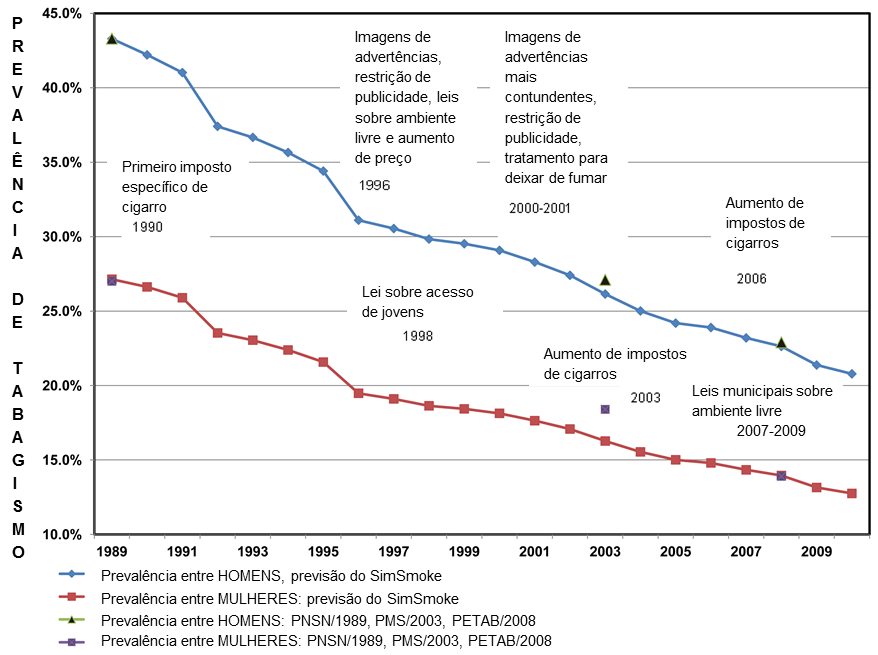
Since government started this trend, in end of 80s, tobacco usage is in free fall, as shown by this Brazilian Cancer Institute chart: https://www.gov.br/inca/pt-br/assuntos/gestor-e-profissional...
Under this logic you’re using, there’s no point to having speed limits on roadways or seatbelts and safety devices in cars. If we can never eliminate car crash deaths, why bother with all those regulations?
Lower number of bad thing is better than higher number of bad thing.
This is known to be effective with cigarettes. Higher taxes reduce usage. Less advertising reduces usage. Advertising induces demand that would not otherwise exist.
The moral justification for speed limits is risks to others on shared roads, not oneself. You can drive as fast as you want on a private track.
There was a lot of anger and discussion about public seat belt laws for the reasons you said.
> Then when I was home for the holidays every man I knew from my home town that was near my age was doing it.
From how he's describing it, this sounds like a big change. I'm also getting the sense that maybe 1 in 100 guys did it before, and it's dropping to like 1 in 10. I think the reason is that drugs can be bought in cash, but bettors depend on credit cards, and when that rail was legalized, the floodgates opened.
And the only thing it achieved was they missed out on billions in sin tax revenue during that time. I have a few friends and family in the retail and hospitality space, and all of them were trading under the table.
Our local ice cream van (who remained operational because they were deemed "essential retail") pivoted to a mobile liquor store overnight.
Cigarettes and alcohol are probably high on the list of things people 'go out for a pack of'. Doubly so when there's fuck all to do. Banning them would theoretically lower some spread.
In the case of black market gambling it seems much easier to keep everything within my direct control, thereby limiting the risk of getting a bad product. I can make a wager or play a poker game with my buddy without taking on virtually any “undue” risk (aside the risk I’m taking on intentionally) because he’s my friend and I know he’s not going to kneecap me if I can’t pay. The chain of trust only needs one link, and it’s an easy one to verify. Some people clearly do go farther, and this isn’t to say that large-scale illegal betting doesn’t exist, but it seems like the majority of recreational gambling demand is met by this type of direct person-person transaction where trust is easy-ish to establish or enforce. In this case banning betting has limited harms, because for most people the black-market is relatively low-risk. Indeed legalizing it, and thus allowing big players into the game, actually seems less safe to me. A friendly poker game on Friday nights is going to self-regulate: nobody's too sharp, everyone has roughly equivalent cash reserves, and my friends are probably going to cut me off if it seems like I'm developing an addiction. In the long-run I'm unlikely to find myself too deep in the hole. Compare this to sports betting with DraftKings. I'm against an odds-maker who's WAY savvier, has much deeper reserves than I do, and is incentivized to keep me playing at almost any cost. It's orders of magnitude more likely that I'm going to blow everything I have and then some, and all through a frictionless iOS app while sitting on my couch.
Compare this to the illegal drug trade. Unlike purchasing gambling services, buying ex. cocaine from the same buddy requires a much longer chain of trust, because of the manufacture and distribution processes involved. Even if I trust my buddy not to sell me fentanyl, I have to trust his dealer, and his dealer’s dealer, and the dealer’s dealer’s supply, etc. In this case I very much want lots of regulation ensuring the product isn’t contaminated, contains what it’s supposed to, etc. Legalizing just takes the already-existing supply chain and big players and moves them under government control. In this case the legalized version is far safer than the black market equivalent.
W/r/t legal enforcement side of things the differences seem similar. A small bet between friends is basically impossible to prosecute. It’s only the really big organized stuff that is even possible to detect, legally. On the other hand, a small amount of personal cannabis is very easy to detect and prosecute, often easier than the professional distribution network.
I had a close family member who spent the end of his life in the Federal custody for being part of it, and he wasn't even 'big time'. This was not long ago.
This gets mighty close to conspiracy territory, but I think that the current gambling wave is just a well made business play by the same people who were running the game previously.
Kind of like the cartel getting tired of dealing with interdiction and getting into the pharma business (which I don't think is a thing btw).
Looking at ex. DraftKings I think your conspiracy theory is pretty well attested to.
Very much so. I've known of people (actual people, not urban legends) who were working as small-time bookies in college (bets under $100, mostly). One started to take bets from non-students and for larger sums. After a few weeks, he got a call from the FBI. They told him it was just a courtesy call to let him know that 1) they knew about him and 2) he was starting to deal with some very very serious organized crime people, so perhaps his wisest choice would be pay out any bets he had taken so far, return any bets that he could, and hang up his hat before he ended up in prison or the ground.
So what?
We saw life under criminalized gambling. There was more loan sharking and kneecap breaking going on but overall gambling happened on a much smaller scale than it did under legalization. The people I see hurt by gambling only seems to have skyrocketed to me since legalization. The legal for-profit gambling industry does more harm than the gangsters ever did.
Just because alcohol criminalization isn’t worth it doesn’t mean we have to throw away criminalization as a tool in the toolbox.
I think the comparison to alcohol is an apt one: we've seen from previous ban attempts that rather than deter people from an activity the ban risks driving people to the black market, empowering those willing to operate illegally, removing the capacity for regulation or legal recourse (exposing partakers to grievous downside risks from product perspectives, such as contaminated liquor and loan sharks) and, ultimately, requiring more intrusion of law enforcement processes on the lives of every-day people.