This is misleading. The phone network used analog links (typically microwave relay) for long distance almost exclusively for many years (into the 80s) after the introduction of T1. T1 itself is not terribly well suited to very long distance links though and can only be pressed into it with repeaters every mile or so.
The reason should be obvious. Digging long distance trenches and all of the property buying/leasing and right of ways/easements and all of the other fun stuff makes it a total nightmare. Radio broadcast just makes much more financial sense as well as logistically.
Had "the second longest T1 in the service area" for a while there. BellSouth declined to renew the contract in 2008, the business folded, etc. In 2013 I was digging through the old building, and the T1 line card in the wiring closet was still powered.
Nowadays the relay boxes all the way into town are mostly hanging open or have been repeatedly run over. I wonder how much of the rest of that infrastructure they just abandoned in place.

How do I know? Well, we had a pretty big wildfire a couple years ago that burned a microwave tower a couple hours away. The official response was that they couldn’t get internet back in town until they rebuilt the tower. Our internet was down for a couple weeks until it was safe enough for them to get back to the tower site.
In a very real sense microwave relays are the direct descendant of the optical telegraph (aka "clacks" in Discworld lingo).
Its a radome, used to protect the antenna from weather.
Those microwave links represent layer 0 in the connection which is by definition always analogue, the same is/was true for T-1 which used alternate mark inversion [1] signalling over a 4-wire circuit. It is the type of signal carried over the link which decides whether it is considered "digital" or "analogue". T-1 carried 24 time-divided PCM channels ("digital"), microwave links could and can carry both frequency-divided multiplexed analogue channels ("analogue") as well as time-divided PCM or packet-switched channels ("digital").
[1] https://en.wikipedia.org/wiki/Bipolar_encoding#Alternate_mar...
Meanwhile, on a random roadtrip through rural Illinois yesterday, I was seeing "5G UC" on my cell phone, out in the middle of nowhere. Unevenly distributed, indeed!
Even if I found one, I would only be able to make a collect call. I never carry loose change on me, and I haven't had a calling card in decades.
Yes
> unfortunately
No. Perfect equality means that nobody can excel in anything, anywhere and any time. With perfect equality comes stagnation. If you happen to know Rush' song "The Trees" you'll know what I'm talking about:
Now there's no more oak oppression For they passed a noble law And the trees are all kept equal By hatchet, axe, and saw
It is not so much inequality which can be a problem but the fact that the lower bounds can be too low for an acceptable quality of life. As long as the lower bounds are high enough - above the "poverty line" - there can be inequality without that being a problem in and of itself.
Another thing which can be a problem is the reason for there being inequality, e.g. when some rule or custom creates artificial limits for some people but not for others ("discrimination").
For a society to thrive you want people to make the best of their possibilities and to use their capabilities to the fullest extent. With that you automatically get inequality because not everyone has the same possibilities and capabilities, e.g. a farmer on a rock-infested piece of glacial detritus will not be able to produce bumper crops even if he is at least as capable as the farmer in the river delta who can not leave his wooden shoes outside without them sprouting roots and growing leaves. On that same river delta a capable farmer will be able to more reliably produce good crops than one who has never heard of crop rotation. If you take the most productive developer in your company and provide him with a fully equipped tool shop he will not be able to produce as good a widget as would the most experienced mechanic who in his turn would not be as productive a developer. Both can do their best to reach their local optimum but the developer will most likely see that result in higher earnings than the mechanic will.
Inequality is not a problem. Equity - forced equality as personified by the "they" in the lyrics to "The Trees" - is a problem.
* https://www.researchgate.net/profile/Shrehan-Lynch/publicati...

In the 1930s, Claude Shannon was trying to optimize the phone network's automatic switching fabric built out of millions and millions of relays when he, more or less by accident, proved that switching circuits are equivalent to Boolean algebra, in a deep sense, and so the appropriate arrangement of switches, can compute anything that can be computed.
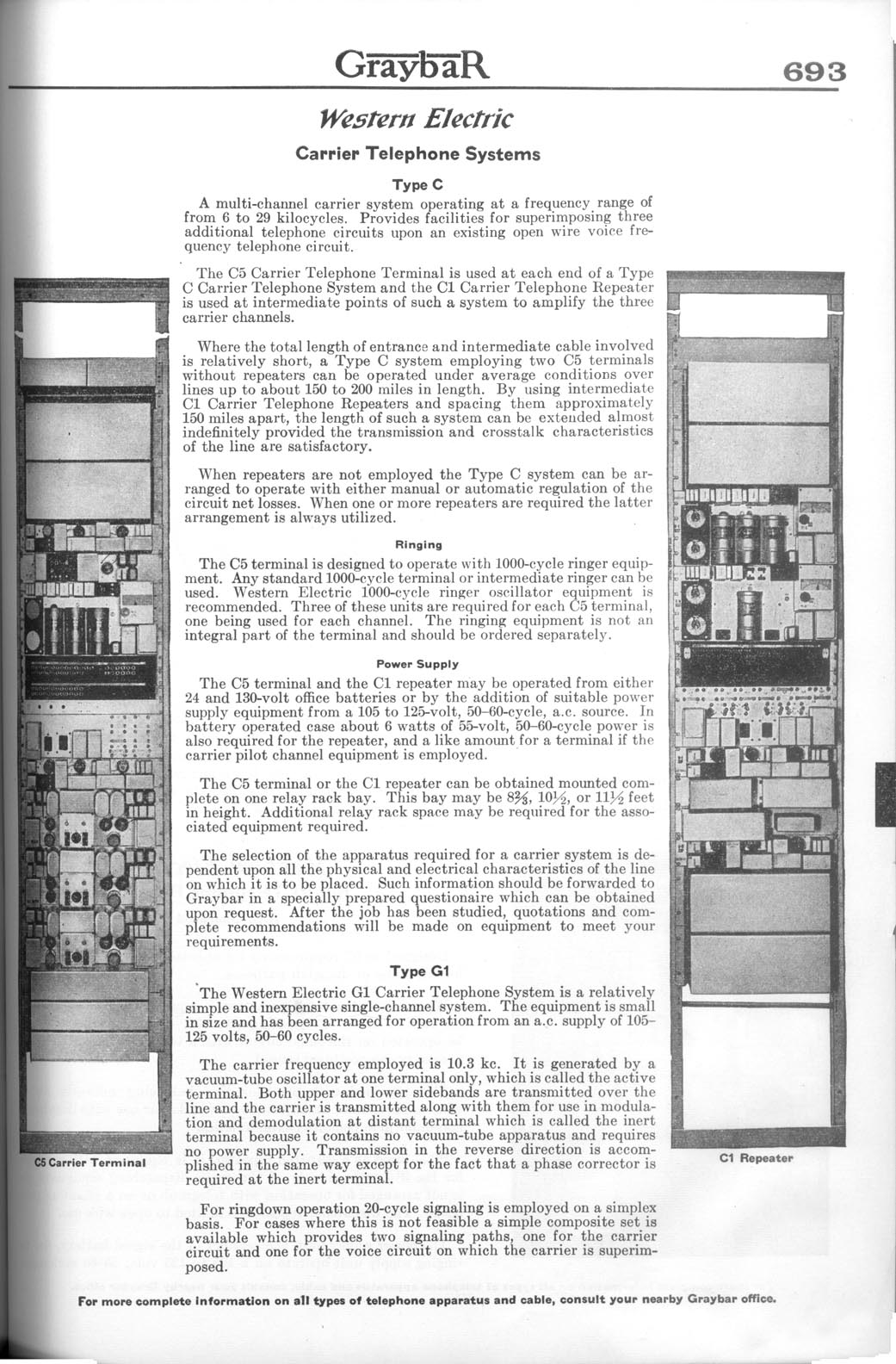
The first major commercial application for the vacuum tube was not in radio, but in amplifying long-distance telephone links. They would quickly find use in frequency multiplexing telephone lines, too. [1]
Similarly, one of the first applications of vacuum tubes as a high-speed electronic switch was for multiplexing telegraph lines, and much of the initial research on high-reliability low-power tubes able to switched fully on without damage began, with the telephone and telegraph companies.
The first computers were built out of relays and vacuum tubes specially designed for telecommunications.
The transistor was invented at Bell Labs. The planned application was the telephone network. The very same year, the theory behind modern error correcting codes was developed at Bell Labs too. These find extensive use today in data storage in computers, but the original goal was arbitrarily accurate transfer of telegraph data over noisy links.
Digital transmission of photographs dates to the late 1920s too; they wanted to send images over extremely noisy long-distance telegraph links. So record the intensity of light over each spot of the image on paper tape. Then send the tape over the wire. And reverse on the other end. [2]
I've come to understand the computer revolution as really the story of the telecommunication revolution. Computers serendipitously came about with advances in telecommunications, enabled by the same technologies, and indeed, often driven by the needs of telecommunications. (One of the very first applications for a computer in an embedded context - dating to the late 1950s in experiment - the telephone exchange, of course.)
[1] https://long-lines.net/tech-equip/misc/Graybar103-0693.jpg
IP routers now do this faster.
The ENIAC was invented to do mathematical calculations for the army.
Blaise Pascal invented a mechanical calculator to do arithmetic in 1642. Leibniz improved on his design and made his own version in 1673. However, not many of either version were made, as it was still cheaper to just do the addition, subtraction, multiplication, and division yourself.
Herman Hollerith invented a punch card tabulating machine and patented it in 1884. It was used to process the 1890 US Census. It could increment counters to do addition and multiplication, but its main purpose was to assist with processing large amounts of data using punch cards, the way SQL databases are used today.
In 1930, Vannevar Bush invented a machine called the Differential Analyzer, which was an analogue computer that could solve differential equations by integration. You could store functions in it by adjusting gears. The purpose was to be able to automatically calculate things like the position of a projectile moving through the air after n seconds without having to calculate it by hand.
Most of this I got from the book ENIAC, The Triumphs and Tragedies of the World's First Computer, which touches on all these predecessors to the computer.
Bush was Claude Shannon's graduate advisor.
I sometimes wonder how much crazy stuff these people didn't write down because they only knew how to make little bits of it happen with current tech.