News for hackers. Stuff that matters.
Re:The short-lived experiment with rubber tires on railways ... by jjgreen on Monday October 02, 2023 @04:37AM (#37735445)
Still in use on a few lines of the Paris Métro
Re:The short-lived experiment with rubber tires on railways ... by almatabata on Tuesday October 03, 2023 @03:49PM (#37756657)
Is it this system: https://en.wikipedia.org/wiki/Rubber-tyred_metro

It mentions Paris Metro line 14.

Re:The short-lived experiment with rubber tires on railways ... by lbourdages on Tuesday October 03, 2023 @03:54PM (#37756708)
Also the entirety of the Montreal Metro, which was inspired by the Paris Metro.
Re:The short-lived experiment with rubber tires on railways ... by NeoTar on Tuesday October 03, 2023 @04:49PM (#37757371)
And Sapporo in Hokkaido.
Re:The short-lived experiment with rubber tires on railways ... by ilamont on Tuesday October 03, 2023 @04:02PM (#37756802)
So does Taipei's Wenhu line (https://en.wikipedia.org/wiki/Wenhu_line) which was built by a French consortium in the 90s (Matra IIRC). Construction disputes were epic but it seems to operate very smoothly now. The other lines in the system are rail-based.
Re:The short-lived experiment with rubber tires on railways ... by lqet on Tuesday October 03, 2023 @04:02PM (#37756803)
AFAIK, basically all French subway systems opened after the 1960s use this system.

This is one of the things I strongly associate with Paris: the slight smell of burned rubber when you enter a Métro station of a line with rubber tires.

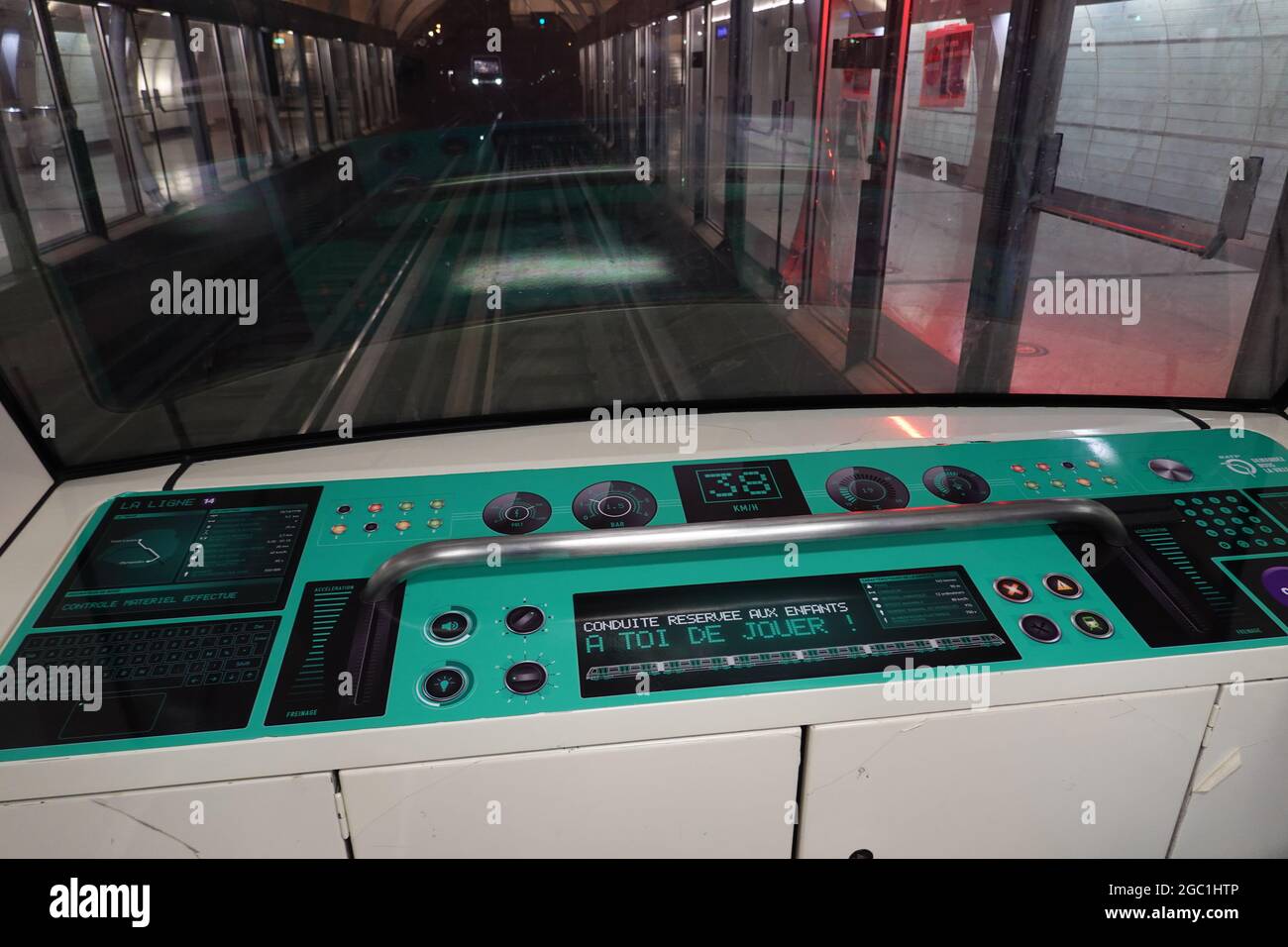
Pro tip for Paris visitors with children: ride with one of the automated lines 1, 4 or 14, and enter through the very first door. There is a fake (printed) control panel for children below the front window [0].

[0] https://c8.alamy.com/comp/2GC1HTP/paris-automatische-metro-m...
Re:The short-lived experiment with rubber tires on railways ... by littlestymaar on Tuesday October 03, 2023 @04:23PM (#37757067)
The reason why metros on tires is a thing is that they used to have much better acceleration/breaking characteristics than rails, which is good for metros since you can cram more trains in the same lines this way.

I said “used to” because, from what I understood, the development of ABS made breaking characteristics of traditional trains much better than before, which reduces the improvement you get with tires.

Re:The short-lived experiment with rubber tires on railways ... by TylerE on Tuesday October 03, 2023 @04:50PM (#37757376)
Half right. The limit at this point is much more do with what (likely standing, possibly not even holding on) people can tolerate, not what the device is physically capable of generating.
Re:The short-lived experiment with rubber tires on railways ... by littlestymaar on Tuesday October 03, 2023 @06:07PM (#37758257)
True, though emergency braking isn't entirely subject to these limitations.

At least for tramways I know for sure[1] that the tram will happily have you break your arm inside the tram because it braked too strong in case of emergency rather than crushing a pedestrian that crossed in front without paying attention.

Maybe the rules are different for metros though, given that there aren't as many pedestrian on the way…

[1] because I got the information from the system design team of a big tramway manufacturer I worked with no later than last year so my memory is much fresher, and the source is more reliable.

Re:The short-lived experiment with rubber tires on railways ... by inferiorhuman on Tuesday October 03, 2023 @06:35PM (#37758541)
Muni reduced the emergency braking force back in 2008–2009 or so, because, yes people were getting injured (and given how frequent EB applications were back then…). You can definitely achieve sufficient braking without having to violently throw people to the ground.
Re:The short-lived experiment with rubber tires on railways ... by inferiorhuman on Tuesday October 03, 2023 @06:33PM (#37758531)
Both BART and Muni had problems with the service brakes on their new trains flat spotting the wheels – apparently it's still not quite as much a solved problem as it should be. BART especially tends to run their trains with out of round wheels – almost certainly not helped by running aluminum wheels.
Re:The short-lived experiment with rubber tires on railways ... by lqet on Wednesday October 04, 2023 @03:42AM (#37762086)
Exactly. After initial testing of the rubber tires in the 70ies, RATP quickly decided to not use the full acceleration/breaking potential of the rubber tires, because it was very uncomfortable for passengers.
Re:The short-lived experiment with rubber tires on railways ... by andbberger on Tuesday October 03, 2023 @08:04PM (#37759235)
rubber tired metros have no advantage over steel wheeled linear induction metros.
Re:The short-lived experiment with rubber tires on railways ... by azdle on Tuesday October 03, 2023 @04:13PM (#37756930)
As far as I can find, the Paris Métro's rubber tire lines all run on special rollways and not traditional railways like the vehicles in the article.
Re:The short-lived experiment with rubber tires on railways ... by m463 on Tuesday October 03, 2023 @06:10PM (#37758292)
also mexico city

Ten of the lines are rubber-tired. Instead of traditional steel wheels, they use pneumatic traction, which is quieter and rides smoother in Mexico City's unstable soils. The system survived the 1985 Mexico City earthquake.

https://en.wikipedia.org/wiki/Mexico_City_Metro