WebP has the big advantage that the quality setting is meaningful, you can set it at a certain level and then encode thousands of images and know the quality is about the same. This is by no means true about JPEG, if you are trying to balance quality and size you find you have to manually set the compression level on each image. Years back I was concerned about the size of a large JPEG collection and recompressed them which was a big mistake because many of the images were compressed too hard.
In 2023 I think you can just use WebP and it will work well, my experience looking at images is that AVIF does better for moderate to low quality images but for high quality images it doesn’t really beat WebP.
https://archive.smashing.media/assets/344dbf88-fdf9-42bb-adb...
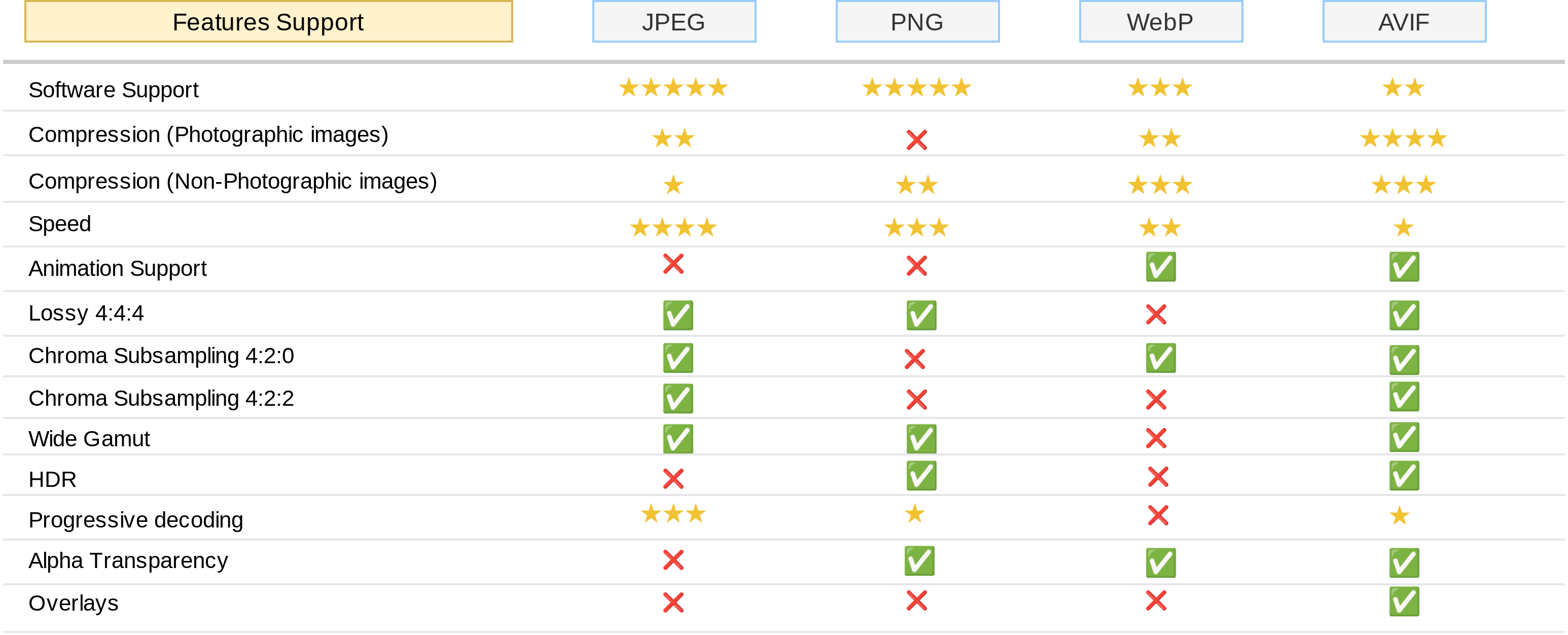
- What is the cross supposed to mean for PNG compression of photographic images? PNG can compress photographic images just fine and for some applications (where you want lossless) it used to be a good choice.
- PNG has animation support, even if everyone except Firefox tried to
- While WEBP and AVIF support lossless compression and animation, those features are not available in all browser versions that support static lossy webp/avif images.
Distortion metrics[0] such as MS-SSIM, MS-SSIM*, SIMM, MSE, and PSNR can be used to define a cut-off or threshold for deciding the point at which the image is "compressed enough" by using one or more of those algorithms and predefining the amount of acceptable/tolerable distortion or quality loss. Each of those algorithms has some trade-offs in terms of accuracy and processing time, but it can definitely work for a large set if you find the right settings for your use-case. It is certainly more productive than manually settings the Q-level per image.
Some SaaS such as https://kraken.io do this on JPG images.
If you're looking for a tool that really smartly optimizes the images (by using SSIM) that is https://shortpixel.com/online-image-compression
and
b) Like any other video codec-based format, webp overcompresses dark areas in images so no, you can't rely on consistent quality across collections of arbitrary images.
Webp has been around for over a decade. AVIF will probably get adoption as a faster rate in my estimation.
Very few sites pay for so much outgoing image bandwidth to make that compatibility cost lower than a 15% savings.
AVIF has gone better because it wasn’t based on a video codec which was never really competitive, was developed collaboratively, and didn’t have feature regressions from JPEG. As with tool support, that last matters a lot at many organizations because the edge experience tends to decide things - even if 95% of your usage is boring 8-bit 4:2:0 the institutional memory tends to be shaped by the times you hit something which can’t be used without more work. If it compressed as well as AVIF, more people might have decided WebP was worth it but since it only marginally outperformed JPEG the case was never that strong.
Part of what I meant by “shipping the prototype” was this kind of stuff: someone at Google wanted to find another use for the On2 IP they’d purchased so they tossed it into a 20 year old container format and shipped it. As with WebM, the benchmarks were fast and loose which meant that anyone who replicated them saw substantially lower performance, which is another great way not to build confidence in your format.