This is what the age pyramid looks like for a first world nation: https://www.populationpyramid.net/finland/2022/
It's a column until you reach 70 then people start dying.
This is what the age pyramid looks like for a society stuck in the Malthusian trap: https://1.bp.blogspot.com/-XfdbjKDGvT0/Ti49-5r5EyI/AAAAAAAAB...
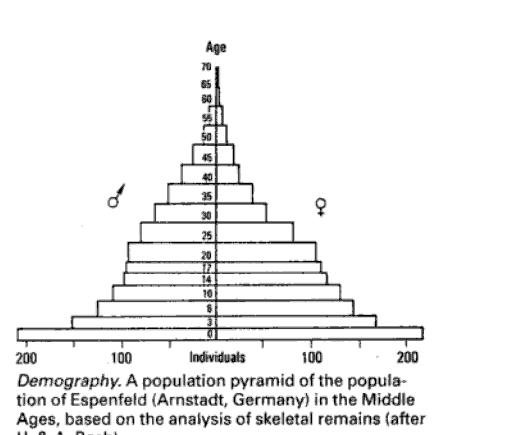
Notice how people have a half life, the chance of dying when you reach 20 years in any year is 5% regardless of age.
Especially after the plague would have been a much nicer place to live for most people than an average ancient Roman city (or even Rome itself given that's its population was only sustainable because of immigration)
there are quite a few weasel words in there, but no, they didn't have life expectancy I would envy, even if they survived adulthood.
Both because of a significant decrease in taxation but mostly because the plague, climate change and warfare killed half or so killed half of the people living in Europe at the time.
The same thing happened in the 1300s and 1400s as the number of people decreases significantly the quality of life for those who remained increased (more land per capita).
Additionally there were significant technological developments during the middle ages which resulted in higher crop yields (especially in northern Europe) (heavy plow, horse collars, wind mills, more water mills, 3 and later 4 field crop rotation, general improvements in metallurgy...
The 20th and 21st century havd been revolutionary from a medical point of view.
> When infant mortality is factored out (i.e. counting only the 67–75% who survived the first year), life expectancy is around 34–41 more years (i.e. expected to live to 35–42). When child mortality is factored out (i.e. counting only the 55-65% who survived to age 5), life expectancy is around 40–45 (i.e. age 45–50). The ~50% that reached age 10 could also expect to reach ~45-50; at 15 to ~48–54; at 40 to ~60; at 50 to ~64–68; at 60 to ~70–72; at 70 to ~76–77.
Early 19th century England
> For the 84% who survived the first year (i.e. excluding infant mortality), the average age was ~46–48. If they reached 20, then it was ~60; if 50, then ~70; if 70, then ~80. For a 15-year-old girl it was ~60–65. For the upper-class, LEB rose from ~45 to 50.
Less than half of the people born in the mid-19th century made it past their 50th birthday. In contrast, 97% of the people born in 21st century England and Wales can expect to live longer than 50 years.
Nope. I see this consistently repeated all over HN or Reddit, but it just isn't true. Only the high clergy routinely reached their late 60s, and trying to analyze general mortality from the relatively sparse ancient records that mostly concerned the richest and most important people introduces enormous biases.
It is the burial grounds that tell the full story without major biases (there still are biases caused by, say, sailors drowning and their bones not being buried on land - a nontrivial cause of death in a maritime imperium). And the bones of average people indicate that over half didn't live to see their 60th birthday until the 19th century.
In some really bad periods (the Dark Ages in Europe), the average buried adult person is in their early forties - a tale of food insecurity and constant raids. Rome, at least, was mostly food secure and had long periods of peace, so celebrating your 50th birthday was very thinkable for a free Roman citizen of non-pauper status.
Edit: someone downvoting this. People, just take any paper about an archeological excavation of an old burial ground and the detected age distribution of the skeletons found. People over 60 are untypical, though always present in all periods until well into the industrial revolution. And early Medieval cemeteries skew a lot younger than either Rome at its height, or the Late Middle Ages with their better agriculture and more capable governments.
https://www.populationpyramid.net/africa/2022/
To compare to a time when slaves were near, surely we must add our poor regions, where people work in mines and factories for us, to our life expectancy. Otherwise we are as much comparing Modern Capitalism to feudalism, etc.
But the current shape of the African population pyramid is partly determined by the baby boom in the last three generations. There were many fewer Africans around in 1963 (which is when people who are now aged 60 were born), so even if they all lived long (which they didn't), their share on the 2023 population would be much lower than in societies which barely reproduce themselves.
For a fast growing population you'll always see a significant narrowing by age no matter if people live long or not.
As far as I know, life expectancy for somebody who reached age of 10 was 36/37. If you include child mortality then life expectancy was in 20s [1][2].
[1] https://www.jstor.org/stable/3184767
[2] https://www.ucl.ac.uk/museums-static/digitalegypt/age/roman....
This is not true and the source of this misconception is a misleading BBC article that only cited sources about the rich privileged elites of ancient Rome and Middle Age England.
The vast majority of people in the past had significantly lower life expectancy than the rich elites of their time.
For females the risk of death during childhood was about 1% per event. So if you had 8+ children (half of whom died). Divided per 20 years that alone is 5 times or so higher chance to die per year than a 30 year old woman has today (from all causes).
> However those who survived to adulthood had a life expectancy considerably closer to modern ones than most
IIRC based on the data we have that was only the case in parts Colonial New England where a majority of 20 year olds could expect to reach 60+. But that was a huge exception compared to every other agricultural society that we know of.
Life expectancy at birth was lower than today. However those who survived to adulthood had a life expectancy considerably closer to modern ones than most people think. It turns out the massive infant and childhood mortality rates greatly dragged down the average overall life expectancy.