Life expectancy at birth was lower than today. However those who survived to adulthood had a life expectancy considerably closer to modern ones than most people think. It turns out the massive infant and childhood mortality rates greatly dragged down the average overall life expectancy.
This is what the age pyramid looks like for a first world nation: https://www.populationpyramid.net/finland/2022/
It's a column until you reach 70 then people start dying.
This is what the age pyramid looks like for a society stuck in the Malthusian trap: https://1.bp.blogspot.com/-XfdbjKDGvT0/Ti49-5r5EyI/AAAAAAAAB...
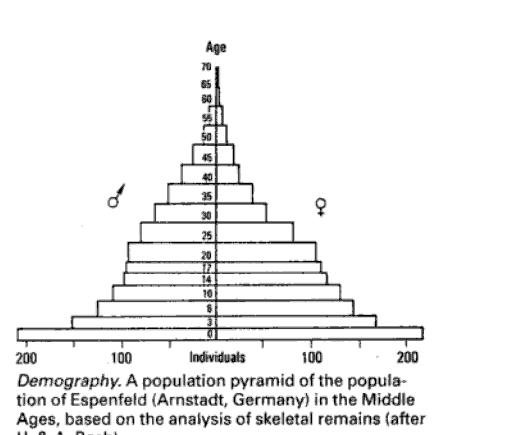
Notice how people have a half life, the chance of dying when you reach 20 years in any year is 5% regardless of age.
Especially after the plague would have been a much nicer place to live for most people than an average ancient Roman city (or even Rome itself given that's its population was only sustainable because of immigration)
there are quite a few weasel words in there, but no, they didn't have life expectancy I would envy, even if they survived adulthood.
Both because of a significant decrease in taxation but mostly because the plague, climate change and warfare killed half or so killed half of the people living in Europe at the time.
The same thing happened in the 1300s and 1400s as the number of people decreases significantly the quality of life for those who remained increased (more land per capita).
Additionally there were significant technological developments during the middle ages which resulted in higher crop yields (especially in northern Europe) (heavy plow, horse collars, wind mills, more water mills, 3 and later 4 field crop rotation, general improvements in metallurgy...
The 20th and 21st century havd been revolutionary from a medical point of view.
> When infant mortality is factored out (i.e. counting only the 67–75% who survived the first year), life expectancy is around 34–41 more years (i.e. expected to live to 35–42). When child mortality is factored out (i.e. counting only the 55-65% who survived to age 5), life expectancy is around 40–45 (i.e. age 45–50). The ~50% that reached age 10 could also expect to reach ~45-50; at 15 to ~48–54; at 40 to ~60; at 50 to ~64–68; at 60 to ~70–72; at 70 to ~76–77.
Early 19th century England
> For the 84% who survived the first year (i.e. excluding infant mortality), the average age was ~46–48. If they reached 20, then it was ~60; if 50, then ~70; if 70, then ~80. For a 15-year-old girl it was ~60–65. For the upper-class, LEB rose from ~45 to 50.
Less than half of the people born in the mid-19th century made it past their 50th birthday. In contrast, 97% of the people born in 21st century England and Wales can expect to live longer than 50 years.
Nope. I see this consistently repeated all over HN or Reddit, but it just isn't true. Only the high clergy routinely reached their late 60s, and trying to analyze general mortality from the relatively sparse ancient records that mostly concerned the richest and most important people introduces enormous biases.
It is the burial grounds that tell the full story without major biases (there still are biases caused by, say, sailors drowning and their bones not being buried on land - a nontrivial cause of death in a maritime imperium). And the bones of average people indicate that over half didn't live to see their 60th birthday until the 19th century.
In some really bad periods (the Dark Ages in Europe), the average buried adult person is in their early forties - a tale of food insecurity and constant raids. Rome, at least, was mostly food secure and had long periods of peace, so celebrating your 50th birthday was very thinkable for a free Roman citizen of non-pauper status.
Edit: someone downvoting this. People, just take any paper about an archeological excavation of an old burial ground and the detected age distribution of the skeletons found. People over 60 are untypical, though always present in all periods until well into the industrial revolution. And early Medieval cemeteries skew a lot younger than either Rome at its height, or the Late Middle Ages with their better agriculture and more capable governments.
https://www.populationpyramid.net/africa/2022/
To compare to a time when slaves were near, surely we must add our poor regions, where people work in mines and factories for us, to our life expectancy. Otherwise we are as much comparing Modern Capitalism to feudalism, etc.
But the current shape of the African population pyramid is partly determined by the baby boom in the last three generations. There were many fewer Africans around in 1963 (which is when people who are now aged 60 were born), so even if they all lived long (which they didn't), their share on the 2023 population would be much lower than in societies which barely reproduce themselves.
For a fast growing population you'll always see a significant narrowing by age no matter if people live long or not.
As far as I know, life expectancy for somebody who reached age of 10 was 36/37. If you include child mortality then life expectancy was in 20s [1][2].
[1] https://www.jstor.org/stable/3184767
[2] https://www.ucl.ac.uk/museums-static/digitalegypt/age/roman....
This is not true and the source of this misconception is a misleading BBC article that only cited sources about the rich privileged elites of ancient Rome and Middle Age England.
The vast majority of people in the past had significantly lower life expectancy than the rich elites of their time.
For females the risk of death during childhood was about 1% per event. So if you had 8+ children (half of whom died). Divided per 20 years that alone is 5 times or so higher chance to die per year than a 30 year old woman has today (from all causes).
> However those who survived to adulthood had a life expectancy considerably closer to modern ones than most
IIRC based on the data we have that was only the case in parts Colonial New England where a majority of 20 year olds could expect to reach 60+. But that was a huge exception compared to every other agricultural society that we know of.
Too many people have not watched "cannibal warlords of Liberia" so they assume that the worst society today is one sexism and racism.
> cannibal warlords
I bet there used be a whole lot more of those (relatively) and in other countries than Liberia in the past too.
I don't know that the situations of the people who owned slaves matter all that much to the experiences of the slaves.
There are two ways to read this article. One is as a pure imposition of modern views onto the past with the implication that everyone involved should have known better and should have had the perspective and empathy of a modern watcher; the other is as a clarification that, "hey, maybe Rome wasn't always a progressive advanced bastion of civilization that we should emulate, maybe a lot of people (even the privileged of the time) had terrible experiences, and maybe some of the regular glorification of the past that we engage in is misplaced, both materially and morally?"
I'm not sure that your comment contradicts that secondary reading. The past was an unpleasant place to live in for everybody. Particularly if you were a slave. It's a good thing that we've started to walk away from it.
Isn’t this a straw man, though? Roman art and culture has a very important part in western minds, if only because our culture largely descends from theirs. But I haven’t seen anyone saying that life was better in the Roman Empire, ever. Even the enlightenment philosophers, to which we owe things like the American and French revolution and gave to their institutions a Roman-like patina, were well aware of the imperfection of the Roman systems. They knew about the social wars, the Gracchi and the fall of the Republic. And that was in the 1600s and 1700s.
I think that many segments of modern society have a tendency to look at history through rose colored glasses and underrate how awful it was for everyone involved, even when it's couched with "but of course you wouldn't want to actually live there."
But this is tricky to talk about because it's not a universal tendency and it doesn't hit everyone the same way. Some people have a tendency to look at history through the opposite lens as if the people involved in it weren't human beings at all and were too primitive and desperate to have any relatable emotion. And the existence of those people who treat history like it was just a primitive hell is why you tend to see memes about getting scammed by a brass merchant being so popular, because it feels like a very human everyday experience and it contradicts that opposite narrative.
Maybe you haven't ever encountered anyone saying that Rome was the GOAT, I'm not going to say you're wrong about that if that's not your experience. But then I remember seeing people get weird online about criticisms of Sparta. There is a real tendency I see to abstract history in a way that papers over the humanity of the people involved, and I think that pointing out that the people involved were human beings who suffered in human ways that are genuinely horrible (sometimes horrible to such extremes that it is difficult to internalize and empathize with) -- I think that has some value in punching through that instinct in both directions because whether people are glorifying or demonizing history, the thing that unites both of those instincts is the reduction of the people involved to caricatures and actors rather than human beings.
But your millage may vary; I don't know what parts of culture you're embedded in or whether you ever find yourself around people who fall into that trap. Maybe you don't. All I can say is that my experience doesn't match yours, and I do run into people who glorify history, and I do run into people who glorify Rome.
Ah yes, you’re certainly right about those, good point. They are indeed a good example of what you say (and of course their specific kind of delusion has been convincingly shown as divorced from any kind of historical reality *).
> All I can say is that my experience doesn't match yours, and I do run into people who glorify history, and I do run into people who glorify Rome.
Using history for propaganda purposes is not that rare, see e.g. Putin doing it with the old Russian empire right now. But my understanding is that they even the people buying into this are happy to rant about how great their country used to be but would not want to actually live at the time they glorify. Even Russian nationalists know how bad life was for the vast majority of the population under Catherine the Great. It’s usually some aspects they want to emulate, it the whole experience. Of course there is the counter-example you mentioned of spartanophile who have too much confidence in their manliness and toughness and who would not be against raping a helot or killing a wolf every now and then…
Doing all these variations of "sparta lord of the rings GoT blog" and just getting links to IMDB pages...
---
Yeah, it's really tricky to talk about this because one of two things can be true:
A) there could actually be a culture of people who need to hear about this and you're just fortunate enough not to be embedded in that culture, or
B) maybe it's the Twitter phenomenon where a news article reads a tweet that was liked 5 times and then makes a controversy about what society believes now. Or maybe I'm embedded in such a narrow sub-culture where I'm more likely to see wild takes about the past.
And it can sometimes be really hard to make a credible argument in either direction. I can't think of any evidence I can give that I see this as a problem other than... anecdotally I see it. But obviously that's not evidence.
Happy to help, I certainly get a lot of mileage from that one:) A convenient one is also the series on the Fremen mirage, which is another trope tough guys like to throw around: https://acoup.blog/category/collections/the-fremen-mirage . It’s actually related to the point you were making. These people like to talk about the fall of Rome and decadence as if what came before was a kind of golden age, but I don’t think their reasoning prowess goes far enough to actually come up with some arguments as to what was better before and why. They are focused on what went bad (disintegration, obviously because men were weak, women were rebellious, and there were immigrants).
> maybe it's the Twitter phenomenon where a news article reads a tweet that was liked 5 times and then makes a controversy about what society believes now. Or maybe I'm embedded in such a narrow sub-culture where I'm more likely to see wild takes about the past.
Yeah, it’s difficult to gauge this sort of things now because Twitter is such an echo chamber, and the most vocal communities are not the largest. I don’t claim to be perfectly informed either, far from it. Imperfect as it is, mainstream media provides a better view, I think. The future will be interesting if Twitter disintegrates.
There's an entire meme format to this effect ("R E T V R N", imitating Latin engravings.)
I'm wary of critising historical figures for being racist etc ( e.g.they recently renamed the Hume building in Edinburgh because he had some racists views, which is ridiculous). However I don't think it's possible to paint slavery as ok because it was the style at the time.
There was also a practice of indentured servitude which people seem to see as basically slavery but was more like a loan in an era where money per se was hard to get hold of. In the absence of the ability to borrow money to pay a cost you couldn't cover, you signed over your future labor for a set period.
It was somewhat common for a time for people to immigrate to the US colonies via indentured servitude as a means to pay their passage -- cover the price of the boat to get here -- because they had no other means to pay it.
Similarly, there was an expression of "working off a dead horse" for people who joined the British Navy or similar to pay off a debt. It referred to both paying the debt ("dead horse") and the lousy hard tack they fed you while you had no money for niceties like food you preferred to eat.
For that matter, to this day, joining the military is more like being "owned" than it is like "having a job." So the clear bright line on slavery vs not slavery that many people want to imagine exists doesn't actually exist.
This was exceptionally common back in the day, with there being the obligation to not leave, and is not really like a job though many of today would confuse it as such because they can't comprehend the concept that getting room and board is not the same as getting paid, especially when that's with the ever present threat of being kicked to the curb or beaten depending on the culture.
And in a world where every apple matters, it's not exactly a simple thing to take on an extra mouth, particularly at first when they're usually weak and unable to do much, thus why the enslaved is made to work so hard.
This naturally progresses into abusive systemic norms which weve seen develop in so many societies in history, but really it appears to me they almost all seem to start in a "survival slavery" format.
The article is mostly about slavery and prostitution, colored by modern views of the world. For much of human history, people were simply trying to survive and life expectancy was usually lower than today. A lot of privileged people had lives we would not really envy.
Articles like this usually make no effort to give that kind of context and implicitly compare their worst to our best or average and make it sound intentionally cruel to a greater degree than was probably the case most of the time.