Under the Magnuson-Moss Warranty Act in the USA, activities such as unlocking the bootloader, launching a service menu, removing a sticker or opening a case cannot by themselves void a device's warranty.
If I understand correctly, in order for the warranty to be voided, it is the manufacturer who has to prove that what you did to the device has indeed damaged it or made it otherwise unsuitable for further warranty service.
Unlocking the bootloader is a reversible action. The phone might implement some one-way unlocking mechanisms though. For example, a fuse which needs to be blown. Or some encryption chip whose private key needs to be erased while a new valid private key can only be generated by the manufacturer. Then it would be a process that is irreversible for a regular customer.
That being said, undertaking such activity would only result in some control mechanism being triggered and some software flag being set. It might be permanent, similar to you scratching the case of your phone. But that does not mean it makes the phone unfit for warranty service.
The phone's functionality would remain unaffected.
It would be on the manufacturer to prove that the presence of a flag indicating an open bootloader is in some way detrimental to the device's functionality.
There might be similar laws elsewhere.
They can’t deny warranty coverage because of a user modification unless they can prove the modification caused the damage?
Having a device in their database as NEVER_UNLOCKED takes away any onus from having to look for this in the first place for a large % of users.
Additionally this is kind of important for a company that's had a history of selling devices with hardware defects. It'd be very useful for them to know the RMA rate and whether damage was caused by such a defect or whether it was from a 3rd party software issue.
I'd argue that it's possible in 2023.
BTW: PINE64 did better on the PinePhone Pro, and (since it's also going to be Rockchip (RK3566) based in all likelihood) is unlikely to replicate the mistake on the PinePhone 2.
Which court case are you citing?
Collecting that data is about not wasting time looking for issues caused by unlocking and not grouping unlocked device issues in with locked device issues.
Warranty could also easily be achieved by flipping a non-reversible bit that the phone was unlocked at least once. Though even if it couldn't, warranty troubles are not a justification for user-hostile behavior. If it were, they'd use it for all sorts of invasive logging/spying with the excuse they have to know if you used your phone in a way not covered by warranty.
Other people might instead say "Pixels are locked down."
> I don't think this is some kind of dystopian over-reach with security as an excuse.
Why?
> "I must connect to the internet once" problem is a very fair tradeoff from the user's perspective.
Speak for yourself.
I am, that's what a "comment" is.
And the second (I dont think...) follows from the first (very tiny bit). I'd just be repeating myself.
This is opinion-based. We just disagree, that's fine.
Very fair. All Google requires is this: a simple offering of earth and water. A token of submission to its will.
Scenarios in which that's not possible are hypothetical (disaster, totalitarian takeover, alien invasion, sudden policy change), and I'm fine calculating that into the risk calculus and deciding that, yep I don't mind driving home and unlocking it the same day I bought it and praying nothing changes in their policy during the drive.
That's basically what I did. We can disagree on this, but it has worked out OK so far.
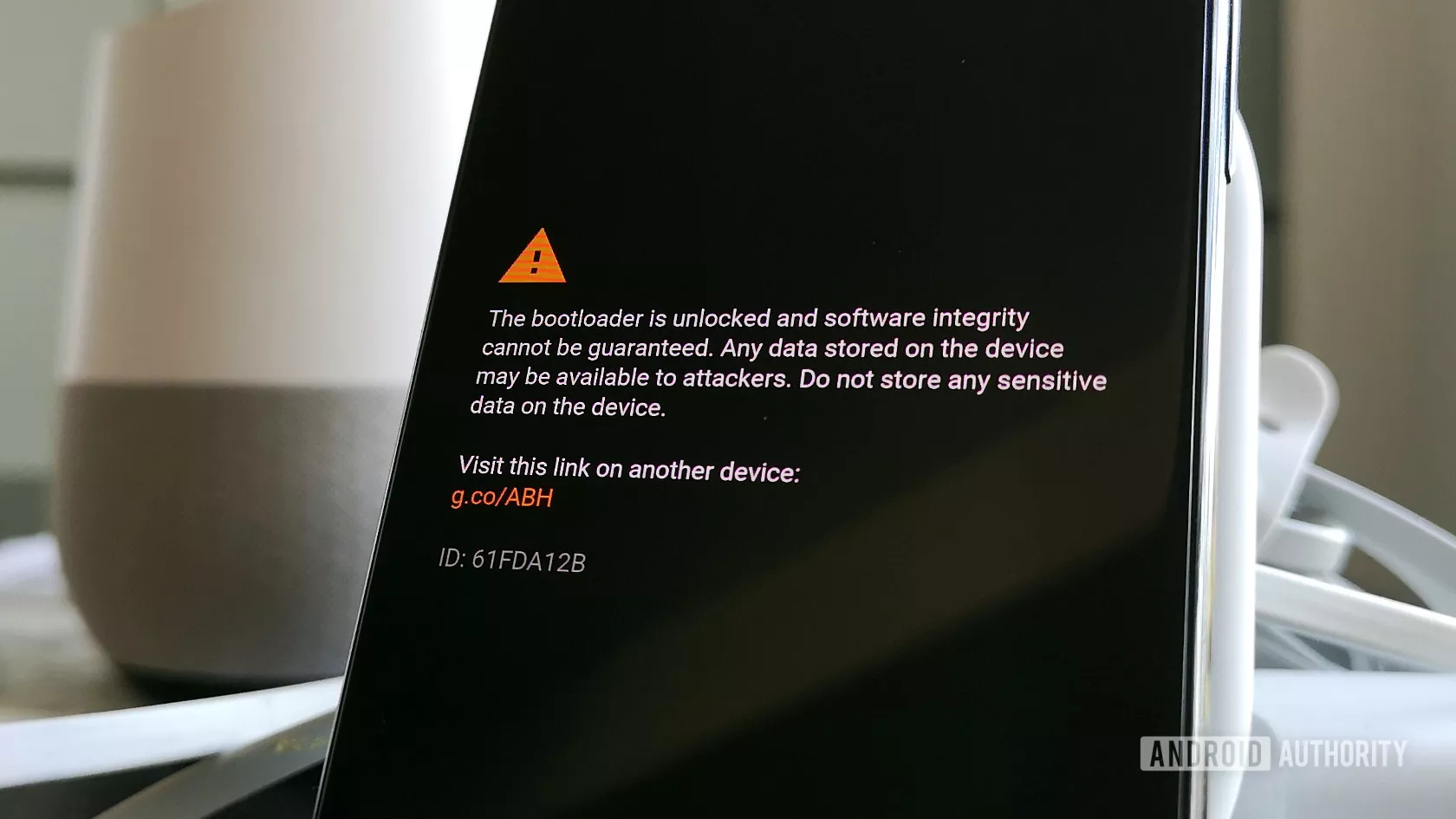
And the warranty thing is moot, unlock does not void Pixel's warranty
1. Pixel phones display an "unlocked bootloader" warning (which can't be disabled) during boot. In case it is re-locked with an additional signing key installed (Pixel-s are literally the only phones which you can do this currently in the market), a similar screen with the SHA256 hash of the public key is displayed.
2. Unlocking does not void warranty.
The only reason Google is doing this is they do not want to have two separate SKUs and pay extra cost to configure each phone physically as unlockable or not in the factory.
It is a supply chain risk. The Android & Pixel teams walk a fine line here: they risk upsetting an important (but small) user group if they change the language and defaults to "THE BOOTLOADER IS UNLOCKED: USE AT YOUR OWN RISK" or even stronger language and shipping these devices to end users.
> The bootloader is unlocked and software integrity cannot be guaranteed. Any data stored on the device may be available to attackers. Do not store any sensitive data on the device. Visit this link on another device: g.co/ABH
It's already pretty strong language (and very accurate! which is a rare combination).
[1] https://www.androidauthority.com/wp-content/uploads/2018/10/...
Kudos to the security folks at Google.
Yet. Other manufacturers have the same warning and have had them disabled. (I did it to one of my older moto phones a few years back)
> 2. Unlocking does not void warranty.
Not by itself, but having a signal in place that it was unlocked lets the manufacturer look for common problems caused by doing things like flashing the wrong device images to critical partitions (go search around a bit for people corrupting EFS on their phones).
Critically Pixel devices do not have a debrick tool that's leaked, at least not for the Qualcomm-based Pixel devices. This means that a brick on any of those partitions means the phone needs a trip back to the depot or a service center that has these tools. Can't be fixed by end-user. Maybe this situation has changed for the Tensor/Samsung pixels but the point is screwing up your device due to flashing incorrect images shouldn't be something the manufacturer needs to foot the bill on.
Then maybe the manufacturers should be more forthcoming with making said tools available to the public, such that they don't have to foot the bill for said mistakes to be corrected.
Doesn't the splash screen clearly show some scary warning when the phone was unkocked?
> very likely they want to have it phone back and send a record that it was unlocked so they can deny warranty in cases where user damaged the device through software
So burn an e-fuse like Samsung does.
That won't happen. I can think of two big reasons off the top of my head:
1. Supply-chain attacks, someone gets a hold of the phone before it gets to you and unlocks the bootloader and then proceeds to modify or install another OS.
2. Warranty reasons, very likely they want to have it phone back and send a record that it was unlocked so they can deny warranty in cases where user damaged the device through software.