As someone who isn't from Australia, can you provide some actual figures, preferably with historical comparison? Without specifics "record profits" doesn't mean much. The most banal interpretation is that profits in nominal dollars went up, which is totally expected given that the economy grows and there's inflation, making it almost guaranteed that each year has "record profits" even if all else was equal.
No, if the source you provided doesn't convey enough information, I'll assume that your claim is unsupported and respond accordingly. I'm not going to wade through the dumpster fire that is youtube search to try to do my opponent's work.
>I don't know where you got your date ranges:
From my previous comment:
>Reading the transcript, the date range for the figures is "pandemic period" and "recent period"
They correspond to literally the first few lines of the transcript
    0:00 according to this chart what is the
    0:02 biggest driver of inflation during the
    0:05 pandemic the blue is the dark blue is
    0:08 the recent period
I traced down the original source to be: https://files.epi.org/charts/img/248291-29919.png
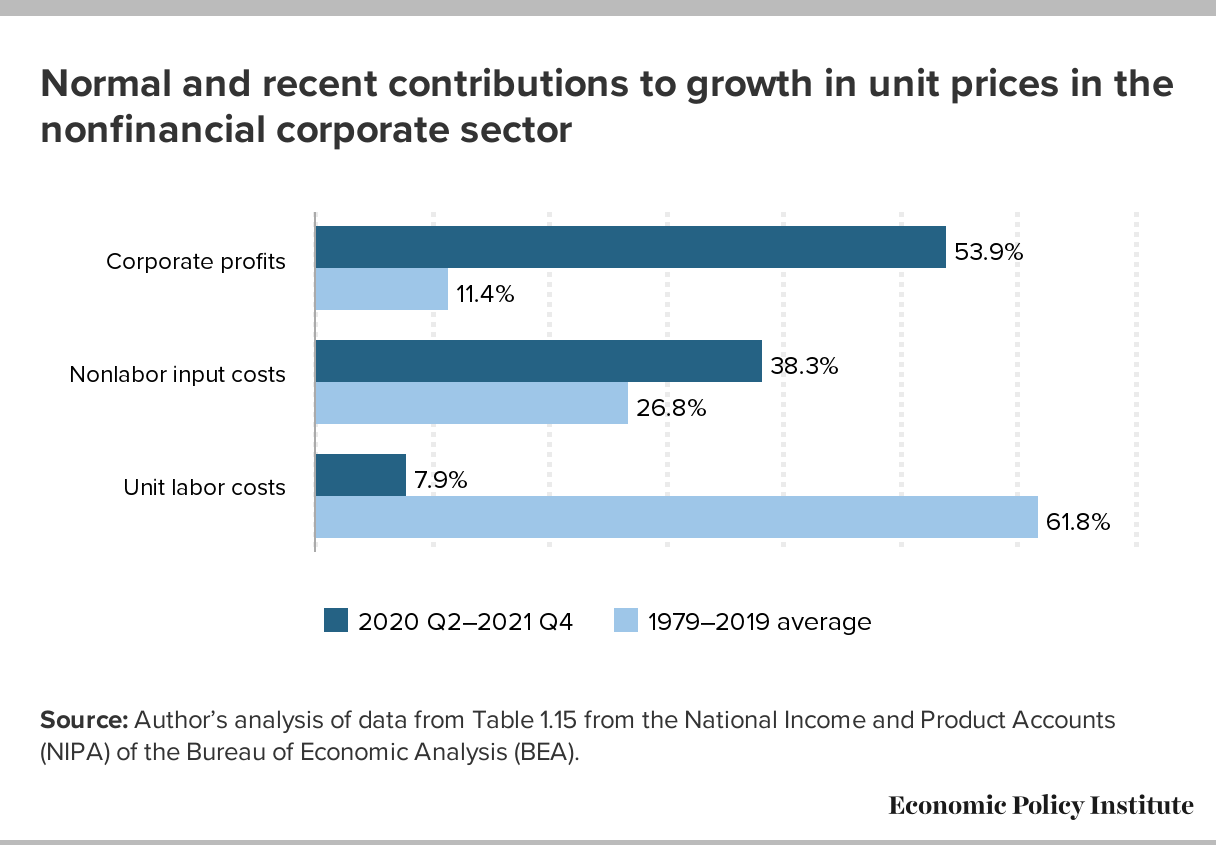
I don't see how this addresses my claim that the data was cherry picked. If anything it strengthens it.
1. the date ranges chosen for the dark blue period starts at 2020 Q2 and ends at 2021 Q4. This is an unusual date range to pick. Most analysis use round numbers and/or whole years. The start date conveniently corresponds to the trough of the pandemic recession period.
2. the date ranges chosen for the light blue period covers a 20 year period. This date period probably isn't cherry picked, but comparing long run data with short run data is inevitably going to show discrepancies, since long run data is less volatile than short run data.
Given that the BEA publishes such data on a quarter to quarter basis, they could have easily made a line chart showing the data across two decades. The fact that they chose to use a bar graph that only shows numbers for two suspiciously chosen time periods, and their overall reputation[1] makes it hard to take the chart at face value.
H23 H22 H21 H20 H19
911 798 1175 1024 1003
As you can see the 'record profit' is just coming off a low base.
Second, looking at the profit numbers in percentage:
H19: 4.5%
H20: 5.4%
H21: 5.8%
H22: 23.9%
Banks - banks make more money when rates are higher, as they can get a bigger spread between what they offer savers and borrows. CBA, Australia's largest bank has a net interest margin of 2.1%. This means that the difference between the cost of interest paid to savers, and that borrows pay is 2.1%. This 2.1% covers all of the expenses and profit the bank makes. Banks make obscene amounts of money due to the volume and value of the loans. Amazingly, banks want to maintain their NIM, to ensure they can fund all of the compliance costs, risk management, and technology costs. If you looked at the Investor Presentation you would have seen that in the last quarter the NIM for CBA dropped which is why the share has been sold off. Due to strong competition in the banking sector
Qantas announced record profit because demand for flights is really, really high, but flight volumes have not returned to pre-covid levels. This is why flights are still very expensive. Again, inflation is on the demand side, to counter the increase in demand, Qantas has raised prices to ensure the flight demand meets what it can supply. You will note, Qantas is also actively trying to build out more flight capacity to cater to the excess demand.
Supermarkets, I already spoke to, down thread. This is a reversion driven by reduced costs from COVID. 'Mr Kierath said it was important to note the companies' profits fell in the last six months of 2021, so these results were rebounding off an unusually low base.'
Ergo, they look good because they were depressed in the prior reporting season. Ergo, it's just corporations bashing, because people are mad inflation is going up.
If you look at Woolworth's profits over time, it would look to be going back to normal levels[1] after a dip due to COVID. [1] https://www.statista.com/statistics/1116200/australia-net-pr...
This is weasly language for "price gouging". There's literally no problem with Qantas just selling the seats they had at reasonable prices and then saying, "sorry, no more seats available".
Instead, you're trying to portray it as totally natural and just that they take advantage of any circumstances to squeeze as much out of their customers as possible.
Market-think has perverted your worldview. The people tolerate markets because they generally serve the common good via innovation, competition and self organization. When the market deviates from that objective, like by price gouging to enrich a few at the expense of the public, it is right to criticize and correct it, not try to justify that the market is right and the common good is wrong.
That extra money they are making, is then used to invest in more planes, and crew to staff more flights to serve more customers/
You can't have capitalism, without both sides of that coin. That's how markets work.
No, they're spent on stock buybacks to enrich shareholders, instead of invested back into their workforce or expanding capacity:
https://www.youtube.com/watch?v=udITRL9-t08
I don't know why people keep believing in this myth, this reinvestment only happens when there's sufficient competition and no coordination, which is not the world we live in.
“Market-think” is about freedom. The alternative is “authoritarian-think” and that always ends in tears. Just start setting prices by government decree and see what happens.
If its costs $100 to fly somebody from Sydney to Melbourne and Qantas is selling tickets for $1000, Australians should run an airline and sell tickets for $200.
Governments should get into the business of keeping markets competitive.
Also, commercial airlines in particular are an industry with a history of over-optimistic expansion followed by cut-throat competition on pricing and then bankrupcy, and I'm pretty sure everyone in the industry knows this by now which is why there's not a huge rush to expand massively.
You just described a command economy, which have a poor track record historically.
I am suggesting governments should consider putting together not-for-profit, but self funding organizations, with fair and reasonable salaries for all employees, to produce good and services for its people.
Then you allow the free market to compete against that baseline profitable business.
If for profit companies can't produce a better or cheaper product, they should just not exist.
Australia's ABC is a good example of what I am talking about. There are commercial offerings, but there is a baseline keeping standards up.
Of course gets a lot more complicated when your state sponsored factories can't compete on quality or price and is not selling any widgets at all. At what point do you decide the market is working to your satisfaction and you should shut it down.
How much of a loss do you allow? How much is it worth to a country to be able to build x widgets or offer x service?
How good would it be if we still had the ability to manufacture things here in Australia? How do you put a dollar value on that?
What specifically does this entail? Is the government providing starting capital? Or is it in charge of creating the organization and letting them handle the rest?
>If for profit companies can't produce a better or cheaper product, they should just not exist.
>Australia's ABC is a good example of what I am talking about. There are commercial offerings, but there is a baseline keeping standards up.
According to wikipedia ABC receives more than a billion dollars per year from the government. How can you say with a straight face that companies that can't compete with that "should just not exist"?
In my imaginary utopia, they are public servants paid salaries and benefits directly.
The government already provides heaps of starting capital for business it wants to get get off the round.
>According to wikipedia ABC receives more than a billion dollars per year from the government. How can you say with a straight face that companies that can't compete with that "should just not exist"?
Every Australian pays just a few cents a day for our ABC, and I can say it with a straight face, because there are profitable commercial channels here in Australia that it directly competes with.
Aussie post is similar, there is a nationalized option, and there is commercial competition. I believe Aussie posts runs a profit as well, ABC is pure expenditure.
I'm not an expert in any of this, just think its fun to muse about when it pops up here on HN.
Oh also, these millions of jobs the government is providing. You could think of these as a UBI. Fairly easy to get. You can move around between them fairly easy until you find one you like with people you enjoy spending time with.
Airlines are also highly capital intensive. It costs a lot of money to own and maintain a plan
Except that's not the case here, both supply and demand for eggs and milk have not changed much, neither have the costs to produce either. That's why prices are skyrocketing and profits are soaring.
Look, the data is out there and very clear on this point:
https://en.wikipedia.org/wiki/Avian_influenza#United_States_...
source? Also, due to how price elasticity curves work, even if production is "basically" the same, it doesn't necessarily mean that prices would also be "basically" the same. If demand is inelastic, buyers will bid up prices to astronomical levels.
https://www.smh.com.au/business/companies/qantas-commits-to-...
>Instead, you're trying to portray it as totally natural and just that they take advantage of any circumstances to squeeze as much out of their customers as possible.
Would you not have done the same? Seeing that we're on HN, there's a good chance that you took advantage of the pandemic tech bonanza (ie. tech companies paying astronomical amounts for developers). If you were currently making $150k, and some tech company was offering you $250k, would you turn down that offer because you want to sell your labor "at reasonable prices"?
Note this isn't limited to job hopping. If you saw the red hot job market and asked for a raise, that's arguably the same.
>But that's besides the point, because individuals are simply not in the same power bracket as powerful corporations that dominate whole markets, particularly when corporations have a proven track record of behaving unethically.
What are you trying to say here? That corporations are unethical and as a result shouldn't be conferred the right to raise prices? Or that price rises in absence of increased costs doesn't count as price gouging, unless you also have "power"?
I think the report definitely could have been better written, because a lot of the inflation is more due to passing on external cost increases, or domestic businesses raising their prices to account for inflation, and all keeping the same margins, hence resulting in larger profits in nominal terms. So I think it would have been more accurate if they’d put it that way.
The important thing is that it’s not demand driven - the RBA talks every update how scared they are and how important it is for them to avoid a “wage-price spiral”, which is nonsense. Median wages here have barely kept up with inflation for 10 years, and now they have gone strongly backwards. Absolutely no sign of any kind of spiral…