Is that so different from any other psychiatric medicine?
if you are taking a psychedelic as part of some therapy regime it is not a tripping balls level dose
There is an anecdotic evidence that bad trips on first intake are more frequent with lower doses of psychedelics than higher.
So it's very possible that those therapeutic sessions will be mind-shattering experiences and not like going to discotheque with friends.
For example for psychedelic therapy with psilocybin, you would see a therapist a few times with no psilocybin, then you would have a session where you take something like the equivalent of 1 gram of dried mushrooms, and go through that session with the therapist. Then come back 1-2 weeks later and take something like a "heroic" dose or about 5 grams dried mushroom equivalent and go through that session with the therapist. Then you come back again two weeks later and have a sober session again to talk about all of it.
My understanding is that this is generally how the well respected research studies have gone. The most I have ever done myself is 2 grams dried mushroom equivalent, and I usually stay under 1.
How long do these sessions last? What are the logistics? I’m very curious.
In all, the whole trip usually lasts a solid 4 hours. You’re going to be ready to pass out at the end
This is completely dependent on the strain[1] and potency of that batch. It also will depend on the person. To make any definitive statements on what people will experience on x grams is not an informed opinion.
[1] https://leafly-cms-production.imgix.net/wp-content/uploads/2...
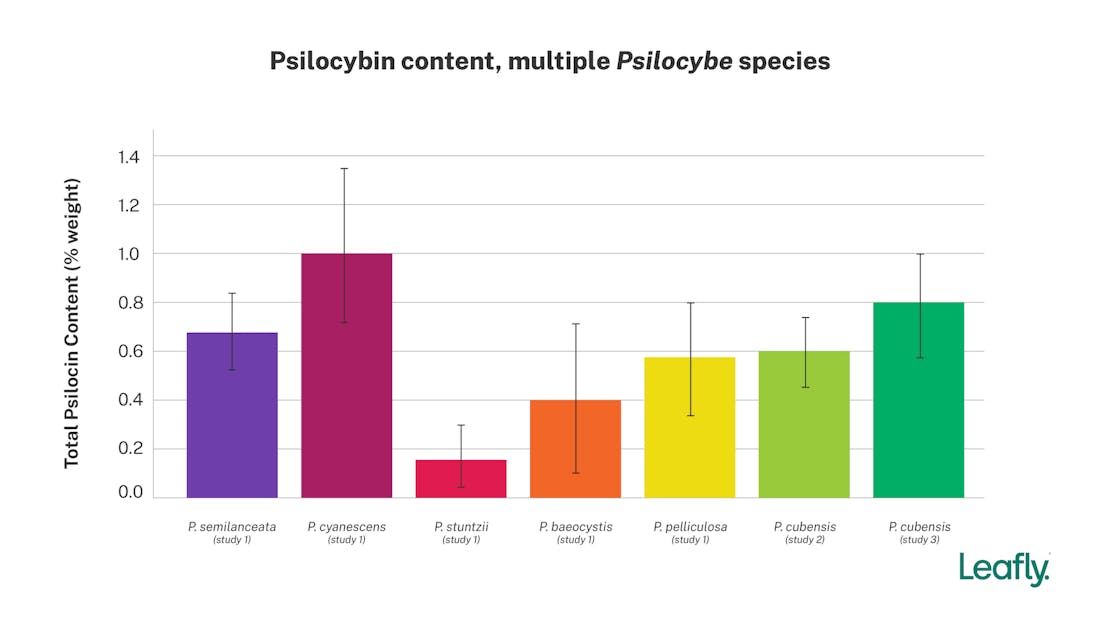
Update: p. Cubensis is what I’m most familiar with
It is absolutely terrible advice. The advice should be "less is more" not this McKenna "heroic dose" bullshit like some kind of dosage sport.
The research backed advice is that set and setting are what really influences the experience.
The dose varies by person, tolerance, genetics of the fungi, and how deep one wants to go in the experience.
Taking 5 grams is not something to do in a whim, for pride or ego, or to keep up with anyone else. Better to ease into a bigger dose over time and not rush the experience.
I have no experience with these dosage levels but what I have heard is that some people don’t experience the full ego death at 3.5 grams but most people do at 5 grams, and I have also heard that there isn’t much additional effect from higher doses. So the thinking is to make sure to get everyone over that edge.
However there are other forms of treatment and I’m only talking about what I learned a few years ago, I’ve not studied the latest work and I am not a medical professional at all.
I did a quick google search to find more info for you and it seems there’s a lot of new work being done. I didn’t find any convenient link with the answer to your question though.
I went to the church of engineering and saw the manifest glory of all levels of abstraction that I understand and leverage to build _all_ at ONCE. I saw what I have been building in a new light ( https://www.adama-platform.com/ ). The absolute beauty of mathematics made me cry.
Ever since this event, I have been... ultra level. I'm just at peace. It's a wonderful experience. The whole "holy shit, I'm dying part..." was kind of rough.
Where are you getting this info? All the good data I've seen is definitely not 5 grams dried. 20-25mg seems to be the sweet spot[1][2][3][4] which is around 2 grams[5].
[1] https://www.nejm.org/doi/full/10.1056/NEJMoa2206443
[2] https://www.thelancet.com/journals/eclinm/article/PIIS2589-5...
[3] https://www.ncbi.nlm.nih.gov/pmc/articles/PMC9751063/
[4] https://newatlas.com/johns-hopkins-psilocybin-study-finds-op...
[5] https://www.leafly.com/learn/psychedelics/how-to-dose-mushro...
Psilocybin has that risk, but it’s lower because the molecule binds to your receptors much less tightly.
With psych drugs, the most common experience is that user takes them for a few weeks, and reports or doesn’t report some subtle change in their psyche. A bad experience is mostly limited to “didn’t work”. If the drug “doesn’t work” they stop using it and try something else.
With psychedelic drugs, the effect is 100% going to be felt within less than an hour, the effect will be very strong and is guaranteed to be one of the most memorable experiences of the user’s life. A bad experience could easily consist of being rapidly confronted with some deep truths about the user’s self and ego. There is a reason psychedelics have been linked to schizophrenia: https://jamanetwork.com/journals/jamapsychiatry/article-abst...
comparison has to take this into account, so they are not different, the dose is the real difference.
-Emily
FWIW, a large amount of the psychiatric establishment believes DID to not be real, per se. Instead they think it can be caused by an especially suggestible patient responding to a therapist or other psychiatric professional's coaching. Essentially playing a role in the therapy (for genuine underlying problems!) that they believe they are expected to play.
https://www.ncbi.nlm.nih.gov/pmc/articles/PMC6296396/#!po=1....
https://www.mcleanhospital.org/essential/did#:~:text=Myth%3A....
“Random samples of the general population in Canada and Turkey (female sample, 50% of whom were illiterate) found a life-time prevalence of DD of 12.2% and 18.3% respectively. A general population study in New York State found a 1-year prevalence of 9.1% for the DD.2,32,39 In Canada and New York, prevalence of DID was 1.3% and 1.5% of the population. In Turkey, the lifetime prevalence of DID was 1.1%”
The claim is indeed just a claim at the moment, sadly, because we're not professionally diagnosed, though we are working towards a diagnosis. (Right now we're waiting for a call back from what is presumably the world's most overbooked mental health center. Only possible explanation for them taking this long.)
> FWIW, a large amount of the psychiatric establishment believes DID to not be real, per se. Instead they think it can be caused by an especially suggestible patient responding to a therapist or other psychiatric professional's coaching. Essentially playing a role in the therapy (for genuine underlying problems!) that they believe they are expected to play.
Believing DID isn't "real" (as in, is not caused by actual brain structure changes) is different than believing that it can be achieved through other means.
There are two main definitions of "DID", and it's important not to get them mixed up in cases like these: "DID the canonical disorder", a direct consequence of certain types of structural dissociation[0], and "DID the set of symptoms" as established in the DSM-5[1], which can apply regardless of root cause.
Some believe that "DID the canonical disorder" does not exist, and that it is akin to subconscious pretending (as you describe). Some believe that "DID the set of symptoms" can be achieved through different means than through structural dissociation in childhood. These beliefs are largely independent, although it would be weird to believe the first but not the second.
(I should add that believing you can willingly create certain specific symptoms of DID (such as plurality) is different from believing that you can create DID itself willingly. The development of DID itself must necessarily be non-willing due to its diagnosis as a disorder, but certain symptoms (such as plurality) can be developed through practice[2] without having any dissociative disorder.)
---
A lot of GPs don't even know DID exists. I once brought it up to our doctor and he had no idea what I was talking about. (I later found out that he had slipped "dissociative disorder" into our medical record. Sneaky~)
The "realness" of "DID the canonical disorder" is incredibly debatable. There is the theory of structural dissociation[0] but that only explains how it forms in the first place and not how it develops or functions over time.
Before learning of "plural" terminology[3] in the first place, for around 4 years, we simply knew ourselves as "multi-personality". We didn't appropriate anything because we had no access to that information.
But I do know for a fact that, since finding out about "plurality" and becoming much more public about it (including socializing in "plural" spaces), we have subconsciously appropriated many mechanisms as they were described to us, mainly when they were a better method of serving some function that we had to perform anyway, but also sometimes for other reasons. We've never been in therapy or even professionally diagnosed, so the development of plurality itself couldn't have been informed by medical professionals.
It was developed and strengthened through roleplay, though, as far as we know. The exact details of this are probably too anecdotal to recount in full detail, but in summary: we were allowed to express individually on a website with individual character profiles, and this is likely how we developed into our own people, or at least what prompted us to develop in this way. We didn't happen completely spontaneously, but we also didn't happen because we were shown or guided to act this way. Our brain had some sort of propensity to plurality already, before we ever knew anything about it.
[0]: https://did-research.org/origin/structural_dissociation/
[1]: No definitive source here, but try googling: DSM-5 filetype:pdf
[2]: https://tulpa.io/what-is-a-tulpa
-Emily
-Emily
-Paul (Stamets)
MDMA is very prone to abuse.
Not saying it doesn't have therapeutic uses, but it is certainly a drug that needs huge respect and caution.
I know from personal experience and that of many people around me that doing molly every weekend quickly becomes a dependency and will mess you up very quickly.
In a therapy setting I'm sure risks are low, but I wouldn't make such black and white comparisons against alcohol or say, cocaine.
The reality of addiction is more than a function of frequency or tolerance and often comparing drugs directly is misleading.
(I would provide a close cite but I only recall from his book "drugs without the hot air" & am on mobile)
Abuse doesn’t require daily or even regular use.
"The use of illegal drugs or the use of prescription or over-the-counter drugs for purposes other than those for which they are meant to be used, or in excessive amounts."
"Substance abuse, also known as drug abuse, is a patterned use of a drug in which the user consumes the substance in amounts or with methods which are harmful to themselves or others, and is a form of substance related disorder. "
The first definition will vary based on your local laws, which as we have seen, are also subject to change. So if that's the meaning of the term 'drug abuse' it's not particularly useful to discuss since it's a technicality.
The common factor between the two definitions (excessive, harmful consumption) might be more useful to discuss. Which was why I chose to talk about that (rate of consumption, risk of addiction) specifically.
The few studies done on using those two drugs in psychiatric settings show phenomenally positive results. I don’t know where you’re getting your information from but it’s not by reading the scientific studies.
I am generally very pro-psychadelic - they seem like they can offer unique aid to people and they are not very prone to abuse. The only "downside" is that, because outcomes vary widely (though are generally not negative, simply unhelpful), it's hard to call them "medicine" in the way that, say, asprin is medicine. However, with the proper understanding, I'm hopeful they can be a really helpful tool for some people.