From Wikipedia:
>In 2002, a review by the National Research Council found that, in populations "untrained in countermeasures, specific-incident polygraph tests can discriminate lying from truth telling at rates well above chance, though well below perfection". The review also warns against generalization from these findings to justify the use of polygraphs—"polygraph accuracy for screening purposes is almost certainly lower than what can be achieved by specific-incident polygraph tests in the field"—and notes some examinees may be able to take countermeasures to produce deceptive results
EDIT to add: Ironically he had gotten in trouble for phone phreaking as a teenager.
If the thing you did was less bad than the penalty for treason or revealing secrets (life in prison and/or death) then the blackmail argument falls apart. It's just more irrational hocus pocus by self-important bureaucrats. Hell the thing you're blackmailing doesn't even have to be true, they can just find an ex lover and blackmail that person to say you raped them or whatever, and well even if you beat the charges your kids get tossed into DCS/foster care your life is ruined etc etc.
Yet another reason why I'll never work for the government.
It's not uncommon for people to _commit suicide_ over things they are being blackmailed about.
Plus people doing the blackmailing aren't stupid. They don't go "we know you lied on your clearance form about smoking weed once. Get us that top secret document!"
They start with something much lower risk and then leverage compliance into higher and higher value targets.
The US has such insane conspiracy laws frankly it isn't much effort for a few motivated individuals let alone a state actor to blackmail someone for the worst of false offenses using some corrupt "witnesses." Maybe before the war on drugs it was easier to blackmail someone with real offenses than fake ones but nowadays it's probably easier to manufacture them TBH.
If you want top secret documents, you don't start by asking for top secret documents. You start by asking them to violate a relatively innocuous rule. Changing a date by one day on a file so it's no longer late or something like that. Doesn't matter what it is. The point is that it's not worth being exposed over. And the rule you're breaking would technically be worthy of getting fired over. Especially for the thing they're blackmailing you over. "It's changing a date by one day, no one would know, and it's not worth losing my job over."
It starts off "Hey man, I was cool about the weed thing, do me a solid here." Then it's "Hey, remember that thing you did, do you think you could do this slightly bigger thing?" If they refuse, you can bring up that first thing they did.
Then, a year or two down the line, you're fucking cooked. They come to you and say, "Look man, you've done this, that, and the other thing. If they find out, you are fired, in jail, life ruined. What I need now is this top secret document."
The idea is to build a list of escalating transgressions so in the end, the asset feels as if they have no choice but to comply with your requests. You don't need fabricated offenses. You just need a small issue you can use as a starting point.
If someone has done something really bad (maybe murdered someone) then yes, directly blackmailing them to do something major might work.
But in general the things we are talking about are mostly things were someone lied on their clearance form and if they decided to they could get that cleared up and cause the foreign agent significant problems by reporting an approach.
So instead they escalate. They don't directly blackmail you - you just happen to meet a woman at a bar who happens to have pictures of you smoking weed at a party 5 years ago. So you are joking around about what a great party that was, and it just happens to turn out that this woman works at a defense contractor and they are waiting on this stupid proposal to be released so they can bid on it, and you don't happen to know when it will be released do you?
So you go look it up. It's not classified, maybe it's commercial-in-confidence at worst. But then this woman needs to know how long she should rent her apartment in town for, so exactly how big is the project? How many units are they ordering?
That's still not classified, but is need-to-know. But she's hot, so you tell her.
And now they have you. You might not actually realize yet you are being blackmailed, but as soon as they ask for classified info you realize she can ruin you.
I'm no expert on spycraft or anything like that, but this sounds overly reductionist. If they can threaten you to lose your career, then maybe doing one tiny little other thing that won't matter seems like it might be worth it. Now they can blackmail you further.
> they can just find an ex lover and blackmail that person to say you raped them or whatever
How do they find that person? How do they blackmail them? It becomes exponentially more complicated than just blackmailing one person. Additionally, someone finding themselves in the situation that they are being actively targeted with blatant lies is much more likely put up an indignant and active defense vs somebody who actually has a guilty conscience.
If working for a murderous government that sends drones to bomb kids overseas, invade vietnam and iraq, imprisons innocuous non-violent offenders for decades, funds nun-raping militias in central america, etc doesn't give one a guilty conscious I honestly have no idea what would. It's got to make you feel far more guilty than whether you put on a form you grew a bad plant or not.
Most people care a fuck of a lot more about things that are close to them than things that are far, far away.
If you're wondering in good faith and not just trying to score stupid political points, all I can say is, uh, strongly recommend you Log Off.
Your words say it all really.
In a Hollywood movie, they would just locate an old acquaintance from your youthful years who is currently in debt.
The counter-example I'll mention is that if someone framed you for CSAM and could convince people you actually were doing that, blackmail might be effective. Not only is it fully beyond the pale, but just going to prison would be a death sentence.
Someone being falsely accused like this would most likely immediately report it to their boss in the government asking for help. It would be very unlikely that the person would hide it and become an intelligence asset for the blackmailer.
This attitude of tolerance eroded later in the 80s. During the Reagan regime, they (DoD?) sent out a memo saying that marijuana use was "incompatible with national security goals". Not sure what the effect was out in the trenches though.
On the other hand, I also never smoked weed and I said so on my application, and nobody ever gave me trouble about it. Maybe I just looked like enough of a square for it to be believable.
What's the hangup with this particular drug that's actually legal in many states?
Ps: I've been asked that question too in less formal settings and I always truthfully say no which does raise some eyebrows as I'm Dutch :) But I've really never done it. Not counting all the second hand smoke around me though.
It's also very easy to detect because pot stays in your system longer than about any other drug and the penalty for pot use by non-firearm owners is so weak and unenforced that people often forget it is a very severe crime for the ~40% of US that owns arms. People mistakenly get nonchalant about it.
The government has to remind you it's illegal because well "everybody" does it and it really doesn't seem like it actually is and it sure as hell doesn't feel like you're doing something wrong or harmful. So somebody has to tell you that this drug is really bad because you'll go to jail for it for a long time.
The main reason pot is bad is because it will get you a jail sentence. The main reason you'll get a jail sentence is because it's bad. Hope that clears it up.
It wasn’t that long ago that marijuana was an illegal drug in every state. And as a schedule 1 drug marijuana gets lumped in with crack and PCP.
I have no doubt updating security clearance requirements is a massive bureaucratic mess nobody is interested in doing.
So the requirements remain, but everyone just “massages” the answers to fit current norms.
Only if you carry them with you, right?
AFAIK it's the feds position that even merely having a medical marijuana card (which doesn't mean you actually have ever even bought/consumed weed) and owning a gun makes you a felon.
Note: not a lawyer, not legal advice.
If anything, Grandma being the card-carrying pot user and not you would likely be evidence in your favor - to be presented and argued by a competent defense attorney in court, of course, not by you to some power-tripping cops interrogating you (the only correct response to a cop asking you anything for any reason at any time under any circumstance is for you to invoke your rights to silence and an attorney - and such a "shut the fuck up" strategy has indeed gotten people out of pot-related convictions, at least if these lawyers are to be believed: https://www.youtube.com/watch?v=sgWHrkDX35o).
Was I an opiate user? If I just keep the script but never fill it am I more an opiate user than the guy on the street with a little baggy of white powder? People seek out and obtain scripts for stuff they never use, all the time.
Given that they were prescribed to you, "yes" would be a reasonable assumption, barring you able to provide evidence introducing reasonable doubt (e.g. "I still have every pill I was ever prescribed").
In any case, "was" is the key word. You were given a prescription for a finite number of doses, whereas usually a medical marijuana card is more indefinite.
The quasi-legality of state-permitted and federally-prohibited-without-direct-enforcement is kind of an awful trap, and that’s even before you consider the risks if the federal enforcement pause – which doesn’t change the criminal law and thus would not raise ex post facto concerns for enforcement against acts that occurred during (or before, if the statute of limitations allows) the pause – were to be lifted.
Perhaps a trap that rises to the level of (HHOS) conspiracy to commit a crime: TITLE 18, U.S.C., SECTION 242
disclaimer: The answers I give on form 4473 are absolutely truthful.
The vast majority do not; there are 137,000 that are authorized to carry a gun and/or make arrests, out of 2.85 million non-military federal employees.
I feel very confident saying being qualified to use a gun is essential to the majority of those with an active clearance, and thus highly relevant to the drugs question part of the clearance.
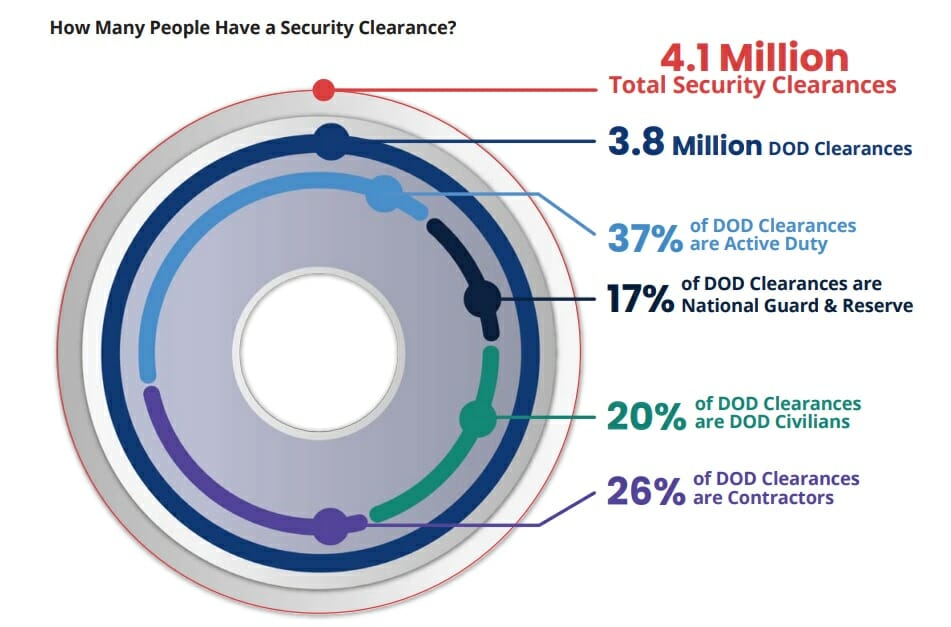
[0] https://news.clearancejobs.com/wp-content/uploads/2022/08/Se...
I've submitted to no less than five background checks for purchasing firearms. My ID has also been scanned at multiple dispensaries in the same state as those background checks. Not once has the latter caused any issue with the former - in all likelihood because "I at one point set foot in a dispensary" != "I actually purchased something in that dispensary" != "I actually consumed something purchased from that dispensary" != "I was a user of something purchased from that dispensary at the time that I answered a question about whether or not I use federally-controlled substances".
Maybe if background checks included drug tests this would be a practical concern, but as it stands, unless you show up to the gun store stoned out of your gourd (hell, even then), there is little opportunity to demonstrate "the defendant lied about not being a user of illicit substances at the time one purchased the firearm".
At the end of the day the feds got a warrant to drag me to the hospital and internally search my body for drugs because third party hearsay that an anonymous cop said an anonymous dog supposedly said I had drugs. If third party hearsay is good enough for a warrant why wouldn't video evidence or ID scan of you at the gun store and the pot shop? Sure you can claim "well the test at the hospital shows metabolites and the video shows buying weed and guns but hey you can't prove I actually used weed" but good luck with that.
So a prosecutor would need to prove that I was "an unlawful user of or addicted to any controlled substance" at the time that I received a firearm or ammunition that has crossed my state's borders (which would presumably be nearly all the firearms and ammunition I own, but still). There's also the parallel prohibition on the seller's end (and another one involving the actual background check questions), with the same present-tense language of "is an unlawful user of or addicted to any controlled substance".
> If third party hearsay is good enough for a warrant why wouldn't video evidence of you at the gun store and the pot shop?
A warrant != a conviction. The video evidence of me at both stores would not establish that I was "an unlawful user of or addicted to any controlled substance" at the time that I took possession of the firearm.
Now, if there was video evidence of me smoking a phat blunt right outside the gun store before walking in and walking back out with a firearm, then yeah, that'd be a slam dunk case (assuming the prosecutor could convince a jury that it was indeed cannabis I was smoking). Likewise, if I was actually tested for cannabis in my system and the tests indicated that it was indeed in my system at the time I took possession of the firearm, then that would similarly be a slam dunk case.
(I guess even in the latter case I could maybe argue "yeah, I was an unlawful user, but I quit before buying the gun", but that defense is pretty weak if it's still in my system; I reckon it'd be stronger if I was sober for an actually-significant amount of time.)
Barring those? I ain't a lawyer, either, but my personal understanding is that the present-tense wording leaves a loophole big enough to drive a truck through it. Obviously the safest bet is to not rely on that being the case, but it's pretty easy to answer "No" to "Are you an illegal user of or addicted to any controlled substance?" without it being a felonious lie.
Doesn't this mean that the prohibition of using such substances doesn't apply just to the moment of purchase, but to the whole period of time that you posses a firearm? I'm not a lawyer either and I'm not even American, but this is how I would interpret it. Also it would make little sense to have a law saying that you can't be a user of illegal drugs at the moment of purchase of a firearm, but you can start using such substances afterwards.
> Also it would make little sense to have a law saying that you can't be a user of illegal drugs at the moment of purchase of a firearm, but you can start using such substances afterwards.
The law in question derives from the federal government's Constitutional authority to regulate interstate and international commerce, which is (I would guess) why the language fixates on that aspect. The federal government doesn't otherwise have the power to infringe on the Second, Fourth, and (possibly) Tenth Amendments - as would likely be necessary to federally require gun owners to submit to random drug tests over something that one's state has made legal.
Meanwhile, my state (last I checked) has laws on the books separately prohibiting intoxication (be it via cannabis, alcohol, or whatever) while in possession of a firearm; to my knowledge, most (all?) states do.
Both those cases entailed the defendants manufacturing something, which would be where the Feds would claim jurisdiction via their jurisdiction over interstate commerce. It's harder to make that argument w.r.t. something after a retail sale has already concluded (i.e. after the interstate commerce has happened). I wouldn't doubt the Feds would try to assert that literally everything that ever happens is or pertains to "interstate commerce", but that'd be sufficiently broad as to invalidate all sorts of other judicial precedents if actually held up in court.
This of course only pertains to federal law; states have their own laws, and said laws usually prohibit being armed while intoxicated - regardless of the legality of the intoxicating substance.
I strongly, strongly believe you are overconfident in your interpretation, particular when I read the provisions regarding possession which may be a seperate crime from say what was written on the 4473 at the FFL.
But I'm not the one you have to convince. I pray you are never in a position you must do the convincing.
I do not believe I am an authoritative enough of a professional to convince you, even were it that I had time to type a more complete explanation. Again I recommend you consult a lawyer, and preferably one that has worked in this area. My opinion as a rando on HN has no legal bearing on the justice system.
That is until they get ransomwared.
In that case I need to report that my identity has been stolen.
I still wonder why the law is that way though. As drugs go, marijuana is probably the least worrying when it comes to gun possession. As it makes people docile and relaxed, it will help de-escalate conflicts.
As opposed to coke which makes people pumped up or even the fully legal alcohol...
It sounds like federal law should catch up to reality. Though as a European I am not in favor of widespread gun use anyway but that's another discussion.
You are not going to lose or be rejected for a clearance because you have a few foreign friends. It is just another one of those things you have to report to the government (meaning the government issuing the clearance).
The only stumbling block came when the interviewer asked "have you smoked marijuana?". I truthfully answered no. The interviewer suddenly changed from bored old lady to the hardened, ex-cop that I suspect she was, glared into my soul and asked again. "No", I answered once again. "Well, that does not check out with your background. We will have to ask around on that one." She did ask around, my friends corroborated my story and I got the clearance.
My background involved undergrad education at a #1 party school, in a college town where open marijuana usage was common well before being legalized. And I had casual experimentation with other drugs (the aforementioned shrooms) and plenty of alcohol usage. I was probably the only one in my college acquaintance circle that didn't smoke on a semi-regular basis. I sometimes think I could had lied and said "yes I smoked weed", and still gotten the clearance. It would have actually been less of a red flag for the investigator(s).