But I agree with you, asking for the phone number and telling me this app is secure is ridiculous. Let me register with something less intrusive, if I want to go the phone number way, then let me use that. Give me an option.
Can you trust your information stored at your messaging app's servers stay secure forever? Can you trust that company to never get compromised? So yeh, they go through all the hassle of making things "secure" but attach everything to something(phone number) most of us can't get without revealing our actual details. So yeh, its ridiculous to go through all this hassle to make things private and secure, but force people to use something that de-anonymizes everything about them.
I don't write anything that would be interesting to the NSA, I'm not a target for them, so I don't care if they see I use Signal.
BTW, say you have an anonymous Telegram username, I'm pretty sure it's trivial to find your name from the content of your messages. Or just from the metadata.
If I told my mom to install some app and we'd connect to each other using some random IDs, we'd probably still be using SMS.
This is surprising to me, since it was my mother's generation that got me into Skype (where you have to manually add the other person by their username), almost twenty years ago.
Can someone explain how this is possible? How does my phone know when to notify me that a friend has joined signal?
Edit: apparently it's "private contact discovery", I need to give this a proper read later.
Security and privacy are not the same thing.
Among many other differences: security is a binary (can an attacker gain access to information) but privacy is a spectrum (what kinds of information do I want to leak).
Only if you're looking through a very narrow lens.
There are a range of potential attackers out there with different motivations and resources available to them. The question you have to ask (for each attacker) is whether the value of the thing you are trying to secure is worth more to them than the cost it would take them to break your security.
In aggregate, that looks a lot like a spectrum of security, with different people being secure against more or fewer different attackers.
Maybe you're saying that some information is more sensitive than others, which is true, but some security failures are worse than others (e.g. denial of service vs. remote code execution, or ability to forge messages vs. ability to decrypt messages).
I do not understand what privacy security or anonymity I can have, when we start with sharing my most identifiable personal information with the app and all my desired contacts. (whatsapp takes it further by refusing to work without full access to your contacts which... Just, no).
I feel I'm in a twilight zone as everybody cheerful regresses to apps you have to bootstrap with your phone number and then proceed to basically only work well with your phone - teeny tiny screen with awful keyboard, instead of allowing me seamless access across my communication devices and preferences.
Messaging seemed like a solved problem until we made it inexplicably and massively worse.
I’ve never given WhatsApp access to my contacts. Works fine. Just don’t get numbers matched to contacts, which makes sense.
I can only talk to people if they've granted access to their contact list, and initiate conversation with me (which is not a solution, just a shifting of problem to others).
On android at least, I cannot initiate a conversation with somebody I don't have a going chat with. It won't let me just type in a phone number.
Specifically, Clicking "new chat" asks me for contacts permission, and if I say no it simply closes. I have to contact a person out of band and ask them to initiate whatsapp with me. By no definition is my experience "just fine". Is this not your experience?
Can two people who have not granted access, converse?
(I would still not call it "just fine" in terms of normal app usage, but it makes my life easier so I thank you for that :)
Yes. There is a little write icon on the top-right of my iOS screen. Click that and paste in the number.
How would this other method make it hard/expensive/infeasible for a malicious company to produce 100M accounts to cause problems with spamming, DoS, and related issues? Phone numbers are finite, cheap, but not zero cost. If sending a spam email cost $0.01 much of spam would disappear.
How would this other method protect a user's social network without having to upload that meta data in signal? Currently this is handled by a user's address book hosted outside of signal. How many users would you lose if you required some key exchange in person?
Sure it's easy to think about generating a key pair, uploading the public key to a DHT, and allow people to communicate directly without a central server. However that has a fair number of practical issues that would be worse for the average signal user, not the least of which would be much worse battery life and bandwidth charges.
So you pay $5 on a credit card, which connects you to said handle, much like buying a SIM. How is that any better?
Someone in your social network joins signal next week, how would they find you?
I know which of my coworkers use signal, despite them not telling me themselves. That seems wrong.
Buying things anonymously is a solvable problem. Gift cards, cash, etc. Let people resell your $5 sign up card.
So the reason signal is so useful is because so many people use it, which depends on things like contacts showing up immediately when you join.
Seems like it's a common theme that people want a messaging client with a huge number of users, but don't want the features that made it popular in the first place.
Signal could use payments (eg via Monero) as spam prevention and revenue stream.
This would not damage any current feature/user
https://community.signalusers.org/t/usernames-in-signal/9157...
complex captcha and/or expensive PoW. and an option to use a phone number instead
>How would this other method protect a user's social network without having to upload that meta data in signal? Currently this is handled by a user's address book hosted outside of signal. How many users would you lose if you required some key exchange in person?
store it on the server, encrypted by the client. jesus.
How do you find each other?
If it's feasible for an end user, say 30 seconds of a phone's CPU, you can be sure that a spammer could generate millions.
You don't, because that's something that's fundamentally impossible to do in a privacy-preserving way - no way around it.
> If it's feasible for an end user, say 30 seconds of a phone's CPU, you can be sure that a spammer could generate millions.
You're picking overly conservative numbers for "feasible". Choose parameters such that it takes something like half an hour on a phone. Inconvenient? Yes, but privacy is inconvenient in general.
And yes, a spammer will still be able to generate lots of these fake identities, but now the cost is much higher, while the expected profit is roughly the same - and that's how you defeat spam.
So if signal was privacy preserving, didn't show or tell contacts about others using the service, do you think it would be as popular? Or do you think we'd be discussing a different popular e2e encrypted app and complaining about the very features that made it popular?
by exchanging public keys over an established communication channel
>If it's feasible for an end user, say 30 seconds of a phone's CPU, you can be sure that a spammer could generate millions.
yeah, that's an inherent limitation of PoW, so it has to be an option rather than a requirement. then people who don't care about privacy can do the SMS thing, and those who do can opt to do the 30 minute PoW.
but this is irrelevant to Signal. it's not the phone number verification itself that people have problem with. if the only purpose it served was to prevent attacks on the service by ratelimiting it to one account per one phone number, that would be largely fine. the problem is that your phone number is your Signal identity, which is utterly moronic for a "privacy-first" service, and the reasoning and excuses for this stink to high heaven.
I get the appeal, but seems like requiring out of band key exchange will add significant friction and make signal much less popular compared to the competition. I've got a few dozen signal contacts, only a few of them close enough to do a key exchange. If I only had a few, not sure I'd use signal.
Signal has been resisting making special cases for the few, and I get it. Why spend developer time on some feature that's not going to benefit the majority of users?
> the problem is that your phone number is your Signal identity, which is utterly moronic for a "privacy-first" service
I can't think of anything that would work as well and result in so many (40M monthly) people communicating securely. They do seem to be considering their options to help with this, in particular: https://signal.org/blog/secure-value-recovery/
Allowing social networks, surviving the death of your phone, frictionless on boarding, account recovery, etc all interact in complex ways.
Personally I like that there's not a contact database/social graph inside signal.
how do you exchange phone numbers and email addresses with people?
>and make signal much less popular compared to the competition
is popularity among the (COMPLETELY) tech-illiterate worth giving up privacy for?
>I can't think of anything that would work as well and result in so many (40M monthly) people communicating securely.
and virtually everyone who had ever used the internet has an email, despite its apparently cumbersome sign-up and contact discovery procedures.
>surviving the death of your phone, ... , account recovery
are less likely if your account is tied to the phone number or email. they can be lost, they can be stolen, they can be seized.
I don't want to find people on Signal, or be found by them. I want a way to securely communicate with people I've decided I trust enough to be contactable by them - that is, people I've met and sufficiently liked face to face.
But why then do you even need a phone number to use WhatsApp? If it is a texting and calling service that is used to circumvent carrier fees, and is almost exclusively used on WiFi (because data is even more expensive than texts), why not just let them make an account and not use the phone number? That way they don’t have to pay a secondary company to use WhatsApp…
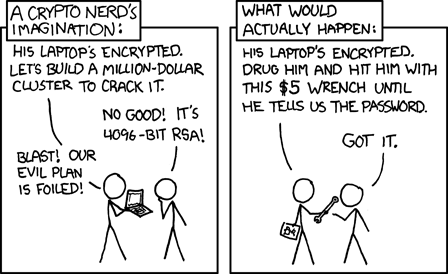
I understand the whole concept behind it. I understand why they want a phone number. BUT. This is not secure (oh, really, my phone number is hashed, how long do i need to brute force a few numbers in range of 0-9, a few seconds on my laptop, maybe?)
On the other side, I can use a simple email/irc/counterstrike chat to be MORE secure. Why? As it doesnt require any PII from me.
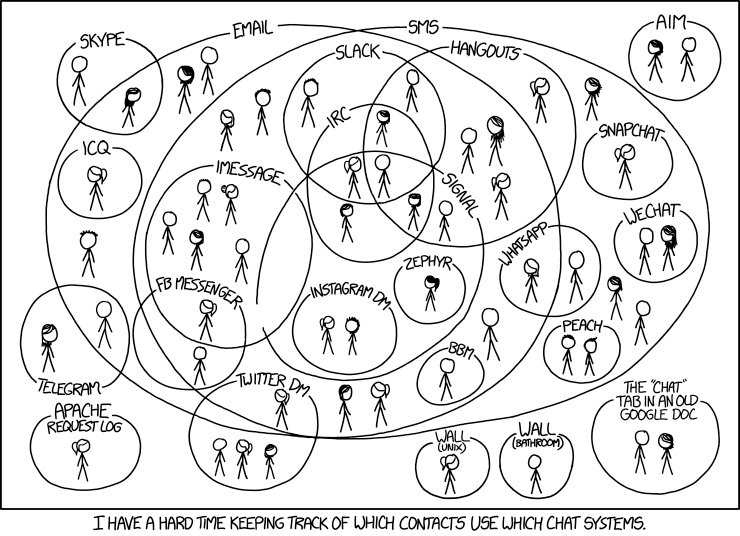
So why bother? Yes, sure, I can use it as a nice chat interface, I can use it as another way beside ~20 chat applications I need to use to contact people I know ( https://imgs.xkcd.com/comics/chat_systems.png ). But dont sell me security. With requiring PII they broke it.
If you are not interesting for the NSA, giving your phone number to Signal is fine. If you are... run. The counterstrike chat won't hide you.
https://hn.algolia.com/?query=Threema&sort=byPopularity&type...
I'm actually with you here. But anonymity is HARD. Way harder than people give credit. We're not anonymous here on HN. But Signal is doing this step by step and I think that is the right way. Yes, the wrench attack works, but it doesn't always work. It would be better if it was hard to use the wrench attack, but protecting against it is surprisingly difficult. Signal seems to be taking this into account and also working on this in steps.
What is hard are their other use cases. Preventing rotten eggs entering the system. And they cut shortcut here, sacrificing security of their users to keep the bills down. The phone number requirement is not there to protect you but to protect their ecosystem and even more their resources (if I take it as lightly as possible, check the last line).
Again I will use IRC as an example, it was able to connect so many people without requiring PII, yes there was spam (same as with emails, I host my own mail server and I dont see spam, it is 100% filtered out by rspamd), for what, 30 years(?), they can do it too. I don't see any excuse for their requirement.
But ok, lets be fair - easy to connect. I have around 400 phone numbers in my phone of people I asked for their phone number - they were relevant to me at some point, for instance primary school schoolmates. How many, do you think I communicate with? I went to count history for last year - 35 numbers. 35! Out of those, I would communicate over secure channel with 6 (current company). And now this is an issue?
Let me say it again, with all the facts, I can only take them as a honeypot.
It is hard to respond to you in good faith because it does not feel like you want to engage that way. Maybe I am misunderstanding your statement. So I will engage in good faith once more (reminding you that this is a HN rule).
Anonymity is nowhere near as simple as not requiring PII during registration. Even from the provider side. We can agree that it is difficult to maintain anonymity from the user side. But choices made by the provider can make these things impossible. Let's suppose Signal gives me one username that I can use and I must use that continuously. What do I choose? If I use "godelski" then I've made a permanent connection between that identity and my real life identity. After all, I do talk to friends, family, and coworkers on Siganl. If I choose another name and share that name through this name, then those two are linked together. All of this is information leakage and highly valuable to OSINT people. I'm sure someone here has significantly more experience than me and would be happy to expand upon this too. But it is extremely naive to believe/claim that anonymity is provided simply by removing the phone number. It is far more complicated than that. Hopefully you now know that.
Super hard to prove though...
For me personally the strongest hints are the fact that it's centralized, there's no getting around connecting to their server(s) for the app/clients to be useful and that it's impossible to know what exactly their server is running (by design?).
Oh, and Signal is based in the US. That fact by itself pretty much means all bets are off when it comes to security or anonimity.
I don't see how the NSA would not be pwning that server or owning/creating that server and/or organization (indirectly or directly).
Or to put it differently: why would it be hard or illogical for the NSA to setup an innocent seeming "good guys" radiating non-profit chat service that is supposedly secure (yet centralized and non-anonymous by design and also a honeypot)?
https://news.ycombinator.com/newsguidelines.html
https://hn.algolia.com/?dateRange=all&page=0&prefix=true&que...
Can we not point out when corporate entities are comprised of these things?
It has to be based somewhere right? Would you trust it if it was based in China or Russia? Or even mid tier countries like UAE or Singapore? Even "neutral" countries like Switzerland isn't safe, as we've seen with Crypto AG.
I hate web3 hype as much as the rest of HN, but this seems like a genuinely useful application for it.
Let's also investigate the inverse side of this. Supposing Signal works, would the NSA not instead want to launch a disinformation campaign against them and exaggerate downsides? I think such action would also be easy and logical.
But I don't think that's happening, to be clear. I think people are just passionate about the subjects and with passion people are often excessively head strong (this is something disinformation campaigns prey on btw. They often play both sides because chaos is often more effective pushing a singular narrative. See "malinformation").
> Oh, and Signal is based in the US. That fact by itself pretty much means all bets are off when it comes to security or anonymity.
(anonymity. FTFY) I do agree that being US based comes with certain risks, but the US is not authoritarian and is unable to force companies to collect data. This is enough to raise suspicion but not enough to be damning. The suspicion is also reduced given that Signal publicly discloses subpoenas that they receive. Insiders like Snowden also advocate for its usage as well as many major players in the security community, globally. One can come back and suggest that this is disinformation but that increases the complexity of the honeypot campaign and as history has shown, complex conspiracies unravel quickly. Especially in high profile cases, and since Signal is universally suggested as the gold standard by the security community, I'd argue it is pretty high profile.
The problem with conspiracy theories is that it is easy to turn evidence against a conspiracy into part of the plot and coverup. But this just exponentially increases complexity. And anyone that has worked for or with the government will gladly tell you how ineffective they are (often in the form of complaints). After all, two can keep a secret only if one of them is dead. The fact that it is difficult to prove (and people have been trying for over a decade without yielding any more evidence than you have put here, +RadioFreeAsia) is actually evidence to the contrary. More should have been uncovered if there was a real plot (especially considering how complex it would need to be).
The point of their private contact discovery is to leverage SGX enclaves so that you can verify what code is running on their server.
Sealed senders allow you to send a message without revealing to the server who you are.
The whole point of Signal is to build something that you don't have to trust. But of course you need to put some effort to understand it (and what it means, e.g. if you don't trust your OS running the client or if you don't trust the SGX enclave).
To the best of my knowledge, Signal's use of phone numbers does not meaningfully compromise the security or privacy of my conversations with my friends or family.
Tell me your threat model, and then I'll tell you whether "anonymity is security" or not. Anything else is just you talking past other people.
This is why Omertà–basically a vow of secrecy achieving anonymity as far as the police are concerned–is taken so seriously and why it has been such a big deal the few times it’s been broken. But Omertà isn’t the only tool employed–they use guns, safe houses, all kinds of other tools and methods to ensure their security.
Anonymity is security through obscurity, by definition.
This is my problem, not my messaging service's problem.
> Given Signal is meant to be used by people who don't know what OpSec is
???
I guess people could call this a growth hack, but without this kind of thing it's likely the number of signal users would be 10-100x smaller and the network effect would mean it's near useless for most.
Just imagine someone installing signal, not seeing anyone they can chat, and never using it again.
They should know only if I ask them to. I don't want to share this sort of information to everybody in my contact list by default. If I think somebody needs to know, I would tell them. If I don't think they need to know, then they shouldn't be told.
Anyway, the consequence of Signal being this way is that I refuse to install Signal at all, and don't recommend it to any of my friends or family. Instead I tell them that everything on phones is insecure and they should never believe or behave otherwise.
If you do not want someone to message you, why have you given them your number?
My assumption would be that if you trust someone enough to give them your number then it shouldn't matter if they know that there is another app that they can use to message you through. Of course this is only my assumption and I am just curious as to your reason why you would not want some particular person to know that they can message you through Signal rather than some other, less secure, app.
To be honest, it doesn't really bother bother me, but just because I communicate with someone does not mean that I want to share any information beyond the contents of my communications. We might both be Signal users, but you're not my friend. If you were, I would already know it.
Almost every communication app requires a phone number now. The claim is that this limits spam which is probably true but I suspect there is tremendous value in having real phone numbers and the ability to do pervasive tracking. We know mobile phone providers sell data on phones. The best that can be said about the Signal org is they are non profit but this is not very reassuring especially given the threat model of people who might be using Signal.
But that's not what's valuable. What's valuable is the social graph: who are your contacts, and who are you writing to. Signal works very hard to not know any of that. And it does it better than the alternatives I know.
But what about PII? Goes against your Signal argument.
Signal needs a phone number, not necessarily yours.
2) Usernames are pretty close. In fact, you can build the beta and use them now. [0] So your worries will be over soon. I really think you're exaggerating the simplicity of replacing the identifier in a way that is not personally identifiable. I mean my name here is only semi-anonymous but it would be a grave mistake to think one couldn't figure out who I am fairly easily.
3) What alternatives do you have? Yeah there are some that don't require this but also haven't had as extensive of audits, open sourced code, or the proof of time. Personally it does matter who analyzed protocols, safety measures, ciphers, etc because I can recognize that I'm not an expert in everything AND even if I was that dual verification is better than singular. With something as important as this, N-verification is important. IMO.
[0] https://community.signalusers.org/t/usernames-in-signal/9157...
In my eval, phone numbers are barely PII, starting with when ISPs and carriers started selling mobile data 2 decades ago.
So, my phone number is very much out there now. No issues using it for secure comms IMO.
If you want truly anon comms, I’m not using signal, but that’s not what signal does anyway.
The Signal app is a messaging platform built on this protocol by the same developers. That is what requires a phone number.
Anyone can build their own messenger using the Signal protocol and use whatever means of authentication they want.
I think there is also a useful distinction between "anonymity" and "privacy". The protocol is capable of facilitating both. The Signal app itself primarily focused on just the latter. Signal knows who you are, at least in so far as they know a hash of your phone number. You are not totally anonymous to them. But they do not know what you are saying. Your interactions on their platform are private.
I couldn’t agree more. In August this story was trending here using basic 101 growth hacking tactics https://news.ycombinator.com/item?id=28340542
Trace the source. The account got deleted from Reddit.
Whoa now ol' timer! j/k.
I like signal because it make switching people away from other platforms easier. It is not anonymous, but it is secure (until proven otherwise). I'll take the latter if I cannot have both.
That being said, they have room to improve. I dislike the work-around I have to do to use two separate phones and keep a single conversation going.
And as such, Signal/Telegram/Whatever that requires me to enter phone number, has zero trust from me. I don't care who analyzed the protocols security, what the safety measures are, what cipher algorithms you use, how many hackers tried to break in and failed, what other PR/SEO methods you use.
Just the fact, that you require information that is so deeply PII as phone number is a reason that overrides everything else. From my standpoint, software that requires that, is honeypot.
(btw, this is my personal opinion, you don't have to agree)