Question of the strawman variety: if a bill comes about that passes meaningful climate change reform but bans abortion (in the united states) altogether, is your position that such a bill should be accepted by the climate change advocacy groups?
yet still there are big groups that care only about a handful issues meaningfully. eg. they usually don't vote, and very few thinfs might move them to do so. but those who vote usually are already well motivated to care for things the parties carry.
I would not call that person a climate change advocate, I would call them a fanatical abortion rights advocate.
Suppose Vladimir Puten says he'll nuke the planet tomorrow unless every Apple employee dances naked outdoors then burns their headquarters to the ground.
Apple does not burn their HQ down and the employees refuse to dance outdoors, naked. Are they "fanatical Apple computer advocates and/ or fanatical prudes?" Or does game theory suggest responding to threats is a bad idea?
If the US did not have nuclear missiles and Russia had nuked countries before for not running outside and dancing naked then yes I would call you a prude if you were willing to risk the lives of 300+ million people to not dance outside naked.
I have no idea what that question has to do with climate change advocacy.
You seem to think "What if someone feels so strongly about a woman's right to choose they are willing to see the world burn?" is a reasonable way to frame the issue.
So then I presented the same framing scenario involving nudity and you instinctively refused to accept the framing writing "Apple won't do it because it believes Russia is bluffing."
Your framing did not in any way involve what climate change advocates "believe" about their opponents. Considerations of bluffing were not part of your evaluation of choices available to climate change advocates.
When someone presents a hypothetical scenario in a wacky, no relation to the real world matter, sometimes the reasonable thing is to reject the hypothetical. As you just did, when you wrote "Apple won't do it because it believes Russia is bluffing".
There's also the fact that your framing requires us to label Apple employees as fanatics rather than the guy who is planning to nuke the planet unless Apple employees dance around naked, which is very weird.
So in a scenario where someone says "climate change is an existential threat" but then acts like it's just one among many issues they care about reveals what they actually believe about climate change.
The problem with your scenario is doesn't reveal anyone's preferences because the threat isn't believable. However if the threat is believable than that does reveal their preferences about the end of the world vs being naked. And I don't mention Putin fanaticism because the entire scenario is not about Putin, Putin is a device to illustrate a choice Apple and their employees would need to make. Just like how if someone asks about the maintenance schedule of the trolly car in the typical trolly car problem they're missing the point.
Of course it's related.
Also, look at the levels of estrogen-related compounds in our drinking water due to all of the birth control and think of what effect that might have on male fertility, which we know is the lowest in recorded history...
https://www.sciencedaily.com/releases/2010/12/101208125813.h...
As for "hookup culture" that sounds like something largely made up by conservative pundents and you are describing it as a real thing.
Yikes.
Meanwhile, nobody has been able to replicate those results in the 10+ years since then, I wonder why.
>As for "hookup culture" that sounds like something largely made up by conservative pundents and you are describing it as a real thing.
Many liberals don't think glorifying hedonism is a good thing. I guess I'm open to hear the argument though, so what is the advantage for society to promote hook-up culture? What good comes from that vs the alternative?
I think it's pretty clear you don't care about scientific evidence but think women having consensual, nonreproductive sex is icky, so very much want it to be true that birth control is poison, and don't really care about the truth level of what you are posting as long as it feels true.
As for your other point, I already said there's no such thing as hookup culture, that's just an outlandish stereotype you want to box people into.
lol https://en.wikipedia.org/wiki/Hookup_culture
I said I was open to hearing the advantages of promoting hedonism in society. And that applies to men or women. What are they?
I don't know how to explain to you that the meaning of life isn't to make babies, and that it's morally wrong to optimize society for making babies by treating women as chattel, banning birth control, censoring art work, screaming all day about birth control being poison, or whatever it is you think you are fighting for.
Agreed 100%. Consensual sex is awesome (the only good kind!), but we're talking about hook-up culture specifically though.
And I never said anything about banning birth control, there are many different types of birth control. The ones that add estrogen to our water supply are problematic though.[0]
As an aside, what do you think is causing the massive drop in fertility and semen counts in western men?[1] It's one thing to handwave away things you don't like, but we know semen counts have never been this low, so why do you think that is?
[0] - https://pubmed.ncbi.nlm.nih.gov/26454754/
[1] - https://www.nytimes.com/2017/08/16/health/male-sperm-count-p...
If the medical community has no consensus about the cause of semen decline, how the fuck should you or I know the cause? Linking to something about bass doesn't really suggest to me you have a basic understanding of the facts. Did it occur to you bass don't live in the same environments humans do and they may have a few anatomical differences than humans?
I think you would benefit from less original thinking on the matter and more sticking with what experts say on medical matters in general.
Here's a mayo clinic article on low sperm count, for example:
https://www.mayoclinic.org/diseases-conditions/low-sperm-cou...
It has a section on environmental causes none of which include estrogen.
If nobody has been able to replicate the results you should be able to document the scientists who tried to replicate the results and failed to do so.
That said, why assume a nebulous concept like "hookup culture" is causing declining birth rates when a simple google search will reveal plenty of well-studied factors with demonstrated influence on fertility (not to mention far more cultural universality). For reference, some examples include: increased educational attainment among women, increased labor-force participation among women, increased urbanization, increased cost-of-living
It's pretty well defined and has been for some time. The link was posted in the thread, but here you go https://en.wikipedia.org/wiki/Hookup_culture.
Based on the above, as well as your lack of engagement with any of the fertility-related factors I provided, I'm assuming you're more interested in voicing some sort of cultural critique than discussing actual drivers behind trends in birth rates.
Overpopulation is narattion for/from pathological politics we have.
If the world ends tomorrow and the only way to avert it is to ban abortion then almost certainly yes, otherwise the baseline deal ought to be better.
It really is what should be at the top of people's minds. We need to reduce its affects and get ready for the changes that are coming.
dont be ridiculous, we are seeing ECONOMIC migrants.
Im not saying we will not see climate/disaster migrants, but the overshadowing majority of migrants are economic opportunists, that are eying the possibility of a better life in Europe/USA. This is why in Europe they overwhelmingly seek to the countries with the largest welfare schemes.
I dont blame them, why wouldnt they do this? but dont fall for the obvious lies about WHY they come.
"If anyone believes X is the most important, they must acquiesce to my every demand, otherwise they're lying!"
Seriously, why are we even entertaining this level of discourse?
If you truly believe the world will end unless you solve a specific problem. You should be highly motivated to solve that problem and willing to make even extreme sacrifices to get that done.
For instance I grew up in the Catholic church and knew plenty of single issue voters. Pro-life voters would vote for anyone, no matter how much they despised them or disagreed with all their other politics, as long as they promised to try to ban abortion.
I don't really see this on the climate change side. They say it's existential threat but they don't act like it.
I haven't checked for America, but at least in Germany it's pretty obvious that with the expected transition to electrical vehicles, it will not happen fast enough to reach the climate goals. But at the same time, electric vehicles have significant pollution in the manufacturing stage, so just making them a lot cheaper might not be a solution (and lead to more demand for vehicles, since they're suddenly much cheaper, leading to unintended emission). Additionally vehicles are getting larger (increasing energy usage) and more miles get driven. This means car mobility has to be reduced or at least kept at the same level.
This is certainly not an easy problem and probably has to be associated with vast changes across society, like rezoning, changing work & mobility. And that's just a single example.
It's also pretty obvious (IMHO) that SAF won't available in a large-enough scale to make much of a difference to flying emissions in the next decades. But flights are booming around the world (with a small damper due to covid) and could make up as much as 10% of global warming contribution in 15 years which (IMHO) looking at the benefits is way too much. What do you do there?
Housing is difficult (how do you incentivize moving to efficient heating based on electricity without people dying because they need to save on heating), adoption to climate change is difficult (sorry, you can't live/build new houses here anymore), ... .
How do you avoid that pricing emissions hurts poor people the most and thus discourages/punishes politicians?
These are all topics with no simple answers and possibly unpopular solutions with no great alternatives. But "solving" climate change is a very multidisciplinary problem, with many unpopular issues associated with it.
It's very easy to tie something to climate change, even if it might not make much sense when looking at it in greater detail. But it's also very easy to surface level say "What's that to do with climate change?" even though for almost any measure you can argue for at-least some benefit.
A 3.5C world is one in which large portions of the tropics (central america, northern africa, the middle east, india and large parts of china) will simply be depopulated. They can leave as refugees or stay as bodies. At 2.5C thats still largely true but say its only half the populations. Nobody is "better off" living through the droughts, famines, and conflicts that lead to that level of depopulation.
Essentially at 3C and above we're doing an irish-famine/holodomor to somewhere between an eighth and a quarter of humanity. To imply they might be 'better off' for it is so grotesque I'll assume you're not a monster and simply don't grasp the 1.5<->3.5C consequence ranges and timeline.
[1] just as one example here's the 'multi sector risk' indexed by (poor) population: https://www.ipcc.ch/site/assets/uploads/sites/2/2018/11/Figu... Those are the people who are being hit the hardest. Many more good graphs in that report: https://www.ipcc.ch/sr15/graphics/ Probably most important of all is to really deeply memorize that first one to understand the most important variable in the whole conversation: TIME
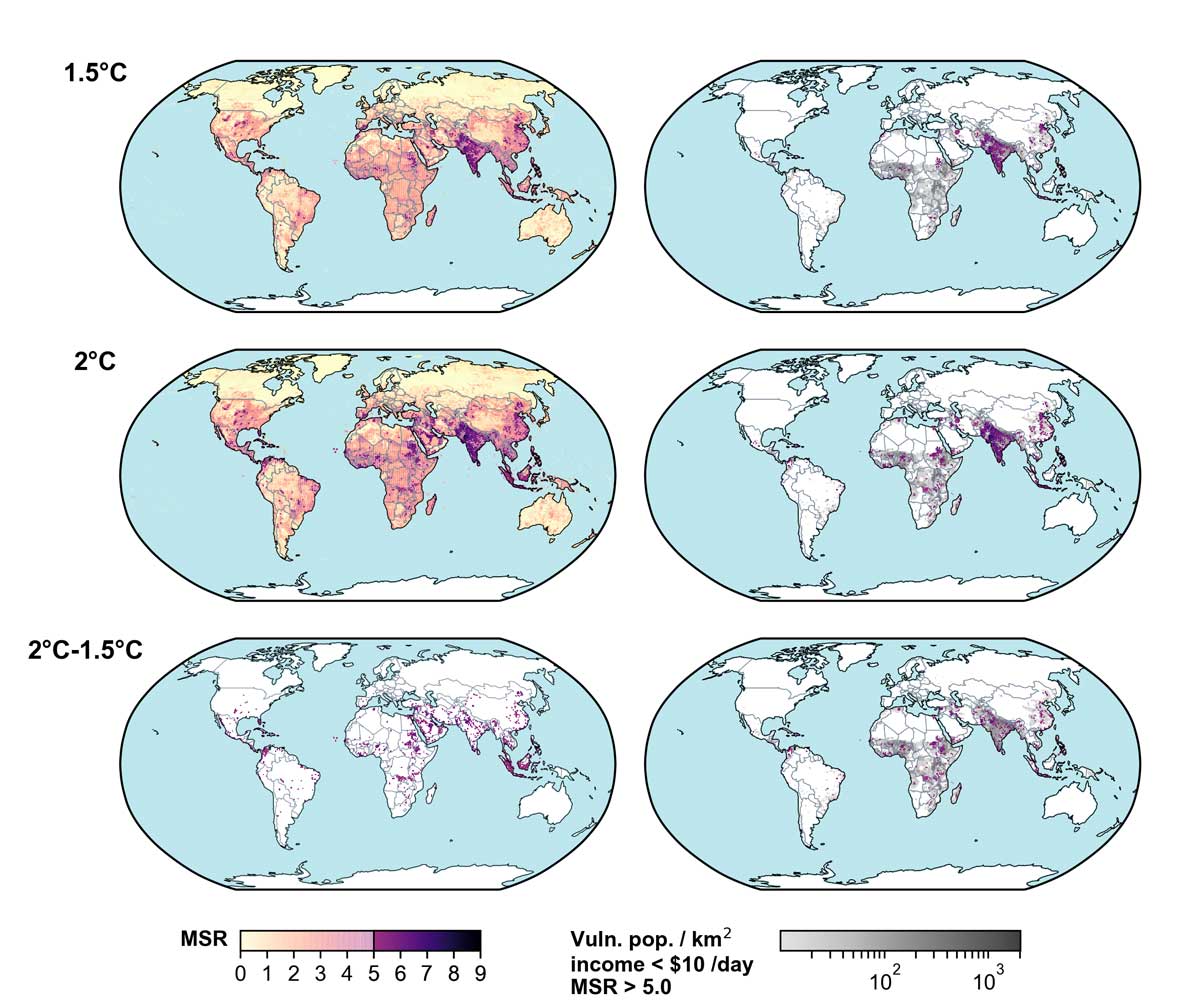
But there is no way that you can frame it as a certainty and call that science.
Climate panic adherents look to fallible and flawed scientific models for confirmation of their beliefs the same way Judeo-Christians look to the Bible for theirs.
Unfortunately, those of us who do believe this are a small minority. That's why it gets tied to other issues: it's coalition-building and the dynamics of advocacy. That's also a big reason why my other favorite cause is election reform, because it can help climate-change targeted reform become less partisan.
>Based on my understanding of “the science” economic development in the third world will still leave those people better off even accounting for climate change impacts.
If we had had economic development to the degree we now think of as "normal" in the third world starting in the 1960s, we would be looking at a very different, less frightening situation. But something went wrong. Currently, and particularly considering the events of this year, we don't seem to have solved geopolitical instability in the general case. Hopefully, the third world keeps developing. I'd still like to have a plan B.
"the people who advocate addressing climate change" - who?
"constantly be trying to tie it to other unpopular issues" - which?
" lot more important than it’s advocates treat it as"
The commenter builds up a profile of a "foe" to argue against, but it's all broad strokes and intimation.
Each person who holds an opinion about climate change and policy possibilities around it has their own reasons and positions. Lumping them all together and building a strawman out of them doesn't serve any healthy discourse.
The comment author evidently has their own opinions and feels like there is some consensus that leaves them out. They'd be better off making those assumptions about what other people apparently think explicit and their own alternatives explicit as well. Point by point. So they can be reasoned about. Instead generalizations are made so they can "win".
Because this is just a rhetorical drive-by.
I agree, but that’s my point! If the people who support addressing climate change really believed it is an existential issue, that wouldn’t be the case. They wouldn’t be treating it as one bullet point on an overall agenda.
1. The activists are hypocrites: buying beachfront properties when you think every coast in the world will be swallowed up by 2050 is very telling. Flying around in jets to tell people to stop flying and eating meat is also infuriating and condescending.
2. It's frustrating to live in Canada and be told we're the biggest problem in the world with our 2% of all emissions. All because of our per-capita emissions are high due to a small population and our economy relying on industry everyone else in the world needs. Yet China continues to increase their emissions every year (and plan to till 2030, fat chance, but that's a different discussion) by more than all of Canada's emissions.
I'm so done with whining like this. I'm going to keep voting for you to lose, and for your emissions (and Al Gore's and China's and everyone else's) to be regulated. If that means you can't drive your two-ton SUVs and eat burgers for every meal, then so be it.
Now you'll moan about how we're threatening your lifestyle.
It's frustrating to live in china and told we're the biggest problem in the world, even we're responsible for less than 15% of carbon in the atmosphere. Wealthy countries like Canada and the US have profited from blowing carbon in the atmosphere over centuries and got wealthy from it, but now refuse to lower their emissions and blame us for wanting to get rich too.
It's all a question of framing.
It was done at the scale of 30m and 300m populations, not a population 1.5b so it's hardly a fair comparison.
We have cleaner methods now, and my province doesn't even have any coal plants left. Our energy costs are through the roof because of that effort to save the planet. Meanwhile China continues to pollute more and more yoy, undoing any progress the rest of the world makes, at a mind boggling scale using outdated technology with no regard for the rest of the world.
I think the idea is to compare countries' per-person impact. Otherwise, a country as populous as China is being held to a higher standard. How else should we compare countries?
edit: to elaborate, if I was allowed to immigrate to China I'd lower my per-capita emissions overnight and be a better citizen in the world. Or if Canada allowed mass immigration and tripled our population our per-capita would drop like a rock. Except I highly doubt it works that way and would solve climate change...
As the climate doesn't care about man-made boundaries, isn't that all the more reason gauge emissions on a per-capita basis, without reference to borders?
> to elaborate, if I was allowed to immigrate to China I'd lower my per-capita emissions overnight and be a better citizen in the world. Or if Canada allowed mass immigration and tripled our population our per-capita would drop like a rock. Except I highly doubt it works that way and would solve climate change...
If migration could lower per-capita emissions as you describe, wouldn't that count in favour of that migration? (Of course, we also ought to consider any variation in per-capita emissions both in locations with net immigration and in locations with net emigration.) Maybe economies of scale help explain lower per-capita emissions in some locations (but not necessarily at national level).
How do you do that? Measuring per-capita can't be done without drawing a border somewhere. Split it up by income?
> If migration could lower per-capita emissions as you describe, wouldn't that count in favour of that migration?
I pointed out how absurd that was, not that it was a good idea.
> How do you do that? Measuring per-capita can't be done without drawing a border somewhere. Split it up by income?
Possibly by income, but there are other options. Other than being impractical (and possibly suggesting individuals are freer to vary their emissions unilaterally than they actually are), we could in theory actually measure individual emissions. How about measuring per-capita emissions regionally, and with regions sub-divided by population density?
This already exists in the form of carbon credits and people/companies spending money elsewhere (like planting trees) to "offset" the pollution they create. The rich are able to absorb the costs of the carbon taxes and will continue to do whatever they want because they're carbon neutral. Carbon neutrality is complete nonsense. This isn't a "calories in, calories out" situation where you can "maintain" if you spit out 100 units of pollution today but buy trees that will suck up that 100 units over 50 years. It's still ending up in the atmosphere and making things worse today.
> How about measuring per-capita emissions regionally, and with regions sub-divided by population density?
Sure, then that way Alberta will be considered an oil producing region and get a pass for their high per-capita emissions just like Qatar, Trinidad and Tobago, Kuwait, United Arab Emirates, Brunei, Bahrain, and Saudi Arabia. I made this comment elsewhere and this is exactly why I think it's unfair to point at Canada and the per-capita emissions. Our big industry and small population is the cause of our high per-capita emissions, and we have an enormous amount of clean energy but we never get credit for that: https://news.ycombinator.com/item?id=32977516
In other words, Canada and the US were even worse polluters with their small populations.
This isn't true. In 2020, out of 34.81 billion tons of CO2 emitted from fossil fuels, 10.67 billion tons of it came from China. Source: https://ourworldindata.org/co2-emissions
That's why I originally compared emissions in 2020 rather than emissions remaining in the atmosphere. You can't have it both ways.
> The world’s largest per capita CO2 emitters are the major oil producing countries; this is particularly true for those with relatively low population size. Most are in the Middle East: In 2017 Qatar had the highest emissions at 49 tonnes (t) per person, followed by Trinidad and Tobago (30t); Kuwait (25t); United Arab Emirates (25t); Brunei (24t); Bahrain (23t) and Saudi Arabia (19t).
> However, many of the major oil producers have a relatively small population meaning their total annual emissions are low. More populous countries with some of the highest per capita emissions – and therefore high total emissions – are the United States, Australia, and Canada. Australia has an average per capita footprint of 17 tonnes, followed by the US at 16.2 tonnes, and Canada at 15.6 tonnes.
Give me a break! How do Qatar, Trinidad and Tobago, Kuwait, United Arab Emirates, Brunei, Bahrain, and Saudi Arabia get designated as a major oil producing countries but Canada is left out?
Canada produces more oil than all of those countries except for Saudi Arabia and the USA: https://ourworldindata.org/grapher/oil-production-by-country...
I thought "Ok maybe per-capita oil production isn't significant so that's why Canada was lumped in with the US and Australia". Nope! Canada isn't on the same scale as the oil producing countries per-capita for oil, but Canada does better per-capita than Trinidad (who is considered an oil-producing nation), USA, Australia, and China: https://ourworldindata.org/grapher/oil-prod-per-capita?time=...
Why doesn't Canada get any credit for their energy production? Canada generates a wild amount of energy from clean sources and nobody in the world comes close to touching Canada: https://ourworldindata.org/energy/country/canada?country=QAT...
Feels like at least one of you is wrong.
If that argument was made, then I don't agree with the "want to help the poor and do left wing things" part. I agree with the not believing it climate change part though - if they did they wouldn't be buying beachfront properties and flying around in jets while scolding us poor people. They'd be taxing the shit out of themselves and their corporations. They would push for price ceilings so they can't pass the taxes onto poor people.
Yet here they are scolding us for our habits and trying to make the 99% of us change while they make record profits every year. They have no desire to put their money where their mouth is though.
Who do you see as a "climate activist" who's buying up beachfront property, flying around in a private jet, and making record profits?
And why on Earth would you think that one person or a small group who does those things is in any way representative of the environmentalist movement as a whole? How can you possibly believe that most environmentalists have the money to do those things?
> small group who does those things is in any way representative of the environmentalist movement as a whole
That small group has an amplified voice and all their talking points are spread by the other activists.
Retraining is hard and slowing down the economy will damage people, mostly poor and middle class.
There is no way around, hence why climate activists are always saying "it's a price we need to pay". That price to pay is why it's unpopular.
Also, the solution proposed are not the only way forward and the negatives are overblown.
The measures feel like they're done to fulfill the Keynesian politicians' agenda more than actually improve the situation (for that you would need way more global cooperation)
This is a popular misconception but not really true. Go search for and read stuff that argues against various climatological beliefs and you'll find they're almost all unaffiliated individuals, often retired engineers or researchers of various kinds. Even in the case where they are affiliated with think tanks and the like, that came long after they independently built a name for themselves engaging in skepticism - the funding followed their beliefs, not the other way around.
This does actually matter. I've become a hard climate change skeptic especially in the past few years, and the first step along the road was going looking for these "oil execs" because I thought it'd be funny to laugh at their transparently motivated reasoning. Couldn't find them. The so-called oil companies all reinvented themselves as energy companies a long time ago and have significant non-oil investments now. They're all fully on board with the climate narrative. Instead there's a whole lot of earnest bloggers who make strong points about the robustness and quality of the underlying science. Before COVID I was only marginally receptive to widespread claims of corruption in academic science. Nowadays it's far easier to believe and I'm listening.
"Even something as straightforward as replace coal with renewables is deeply unpopular"
It's unpopular because it's a strategy that doesn't work technologically, that's why Europe now faces an energy crisis, but anyone who pointed out out over the preceding decades was immediately attacked with vicious ad-hominems such as those you're displaying here. "But what about storage?" ... "shut up oil exec who profits off destroying the Earth". That kind of thing will make the people doing it unpopular pretty quickly in any context.
They've been unpopular before. "We must abandon capitalism", "We must not eat meat" etc didn't suddenly come up with climate change, they've been here before, and their proponents seem to be using climate change as the train they can attach their issues to.
If you think pointing the finger at one group explains it all, I suggest you haven't looked deep enough. People have done to the noble quest against climate change what they always do to noble movements; it's been co-opted and corrupted.
I've long wondered why this oh-so-blatantly-obvious fact is so hard to grasp for so many. Right alongside the oft-ignored fact that your favorite politician couldn't care less about you as an individual, or as a group, except insofar as your existence as a statistic (your vote) gives them access to more power and / or money.
I personally think climate change is a lot more important than it’s advocates treat it as, though it’s a stretch to say it’s “the most important” issue. Based on my understanding of “the science” economic development in the third world will still leave those people better off even accounting for climate change impacts.