I found my english, psychology, history and philosophy educations, which I took dead seriously as you did, to be tremendously useful. They didn't force me to learn, and the classes were relatively easy if you just wanted to pass, and I saw plenty of classmates learn nothing but still pass or get high marks.
But for those who take it seriously, it is nothing short of enlightening. You can skim through it and get your A+ and go on to the next stage of your rat-race, but you're shortchanging yourself.
I pity those who don't understand what the great scientists and artists of the past called "enlightenment". It's something you can only get from a serious study of the liberal arts. It has nothing to do with making money, although it can certainly help with making money, even if it doesn't lead to some well-defined corporate career.
Engineers scoff at me when I talk about phenomenology or existentialism or the value in mythology, fiction, critical analysis, personality theory. I pity them. They don't know what they're missing.
My engineering courses got me my job, my "soft" courses made me good at it.
While the cynic in me might say you just need to keep up with American Idol and an occasional Fox news broadcast to be able to chitchat with most Americans... I'm not feeling that cynical tonight ;) I'm certainly no expert on any of those subjects I studied in college, but I'm also not afraid of them either.
For me, philosophy was a way of developing my critical thinking and logic skills (which I already had from programming at an early age) outside of computers and seeing how to apply them constructively to a wide range of topics/issues (religion, law/politics, ethic, etc). Taking even more computer science and progamming courses in university would have bored me to death (well, it started to when I tried it).
Thanks to globalization that luxury is going to start to seem just as extravagant to Westerners.
Anyway, for a community that loves Steve Jobs so dearly - a man who claims the Mac wouldn't have been so successful if not for that calligraphy class he took at Reed College - there's an awful lot of derision in these comments for non-engineering around here. Of course, this is also a guy that dropped out of school and taught himself technical skills. Just enough to be dangerous... and convince someone like Woz to help him out. Or maybe that was the LSD and Buddhism talking.
And I agree with him: many tech-oriented sites tend to think the only jobs that (should) exist end in "Science" or "Engineering". Does the entertainment industry not fuel economic growth? Would Netflix be popular if we didn't have movies and television shows to stream? Would smartphones be pushing the envelope if all they did was allow you to check your email and take calls? Do we not laud video games that have fantastic stories and artwork?
I've even seen commenters express superiority between the science degrees. For instance, "Computer Science isn't really a science. It's just math!" and, "You can't call yourself a software engineer! Real engineers get qualifications! Real engineers do something that can affect public safety!" are both common sentiments.
Why is this? Do these people really not see the importance of the liberal arts, even when their own work is heavily reliant on them?
Engineering is a process by which professionals create and better their surrounding harmoniously with nature and society. Software is also built like this.
However, to suggest that being a code monkey or a WOW tester is an 'engineering position' is a leap you can only make in software. Cause suggesting that someone who took 2 classes of AutoCad can build you a bridge is ludicrous.
You can, however, get a job in entertainment industry without a degree in the said field. And getting a degree in, let's say, singing, does not make you the next Madonna either.
Whereas taking an engineering degree make you an engineer.
And you can't possibly think Apple is successful cause Steve Jobs took a calligraphy class, do you? If so, you're in denial of what it really takes to do what he did.
I guarantee you that if everyone had science/engineering degrees, Netflix would still be streaming movies and television. Just because I am going to school for an engineering degree doesn't mean I won't take a job in the music industry (nor do I need a formal system of education to play good music)
It seems like you've never talked to an engineer, as math is very highly regarded in the engineering world as it allows engineers to do most of what they do. On top of that design is also very highly regarded in the engineering world, as most of the things 'created' by engineers are 'designed' by engineers. Your senseless disconnect between science and math (and strong connection between math and liberal arts) is a whole other debate that I don't ever want to go into.
I can't even imagine hearing a respectful engineer talk down on computer science (or software engineers), I haven't met an engineer that has done this yet. In fact, most of the engineers I know started with computer science and then moved onto things such as ex. electrical engineering or mechanical engineering (and even vice-versa!)
You are also making the assumption that the entertainment industry is built off of people with liberal arts degrees, when it is exactly the opposite. The people who built the entertainment industry were people who had a burning passion.
I'm trying to make the point that design and engineering are practically the same thing.
My completely uneducated opinion is that middle and high school should do what colleges are supposed to: prepare students for the real world with useful skills. Teach them how to teach themselves. Then, when they go to college, they can focus on a subject they really want and not treat it like Camp College™.
Surely if the job doesn't appeal to many people, it is an oxymoron to say it is the most sought-after job.
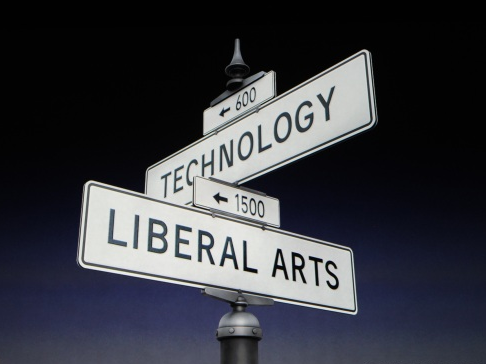
"We’ve always tried to be at the intersection of technology and liberal arts, to be able to get the best of both, to make extremely advanced products from a technology point of view, but also have them be intuitive, easy to use, fun to use, so that they really fit the users – the users don’t have to come to them, they come to the user.” --Steve Jobs
No, it's an economic one.
> I have a liberal arts degree from an "elite private university".
Ok. Let's make the assumption that you're at least moderately intelligent and would be able to get a job for 40K from the bat.
40K * 4 = 160K
College tuition is 40K itself at an "elite private university". Then you add living expenses, books, food, etc. and you have another 25K. That's 65K.
65K * 4 = 260K
160K + 260K = 420K
Yup. Half a mil to learn about Poetry Writing. Sorry, but that's just silly.
I would much rather my kid spend his time working in a small business and learning about entrepreneurship hands-on, than pissing away untold fortunes to sleep in a class about poetry. You can slip the kid some Robert Frost after work.
Trust me, if he has an inquisitive mind, he'll explore all the weird and strange subjects on his own time. With the internet, he can even be challenged by greater minds.
The best argument for college is the social environment, which can't be replicated outside of it. Not education. The kids get that. That's why they don't go to class.
I didn't make a lot of money right out of school, but 3 years later I was making a boatload. Why? Because I can write the kind of email that will make someone who has a job I'm able to do agree to coffee with me, and pitch myself successfully in that meeting. I'm a "go getter" who goes and finds my success, because I'm the opposite of the kind of kid who goes to sleep in his poetry class.
And by the way, I taught myself programming. That CS 201 class I took was a java programming class where the instructors wrote a framework that we learned. At the end of the semester, all I knew were a bunch of the functions of their framework. Why would I need school to learn programming? Unlike my major, CS had something like 20 required courses. That's at least half of your whole university education, more once you find a particular area to focus in.
However, I took an economics class from a Nobel laureate and a history class from a professor who lit the room with his enthusiasm for storytelling obscure historical anecdotes. It's the difference between reading a textbook about WWII and watching Band of Brothers. You can't get that stuff on your own.
Also to clarify: I partied my face off in college, too. But it was work hard, play hard. I'm a student of life, not of how to optimize my bank balance before I'm 30.
Regarding below comments: other than an internship I got during college from a graduate of my school, I haven't experienced much nepotism from my university. Most people have never heard of Washington University in St. Louis unless you work in Medicine.
It's funny, because that's my attitude towards the liberal arts. I took almost nothing but math, physics and CS in college, and then went on to get graduate degrees in CS, but I read history, politics and public policy on my own. Also some econ and financial stuff since 2008 because I decided I wanted to understand it.
In contrast, the two history classes I took in college were awful. You could just as easily flip your anecdotes - I learned an amazing amount from my technical courses, things I just wouldn't have learned by reading books on my own.
We agree in the sense that we both believe there is value in a good education. Especially a liberal arts one.
I learned how to learn in college. By taking disparate subjects, I can absorb new information with ease. That is the most tangible and valuable skill I picked up. I got it by taking random subjects. The very definition of a liberal arts education.
That said, the degree itself is worthless. I never had a resume. I started my first business in college. That was 12 years ago.
For me, it might have been better to simply audit those classes or do something on my own, and put the tuition in my pocket. I have a strange feeling that applies to many people here.
There are some really good resources out there for self-study. An easy one to start with is Ron Gross's The Independent Scholar's Handbook, http://www.amazon.com/Independent-Scholars-Handbook-Ronald-G....
But the much older (early seventies) book This Way Out is even more useful. My Amazon review:
This book is in 3 parts, the last 2 Experimental Colleges and Foreign Study are too dated to be useful.
Part one is the best book for college-level self-study I have used. I first read it in the early 1980s and have reread it several times since, it is only 135 pages but packed with useful advice. The biggest weakness for the current user is that it has nothing on computers or the internet, but some of its advice such as "Write lots of short papers. Long papers kill students and tutors alike. Write lots of short papers. It will teach you too write and that, as we will demonstrate later, is essential" could almost have been written for the Web (most books on creating web pages emphasize short, to the point writing). They also mention the absolute essential for self-education - you must love to read, if you don't, then stay in college where they will force you to read.
http://www.amazon.com/This-way-out-alternatives-traditional/...
Or are old enough to remember the heyday of ftp.wustl.edu. :)
- In the current economy, the number of high school grads making $40k/year is vanishingly small. It's more likely he'd be making 25k or less if he has a job at all. - 25k for living expenses and books for a college student is way too high unless she's going to school across the country and flies home a ton. - The average student doesn't pay 40k/year in tuition unless he has rich parents and is a below-average student. The average is less than 20k.
Let's redo the math: Tuition: 20k * 4 = 80k Living Expenses: 15k * 4 = 60k Total Expense: 140k
Let's say that our college student gets a below-average job that pays 32k/year.
In a 35 year career with 3% raises, our high school grad makes a total of $1,511,552. In a 31 year career with 3% raises, our college grad makes a total of $1,600,086.
Considering the time value of that $140,000, it's a wash. Go to college and study poetry if you want. The impact to your long-term bottom line is negligible.
Now, if you could invest that money at 3% compound interest over 30 years, you're talking about $650k -- that's 33% of your final career totals. (When I do that calculation for my 10 years of BS+PhD engineering, its pretty dramatic!)
So where are those types of values in the calculations?
Now that I've graduated my starting job is ~$60k with a $20k annual raise once I've been in this position for a little over three years. There's not one friend that started work directly out of school that I can say that for.
Not to mention my degree allows me to venture to the upper ends of this company where education is a requirement while they'll plateau in seniority because of that.
Again, way too many variables and gray areas for us to do a number to number comparison because no two situations are identical and the idea of "average" or "typical" probably only makes up a small percentage of personae anyway.
Like you, I lived frugally during my entire educational experience, and the tuition was largely paid for through scholarship / fellowship. For talented people (who could prosper after dropping out), college expenses can be fairly minimal.
I'm not sold either way on the debate myself. I think there are a lot of people in college who'd be better off outside, and a lot of people outside who'd be better off in. More to the point: I think that society as a whole would be better off with a different distribution of higher education opportunity.
Paraphrasing William Gibson: higher education is here, it's just not evenly distributed.
This is a bit disingenuous. Elite universities are almost universally free for those who need the help.
>Yup. Half a mil to learn about Poetry Writing. Sorry, but that's just silly.
>I would much rather my kid spend his time working in a small business and learning about entrepreneurship hands-on, than pissing away untold fortunes to sleep in a class about poetry. You can slip the kid some Robert Frost after work.
Money has such a weak correlation with happiness that the argument needs to be fleshed out a bit more to be convincing. I've known many engineers in my life and I've seen no evidence that they are happier than those who have pursued the arts. Life isn't a video game in which money is a score. Heck even in a video game, it's rarely about the accumulation of money.
Even in terms of building a lasting legacy, there is much to be said for the arts over business. Byron will be remembered long after the Vanderbilts are forgotten.
Baloney. They don't go to class because they are hung over, or because a new movie came out, or because they want to play video games, or because they just don't feel like going. A very few don't go because they are sick or have actual life issues beyond being unmotivated.
They are - as a rule of thumb, say, about 98% of the time - not sipping wine and discussing complex and nuanced issues.
Being good at socializing and networking will. An awful lot. And being hung over with friends does qualify for that.
As much as I'd want this for my kids, not all kids have the passion for entrepreneurship, or innovation, necessary to be successful. Liberal Arts degrees can help by allowing young adults find an interesting and for them beneficial and hopefully rewarding career, that they might not otherwise find if their best option is working as a cashier at a dollar store.
The cost though for Arts degrees, and I have sat on the board of governors for a well-known and high reputation university, is ridiculous and largely driven by politics & tradition, more than economic value.
But I don't want to pay for my children to party & socialize for four years at that cost!!
The best argument for college is the social environment, which can't be replicated outside of it. Not education.
I don't think that's true in serious liberal arts colleges. They're all about changing the way you think.
Edit: of course the social aspect is important. But it's not the best argument.
Reading books where others smarter than ourselves ask these questions can also unfold new paradigms and impart the same intellectual growth.
Still a lot for learning to write poetry but that's not all he did...
No. When it comes to non-technical degrees, it's the classroom environment. It's the academic and intellectual environment. Which the internet isn't close to replicating. Someday it might come close, but certainly not in the near future. If you think the internet is approaching a college education in value, you haven't experienced a proper college education.
Except it's payed for by your taxes. Who is silly here?
Half a mil so that when you apply for a job at $MEGA-CORP or in government the hirer says "Oh you went to %SCHOOL%, same as me" welcome to our management fast-track program, followed by promotion and VP-dom.
As opposed to "Oh you got a CS degree", well programmers get to sit in this cubicle and get paid $50k until we outsource the whole thing to India.
If you're making $50k you're being screwed.
Also, a small percent of people (business students, poetry majors) ever go down the VP track. As a CS major I'm much, much better off in pay, quality of life, career stability than my friends who got business degrees. Never mind liberal arts, liberal arts is a vacation you take before you actually go to (graduate) school.
I'm being screwed then. I have a CS degree and a business Masters degree. I'm a "senior" developer and make $55k.
The primary employer in my area is the Montana State government. Programmer pay here tops out at about $60k/year. Low-end programmer salaries are about $35-$40k. In the private sector you'd be lucky to get $70k/year.
My wife and I are thinking about moving, but you can't really beat the quality of life here. Remote work is an option, but I don't really have the network/stomach to freelance and remote permanent positions are pretty scarce.
Cost of living is cheaper in rural areas, and there are fewer tech companies. But the vast majority of CS graduates live and work in metropolitan areas, so for the vast majority of CS graduates $50k is getting screwed.
A senior developer in SF or NYC is still coming out ahead - probably due to the sheer amount of competition for them - but not quite as much as you'd think at first glance.
You either adjust your expectations when you live here, or you go somewhere else.
I am somewhat worried that when I do decide to leave that my wages will be pegged artificially low because of the cost of living difference. But I figure I can always convert my salary to the local equivalent when asked what my current salary is.
Why would an interviewer have a right to know your current salary? That person is tasked with acquiring your intellectual resources at the lowest price possible. And by giving them your current salary, you're clearing up a big unknown in their equation -- your current alternative to a negotiated agreement.
When you go and buy a car, the sales people don't generally offer to tell you the car's invoice price, do they?
Same. I make in your salary range, and I figure I will simply grab some COLA calculators when I go job hunting and adjust upwards to correct for the local difference
I have one friend who got $75k off the bat but that was a job in a company that employs 4 programmers for the entire company (national) and is energy industry related.
Just trying to find the right place to go. Right now I'm doing a software craftsman apprenticeship to increase the quality of place I can get a job. When that's done (it's a 20-30 hour commitment on top of a full-time+ job) in January, I'm going to get involved in some OSS projects.
The move is probably at least 6-12 months out.
Worst case scenario if you do? You won't get anything good.
Worst case scenario if you don't? You'll have spent a year trying more or less random things and then still not getting anything.
You're right on with the confidence (and persistence?) issues. That's one reason for doing the SC thing. It's helping me build up some confidence. I've been programming for quite a number of years. My day jobs for the last several years have destroyed the confidence I used to have. I'm getting it back, and quickly. And that makes me very, very happy.
OSS is something I want to be a core part of my job, because I use and appreciate it so much. I've tried getting involved with several projects before. Invariably my confidence falters enough that I give up before I really get going.
I'll go over to the two jobs threads from the other day and apply to some places. There were at least 3 or 4 that I would LOVE to work at.
Having concerns about your abilities and taking steps to improve them is a very positive trait.
> OSS is something I want to be a core part of my job, because I use and appreciate it so much.
I'll challenge you to find a single job on those hiring threads where you won't be steeping neck-high in open source software. Whether you'll get to contribute back is a different issue, but if nothing else you'll gain loads of exposure that you can use to contribute on your own time.
> I'll go over to the two jobs threads from the other day and apply to some places. There were at least 3 or 4 that I would LOVE to work at.
Awesome! Good luck!
If going to an elite college gives you a better chance of reaching the top, then hirers will come from elite colleges.
If getting a CS degree gives you a better chance of reaching the top, then hirers will have CS degess.
Getting a CS degree does not give you a better chance of reaching the top. It gives you a better chance of reaching the upper-middle.
Of course this system eventually breaksdown. But for Eton school it's worked since 1440, for Oxford since 1096, Cambridge since 1284 - but eventually it will break down.
Universities pretty much had the monopoly for highly specialized knowledge until very recently. The companies, public and students waking up to the fact that knowing your rhetoric & poetry ain't so valuable any more IS the system breaking down. Right now.
You'll rather hire from HN than from Oxford.
Do companies really work that way? I think trying to max-out your competitiveness and money-making skills by hiring the right guys would make more sense than hiring via secluded grapevine.
In terms of hiring people because they went to the same school you went to... I've never seen it, though I wouldn't be surprised if that happens with Ivy Leaguers.
From one point, a curve, right? :-)
I can't imagine this working out well on the average, though.
So if you are an engineering company and you work like this you will be destroyed by countries with more meritocratic hiring systems.
If you don't have any competitors because you work for government or in a sector like banking where you are protected from foreign competition and all you competitors hire on the same system - then you will do fine (for now).
Can we spot any English speaking countries which might be an example of this?
Two decades ago, not many alternatives existed (libraries? buying books? maybe private tutors?). A decade ago, the online world started opening up a ton of information, but it was basically a wild west of unstructured information.
Now fast forward to the present. Information is beginning to have a bit more structure. More importantly online learning is becoming more social. As this trend progresses my best guess is that the comparative value of college will decline. Not because students in college are learning any less. Indeed thinks to technology they're probably learning more efficiently than ever. But, a lot of that learning can take place online and outside of formal academia at much, much lower costs.
So, yes, college has been a nice investment, but I see the returns declining rapidly on that investment. Sort of like how investing in newspaper stock might have been a good play for most of the 20th century. The last decade, not so much so.
I agree with you with a slight change. I went to a public liberal arts college and received a BS in Computer Science. I ended up having many hard math and science courses along with courses in philosophy, religion, and chamber music. Overall, I think I received the best of both worlds.
In the past anecdotally at least in the City of London 'well rounded' individuals were preferred for high finance i.e. you might be better off studying Classics at Oxbridge than pure math. Today this is probably less true as computerization and trading systems have come to the fore.
However, I would be very surprised that in your case you didn't have all of those skills mentioned in place before going to university. Is it likely they got some enhancement? It certainly wouldn't do any harm studying anything in a good department.
I don't see any tangible evidence that 'soft skills' are manufactured out of liberal studies and I find it a baffling conclusion that there even would be an automatic superiority of these skills versus a 'high calibre' person studying engineering.
Although I think plenty of other comments defending Liberal Arts make this point more explicitly about the relative benefits.
But couldn't you have learned those skills with another degree as well? So, wouldn't you have been better off learning those skills in classes where you also learned about the subject matter in the area where you are working?
I'm curious: where did Mr. Ponzi get his degree?
Yes, it's pretty obvious that if you get into a name-brand university and manage to teach yourself marketable skills on the side, you can be pretty successful. What if you don't get into a name-brand university? You're screwed for life and your best shot at success is to work for someone like you? No thanks.
It was a rhetorical question. The point was, Andrew Mason's accomplishments don't seem quite so respectable anymore.
The article is about the growing number of Liberal Arts graduate s. My point is that if you are going to study liberal arts in this economy, you'd be better off studying somewhere good and have more opportunities later.
I submit that if you get into a name brand university, you probably already have the upper-middle-class/upper-class background, connections, and upbringing necessary to do well in the job market regardless of what you actually study. And either way, now that you're in the elite social category of "people who got into a name brand university". That's all status, and no one ever argued that status didn't get you places in the world.
I strongly agree that college has just become a place to delay becoming an adult, and delay the real-world.
To me, the problem is that most people don't view college as an investment in their future, but rather as a temporary place to delay choices. Certainly, it is positioned as an investment by educators, and it is probably true for science & engineering degrees, but do students approach it that way?
I have a liberal arts degree from an "elite private university", and I can tell you that the school's approach was to give someone like me everything they could possibly need to succeed, but to leave it up to me to do the actual succeeding. My major's requirements had only 8 classes - 1.5 semesters. Our "core curriculum" had a diversity of requirements, but all were easily gotten around; the science core was easily satisfied by courses such as "Solar System Astronomy", "Oceanography", or "Stars, Galaxies, and the Cosmos", as opposed to Calculus 101 or what-have-you.
I took those classes, but I took those classes in all seriousness. They may have been soft on the hardcore science, but they opened up the breadth of my understanding of the world. Some others in my class did not - they were not at school to invest themselves, and that was their right.
I think I'm much better at the work I do today because I took classes with titles all the way from Quantitative Political Methodology, to Metaphysics & Epistomology, to The Political Economy of Development, to Psych 101, to Poetry Writing, to Arabic, to Computer Science 201, to The American Frontier.
But that's because I took all of those courses dead seriously. That's what makes college a good investment. Well, and the life experience itself, but that's not exactly an "investment" in the monetary sense.
If you don't approach school that way, you're not just wasting your money on tuition - there's a massive opportunity cost. 4 years of failing at a startup is certainly a better business education than an undergrad business degree from my school.
Really, it's a cultural problem. It's like a stomach ache after eating too much candy; things were so good for so long, we collectively forgot what it was like to have to sacrifice and work for the things you want. Applying for entrance to school and actually graduating doesn't have much of anything to do with your education. That's something you have to work for.
Now, is it "in the state's interest" to promote, say, English majors? I think that's a whole different topic. I think anyone who is asking the taxpayer to fund their education needs to be ready to pay that back with directly applicable skills, which would seem to suggest you mostly need scientists & engineers.