Also, I gotta say that language like "moral deficiencies" sounds incredibly broad without some examples. I think that speaks to the drawbacks of a religious context. I don't necessarily mean to direct these comments at you in particular (after all, I don't know what you meant by "moral deficiencies" without more info), but morality is a slippery topic and religion often seems to treat it like it isn't.
The pali word is "sila", the closest translation is morals. To be deficient in sila is to be deficient in morals, was my thought process. One example is do no harm, or avoid lying. If all your daily life is filled with causing harm, and deceit, then it will be filled with chaos and end up making it harder for you to make progress in awakening or do good stuff. This is one interpretation of karma (cause and effect).
There's a whole other philosophical side to it that I think about, outside of the Buddhist context. That certain choices or circumstances in life end up reducing your moral agency in this world. People can be born under unsafe, and unkind environments, so sometimes it becomes harder to be generous and kind, as if there was less wiggle room in your ability to act as a moral agent. One of the things Buddhism tries to address is removing the layers of conditioning in your mind and concept of self, to give you more freedom.
The traditional answer: they are synonyms. English (and many other European languages too) often has pairs of words with interchangeable meanings, one of which comes from Greek ("ethics"), the other from Latin ("morals"). The traditional identification of the two terms comes from the fact that when Cicero sought to explain the ancient Greek philosophical tradition on ethikos (ἠθικός) in Latin, he coined the Latin word moralis to translate that Greek term – hence, the Western philosophical tradition (and the Western intellectual tradition more broadly) begins by treating the two terms as essentially synonymous – the idea that there is some difference between them did not arise until over a millennium later
Most popular contemporary answer: they are two different things. However, while many (maybe even most) people agree they are two different things, there is much less agreement on what exactly is the difference between them – some say one is religious and the other secular; some say one is personal and the other public (confusingly, some say morality is the personal one and ethics is the public one, others say the opposite); some say one is about detailed rules and the other is about principles; etc. (I'd also note you can find innumerable web pages claiming to explain the distinction – but if you read them carefully, they often contradict each other in various ways, and rarely do they cite any kind of authoritative source in support of their claims.)
I think a large part of what has happened here, is "morality" has picked up a lot of connotations of (Judaeo-Christian) religious and social conservatism, of which "ethics" remains relatively free. Since for many people (especially secular/progressive people), "ethics" has positive connotations, "morality" rather less positive ones, people assume there must be some difference in denotation as well. But, while that assumption is widespread, there is far less agreement on what exactly that difference in denotation is. Indeed, I think attempts to give them different definitions are somewhat of a retcon.
Personally, I just stick to the traditional answer. My impression, is that among professional philosophers (especially of the analytic tradition), the traditional answer is the more popular one [0]. "Moral philosophy" and "ethics" (in the sense of the philosophical discipline) are two different names for the same thing, albeit the former name sounds a little old-fashioned, the later a bit more contemporary.
[0] To quote the Stanford Encyclopedia of Philosophy – "The term ‘morality’ as used in this entry will not be distinguished from ‘ethics.’" – https://plato.stanford.edu/entries/religion-morality/ – the same entry also notes, that while some philosophers have attempted to distinguish the two terms, including even such illustrious figures as Kant and Hegel, there is a lack of consensus among philosophers who believe them to be distinct as to what the distinction actually is.
In my head, morals usually equates to acting within some set of conduct guidelines laid out by society or religion.
Ethics, is the same but instead of not (e.g) just shooting someone because it says not to in some book or law, I do it because I somehow know it’s harmful.
That’s a pretty awful explanation. I guess I mean, I somehow draw the distinction between these terms based on where these “seem” to come from.
I think most people have the intuitive ethics, morality is something we pick up.
Of course, that’s probably complete nonsense ;)
Morals are easy (and clear) once you don't have to deal with the real world.
A fundamental misapprehension of these teachings is what gets people wound up. The Buddha's teachings are not going to answer if rent controls are good policy or not because the world in which the laity live is a stew for the perpetuation of dukkha. Certainly not lying, cheating or killing are all good principles for living a life of less dukkha but given the Buddha's observations that samsara has no beginning or end spending your life on answering if rent controls are good policy or not is doomed to be unlasting and unsatisfactory.
The dhamma is not to be realized through discursive thinking alone. It must be directly experienced. The Buddha invites anyone to practice the teachings and discover for themselves if they are bullshit or not. So sit and examine or don't. Throwing the teachings under the bus because people want to pull out the part they like and dump the rest is wrong practice and the Buddha was painstakingly clear on this.
None of these are sins in their absolute sense though, and this is what I am underlining, that you can't possibly create absolutist ethics in any way. Philosophy had created a lot of points of view on this, but none of them managed to create a consistent worldview that would work for any occasion.
This is not complicated. Trying to objectify these acts as anything but harmful is not helpful to you or anyone else. The next time you harm someone look closely at yourself first and observe the tumult of feelings that follow. Observing them closely, directly experience their result. Then you can know for yourself what the Buddha taught: evergreen wisdom that will remain applicable so long as people suffer anywhere.
We are not beings of pure intellect. That is complete folly. The mind is real, yes, but so is harm, pain, suffering, and craving. These are not abstract concepts. They can be directly known by anyone living. We must engage with the human faculties we are given and use them to understand our condition and the way leading out.
Is there any harm outside of the mind perceiving it? Can we talk about harm independent of causes and conditions? Could these actions be not harmful, or even skillful under certain conditions?
> The next time you harm someone look closely at yourself first and observe the tumult of feelings that follow.
What if there’s no tumult of feelings that follow?
This is almost the opposite of Christianity, depending on what you mean by "right morals". Christianity says you simply can't reach salvation and be with God unless you are flawless, which is humanly impossible, so unless God does something... hence Christ.
Thing is, Buddhism makes very similar claims. That's what the Bodhisattva vow is all about; a commitment, made out of pure loving-kindness, to delay ultimate enlightenment so as to accumulate a store of merit (good karma) that other beings can freely call for and attain their own enlightenment. For all we know, every practitioner of Buddhism who actually manages even the slightest semblance of enlightnment might be tapping into the power of countless bodhisattvas.
I'm pretty sure you can find some sect of Christianity somewhere that will contradict another one completely, just consider the Northern Conservative Baptist Great Lakes Region Council of 1912 interpretation vs. the Northern Conservative Baptist Great Lakes Region Council of 1879.
>Unitarians generally reject the doctrine of original sin.
I agree that basically that if you do a random sampling of Christians the odds are likely somewhat greater than 99% while still less than 100% that anyone you pick will believe that Jesus saved humanity from sin and salvation is related to accepting his teachings.
Some will also say salvation is accepting his teachings and divinity, and some will say salvation is accepting his teachings and divinity and doing good works as well.
But not everyone will believe in original sin, and as such they may believe that you can be very good and still be saved without accepting Jesus.
This of course answers several common complaints against many Christian faiths that a good person who lived all their life following Jesus' code of conduct without knowing who Jesus was would not be able to be saved.
I don't have any particular side of this fight, as I am an Athiest, although relatively well read in theology (at least when younger)
On edit: also note that there were probably sects of Christianity that were deemed heretical in former times and wiped out that differed on this part as well, it is my understanding that the Adamites https://en.wikipedia.org/wiki/Adamites did not have a doctrine of original sin and Jesus' death being necessary for salvation.
God has always wanted humans to "be perfect", if by that we mean without sin. We have always failed at this, and God has always gotten angry. This starts in Eden, and even Jesus told us to "be perfect" (e.g. see Sermon on the Mount), and was really upset at sinners _who did not want to change their ways_.
Romans 3: "... for all have sinned and fall short of the glory of God." Yeah, it's humanly impossible not to sin.
It is crucial to Christianity that humans are saved "freely by his grace through the redemption that is in Christ Jesus" (Rom 3), "and this is not from yourselves, it is the gift of God" (Eph 2).
If you are willing to confess your sin and repent for your mistakes with godly sorrow, God will forgive your trespasses.
Even the most handsy of trespassing priests is forgiven.
But like anything, institutions are run by humans and sometimes go the wrong way, focused on dogma, enrichment or power.
Wow! I haven't meditated before. That sounds like a lot of time.
Do you still meditate? What does it offer you? Has it offered you what you expected?
I am very good at deep work, and concentrating on stuff. It is also easy to deal with stress and emotions in my day to day. My life feels like playing a third person video game with the FOV slider turned to 360 degrees. Every sensation comes discretely where I can see the beginning and end. 1 second is a really long time, enough room to fit 1000s of sensations, bounded only by your speed of perception. I am aware of how my mind constructs the concept of time, the idea of later. The cool part about hitting stages of enlightenment is that there is a quantum shift in how your brain processes, that I know I cannot regress to a previous stage. But I wonder if awakening is built from physical, neural correlates, then things like dementia or a traumatic brain injury might reverse some of the effects.
Another interesting note is that I have a much higher pain tolerance, as well as sort of better control of my body movements. I know some people describe enlightenment as a full body transformation, not just the mind.
One thing that is keeping me from progressing further is the inconvenience that comes with sleep alterations caused by meditation, and how it affects my work as a programmer. I still have obligations to participate in modern society, pay bills, keep relationships, etc. And I know if I didn't do this, I would be perfectly content doing nothing all day, just meditating. It's why retreats and the monastic life is so conductive to awakening. Maybe this is the ultimate FIRE goal, I'm just working on the FI :)
For the record, the Buddha has never advocated leaving society, especially lay followers. Whether we are a monk, at a retreat, in a family, we all have a duty to be a wise citizen.
That sounds absolutely terrifying to me. [1]
All these articles about the downsides of meditation and the above statement just keep pushing me away from it. I enjoy guided meditation with a licensed therapist, but unguided meditation by myself feels more and more unnatural.
1: Aside: I have enjoyed enhanced senses under strong drugs, but I also enjoy spending most of my life sober with unheightened perception. There is a reason why our brain is filtering out most sensory signals. I would not want 360 view and to fit thousands of sensations during my normal day.
This article comes close to describing how I experience "Attention Deconcentration" http://deconcentration-of-attention.com/deconcentration-soft...
Here's a video of it captured live https://www.youtube.com/watch?v=4t8KvdMtT4A
When I first reached stream entry, or the first stage of awakening, a slightly less filtered state, it felt like a massive relief and dropped a huge weight out of my body. My day to day is filled with far less suffering and I would rather die than return to how I was before.
On the other hand, simple guided meditation by a licensed therapist, or the many apps out there are great introductions to the vast majority of people, without the risks that come with insight practice. It's especially important to be cognizant of when you get into "insight territory", which a good teacher should be equipped to deal with safely. The sad part is some Goenka retreats completely neglect this concern for safety.
+1 Sounds like some rather scary dissociative experiences I've had (without drugs, or meditation)
How has meditation affected your sleep?
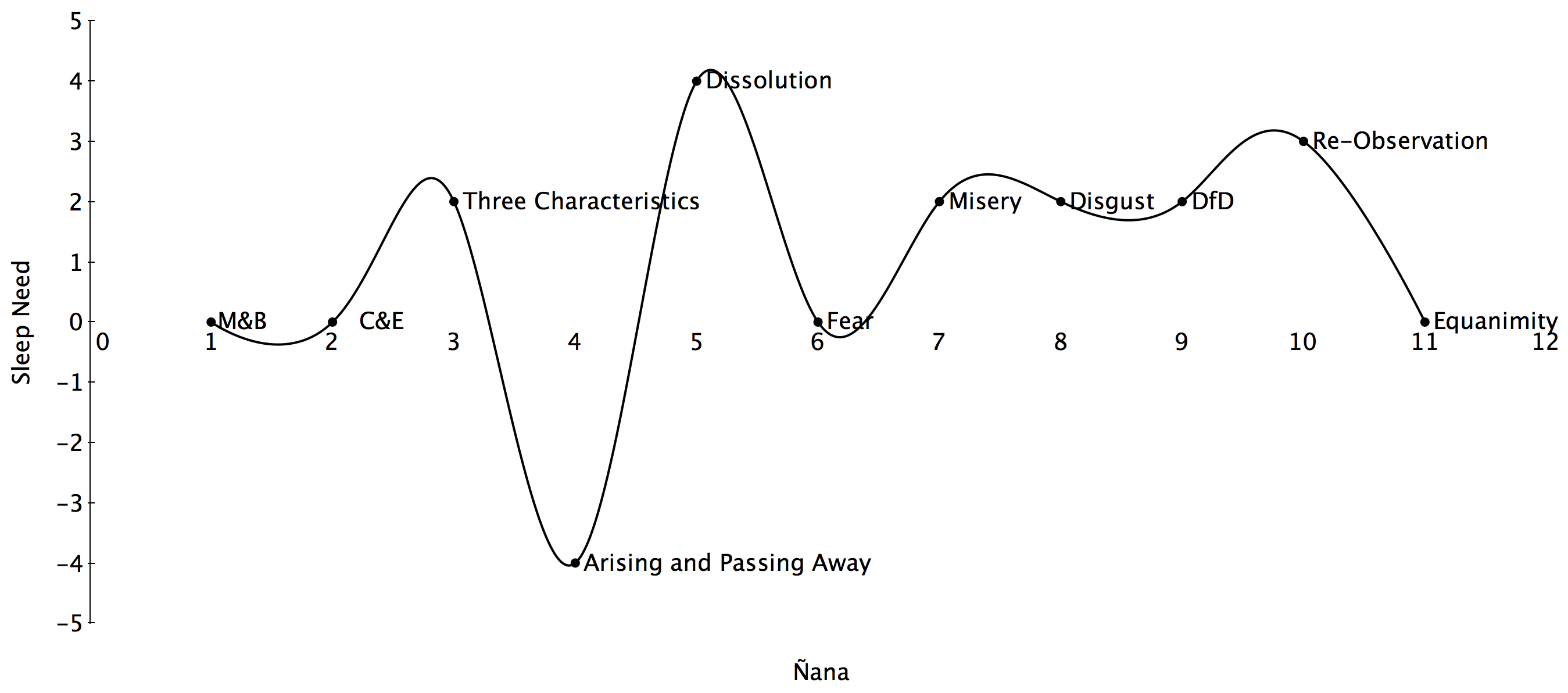
I let my manager know that there may be times where I have sleep issues. Sometimes it lines up with a 2-week sprint cycle. When I meditated seriously, it was +/- 4 hours. Now it's more like +/- 2 hours. So if I normally wake up at 9am, sometimes I wake up at 7am, other times at 11am. I actively search for companies that are flexible with core hours, and have a later standup (>11am).
> On your journey so far, you’ve come off the freeway and you have driven through a suburban road. Now, you’ve hit the countryside road, the third stage of mental stillness. Just like effusive rivers rush into the sea but the sea remains unmoved, the mind of a yogi remains unaffected by the rise and fall of thoughts and emotions. Sea is not always calm, it has tides and it can get tempestuous, but such choppiness is not an everyday affair. A meditator in the third stage can have rough periods but they are far and few in between. From my experience, less than half a percent of meditators get to the third stage of mental stillness. This is not because they are not earnest about it but because wrong meditation does not lead to improvement. When a meditator has gone past the first two stages, they develop an unfailing stillness of mind that reflects through their actions, thoughts and speech. The energy of a stage three meditator has a quieting effect on those around him. The third stage is the countryside road. You can drive for several miles before you come across any other vehicle. Green fields, meadows, pastures, pristine air, blue sky, expansive views, beautiful landscapes, quiet surroundings, no rush – ah, the pleasure of countryside driving! You can go slower or a bit faster, you choose your own pace. The conditions permit you to do that. A meditator who has reached stage three learns to harness and channelize his thoughts. Most of their sessions comprise spans of quiescence and bliss with occasional thoughts emerging here and there, on and off. They don’t get up all relaxed from their meditation, for relaxed they already are, otherwise it would not have been possible to get to this stage. Instead, they get up feeling supercharged, refreshed and alert. A great meditator is always alert. Alertness is not only the reward but an essential ingredient for good meditation. A stage three meditator can easily sit unmoving for three hours.
I'd recommend you also read on Kundalini [1]. You have a great chance of awakening it in short time and experience the supreme level of bliss and peace.
Also, I request – it'd be great if you can join https://os.me/ and share your practice/experience as posts with spiritually inclined seekers out there.
0: https://www.amazon.com/Million-Thoughts-Meditation-Himalayan... 1: https://www.amazon.in/Kundalini-untold-story-Om-Swami/dp/818...
And another study published as a research paper on his voluntary control of brain regions: https://ieeexplore.ieee.org/abstract/document/8717094./autho...
I'm not the OP, but after I practiced meditation intensely for a few months I found two huge benefits:
First: before I meditated I used to get annoyed and bored when I had to do chores like washing the dishes or standing in line. But after meditating for a while, when I had to do such a chore I'd just focus on my breath and I'd no longer feel bored or annoyed. In fact, such chores and waiting in line became almost pleasurable because they gave me an opportunity to meditate.
Second: when someone said something mean to me I would just focus on my breath and sort of catch myself about to get angry and saw that I had a choice whether to get angry or not. I didn't have to get drawn in to the hurricane of feelings as an unconscious reaction to the meanness directed at me. Instead I could just continue to focus on my breath and I wouldn't get angry at all.
Unfortunately, for some reason that I no longer remember, I fell off the wagon of meditating regularly and went back to my old easily bored, quick to anger self. I still try to meditate occasionally by focusing on my breath, but it doesn't help nearly as much as when I meditated regularly for hours at a time.
I personally don't consider what I was doing meditation, but I wouldn't be surprised if I accidentally mimic'd some meditation-like behaviors to aid in this.
Not to be rude, but to expand how this sounds to me - It’s like going to shower to incorporate shower thoughts to be part of your daily routine. Which is profound but at the same time somehow narrow view of the whole routine and tradition of having showers.
The wounds are part of the body and personality. They are not you.
To come out of the duality we can leave the meditation open. It doesnt have to take any particular form and it should have no goal in mind. Objectless. It is this sense of beingness or presence that is a true meditation. It is the sense of existence which is the background of every other thing itself not perceivable to the senses. It remains constant throughout while everything else fades.
Highly recommend his channel by the way.
I was warned about it when I started getting "serious" about my practice, but I didn't believe it until I confronted it, face-to-face, on a daily basis. To this day I am the renegate and persona non grata at my Temple, ex except for the Abbot and my Zen Master who know how to tolerate, navigate, and leverage that BS for the greater good.
Samurai training is Buddhism training on steroids.
Regardless, my practice continue with a lot less time at the Temple, and I have relinquished my Center (the Center that I founded).
Ironically, and bit hilariously, conceit/pride is one of the fetters discarded at enlightenment, yet the Buddha Gautama has been quoted, "I am the greatest!"
The idea that Buddhist teachers should be some kind of perfect being is utterly false, and to be fair, if you ever thought so or believed someone when they claimed to be such a one; perhaps buddhism wasn’t so suitable for you anyway.
The goal is not to become some kind of zen droid. Quite the opposite.
Humans are just naked apes, no need to judge that harshly.
Having sex and drinking alcohol is fine in my mind, since i don't believe in religious morals.
Cognitive dissonance makes it possible to preach one thing and do another. We call it hypocrisy no?
More of a "whoops, woah cool" than a "let there be light"
Very much unlike of the Christian conception of God.
I'm not describing this well, because I can't describe it well. But I can't imagine anyone experiencing something similar would be a jerk about it. See the universe unfiltered though the mind's perception and it just...is. Timeless and meaningless.
Consciousness and ego create their own meaning.
> The five spiritual faculties are said to be like a cart with four wheels and a driver. If any of the four wheels is too small, wobbly, or not in balance with the others, then the going on the spiritual road will be rough. The four wheels symbolize faith, wisdom, energy, and concentration. If the driver is not paying attention there will also be problems. The driver symbolizes mindfulness. [See SN 48.18, also Visuddhimagga, IV, 45.2.]
> The five spiritual faculties have also been presented in another order that can be useful: faith, energy, mindfulness, concentration, and wisdom. In this order, they apply to each of the three trainings, the first of which, as discussed earlier, is morality. We have faith that training in morality is a good idea and that we can do it, so we exert energy to live up to a standard of clear and skillful living. We realize that we must pay attention to our thoughts, words, and deeds in order to do this, so we try to be mindful of them. We realize that we often fail to pay attention, so we try to increase our ability to concentrate on how we live our life. In this way, through experience, we become wiser in a relative sense, learning how to live a good and useful life. Seeing our skill improve and the benefits it has for our life, we generate more faith, and so on.
https://www.mctb.org/mctb2/table-of-contents/part-i-the-fund...
Always thought it was faddish.
I've also seen it make some people more likely to fall into the trap of woo-science and dodgy, spiritual scams. The practice of awakening forces you to investigate the ways you suffer. Before, they may throw their money at these sketchy MLMs and still suffer. With meditation, they can throw their money at them and also suffer a lot less.
Your comments on the nature of this phenomenon are insightful.
If you are not trying to do zazen off the cushion you aren't putting in right effort. You should be aiming to manifest non-discriminating mind at all times
I don’t think this means you dont feel sad or angry or even jealous or anything else. It means, when you’re sad, just be sad. Don’t be too sad about being sad.. :)
I saw a Dr. K video in another comment, and one of my favorite quotes he uses to describe meditation is that, "if you run for 5 miles a day, there will be changes to your body that will definitely happen".
More here:
- https://www.mctb.org/mctb2/table-of-contents/part-i-the-fund...
- https://eudoxos.github.io/cfitness/html/index.html
- https://themindfulgeek.com/ plus a talk he gave at Google https://www.youtube.com/watch?v=s2xxsA9Bn-4