Efficient city planning is not easy, and requires well intended coordination on many fronts.
On the other side I'm personally convinced closeness to nature is a life saver on many aspects so renewing those policies is a battle worth having.
[1] https://arquitectura-sostenible.es/el-barrio-multiecologico-... [2] http://concellodelugo.gal/es/actuaciones/proyecto-lugobiodin...
where i live there is constant discussion of "we need high density housing" and this is exactly what comes to mind. eventually this would end up with something like soviet style block housing, which doesn't seem so well received around the world. not to mention this style of housing is very constrictive in terms of lifestyle - maximum 2 child family with minimal space for hobbies/interests, limited sunlight, high noise pollution, etc.
this city in Estonia [0] for example, is somewhat pleasing to look at from a birds eye view and seems to check the boxes for having green space but i wonder about the range of residents' experiences.
[0] - https://www.traveller.ee/blog/wp-content/uploads/2016/06/852...
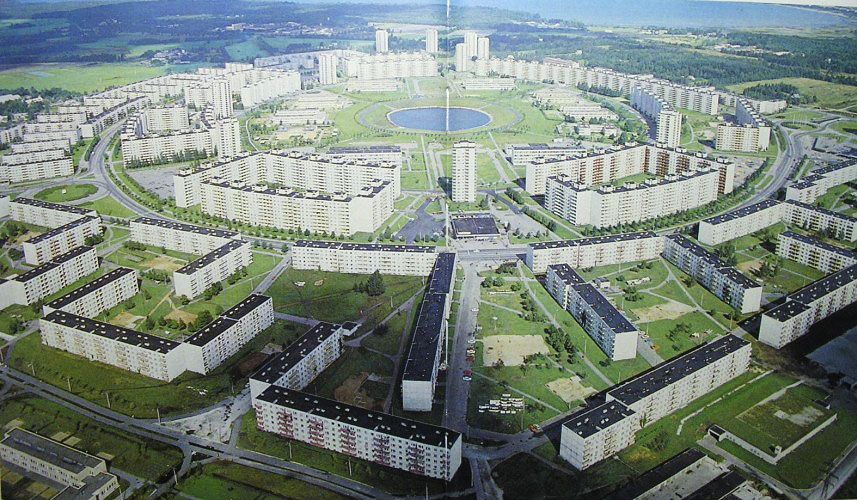
Apart from that I do think it's true that block housing separated by large parks (as shown in your picture) doesn't work well; it's discussed in e.g. Jacob's _The Death and Life of Great American Cities_.
[1]: https://images.adsttc.com/media/images/6238/5b71/3e4b/31a8/5...

and of course we can't forget that many places are at an inflection point in population growth so all of this capacity could be vacant in 15-20 years.
Strong towns [0] advocates a more bottom up approach to development, and is a good resource for anyone interested in how to add density in a sane manner.
The CCP seems to have been very successful with their "build an entire city and move people into it model" (seeing the cities have filled), but I'm unsure how it works in a more capitalistic model.
The issue in the US is that zoning is excessively restrictive.
Terraced housing has kind of okay density, at least it's not a total land crime like US suburban detached housing but affords many of the freedoms associated with it.
Berlin is outstanding for this. Wherever you are, it's easy to escape loud traffic and sit in a green, public space. Some have cafés and Biergarten in them.
I find returning to Canada difficult because there is no way to escape loud roads. There's no path along the fields, forests or rivers. If you want to walk in nature, you have to drive to it.
Very slowly things are moving in the right direction, but it is a constant fight against a loud minority and old local and federal rules favoring cars above all.
In Berlin in comparison only 30% of the city area is green spaces and woodland, totaling ~260km2.
One of the reasons why Berlin population is 1.2 times larger than Rome, even though the surface of the city is only 70% of the Italian Capitol.
I have not seen ANY good examples of comparisions between cities, but I know these problems comes up alot when we discuss cities here on HN.
As a Roman, I also thought that Paris or Berlin were greener or bigger, they are not.
> You have to show these things on a map
Here it is
Berlin and Rome, same zoom level on Google maps
I've highlighted on the left the area that is actually Rome's territory, Google maps only highlights the area inside the "Grande raccordo anulare" [1], but the city of Rome extends much farther than that, also the area on the beach (the one called Ostia) is actually part of the city even though it is disconnected from it.
That's Rome, the city, then there's the Metropolitan City of Rome Capital [2], which is much larger and includes many smaller municipalities around it, which is in turn smaller than Rome metropolitan area [3]
[1] https://en.wikipedia.org/wiki/Grande_Raccordo_Anulare
[2] https://en.wikipedia.org/wiki/Metropolitan_City_of_Rome_Capi...
Parks and gardens seem an afterthoughts in American urban planning. The National and state parks are gems but not accessible near the cities.
Edited to add, there's a very good Economist article about building miniature forests in cities, I can't find it right now but here's an article that was referenced: https://daily.jstor.org/the-miyawaki-method-a-better-way-to-...
Somebody mentioned Rome downstream, one more thing I love about Rome, all the public fountain water is potable. There's something so awesome about going to the fountain and getting water that you can drink. (Native Romans, don't crush my dreams by telling me I was a dumb tourist and who knows what I drank when I took my chances with the public fountains.)
It’s nice that they exist. But it’s not so nice that they’re a perk for the rich and not accessible by an average resident.
And AFAIK, there is no planning rule that requires they be added with new (re-)development. Only maintaining what’s there.
The Eaton Square viewed on Google Maps shows a variety. The main square is shoulder-high iron fencing. But many blocks have walked or internal gardens.
I live in a mid-sized city in the States, and all of our streets are tree-lined. Our fields too, which used to just be grass for sports, are getting more and more trees planted.
And the Roman water is potable, yes, and delicious because of the limestone it filters through. Although if you drink or fill a bottle from the bottom of the sprout, instead of putting your finger underneath and letting the water spurt up from the little hole, someone will tell you that's disgusting, because that's where the dogs lick. Nevermind that the water coming out the hole is still touching that bottom portion of the pipe.
There's a number of European cities that have made huge leaps in recent years beautifying themselves while allowing more people to bike every day.
even better, make them walkable.
5min walking through a park + 5-10 minutes in high speed, transport that is the future
what do you mean it doesnt fit your person? i am curious because it feels like such a weird statement.
1. I despise biking in non-ideal conditions (and where I live this is roughly 60% of the time) 2. From my observations as a pedestrian, driver, biker I have concluded that other bikers are bikers own worst enemy when it comes to the commute, a problem that has not improved with improved bike infrastructure 3. Bike commuting kinda never is at home anywhere, at rush hour you are not at home at the bile lane, you are way to slow for general traffic and way way too fast for the pedestrian sections and there is no solution to this, you have to cross at some point somewhere where you are the „bad guy“ 4. I get sweaty when I bike and I don’t like having to shower away my commute before I start my work day (I’ve usually showered already before taking off..) 5. Running errands on the commute route is also problematic with a bike as at rush hour there is just too much going on and too little space in European cities. If we assume that everybody/majority commute by bike this just exacerbates 6. there’s more but I think the reasoning becomes clear
All in all I applaud people for doing it, I just couldn’t live with it and prefer to be a pedestrian that uses fast transport for the big sections. And yes, I also think that mass bike commuting is a delusion, low hanging political fruit that is being pushed to pump greenwashing agendas and does only kick the problem further down the road. The future should be pedestrian first with well decentralised cities, work from anywhere Job culture and fast (ideally self driving) shared transport.
But that’s just my 2c
Of course you can remove roads to create cycle paths, but there's a point at which this starts to affect public transport and services - after all it's not just cars that use the roads.
Walkability is an harder problem to solve than biking in modern car centric cities.
Bikes can easily use repurposed space from existing roads, walking lanes solve no problem if things are not at walkable distance.
On the contrary it takes quite a bit of effort to keep the nature at bay. Neglect a corner of your house and next thing you notices small ecosystem developing full with small grass, mold, insects and what not. When Indian cities were locked down for a few months all sorts of birds and animals started appearing in the neighborhood.
The idea is that citizens themselves are then responsible for the gardening, and as you say "keeping nature at bay". The city has become prettier because of it.
Where do you walk, then?
Is this a downside or a positive?
Most people don't like mold, ants or snakes in their home. Me neither, and I love sleeping outside.
I actually have a different experience in Arizona. The masterplan communities here are great at prioritizing community space. My neighborhood is connected by an interior park-like trail that twists and winds for 22miles. Most houses are within 2 blocks of an entrance to the trail system, and there are two separate k-12 schools attached to the trails so kiddos can ride their scooters/bikes to school in the morning.
There’s also some of the best hiking in the world around here. The camelback ridge line is awesome, a bunch of abandoned mines with surrounding settlements to go explore, etc. and it’s only 45minutes to the rim where, thanks to the jump in elevation, you start seeing more green.
Part of the reason I am jealous of these other countries is there isn't as much of a divide between who gets the nice / and who is relegated to the commuting "concrete wasteland" as I phrased it. There's a strong sense of community / wanting everyone to have access. I'd love for our cities to start investing in the same way so everyone can reap the benefits (which I think are numerous, it has crazy dividends and life long impacts). Hard to push that here though.
Stockholm, as an example, does it very well: a dense but small city-centre with lots of parks and greenery with the remaining sprawl outside the centre being scattered urban areas in the middle of the green with great public transportation connections.
What's impressive though is that Stockholm manages to keep (most of) that water clean, and you can go swimming in the city center, without ever visiting a swimming pool!
At some point I realized they have zero trees in the streets. Also means no bird sounds in the background, no green leaves adding some colors to the concrete, no blossoming in the spring.
Being in a city where every street is filled with trees I realized how big of an impact it is.
It is however not "easy", the old big trees you want, destroy your streets, branches fall in storms, sometimes even whole trees fall over.
While I know London isn't everyone's cup of tea, it has a ton of parks, trees and nature compared to many other cities, and it's usually quick to dip away from the bustle into a relatively quiet oasis. You're rarely more than a 5 minute walk away from a small park.
I imagine a lot of it is “topographically forced” by the harbour / rivers intruding everywhere.
You've just described a wonderful and very intelligent form of traffic calming.
I’ve seen this sort of thing work in London, so my theory is that traffic calming only works if you don’t treat vehicular manslaughter as akin to petty theft or even less as we do in the US. Good luck changing that, way too many people operate a vehicle everyday for them to want to take on that liability. Also young men are going to continue to drive with a devil may care attitude. Traffic calming measures in a motorist society like the US, in my observation, ironically cause much more aggressiveness on the road, and to me are the transportation equivalent of hostile architecture.
For example moving parking space and roads to the back of the shops and create a green walking area in the front of the shops.
And in the cities, people can do things like hanging baskets out of windowsills, or potted plants out the door. And of course things inside the house.
I will acknowledge though that this is from a position of privilege, we have a lively plant and flower industry in my country and hundreds of garden centers around the country.
It’s much easier to plant a mix of greens - clover, grasses, etc (effectively pasture seed blend). Requires less water, less mowing, and much less fertilizer.
This is how commieblock districts of my city look like: https://spoldzielnialsm.pl/wp-content/uploads/2018/05/Obecni... https://4.bp.blogspot.com/-ud9-Z0UHVHg/W7-qUjfNT9I/AAAAAAAAi...

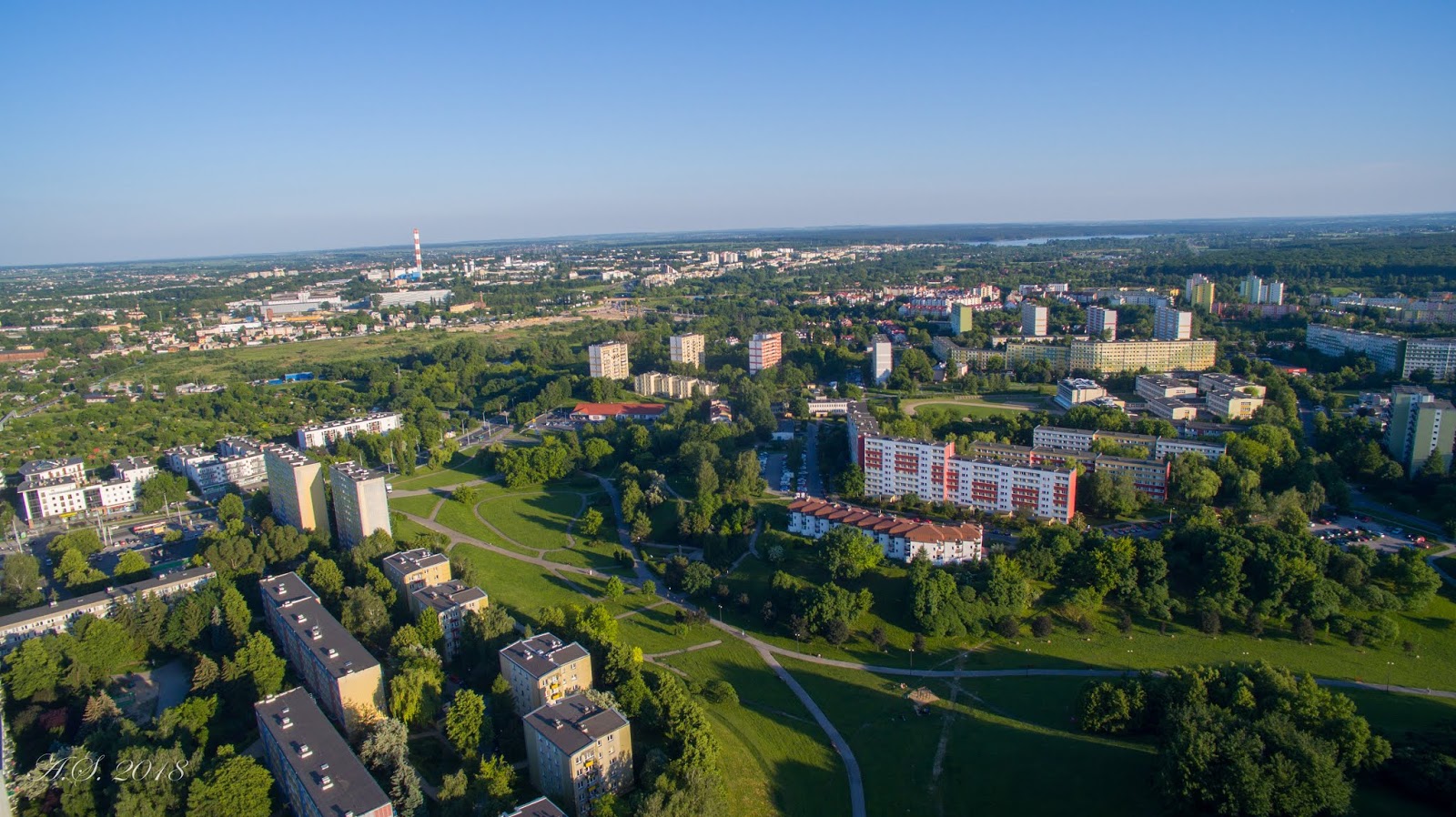
Modern car-centric districts are much worse, and single houses districts are car-centric concrete hell in comparison.
Personally, I would not mind sharing a TV (barely use one) or washing machine or garden with more people, but the way western society works in terms of building defaults is biased towards individualism not community building.
Now it looks pretty shit (just imo), and it's hellish in summer - no shade, hot as hell, the buildings with their new windows and white finishes are blinding. I used to love walking there, now I avoid them.
Actively looking for a cofounder who can develop full stack. If interested, please email [email protected]
There is no one solution, of course, since at the very least climates and budgets can be wildly different, but a good start is making sure every street has a green canopy above, starting with the largest. After that, take every space you can and put something living on it.