Which is lower than most death estimates for Fukushima.
In other words, the world's second worst nuclear disaster killed fewer people than another fossil fuel disaster that happened on the same day, due to the same external reason, which was so minor (for a fossil fuel disaster) that most people outside Japan haven't even heard about it.
Hell, that's less direct deaths than Chernobyl, the worst nuclear disaster ( only in direct immediate deaths, indirect long-term deaths are hard to calculate, and the WHO estimated them to be at around 9,000, which is still probably less than what that oil tank's oil killed indirectly via pollution).
You may well be correct with respect to pollution - I don't know and certainly would find it tricky to determine (is there a consistent measure of "negative environmental impact" for comparing such things?).
However, with respect to catastrophic destruction, this recent example at a coal plant [0], pales in comparison to something like a Chernobyl or Fukushima.
[0] https://reneweconomy.com.au/worlds-newest-and-most-expensive...
That's not a catastrophic destruction, merely a generator explosion.
Wikipedia has articles on mining and energy accidents, and you can see there are far more catastrophic one with coal:
I support expanding nuclear energy in areas that are capable of doing so, but there are some places where nuclear would be an absolute disaster far beyond what coal could ever be.
I can’t see it happening in the current anti-nuclear climate but I think it’s fixable.
do you know why there is no article how bad coal is? because everybody knows but unfortunatly most people do not understand how fucking bad fukushima even is, people like you that try to make nuclear look cool just because there exists something worse does not make nuclear look cooler.
Because reams of news articles are written about one but not the other, feeding the incorrect perception that one is vastly more dangerous than the other.
There is no way to control the impact to the environment - areas immediately surrounding a coal plant have much higher cancer rates, the ground & streams becomes toxic, wider areas have heightened acid rain risks. Then you get to impact on the global climate. All this in a perfectly operated idealized plant.
In a nuclear plant that is run properly, not even perfectly, produces radioactive waste. No atmospheric pollution, no water pollution.
Major "normal" failures cause radiation leaks. These are so rare that the events are individually named. Accidents that result in atypical operation that don't even harm the plant, let alone cause external impact are all recorded, and systems are updated to prevent recurrence. Even major events like three mile island have not caused any excess deaths or cancers.
Catastrophic failures have basically be down to understood design flaws: Chernobyl had an RBMK reactor with know flaws, Fukushima had emergency generators in the basement despite being advised to place them higher up. Precisely because of flooding concerns.
As for waste: Nuclear waste is of course hard to manage, with most "solutions" being "bury it". Whatever the end solution is, we know it won't be as horrific as a coal plants solution: aerosolizing it and pumping it into the atmosphere.
A lot of noise is made about decommissioning a nuclear plant. Decommission a nuclear plant means deconstruction of the reactor and removing the remaining waste. There is no need to remediate the land itself. No one talks about decommissioning coal plants as they simply don't: the land on and around the site is left permanently toxic.
And most people have zero idea how bad coal is.
How many lakes and streams has nuclear destroyed? Nowhere near the number that coal has between both acid rain and mine runoff. The Monongahela river and its tributaries still have enormous sulfate loads.
How many people have died of nuclear radioactivity? Nowhere near the amount that have died of black lung.
And this is before we start talking about just how bad the pollution in Pittsburgh, Cleveland, etc. used to be and how many people died from that.
People don't understand even the tiniest fraction of how bad coal is. Nuclear power, even with accidents, is a saint compared to coal.
That being said I still think that nuclear is our best option.
Coal is killing the planet now.
Carbon is killing almost a million and a half people a year, plus screwing the atmosphere.
We've put ten times the money it would take to solve this on nuclear into solar, and unless you incorrectly use nameplate capacity, it hasn't even broken the 2% mark yet, but it's already throwing the grid into chaos.
Worldwide, in all of history, nuclear power has killed fewer than 200 people. Yes, I know HBO told you it was more. HBO is lying for profits. The UN says it's 156.
There is no safer technology in history, of any kind, than nuclear power.
Nuclear has already fixed 1/4 of the problem. It can fix the rest in time. Nothing else can.
You have six years left to wake up before it's too late to vote for the fix we already have.
Could you share the numbers for how much subsidy money was put into solar technology, and how much for nuclear energy (and fossil fuels, for that matter) over their history?
> and unless you incorrectly use nameplate capacity, it hasn't even broken the 2% mark yet,
The number I'm seeing[0] for solar, globally (based on 2019 data), is 2.7%, which, combined with wind, wave, and tidal etc. comes to 10.5%, compared to 10.4% for nuclear. Both are dwarfed by hydropower's 15.8%, of course, but it's hard to manufacture the right sort of rivers.
> but it's already throwing the grid into chaos.
That hasn't been the experience in Australia[1], so it sounds like you're referring to a politics problem, not a technology problem.
[0] https://ourworldindata.org/uploads/2020/08/Global-energy-vs....
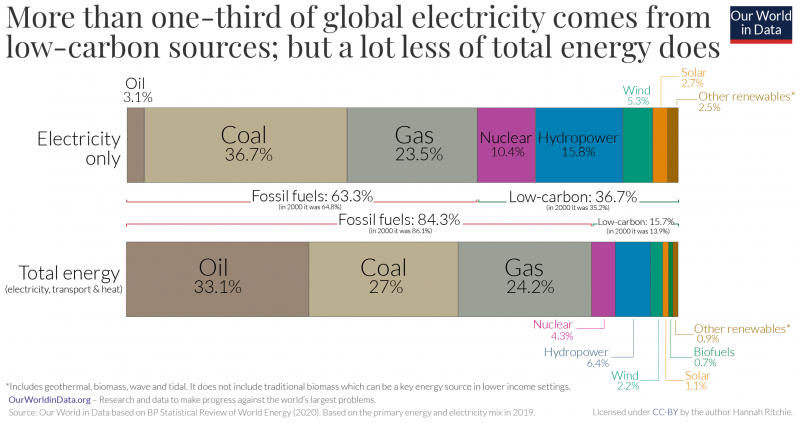
[1] https://www.pv-magazine.com/2020/08/31/renewables-improve-re...
No thanks, you're doing a fine job finding wrong numbers by not knowing the difference between nameplate and delivered already.
> The number I'm seeing[0]
is irrelevant, as it's about how much power the solar panels could produce, if the planet had noon 24 hours a day and the panels were forever perfectly aligned.
Energiewende is unambiguous.
> which, combined with wind, wave, and tidal etc. comes to 10.5%,
When you learn what to look for, it's under 1%.
No, I don't have to teach you this in order to speak where you are also present.
No, googling things without foundational knowledge isn't a valid push back. This is energy anti-vaxing.
> That hasn't been the experience in Australia
Gee, who'd have thought that Australia, whose solar panel industry barely exists and which is entirely fuelled by coal and LNG, which can ramp up and down, would not yet be facing this?
If only there was a valid piece of history to meausure, which left an entire country dumping power at negative prices for more than a month in the desperation to not blow their grid
If only that country was radically more industrialized than Australia
If only you knew enough about power history to not need to ask me who I mean
If only you'd look at that eleven years and figure out what it meant
Chernobyl had something like 60 direct deaths and a few hundred to thousand long term deaths.
That is equivalent to about one day of coal.
The official UN long term number is 53.
For everyone prognosticating future deaths, in reality, the cancer rate in the area went down substantially.
You will never find a sourced, measured third digit.
It’s like if one plane crash cost more to clean up than the revenue of the entire airline industry for years.
So not only did their nuclear engineers fail to foresee the effects of the tsunami, they are still being caught out by unexpected problems a decade later. It seems that nuclear energy is just beyond the ability of even well organised societies to safely manage.