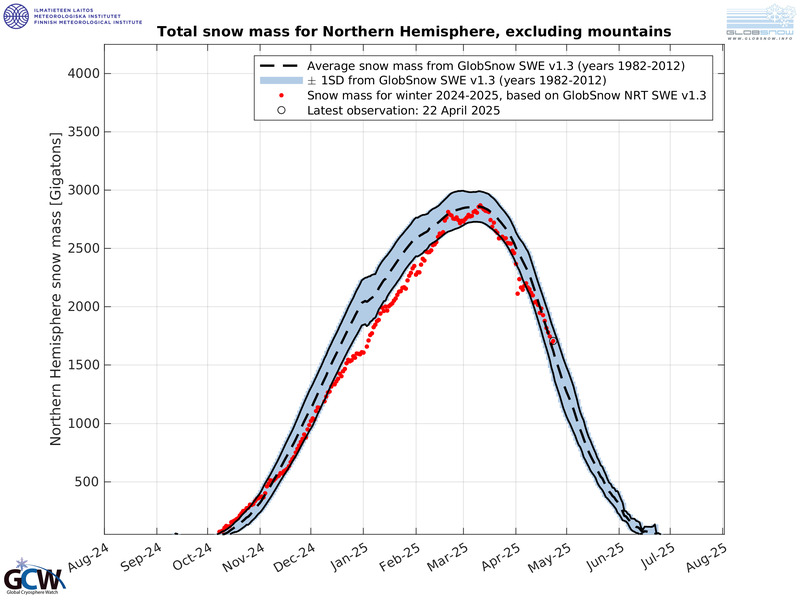
Northern Hemisphere snow mass is one standard deviation above 1982-2012 average.
Anecdotal data points are meaningless in systems as complex and dynamic as weather.
Exactly. "global warming isn't real because it's still snowing" gets ridiculed (as it rightly should), but I find it appalling that "global warming is real because it snowed really late where I lived" gets a free pass.
Further, the aggregate for all of North America hardly excludes the possibility of regional snow drought.
The line where snow sticks around for the whole season has been steadily moving north.
It's completely possible that the Northern Hemisphere also has more rainfall then ever before, would that mean that lake Mead isn't drying up right now?
I find it a bit hard that you're really posted that information in good faith given it would require an almost willful misunderstanding of what the parent is saying and how hemisphere wide observations completely miss essential regional variation in weather patterns.
What you're describing is due to the La Nina effect:
>La Niña could also worsen California's ongoing drought and make its wildfire season even more of a threat. As Bloomberg explains, the state usually gets most of its annual water from rain and snow between November and April — the same period when La Niña is predicted to shift storm tracks north and away from the region that needs it.
https://www.npr.org/2021/10/15/1046313870/la-nina-winter-wea...
- climate change is not happening in a meaningful way now.
- the future impacts of climate change are wildly overstated.
- all potential issues that may come up with climate change can be mitigated through technology.
Any comments that violate any of these assumptions will be aggressively downvoted or often times even flagged. I have alt accounts that have had the latter happen frequently and I know because the flagged comments are always unflagged on review (conveniently hours after the article is no longer on the front page, and the discussion is effectively over).
This tendency may have always been a part of this community, but it has become a bigger issue in recent years because it has been increasingly apparent that severe climate impacts are being felt "faster than expected" right now, there is absolutely existential risk at play (on both a civilization and species level), and that nothing short of immediate reduction of the use of hydrocarbons can prevent extreme impacts (i.e. no techno solution).
Personally I think this is largely because these ideas pose major challenges to the ideological foundations of most of the HN community. In general people are brought here out of a common interest in the future, and the belief that technology (specifically VC funded technology) can solve any problem out there.
Our current understanding of climate change and its impacts shake this ideological foundation and makes a lot of people uncomfortably in a very profound way. Their only way to react is to try to make it go away. Down voting and flagging comments happens precisely because these realities of climate change hit a bit to close to the bone.
>Any comments that violate any of these assumptions will be aggressively downvoted or often times even flagged.
examples?
>there is absolutely existential risk at play (on both a civilization and species level)
What's the evidence for "existential risk"? The IPCC's own estimates places economic losses stemming from climate change at "between 0.2 and 2.0% of income". If global is really going to wipe us from existence, then surely the economic losses will be much greater than 2%?
https://reason.com/2014/03/31/new-ipcc-report-unchecked-clim...
That piece of the IPCC report that article is cherry picking is a.) a bit out of date now and b.) assuming a warming of 2C which we've already given up on, at least according to the more recent report which framed our current condition as a "code red"[0], though I find it very hard to believe that you missed that press release this some.
And to be clear, existential risk doesn't mean I'm claiming "we're going extinct!" it means that that lies in the realm of realistic possibility. The IPCC reports are well acknowledged to be fairly conservative and fail to incorporate a lot of unknowns (Thwaite's glacier is an obvious example of this).
One example of evidence for extinction risk is work of paleontologist Peter Ward. Ward's "Under a Green Sky" is his popular science version of some of his work (and worth a read). Ward discovered that quite a few major extinction events in the past have been connected with sudden rise in atmospheric CO2 and rapid climate change. He makes well reasoned arguments about how quickly conditions can change and how that could easily lead to massive extinction events (we're already in the 6th largest extinction event right now, which again, I'm sure you know).
The main issue with climate change is there are many positive (and of course some negative, but we don't quite now the balance) feed backs that we don't understand. It is quite possible that enough of these trigger and all of our "worst case" projects turn out to be quite optimistic.
Did the latest IPCC report contain a more updated projection?
>b.) assuming a warming of 2C which we've already given up on, at least according to the more recent report which framed our current condition as a "code red"[0]
What is code red supposed to mean? I looked on wikipedia for a more detailed summary and got an "intermediate" projection of 2.7 °C of warming by 2100. I'm having trouble finding out what the "intermediate" projection was in the 2014 report, so it's unclear how much the forecasts changed. Depending on how "~2" is interpreted, it could be anywhere between a 0.7 degree rise and 0.2. How that would affect the estimate would be unknown, but 2% was the upper bound of the original estimate.
>though I find it very hard to believe that you missed that press release this some.
I'm having trouble understanding what your point is here. Are you accusing me of arguing in bad faith because the report says "code red", therefore it obviously means we're facing existential threat? I don't see how that follows. I could plausibly imagine a report coming out (for sake of argument, in feb 2020, before the death rates were known) saying that our situation with covid is "code red", but that doesn't mean I'll think we're literally at risk of going extinct from it.
>And to be clear, existential risk doesn't mean I'm claiming "we're going extinct!" it means that that lies in the realm of realistic possibility.
what counts is "realistic possibility" here? I guess if you take the most pessimistic interpretation as 2% (ie. 1 in 50 chance of earth going up in flames, 49 in 50 chance of nothing happening at all), then I suppose it's an high enough risk to count as a "realistic possibility", but I doubt the situation is that dire. It's far more likely to produce a normal distribution centered at 1.1% economic lost, the probability of 100% loss (ie. humans ceasing to exist) being at the tail end.
>The IPCC reports are well acknowledged to be fairly conservative and fail to incorporate a lot of unknowns (Thwaite's glacier is an obvious example of this).
Now would be a great time to answer my original question. "What's the evidence for "existential risk?". Are there studies that incorporates the unknowns in an objective way?
>He makes well reasoned arguments about how quickly conditions can change and how that could easily lead to massive extinction events (we're already in the 6th largest extinction event right now, which again, I'm sure you know).
Based on the description it sound less like an objective analysis on existential threats, and more of a "well if these things happen, then theoretically it will be Really Bad™".
It's also worth mentioning that the recorded history is rarely more than 100 years, and in almost no case more than a thousand.
Sitting on the chairlift in Canada just pre-covid it was a daily occurrence to talk to an American who had come up to Canada for a week because their local ski resort had no snow.
They all said their resort used to get a ton, now it's lucky to get a foot for the whole season. This is a reality now.
EDIT: Also worth mentioning the capital city of Alaska had zero recorded snowfall for an entire winter for the first time in recorded history. Yes, it's very real.