Re:QOI: Lossless Image Compression in O(n) Time
by spc476 on Wednesday November 24, 2021 @02:58PM
(#29334389)
And the red in my left eye isn't the same as the red in my right eye. Yes, when the lighting conditions are just right, I see different hues out of each eye [1]. I have to wonder how one would (or should?) correct for that in an image file format.
[1] I think from a stupid thing I did as a kid.
Re:QOI: Lossless Image Compression in O(n) Time
by cornstalks on Wednesday November 24, 2021 @04:37PM
(#29335468)
I think the best we can do with file-level metadata is account for only objective metrics. Subjective differences are best handled outside of the file metadata. The user can tune their display settings to match their preferences. This allows for correcting for physiological differences and stylistic preferences. If all files had correct metadata (for objective metrics), it would be a lot easier for an end user to tune the system to their liking because their end results would be consistent with their preferences.
Re:QOI: Lossless Image Compression in O(n) Time
by dekhn on Wednesday November 24, 2021 @05:56PM
(#29336168)
took me a while to notice that I perceive color and light intensity differently in my two eyes. I think this is actually pretty natural (IE, it happens commonly?). Either way, I can also see polarization (haidinger's brush) which confused me a bunch when I was trying to explain what I saw and everybody else thought I was crazy).
Re:QOI: Lossless Image Compression in O(n) Time
by formerly_proven on Wednesday November 24, 2021 @02:06PM
(#29333808)
> An absolute color space exists. It's called XYZ. We could use it. Some image formats support it.
XYZ is really annoying to work in though. ACES is a pragmatic solution here, quite literally: https://blog.frame.io/wp-content/uploads/2019/09/ACES-APO.jp...
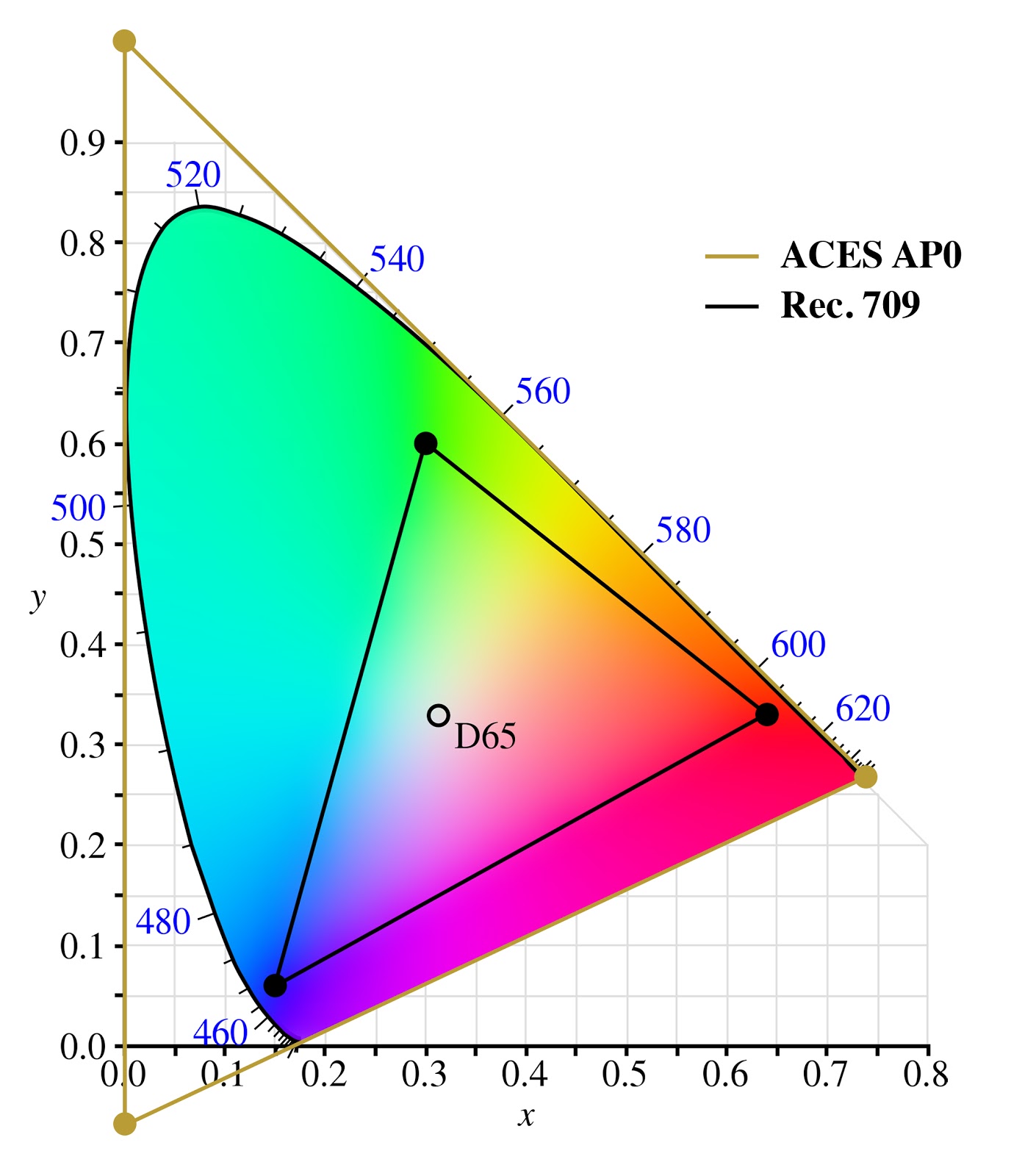
Okay, fair enough two out of three primaries are imaginary colors, but nobody said you have to use the whole color space when your processing pipeline is meant to be using 32 bit floats. Delivery formats might want to be using a more real color space.
Re:QOI: Lossless Image Compression in O(n) Time
by pixel_fcker on Wednesday November 24, 2021 @02:22PM
(#29334017)
ACES (AP0) is an archive format for when you want to be absolutely sure you’re not clipping any colours. As a working space it’s terrible and AP1 should be preferred, either as ACEScg or ACEScc
Re:QOI: Lossless Image Compression in O(n) Time
by Dylan16807 on Wednesday November 24, 2021 @04:28PM
(#29335381)
AP1 is almost the same as rec.2020? I'm not sure what you mean by 'working space' but if preserving all colors was a primary or even secondary goal I definitely wouldn't cut myself down that far.
Re:QOI: Lossless Image Compression in O(n) Time
by pixel_fcker on Saturday November 27, 2021 @01:25PM
(#29362194)
AP1 is essentially Rec.2020, yes.
By working space I mean a space in which a user manipulates the data in some way, e.g. image editing, grading, compositing or rendering.
Which red? There isn't a single, true "red". And different materials produce different reds (my work's Sony BVM-X300's reddest red is going to look way different than your monitor's red). Not all displays use only RGB color primaries, too. For example, at Dolby's office in San Francisco they have a projector in their theater that uses 5 (IIRC) color primaries, not 3. 6-primary projectors exist. And other non-RGB displays.
> When I say (255, 255, 255), I expect the display to show me something as close to white as possible
Which white? D50? D55? D60? D65? D67? Something else? And yes, these different white points (and many others) are actually used in practice.
> (and at the brightest possible setting).
100 nits looks way, way different than 4,000 nits. Some monitors can do 10,000 nits.
> When I say (0, 0, 0), I expect the display to show me something that looks as close to black as possible. It's up to the display technology to decide whether this means just turn off that pixel on the screen or disengage the backlight or do whatever, but at the end of the day it's just trying to approximate black.
Which black? This might sound dumb, because we can agree that there is an objective "absolute black" (i.e. zero photons). But when an artist creates an image, the monitor they use has some version of black. If you don't account for that, the image may be distorted. Blacks can be crushed, for example.
An absolute color space exists. It's called XYZ. We could use it. Some image formats support it.