NYC isn't for me personally, but I absolutely see the appeal for others, and I can see why Google would want to expand proportionally there.
the problem is that offering remote work as an isolated option isn't feasible, because the cost of living when remote is lower (presumably), and thus, either they must be paid lower, or the office-working colleagues must be paid more to adjust for said cost of living.
I feel there would be social friction caused by this market-force mechanism.
It shouldn't matter where in the United States you live, NYC, Puerto Rico, Hawaii, Guam, or some forsaken place like Indiana, etc.. If you get your work done, you should have the same responsibilities and benefits.
Salaries are mostly controlled by market forces, opening up to remote work will result in a larger supply of potential employees, to include those who were previously not considered, but are good enough, and are willing to accept less than current Bay Area/coastal salaries.
With two kids aged 10 and 12, I need access to a sports park for practices and games. I need space to park a car and roads wide enough to support them because I have a lot of things to haul. I need good public schools that don't break the bank to provide my kids the support and community they need.
Everything smooth and convenient about living as a single person in an urban area quickly turns into living life on Hard Mode for families. As our working adult population ages, cities need to evolve to meet these needs, or expect people to move out as they outgrow the lifestyle.
I'm sure there are folks who live in places like SF with families and ride around in heavy urban traffic with 2 kids on an electric cargo bike, but that's just not for many of us. We're happier and way more stress free in the suburbs or even in the rural areas working remotely.
"Who else benefits from the Dutch cycling infrastructure" https://www.youtube.com/watch?v=xSGx3HSjKDo
"Why Great Cities Let You (Easily!) Cycle to IKEA" https://www.youtube.com/watch?v=CgvYgxo6UY8
"8 to 80, people of all ages cycling in the Netherlands" https://www.youtube.com/watch?v=swqaAIkGtpA
As you can see, you don't need "wide roads". Quite the opposite, in fact. When safe cycling infrastructure is present, traffic shifts to cycling, because it's faster, cheaper and more pleasant. This makes roads less congested for your car trips. Widening roads does not have this effect, as additional lanes simply fill up with more traffic if there is no faster, safe alternative. Also, wide lanes encourage high speeds, and you don't want that around your kids.
This is debatable. Tokyo lacks widespread European-style cycling facilities and still has quite high bike mode share.
Low stress roads can fill much of the same gap, as long as they are well connected.
Anglo or Japanese culture, you can't really blaze down this street at 80kph without hitting something. https://1.bp.blogspot.com/_9Wu_fv0DMXQ/TEbn2b8Hu4I/AAAAAAAAA...
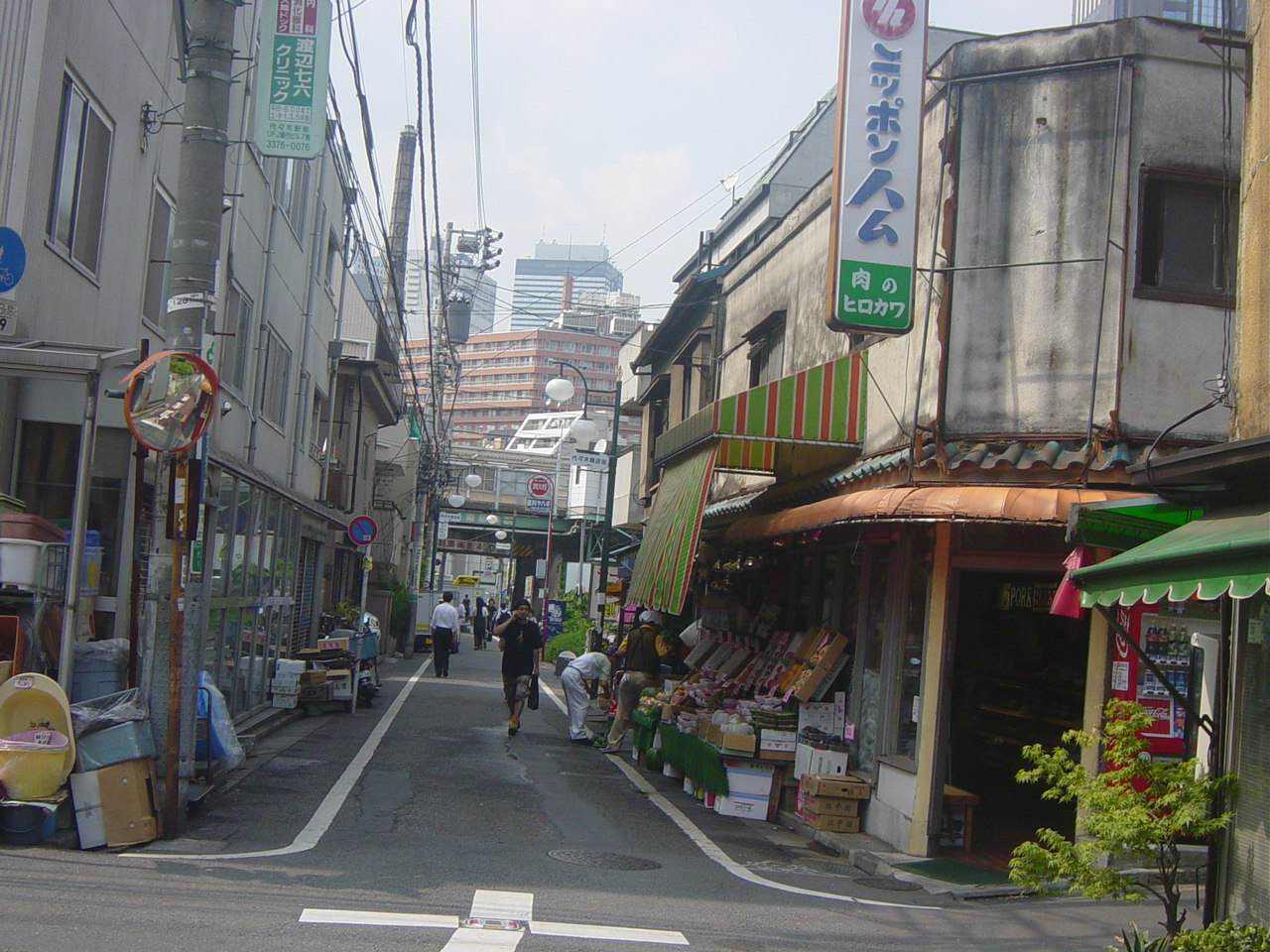
> I'm sure there are folks who live in places like SF with families and ride around in heavy urban traffic with 2 kids on an electric cargo bike, but that's just not for many of us.
Maybe riding a cargo bike with your kids on the back is unpleasant because the suburban lifestyle you are talking about has bled into American urban planning. If American cities were designed around people instead of cars many of the problems with urban life you are talking about would be moot.
I point this out because you thesis seems to be that getting older and having kids is orthogonal to urban life. However, historically, and in many cities outside of north America, this is not the case. If you look at the Netherlands for example, where a deliberate effort to plan cities around people has been ongoing for 50 years, many people don't own cars, their kids bike to school and use public spaces for recreation, and they can pickup furniture from Ikea on their cargo bikes while never touching a road built for cars.
As Douglas Adams said about NYC.
"In the summer it's too darn hot. It's one thing to be the sort of life form that thrives on heat and finds, as the Frastrans do, that the temperature range between 40,000 and 40,004 is very equable, but it's quite another to be the sort of animal that has to wrap itself up in lots of other animals at one point in your planet's orbit, and then find, half an orbit later, that your skin's bubbling."
Highways are built with “levels of service.” There are no level of service standards for pedestrians: sidewalk availability, trees, protection from car traffic, directness of routes, etc. Bike lanes often don’t exist or are blocked by parked cars or trash. This would never be accepted for a road.
Uhhhhh I think this is also what hkarthik was saying with his first paragraph.
> I think European and Asian cities have done a much better job at this.
.... Either way it sounds like we all agree, urban family life in US is subpar to our economic counterparts.
Asian and European cities did not make themselves more hospitable to families by adding wider roads and providing parking spaces for cars like op was talking about, they did it by doing the opposite, which is what I was commenting on.
https://www.urban.org/policy-centers/cross-center-initiative...
I have to assume at least a few of those folks will be New Yorkers!
For what it's worth, though ... I'm not sure Google buying a building it already leases means anything other than perhaps they are bullish NYC real estate?
Pluses of living in New York include not needing to drive, most things being close by, and generally more widespread things like elevators. Old people can become less able to drive cars over time, or climb the stairs in a suburban home, or carry an SUV's worth of groceries.
They can walk to do their errands and meet friends.
They have an abundance of access to world-class medical care and specialists.
They have plenty of options for culture and entertainment.
There's no need to worry about shoveling a driveway or house/yard maintenance.
>With two kids aged 10 and 12, I need access to a sports park for practices and games.
[0] Park access is WAY higher in US urban areas vs. the suburbs. I think having a car and driving skews your view of this.
>I need space to park a car and roads wide enough to support them because I have a lot of things to haul.
Again, I think you just like driving.
>I'm sure there are folks who live in places like SF with families and ride around in heavy urban traffic with 2 kids on an electric cargo bike, but that's just not for many of us. We're happier and way more stress free in the suburbs or even in the rural areas working remotely.
Yeah, you just like driving. Which is fine, but don't shit on our cities because of it. It's the driving that's the PROBLEM.
[0] https://www.brookings.edu/blog/the-avenue/2019/08/21/parks-m...
For example, A 5 mile radius city has x baseball diamonds in it. That’s x per every 78.5 square miles.
Let’s say the suburbs of that city are a ring of width 25 miles with y baseball diamonds in it. That makes the baseball diamond density of the suburbs y per every 1885 square miles.
I’ll spare you the math x=24y give or take.
Then I encourage you to go to google maps and look at America’s most notoriously crowded cities like nyc, sf, Boston, Chicago. There are dozens if not hundreds of baseball fields in city limits. Central park’s 26 fields alone would need to be offset by 624 in the suburbs to achieve equal density.
The “problem” is that most of those diamonds are difficult to drive to and park at, which is why OP considers them non-existent.
Basically everything that I needed as a kid was in walking distance. So from about the age of 7-8 I rarely needed to rely on my parents for anything, school/sports/friends/etc was all a less than a 30 minute walk away, and in turn, my parents never needed to plan around my schedule.
The caveat is that I didn't grow up in the US, where cities are usually sadly quite pedestrian hostile.
The manhattan model is so strikingly effective that the rich have basically monopolized it. What needs to happen in many urban areas is to replicate this. Of course that would mean huge numbers of buybacks of individually owned blocks of city, an almost impossibility in US legal system practically speaking, even with eminent domain.
In other words. It's much easier to find likeminded people closeby in dense, populated cities.
"Minor repair and maintenance of vehicles and similar equipment shall include brake part replacement, minor tune-up, change of oil and filter, repair of flat tire, lubrication and other similar operations."
"It shall be unlawful for any person to engage in, or permit others to engage in, minor vehicle repair or maintenance under any of the following circumstances: - Using tools not normally found in a residence;"
At least one of the reasons give is "not readily believable"
SF I'm with you. That city is just brutal on any family
You don't need all that sports gear, it's an arbitrary choice. The most popular sport in the world is played with just a small ball.
Drawing the line of what conveniences of modern at "city apartment" but not "suburbs" is extremely arbitrary (I am also guessing you are saying that as a single city-living male, so your view is theoretical and not borne of experience - just a thought.)
I absolutely loathe going to the office.
Just because people like living in cities doesn't necessarily equate to people enjoying going to the office.
More importantly, this seems like it's mostly to hedge given that office building prices in NY are reaching new lows and they've already leased space in this building for a while.
That being said, Google does seem to snag big properties in a down market. They bought 111 Eighth Avenue back in 2010 around the financial crisis.
These companies hate not having their workers under their thumb, but won't come out and say it.
They know they will never have a hard time attracting workers. The 1 out of a thousand Rockstar might be another conversation, but the run of the mill worker--no problem.
They know they will be able to do whatever they want for years. I imagine Zuck, and the Google Boys, thanking their god, the dollar, they don't live in China.
(Xi is cracking down on certain big businesses. He, and his mates, don't like the extreme wealth disparity rearing it's head. He doesn't like companies that seem to exploit people. He doesn't like the fact that houses are rising in price so quickly, only the wealthy, and companies that buy up realestate, can afford them.
Xi is worried about the amount of credit certain businesses are taking on. I heard business debt is almost 3x ours. Business leverage that is, not governmental debt. This couldn't be right?
Xi is worried his unchecked Capitalistic experiment might come crashing down.)
Ok, back to employers salivating for the day they can demand everyone show up.
I've thought about it, and don't see an out. They will drag everyone back in. It doesn't matter if the tech works.
Maybe if we started using Global Warming as an excuse to not came back? All those extra cars on the roads couldn't be good.
(Sorry about bringing China in to the mix. I'm a tiny bit jealous just how quick they can move there. I liked city life when they were diverse, and then only for awhile. In all honesty, the only thing about city life I liked was the ratio of single women to men. I said it.)
I knew a lot of people like city life. I didn't. They say you are suspose to habituate to noise. I never did.
why would someone rather not live in a countryside with expansive views and much lower stress and work remotely? (especially when tech like Starlink are going to remove the comms friction)
You do you, I'll do me, and if we're lucky in life then we'll each find someone whose preferences are similar to our own to share a life with.
I love the countryside for weekend or longer trips when I'm not working and just want to relax all day or go for hikes.
I definitely see the appeal of owning a huge house and I might well consider it in the future, especially if I have children. But for now, I wouldn't know what to do with it. I own few things of the maximal quality I can afford. Even my city apartment is viewed as somewhat spartanic by some. So I prefer renting an entire place in different parts of the country with my girlfriend or friends for a couple of days at the time meanwhile living in my favorite part of the city where most everything I want to do or need is within 20 minutes walking distance.
Each have their pros and cons, just like anything in life.
For one, in NYC I liked being able to walk everywhere and not owning a car.
The only stressed people are the ones coming from the suburbs to the city and back again every day and almost all of that stress is in the driving / transport part.
Seriously, you couldn't pay me to live in the countryside.
In a city like New York, living day to day life across many physical spaces is a core part the experience. In fact it's one of the major draws. The park is your front lawn, the cafe your breakfast nook, the theater your living room, and the office is... your office.
Remote work is great and all if that's not the lifestyle you want, and I think the pandemic has perhaps shown that many were living this lifestyle who didn't want it (especially if you were living the quasi-bedroom-city life of SFBay where you slept in SF but commuted out of the city daily for work), but Google embracing the deeply social and physically connected lifestyle of a functional city like New York isn't really a rejection of remote work being viable-- it's just accepting that to many, this type of city life is preferable and having a physical space to do your work provided by your employer is part of what makes that so.