The different between NPH (regular insulin) (maybe R too, not sure??) sold by walmart and Fast Acting insulins (Novolog, Humalog, Apidra) is massive.
Fast acting insulins start working at about in about 30 minutes and "peak" at like 2 hours, and may slowly have some effects for another 1-2 hours.
NPH on the other hand, starts working at ~2 hour mark and continues to work slowly until peaking at like 6 hours and slowly degrades away, that means its in your system for something like 9 hours - trying to meal plan around multiple doses of that is unsafe at best.
R is slightly better but still remains and slowly peaks closer to 4 hours.
These are obviously GREAT IF and only IF you dont have access to fast acting. I applaud Walmart for giving access to these, as they are way better than nothing.
source: Type 1 diabetic
Yes, there are different insulins and Novolin is an intermediate-acting insulin like you describe and available at those prices.
Humalog's patents have expired, as I understand it, but cartel behavior has kept the price high in the US.
See https://www.fiercehealthcare.com/payer/facing-criticism-pbms...
That is exactly what is happening, and it's legal. It's very easy to hide profits and move them around.
However, insurance margins remain unaffected as the money did, in some sense, go out the door and is no longer in control by the insurer directly. It's not fraud. It's just anti-competivie self-dealing. So, no, it's not profits per se, but rather increased valuation via clever financial engineering.
A quick search shows me that on page 73 of Cigna’s 10-K, it clearly does not have its Express Scripts division accounted for in the “Investment Assets” section, based on how low those numbers are.
It just does not pass the smell test to me. The simpler answer, based on all the numbers, is that managed care organizations are squeezing other entities in the healthcare chain, but due to competitive pressure and upper profit margin limits due to ACA, they are not raking in big bucks.
https://www.hopkinsmedicine.org/news/media/releases/why_peop...
Slightly exaggerated, but only slightly: Imagine you could only drink water 6 hours before you got thirsty, but if you drank too much you might pass out (at any point 2-6 hours from now) or if you drank too little you're doing major damage to your body.
Really the only way to manage with that kind of insulin is to live a very, very low carb lifestyle. Its doable, but it limits your variety and leaves you prone to other potential issues.
Whereas, if you use pens (or from a vial) with direct injection, you also take a long acting insulin (levemir, Lantus, etc) once or twice a day (they are supposed to last 24ish hours but often people find splitting their total daily dose up into morning and night has better results). And these insulins cost even more than the fast-acting stuff.
It's likely not what your doctor prescribed, it doesn't last as long, it requires you (or your young children) to eat on a very specific schedule, it can't be used with an insulin pen or insulin pump, it's just all around a worse and less effective treatment.
FTA: >In 1996, a vial of Humalog produced by Eli Lilly cost $21. Today, it's priced at $324 despite the cost of production remaining steady.
>Rising costs are nothing new. Insulin prices tripled from 2002 to 2013, and doubled between 2012 and 2016. To put this into perspective, in 1996 a vial of Humalog produced by Eli Lilly cost $21. Today, it's priced at $324 despite the cost of production remaining steady.
If everything is working as intended, it begs the question, what institution intended for patients to die from rationing insulin[0], and why is the USA ok with that institution's intention?
[0]https://www.ontrackdiabetes.com/live-well/diabetes-managemen...
Otherwise, you seem to be repeating the old economics joke:
"The young economist looks down and sees a $20 bill on the street and says, “Hey, look a twenty-dollar bill!”
Without even looking, his older and wiser colleague replies, “Nonsense. If there had been a twenty-dollar lying on the street, someone would have already picked it up by now.”"The world has many very smart people spending many hours working very hard to find these opportunities, so the likelihood of it just sitting there like a $20 bill on the street, and not being picked up, seems quite small.
I do not know the answer myself, so I am interested in finding out. reddicky posted this:
https://www.hopkinsmedicine.org/news/media/releases/why_peop...
which sort of answers it:
>Biotech insulin is now the standard in the U.S., the authors say. Patents on the first synthetic insulin expired in 2014, but these newer forms are harder to copy, so the unpatented versions will go through a lengthy Food and Drug Administration approval process and cost more to make. When these insulins come on the market, they may cost just 20 to 40 percent less than the patented versions, Riggs and Greene write.
So it looks like there is some expensive expertise involved and investment into R&D that needs to be done.
In theory there is 'nothing' stopping another company from coming along, even a group of Biohackers may try to do something - I wonder if that's been done... :)
I would imagine that even other companies already in the pharma space would be interested. They don't want to play the race to the bottom game with billions of dollars in upfront costs. If anything, it's probably more profitable to make a new form of insulin that you get to patent. Which is how we end up where we are.
The insulin in question is Lyumjev from Eli Lilly.
[0] = https://www.cnbc.com/2019/03/25/eli-lilly-discloses-pricing-....
https://1.bp.blogspot.com/-ZfBANMMU5dQ/XzFtNw93ZCI/AAAAAAAAq...
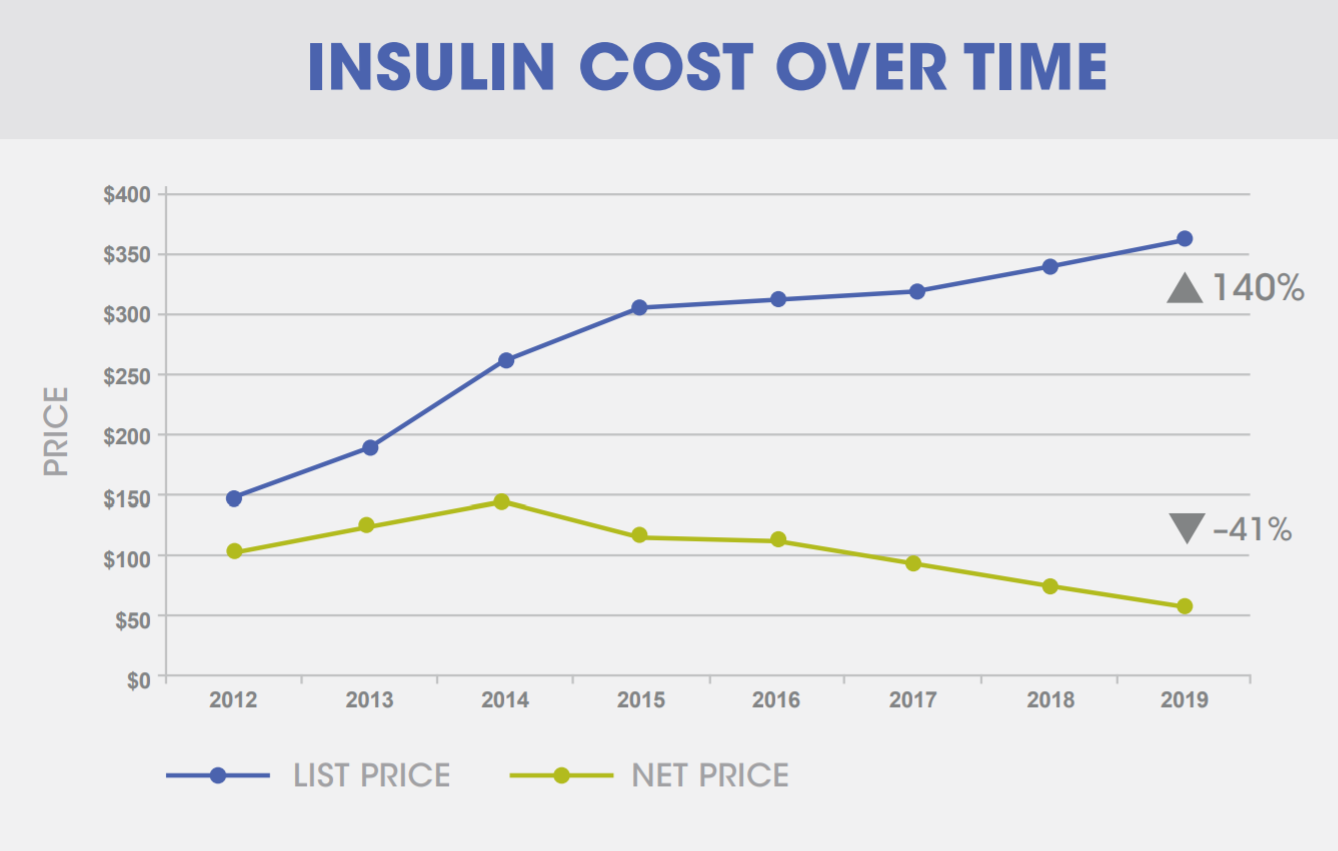
See https://www.fiercehealthcare.com/payer/facing-criticism-pbms....
https://www.macrotrends.net/stocks/charts/CVS/cvs-health/pro...
Cigna purchased Express Scripts in Mar 2018, and has profit margins of 3% to 5% over the last couple years.
https://www.macrotrends.net/stocks/charts/CI/cigna/profit-ma...
If these PBMs are making lots of profits, then they are simply subsidizing losses elsewhere in the MCO. The total costs paid for insurance premium plus out of pocket costs by the end user in the US would not be affected.
PBMs are important but they should not be able to put a gun to these pharma companies heads because they control the formulary.
CVS net margin includes their retail business. You can't compare AWS's margin to Walmart's e-commerce margin.
As a customer, it does not affect me.
In the healthcare business, the flow of money is:
Individual -> MCO (insurance company) -> healthcare providers and drug manufacturers
What does it matter to the individual what portion of an MCO is earning what profit if the net profit margin of the whole MCO is 5% or less? They are obviously not left with a lot of money, their employees are not known to be lavishly compensated.
This sounds like it's responding to a strawman. Proponents of the patent system aren't claiming that zero innovation would happen without patents, just that it would be much less. In other words:
No patent system: only inventions from altruistic inventors
Patent system: inventions from altruistic inventors and profit-focused inventors.
It would depend on the project's margins and/or sunk costs. A project that had very little invested in it or is a breakout success might we able to weather a 50% cut in exclusivity period, but a marginal product might not. Most of the already developed drugs are probably going to be fine, assuming that the financing for them was already secured.
>or would they keep trying?
For the projects at the margins? most certainly. That is not to say all private drug development would, stop. If some sort of unpatented-but-super-cheap-to-perfect-but-still-not-patented drug showed up it might still be developed, but in aggregate I'd expect drug development to drop significantly.
How does the act of buybacks imply that there are no marginal projects?
Perhaps it is because there a huge amount of risk involved?
And that's with the $700/vial insulin... the $25/vial stuff is stone age technology by comparison; you have to take it twice a day, and then eat at two specific times afterwards, or you'll go hypoglycemic (unconscious or maybe dead hypoglycemic, not just the feeling-a-bit-tired kind that people who don't use insulin are familiar with).
The situation right now is that the best and most expensive T1D technology, even the various "artificial pancreas" solutions, still gives you nothing like the experience of a normal pancreas. It would be really nice if the Walmart insulin were a viable long term solution for the cost problem, but unfortunately the negative health effects of older insulin tech are considerable :(
Generic Novolog is also ~$55 at Walgreens (more at other places).
T1 is really complex even with a low carb diet, if you don't only eat vegetables, but meatier food.
Unfortunately (doctor's orders) I also have to cut back on the cholesterol, which seems to be very high in all my favorite low-carb foods :( It's a constant experiment; it may turn out to make more sense to eat more fat but take statins, but I need to wait a bit longer and see how my lipids look with the current diet.
(BTW I'm actually doing fine -- pretty decent control/A1C -- but I had to rant in response to the Walmart insulin suggestion above!)
- waking up, liver produces glucagon
- stress at work, hormones going wild… including glucagon
- weather changes, when it is cooler you need more insulin
- you get sick. 2-3x insulin for me
- liver just having a normal glucagon production, that needs insulin without you ever eating anything
Nice that you have your A1c in control. Mine is 5.8% without too many hypos after 26 years of having T1. The tech I need for this costs a fortune without insurance, but at least I can finally live a normal life without nasty surprises every day.
The regular stuff is not really stone-age by comparison. They are both old tech.
It's changed a lot recently as doctors have become more aware of the cost of these drugs. But you still have to self advocate for less expensive drugs. Less savvy people often have trouble getting transparency into drug costs. Often even the doctors can't get a straight answer on pricing and insurance coverage.
Additionally, managed care organizations (MCOs, commonly known as insurance companies) do not pay for brand name medications just because a doctor prescribes them. If the MCO is aware of a generic option, then they will only pay for the generic or they will ask the doctor for a "prior authorization" to justify the use of a brand name medicine (such as the generic version not working).
The pediatricians I have visited in recent years even have the MCOs' formulary available for the patient in their systems, so they can see which medicines need a prior authorization and which do not so there is no time wasted on figuring out what the MCO will pay for without prior authorizations.
This is so obnoxiously common across every profession.
People are willing to piss away other people's money on "the best" without even telling them what the options are.
Every time I try to wrap my head around this stuff. How to fix the problems with our current system. I keep coming back to socialized or single payer health care.
Sure the current system works okayish for people like me. Insured and employed. But for my friends and the people I meet on the streets or the grocery store it's a nightmare. There is real suffering and death caused by no access to adequate health care. Even basic preventative stuff like diabetes care and checkups is missing.
https://khn.org/news/you-can-buy-insulin-without-a-prescript...
Bear in mind: when you mis-dose insulin, your blood turns into acid.
No endocrinologist would ever recommend treatment with older insulins over the new stuff. The only way it happens is because of cost.
Edit: Perhaps high speed internet vs dial-up would be a better analogy to spare us the comments about how bikes are actually better than cars...
There's no simply substituting. These are two different brands of a generic statin pill or something. Although it's all insulin, these are very different drugs. The dosages for the same insulin in the same patient can vary, and the calculations or charts for what to take when vary across types of insulins. The handling instructions vary. There's different patient training for a pen vs. a vial and syringe.
https://khn.org/news/you-can-buy-insulin-without-a-prescript...
Wal-mart sells insulin for $24.88 a vial without prescription currently.
It's only the newer 'guchi' insulin brands that are crazy expensive. Stuff from 1996 that is compared to in this article is actually cheaper than it was in 1996 (adjusted for inflation).