Otherwise, you seem to be repeating the old economics joke:
"The young economist looks down and sees a $20 bill on the street and says, “Hey, look a twenty-dollar bill!”
Without even looking, his older and wiser colleague replies, “Nonsense. If there had been a twenty-dollar lying on the street, someone would have already picked it up by now.”"The world has many very smart people spending many hours working very hard to find these opportunities, so the likelihood of it just sitting there like a $20 bill on the street, and not being picked up, seems quite small.
I do not know the answer myself, so I am interested in finding out. reddicky posted this:
https://www.hopkinsmedicine.org/news/media/releases/why_peop...
which sort of answers it:
>Biotech insulin is now the standard in the U.S., the authors say. Patents on the first synthetic insulin expired in 2014, but these newer forms are harder to copy, so the unpatented versions will go through a lengthy Food and Drug Administration approval process and cost more to make. When these insulins come on the market, they may cost just 20 to 40 percent less than the patented versions, Riggs and Greene write.
So it looks like there is some expensive expertise involved and investment into R&D that needs to be done.
In theory there is 'nothing' stopping another company from coming along, even a group of Biohackers may try to do something - I wonder if that's been done... :)
I would imagine that even other companies already in the pharma space would be interested. They don't want to play the race to the bottom game with billions of dollars in upfront costs. If anything, it's probably more profitable to make a new form of insulin that you get to patent. Which is how we end up where we are.
The insulin in question is Lyumjev from Eli Lilly.
[0] = https://www.cnbc.com/2019/03/25/eli-lilly-discloses-pricing-....
https://1.bp.blogspot.com/-ZfBANMMU5dQ/XzFtNw93ZCI/AAAAAAAAq...
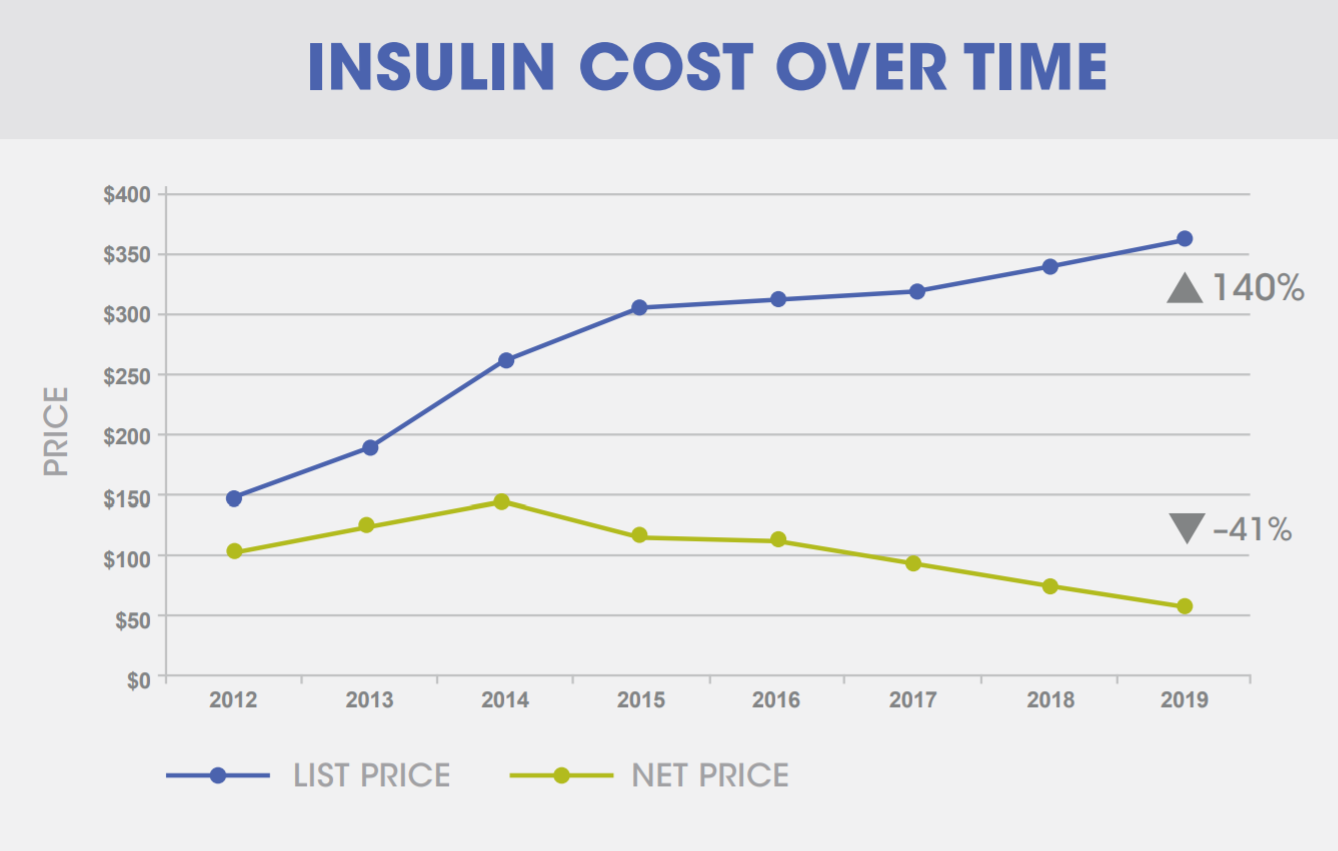
See https://www.fiercehealthcare.com/payer/facing-criticism-pbms....
https://www.macrotrends.net/stocks/charts/CVS/cvs-health/pro...
Cigna purchased Express Scripts in Mar 2018, and has profit margins of 3% to 5% over the last couple years.
https://www.macrotrends.net/stocks/charts/CI/cigna/profit-ma...
If these PBMs are making lots of profits, then they are simply subsidizing losses elsewhere in the MCO. The total costs paid for insurance premium plus out of pocket costs by the end user in the US would not be affected.
PBMs are important but they should not be able to put a gun to these pharma companies heads because they control the formulary.
CVS net margin includes their retail business. You can't compare AWS's margin to Walmart's e-commerce margin.
As a customer, it does not affect me.
In the healthcare business, the flow of money is:
Individual -> MCO (insurance company) -> healthcare providers and drug manufacturers
What does it matter to the individual what portion of an MCO is earning what profit if the net profit margin of the whole MCO is 5% or less? They are obviously not left with a lot of money, their employees are not known to be lavishly compensated.
FTA: >In 1996, a vial of Humalog produced by Eli Lilly cost $21. Today, it's priced at $324 despite the cost of production remaining steady.
>Rising costs are nothing new. Insulin prices tripled from 2002 to 2013, and doubled between 2012 and 2016. To put this into perspective, in 1996 a vial of Humalog produced by Eli Lilly cost $21. Today, it's priced at $324 despite the cost of production remaining steady.
If everything is working as intended, it begs the question, what institution intended for patients to die from rationing insulin[0], and why is the USA ok with that institution's intention?
[0]https://www.ontrackdiabetes.com/live-well/diabetes-managemen...