When you look at Eastern European population curves, most are flat. On the other hand, in half a century, California went from 15 million to 40 million people. In addition it built a HUGE agricultural industry that absorbs water from the entire western side of the nation. 1/3 of vegetables and 2/3 of tree nuts in the US come from California.
I wouldn't be surprised if California revitalizes in a few decades when they get their head out of their butts on housing. Getting rid of R1 zoning, building better transit, etc... Water on the other hand is going to be a problem unless South and Central America start growing a ton of tree nuts and drops the prices. (Probably in the smoking crater of what used to be a rainforest)
Luxury apartments doesn't mean anything other than new construction. No one ever build super low end new housing in a desirable area, the land is too expensive. You need new construction like this to push down the value of existing housing.
https://www.lyonliving.com/santa-ana-california/the-marke
All of the buildings you're linking to are mid-rise developments with VERY low lot coverage dictated by local zoning. The look nice, but not that amazing compared to other new development around the country.
My point being, you can't just build cheap housing on astronomically expensive land, the math doesn't work. Crazy zoning laws add to that cost. Pointing to new development as the problem is simply wrong. If people want new construction at a lower level of affordability, then they need to change laws that drive up the costs of building. If the banks won't/can't loan money to a real estate project with an expected margin of return of < 3%, then what do you expect?
Sure it has it's problems, but I think what you're describing is an area that's rising (eastern europe) vs an area that rose in the past and is dealing with an equal balance of ups and downs. So it looks like a hellscape. That being said, the governments there do make some weird decisions, and issues with rent prices could be solved by allowing new/higher density construction.
What I'm getting at is income and standards of living are probably rising in your area faster than California, and that makes it feel like its wealthier/more pleasant on an absolute scale when it's in a phase of catching up.
I've noticed that Californians have a "we have to do something / we can't just do nothing" mentality when it comes to problems. So what ends up happening is that the California legislature will gladly pass laws which implement new bureaucracies to address whatever issue happens to be trending. This is how Californians end up with so many line items and fees tacked on to every government transaction. You wind up with a very complicated government and some bizarre rules that seem like overkill. And, the more complex a system is the more likely it is to be inefficient and ineffective due to all the moving parts.
I think some laws are passed with expiration dates. I would support more of this to reassess if people still have the will to enforce and support them.
For instance you'll notice most Tesla cars have a sticker on them that says "Access Ok, California Clean Air Vehicle" https://cleanvehiclerebate.org/eng/ev/incentives/hov-lane-ac...
To me it's dumb that the government needs to issue a sticker to know which cars are EV's or Clean Air vehicles. Wouldn't it be more simple to just know that Tesla's and Toyota Prius's are clean air cars than to require people to put stickers on their bumpers that expire every four years in order to get prime parking spaces and HOV access? Additionally, there's a bunch of paperwork involved and qualification processes based on income and other things https://www.dmv.ca.gov/portal/vehicle-registration/license-p...
I'm sure that this bass-ackwards system provides plenty of work though.
So you have the features of a big state, with some of the quirky weirdness of western governance (propositions, etc). I'm not an expert on California, but looking at it, it feels like a place that selected the best thing and worst thing about governance in Florida, New York, Idaho, New Jersey, Illinois and Virginia, and did all of them.
NIMBYism, density restrictions, etc, are largely "universal" US policies, vs liberal/conservatism splits, so it's the demand that's the difference here between the rest of the country. Note the difference in population density between a Houston and a Los Angeles. LA just ran out of neighboring land to sprawl into first, yet the demand kept coming...
And on top of it, there's a mismatch between where people want to live and where jobs are available, so you've got homeless in CA cities and unfilled jobs in the middle of the country...
Those prices are increasingly starting to cause more and more people to leave, but still predominantly lower-and-middle-income people - and the demand and prices are being driven by the high-income or high-wealth people - so I'm not sure it'll change much.
Unless the high income people are going to pour their own lattes then their quality of living is going to fall too eventually.
California is fairly racially diverse, but isn't that ideologically diverse - election results will clearly show that. I have conservative friends (both Trump conservatives and anti-Trump conservatives) who very frequently complain about the lack of diversity in the state. It's great if you are a liberal, not so much otherwise.
The weather in California is indeed good, but not for everybody. Its famed summers are very dry. If you like sun, you will love California summers, but you can get a LOT of dry days in a row. If you like a balanced mix of rain and sun, you will not like the summers in most of California. Also, because of this, a lot of the state's urban areas - especially in SoCal - is very brown and not really that pretty if you like the lush East Coast forests.
California beaches are not that good depending on what you expect from a beach. It's easy to do fun activities at the beach, but the water is quite cold and the sand isn't to everybody's tastes. Parking and driving times can also be brutal in the urban beaches. Very many people would rather go to the beaches in Florida or in the Carolinas than California, not including of course beaches overseas. I personally disliked the beaches there and only went a couple of times over the years.
Overall, I think the reason many people say California is a paradise is that it's a pretty unique state with a lot of personality (for better or worse), so if you are into the things California is good at, then California is the place for you because you won't find their particular mix anywhere else in the US.
But it remains to be seen that this particular mix of traits would be considered a "paradise" for most people.
What I'm saying above is somewhat obvious, as in "If you like California you like California". But when people make grand statements such as "this state is a paradise", one would assume that the vast majority of people who go to California would absolutely love it. But I'm not sure that's the case, especially if you include the enormous number of man-made problems we discuss so much.
The grass can literally be greener elsewhere. :)
It's amazing what actually going to places reveals - that there are actual human beings that live in these places, and perhaps aren't as unreasonable as twitter makes you think.
Firstly, I think its important to note that everything you cite as an issue in California is happening writ large across the United States. Every issue you cite is repeated again and again in every productive economic center across the United States. Absurd rents/ housing prices/ CoL, devastating issues with homelessness and drug abuse, increasing devastation from climate related weather issues. California stands out as particularly addressable because for better or worse (or due to the sierras and the southern desert), California is a bit of an island unto its self.
I grew up in southern California and watched the impacts of the 2007-2009 economic collapse in real time. I was extensively involved in activism related to homelessness at the time. I watched families and communities become absolutely devastated by the economic (and resulting homelessness and drug abuse that inevitably follow) fallout from those events. To summarize, California (and the US through analogy), never actually recovered from the 2008 crisis. The families that fell during that time never really got up again. Working class (labor) families went from thinking they could support their first and second children through community college and eventually four year university, to barely scraping by or living in slow decline. The vast majority of families impacted by the 2007-9 economic collapse never actually recovered, and have basically limped along or tread water since then.
The result has been an ever increasing disparity between the rich and the poor in California. In few places is this as well displayed as in the Bay area. The amount of wealth that has accumulated there is almost preposterous; and yet, it fails to hide an utter epidemic of homelessness and the problems that accumulate in its presence.
Several in this thread cite governance issues in the state of California. I call bullshit on this. The reality is that California is a huge and complex state with more economic activity than most countries. It shouldn't surprise you that it requires a complex bureaucracy to respond to that.
Very simply, the US stopped taxing or regulating wealth in the mid-late 2000's, and in the post 2008 era made it clear it had no intention of holding any one accountable for their actions in financial markets. Almost everything you see politically, socially, and economically in the United States is a direct consequence of that era.
Its my opinion is that the US is in serious decline and on a random walk towards a failed state (if it isn't there already? how do you define a failure mode for a country?). The US is unable or uninterested in taxing wealth or its highest income earners, and as a consequence, the wealth curve has gone asymptotic. The distribution of wealth in a society is key to its stability, and as the kurtosis becomes more and more positive, people begin to lose any incentive to participate.
The solutions to these problems are quite simple and no new technology is required to implement them. Return to a 90% tax burden on highest income earners and tax wealth directly. Force billionaires to spend their money or lose it. IF they want to take their ball and go home, then they lose their seat at the playground. The US has had policies like this in the past and they've shown their effectiveness.
In regards to the specific drought issue, the state was effectively plumbed during an abnormally wet era. What you are seeing here described as 'drought' is not too far off from the historic norms. Coupled with drought, California is also seeing its wettest years on record (2017/18), but due to climate forcings, its all rain and no snow.
I think the final emphasis that I would like to place is that what is happening in California is repeated all across the United States. Climate issues, housing prices detached from reality, homelessness and drug addiction running rampant, and no ability or will from the political apparatus to respond to these issues.
In a word, history. If you just look at the last few decades you're seeing only a snapshot of an explosion.
California (the USA state) is young, ~150 years old.
For thousands of years only ~100k-300k people lived here.
> Settled by successive waves of arrivals during at least the last 13,000 years,[40] California was one of the most culturally and linguistically diverse areas in pre-Columbian North America. Various estimates of the native population range from 100,000 to 300,000.
The Spanish only got started in a big way in 1769 or so, then...
> In 1821, the Mexican War of Independence gave Mexico (including California) independence from Spain. For the next 25 years, Alta California remained as a remote, sparsely populated, northwestern administrative district of the newly independent country of Mexico.
Then we Americans got in on the act.
> When Commodore John D. Sloat of the United States Navy sailed into Monterey Bay and began the military occupation of California by the United States, Northern California capitulated in less than a month to the United States forces.[67] After a series of defensive battles in Southern California, the Treaty of Cahuenga was signed by the Californios on January 13, 1847, securing American control in California.
But before anything could really happen gold was discovered.
> In 1848, only one week before the official American annexation of the area, gold was discovered in California, this being an event which was to forever alter both the state's demographics and its finances. Soon afterward, a massive influx of immigration into the area resulted, as prospectors and miners arrived by the thousands. The population burgeoned with United States citizens, Europeans, Chinese and other immigrants during the great California Gold Rush. By the time of California's application for statehood in 1850, the settler population of California had multiplied to 100,000. By 1854, more than 300,000 settlers had come.[70] Between 1847 and 1870, the population of San Francisco increased from 500 to 150,000.[71] California was suddenly no longer a sparsely populated backwater, but seemingly overnight it had grown into a major population center.
During the ~150 years since, California has become "the largest sub-national economy in the world" with a population of nearly 40M people.
> The economy of California, with a gross state product of $3.2 trillion as of 2019, is the largest sub-national economy in the world.[14] If it were a country, it would be the 37th most populous country and the fifth largest economy as of 2020.
All this happened in the blink of an eye, and before there was a lot of what we might call "adult supervision", in the sense that things like water supply were dealt with without deep thought about long-term consequences.
E.g. "land subsidence": We have taken so much water from the ground that the San Joaquin Valley has sunk many meters! Here's the classic photo showing the subsidence:
https://water.usgs.gov/edu/pictures/full-size/land-subsidenc...
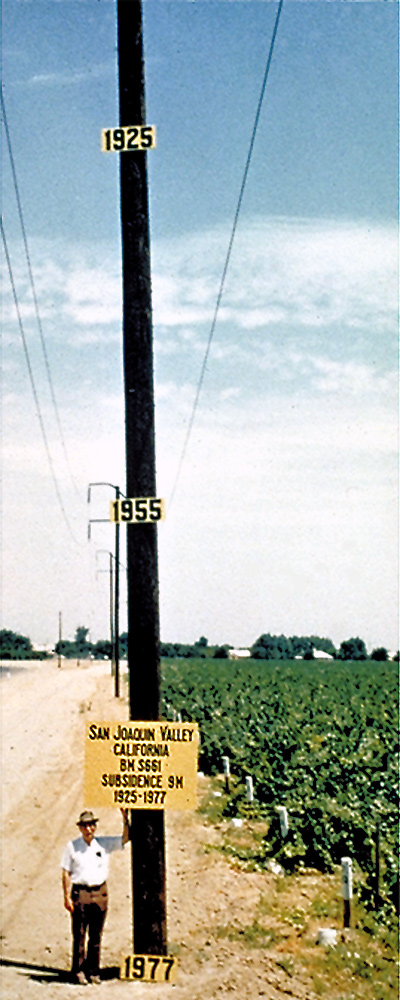
So that's what's happening in the paradise state.
I'd argue if we let the tech bubble pop properly, have a recession for 2-3 years, but keep interest rates at higher rates, it would have preventing a housing bubble.
And that's down to greenspan, and government intervention, not the market.
Government then bailed out the banks
Don't believe all the crazy hyperbolic news - it's always overblown - and definitely don't believe the onslaught of right-wing propaganda.
The laws and regulations they pass are directly contributing to homelessness and lack of housing.
v misleading esp w/ language such as 'likely' and 'most socialist' w/ zero sources.
Too. Many. People.
The east coast has unlimited supplies of fresh water. California does not. The east coast megalopolis is also situated on a coastal plain, with a deep hinterland unconstrained by any mountainous geography. California crams a similar amount of people into a tiny sliver of coastal land in between the mountains and the sea, surrounded by some of the driest deserts in the world.
Well, the decline in precipitation is due to changing air circulation related to climate change. Speaking very broadly, the Southwest is likely to get drier, while the rest of the US will either get wetter or stay the same. We don't pay attention to areas with increased precipitation, although it might lead to some flooding: it's generally easier to deal with than drought. But obviously droughts are not related to the effects of locally determined economic policy in the short term (drought resilience contrasts).
What else is happening is primarily due to the fact that California's population has grown very rapidly in a short period of time. Historically, population transfers like this were accompanied by wars and massacres. By that standard, California has been relatively peaceful and successful since the end of the California Genocide.
We can point fingers at bad policies responsible for specific problems, but the overall immaturity of the political system in California is the general underlying factor. Examples include the minuscule size of the California legislature relative to its population, or the too-big counties in SoCal that were drawn when nobody lived there.
According to the cube root rule, the natural size of California's House of Representatives is about 340! That's a far cry from its current 80.
California led the US in job growth (or rather, job restoration) this spring, and many sectors of its economy survived COVID19 unscathed. (https://www.latimes.com/business/story/2021-06-02/la-fi-cali...)
there's a massive drought
Drought has been part of CA's climate history for centuries.
Rents have been insane for years in most cities
Objectively false, unless by "most cities" you mean exclusively the major metropolitan areas like LA, SF, and San Diego. CA has hundreds of cities with affordable rents, some of which are even located within the LA, SF, and San Diego metropolitan areas.
Huge homeless and drugs problem in LA, San Francisco.
Yes, with the caveat that more than 50% of the homeless in LA and SF are not locals. They're out-of-staters that either came to LA/SF or were shipped here by their home states to avoid housing them. (Texas especially is notorious for this; former governor Rick Perry publicly bragged that Texas' homeless solution was to buy them tickets to Santa Monica.)
For what?
Amazing weather. Amazing beaches, and mountains, and deserts, and forests. Amazing food. Amazing people. Amazing culture. One of the world's biggest economies (as a sovereign nation, California's economy would rank ahead of India, a country of more than a billion people, Germany, the economic engine of the EU, and the UK, the former financial center of the world).
Then I see all the news from California, the whole economy got closed up, there's a massive drought. Rents have been insane for years in most cities. Huge homeless and drugs problem in LA, San Francisco. And on top of this, some of the highest tax rates in the US. For what?
What is happening to this paradise state?
And what worries me a lot is, a lot of the culture worldwide is set by people living in these conditions. Not just film, but tech now. I mean I can see why everyone in california is frustrated with capitalism and all the rest of it, but that's california... The conditions of which I've just listed.