Yes, and that is paid for by my outrageous property/vehicle registration/gas taxes. Huge portions of our cities have roads in near 3rd-world conditions. The major arteries of every top-50 US city grind to a halt twice a day, and you have been conditioned to believe this is normal/acceptable. Our bridges, roads, and railways are falling apart.
> Do you live, work or shop in a structure that adheres to building codes?
Yes, and I pay for that directly via the price of homes (home inspection and permit costs are passed on).
> Do you have power? Do you have access to the internet? Do you enjoy food that doesn't kill you?
I pay for all of these things directly out of the money left over that the government does not take from me. In the case of food, I pay taxes again on it when I buy it.
> share the frustration that tax money isn't always (often) spent effectively, but then I ask...what have I done? what would I do differently? At the end of the day, I'm not that interested in doing these things.
Where do you live that the government provides you home, roads, sidewalks, food, power, and water for $0 post-taxes? Because I pay for all those things directly with post-tax income.
>Paying these taxes doesn't measurably impact my overall well-being.
How does 30-50% of your take home not impact your "overall well being"? All forms of calculation that result in a lower number than that have, in my experience, come from ignorance of the comprehensive tax cycle.
> How does 30-50% of your take home not impact your "overall well being"?
How do you respond to the claim that if income and other taxes were lower, then everything would go up in price to compensate for the extra liquidity in the market?
By which you mean Social Security, Medicare, and Medicaid? Those programs have broad public support.
Which is largely an education problem. Diamonds have overwhelming public support and are essentially a scam. We need to build sustainable, healthy systems that work for our population and don't make naive assumptions like infinite growth.
This is extremely misinformed.
Social Security Retirement, Survivors, and Disability Insurance are entitlement programs, and by far account for the vast majority of this budget (along with the Medicare that most of these individuals are entitled to have). You do not have a right to it, and you are obligated to participate in the insurance program by paying taxes. They are payed for by the individual worker and in some cases, partially, by the employer, via FICA taxes deducted from your US paycheck. Other taxes may be withheld from your paycheck, which lower income individuals will get money back from the IRS for, upon filing their taxes. But, this is not the case for FICA taxes.
The issue is that actuaries have not properly estimated the costs of things like Medicare, and then Congress has really never updated the tax code to account for proper FICA taxes for future projections.
Bottom line though is we are taking in about 3.5 and spending about 7. We are well past 'buy one less bomber'.
A just system would be something like "invest 15% of your income in XYZ approved categories, or pay a penalty tax on up to 15% of your income". This effectively mandates citizen savings via penalizing irresponsible spending/lack of savings.
"We'll tax you and we pinky promise to pay you back someday... totally investing that money and not spending it now then printing more when we need to pay up" is both so insane and obvious an outcome I suspect leaded gasoline played a role in societal acceptance.
Likewise, not true. I find your comment to be extremely offensive, too.
I have 2 rare immune-mediated neurological diseases affecting my peripheral nervous system plus type 1 diabetes. I worked nearly full-time at university, while going to university full-time, while still making good grades in undergraduate, in electrical engineering. I had to do this just to keep medical insurance so I would not die.
Anyways, I was extremely sick from age 18 on at university. I was misdiagnosed, and my health problems were blamed as "diabetes complications". I found out that I had a very rare neurological disease, that very likely caused my type 1 diabetes, when I was 22.
I was declared disabled by the Social Security Administration at age 21. I am sure I am not the only one, and some people incur costs that cannot be paid for by just "saving up". This especially applies for medical care. In my case, I really had no chance whatsoever to do this.
By the way, I am off of disability now.
That's great to hear! The issue I take with your story is not that you got help, but that a government mandated retirement program should never have been retrofitted to provide socialized health care. It is an absolutely terrible design.
I'm not going to write a blog post about my theory for an optimal health care system architecture, but I suspect we would agree that a lot of things are wrong and need to be redesigned.
When I lived in China, I was shocked not by how controlled it was (which is what I expected given the western vision of China) but by how chaotic and uncontrolled it was compared to the US. Everything from food, health, and safety inspection, to the enforcement of traffic laws, the regulation of lenders and financial products, academic integrity, I could go on forever. I became aware of these things only when I lived in a place that lacked them.
It's invisible because it provides no true value to them.
Right now you and I are paying for some NSA hacker to compromise American telecom networks, 13 carrier battle groups to put around the ocean doing nothing, literal armies of people in a hundred plus bases on literally every continent that provide NEGATIVE value to your average person on the street, and so much more.
Your car has broken down and you can't afford to fix it, while the government has taken ten grand from you in the last 12 months that could have purchased you a new car. But it's ok, some overpaid bureaucrats are making real progress in abstract geopolitical interests in a country you can't even find on a map! It's a simple example, but people really underestimate how much more they'd have in their pocket if the government wasn't siphoning off cash at every step on the economic cycle. Look at the number of people struggling, and imagine how much we could relieve that by simply stealing less from them.
Your examples show that there is money being used in malicious ways, which I don't disagree with, but it doesn't mean that there aren't a huge amount of positive things happening. There are so many of these it's impossible for a single individual to know all of them.
You've articulated a few highly non-controversial programs which is fine, but to then project that unto the government as a whole when programs like that are the exception not the norm is unfair.
"Unimaginable theft and loss of life carried out by our government and laundered by "reputable" sources like NYTimes? But what about some fisheries man?! We can't scale back the government!"
It just comes off as inauthentic.
This is an extreme lower bound looking only at FICA. In reality you have:
-FICA
-State income tax
-Local taxes for your city
-Social security and medicare tax
-Sales tax at point of purchase
-Property taxes (directly if you own a home, indirectly + margin if you rent)
-Gas tax
-Vehicle registration fees/taxes when purchasing
-The payroll taxes your employer pays for paying you, directly suppressing your income/earning potential.
-A whole host of taxes on any capital gains, inheritance, gifts, your phone bill, the list goes on and on.
When you _only_ look at your tax burden in terms of what gets deducted from your check you get a highly misleading figure. This doesn't even factor in what happens when the gov inflates the currency and "taxes" your cash holdings.
Disintermediating the health care system with a public option could lead to the biggest savings in the system overall. The military budget stuff is somewhat disingenuous because it was necessary for the U.S. to maintain a capable military first because of the Soviet threat and later to back the USD as the global reserve currency and secure foreign oil - unless we could get the domestic shale up and running (USD as the reserve currency improves the purchasing power of every American and allows us to live "beyond our means" on an international level - while on the downside making our exports uncompetitive). But nevertheless, if our military went away, Americans would have to take a haircut to their standard of living.
So it's not as simple as you make it sound.
Please just write out the word "people". You're already using full words and normal punctuation everywhere else.
If the above individual wants to see widespread corruption, you may want to check out some European Union countries that have this culture. Croatia is a good example, where nepotism is the modus operandi, as in whom you know will get you places in society. Bulgaria is also a great example.
When I think of a country like Croatia, I like to compare it to some locale in the US with a similar total pop (4-5M?). Things start to make more sense then, that's a smallish metro region where that kind of networking is more common.
It's pretty clear that a huge chunk of the US doesn't consider nepotism corruption, given the complete lack of repercussions to Trump for hiring his family into the White House.
Ever heard of the Pentagon? Here's a good start: https://www.thenation.com/article/archive/pentagon-audit-bud...
I will say that looking up the results of the more recent audits (2020), the summaries frequently talking about failing audits but also of uncovering zero evidence of fraud.
Is it really? We could eliminate entire sectors of the federal government and your average person would have no clue. Why do we need 18 intelligence agencies? Why do we need 13 carrier battle groups? What, exactly, do our 100+ overseas bases do for the average tax payer?
None of it makes sense in a supposedly representative government where those who slave away and pay for it get a say in how things are run, or where their collective effort is spent. The current distribution however makes perfect sense if said representative government is an illusion and the taxpayers instead really work to supply the whims of an unelected and unaccountable few. They want to play the great game, and you're gonna go to work to pay for it or we'll send men with guns to your house to take you away. This underlying threat of violence underpins every aspect of our civilization.
https://cdn.cfr.org/sites/default/files/image/2020/12/010_na...
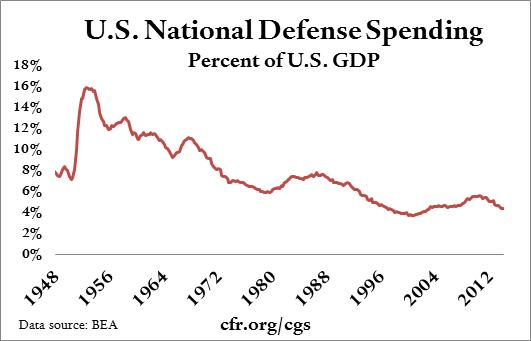
As for the philosophical argument that they take my money by force, I just don't get it. This is the best way we have found to have a civilized society so far. Going far in either direction communism or anarchy is not a good solution. You have to also consider reality when arguing policy.
"No taxation without representation" was one of the core driving motivations behind the American revolution. The problem is that I, and I suspect a growing number of others, have completely and totally lost faith in my government to represent my interests while taxing me. The "men with guns" line is just to reinforce that I have no choice in the matter, they are free to do whatever they want with zero accountability and I have to pay them or they send me to jail.
It is incredibly depressing how little I get from the government vs how much they take from me. The entire system is a sham and I honestly don't want to support it anymore. I'm working as hard as I can to try and escape it at the earliest possible moment.