News for hackers. Stuff that matters.
Re:AirGradient: DIY Air Quality Monitoring with Open-Source ... by Havoc on Tuesday May 11, 2021 @07:52PM (#27125060)
Is that Co2 sensor reliable? I've been googling sensors lately and CO2 seems to be a mine field. Hard to tell what is a CO2 sensor and what is a VOC/CO2 equivalent sensor...
Re:AirGradient: DIY Air Quality Monitoring with Open-Source ... by ahaucnx on Tuesday May 11, 2021 @09:50PM (#27125785)
Yes the senseair S8 is very reliable. Our professional air quality sensor uses the same CO2 sensor and we have hundreds of them deployed without a single one failing so far.

Only need to keep in mind that the baseline calibration sometimes needs 1-2 weeks to kick in but you can also force a manual calibration.

In general NDIR CO2 sensors are quite reliable but you should stay away from TVOC sensors that give an eCO2 (estimated CO2) value. These are often very off and I would not recommend to use TVOC sensors for CO2 measurement.

Re:AirGradient: DIY Air Quality Monitoring with Open-Source ... by nmaggioni on Wednesday May 12, 2021 @07:10AM (#27128936)
Have you ever experienced spikes in the S8's readings? Mine seems to underflow and wraparound every once in a while for no apparent reason or when exposed to fresh air for prolonged periods of time. I tried recalibrating it on the 400ppm baseline a few times but the issue hasn't gone away.
Re:AirGradient: DIY Air Quality Monitoring with Open-Source ... by SilverRed on Tuesday May 11, 2021 @11:45PM (#27126360)
How does the calibration work? I saw comments saying you have to get a canister with a known co2 content and run it through to calibrate. Do these home sensors just assume the outside level is a fixed value and calibrate to that?
Re:AirGradient: DIY Air Quality Monitoring with Open-Source ... by jfim on Wednesday May 12, 2021 @12:49AM (#27126706)
It assumes that the sensor is exposed to fresh air every once in a while, and that fresh air is at 400 ppm CO2. It'll basically slowly lower its baseline calibration over several days, and if the value ever drops below 400 ppm it'll increase the baseline calibration relatively rapidly.

It can be disabled via a command IIRC.

Re:AirGradient: DIY Air Quality Monitoring with Open-Source ... by agurk on Wednesday May 12, 2021 @04:06AM (#27127919)
Isn't this approach flawed as it look like seasonal lows of CO2 [0] are above 400ppm are are going to continue rising making the alignment drift even further out. Is there any way to adjust the calibration with the expected low CO2 readings?

[0] https://www.co2.earth/seasonal-co2-cycle

Re:AirGradient: DIY Air Quality Monitoring with Open-Source ... by jfim on Wednesday May 12, 2021 @09:37AM (#27130165)
In theory yes, but in practice any sensor that's not regularly calibrated against a well known reference (eg. a chamber with 0 ppm CO2) will always be off somewhat.

This automatic calibration just ensures that the sensor is in the right ballpark, but if a 10-20 ppm absolute difference in CO2 concentration is important for your application, you'll need a better sensor and/or calibration procedure than the automatic background calibration.

Realistically, for home applications, it'll be more like CO2 < 500 ppm, things are good, above 700, might be time to consider opening the windows, above 1000, definitely time to open the windows. For that kind of application, being off by 10-20 ppm doesn't really matter too much.

On a side note, it is pretty disheartening to think that the 400 ppm CO2 background level was accurate a few years ago when the sensors were designed, and that in the span of a few years that background reference is now off.

Re:AirGradient: DIY Air Quality Monitoring with Open-Source ... by Havoc on Thursday May 13, 2021 @03:04PM (#27145998)
>Yes the senseair S8 is very reliable. Our professional air quality sensor uses the same CO2 sensor

Thanks!

Re:AirGradient: DIY Air Quality Monitoring with Open-Source ... by dheera on Tuesday May 11, 2021 @09:40PM (#27125722)
You want an NDIR CO2 sensor such as an SCD30 or a T6713 and not an electrochemical sensor.

Electrochemical sensors respond to CO2 and other VOC gases and give you an "eCO2" reading, and you can never be really sure if it measured CO2 or something else, and require frequent calibration. They suck.

NDIR CO2 sensors work by emitting IR light and measuring the CO2 by its IR absorption band, and are much more accurate at singling out only CO2 among other gases.

Re:AirGradient: DIY Air Quality Monitoring with Open-Source ... by parsecs on Tuesday May 11, 2021 @07:59PM (#27125110)
Pardon my lack of knowledge, but what's wrong about an equivalent type sensor?
Re:AirGradient: DIY Air Quality Monitoring with Open-Source ... by NortySpock on Tuesday May 11, 2021 @08:08PM (#27125167)
VOC: Volatile organic compounds -- aerosolized oils, greases, perfumes, "bad smells", solvents, exhaled breath which would contain normal biological material, or anything else having to do with carbon compounds

A VOC/CO2 equivalent sensor is measuring VOCs and using them as a proxy to estimate CO2 concentration levels. CO2 is of course fairly non-reactive so it'd difficult (read: expensive) to make a chemical sensor for this. VOCs are more reactive and easier to make a sensor for.

Basically, you're getting a sensor for VOCs that, based on some assumptions about outdoor or indoor air quality, is then being used to estimate CO2 levels.

This is fine if all you want is a loose estimate, but if you have reason to think your VOC/CO2 ratios are going to be different than "usual" (e.g. a CO2 storage facility, next to a poorly maintained combustion system) or where CO2 detection is of paramount importance (e.g. life-or-death situations), then a VOC detector is not acceptable.

EDIT: tried to improve the VOC examples

Re:AirGradient: DIY Air Quality Monitoring with Open-Source ... by parsecs on Tuesday May 11, 2021 @08:20PM (#27125245)
Some of the CO2 sensors that I worked with use separate signals for deriving estimated VOC and CO2. For example the Senserion SGP30 [1] measures ethanol and H2, and uses H2 to determine eCO2 value. Indeed the Senseair S8 [2] used in AirGradient seem to feature a "more direct" NDIR CO2 sensor, so there's not really any issues there.

Is using H2 to detect CO2 "good enough" for all non life-or-death situations?

Edit: And to clarify, I was mainly asking the parent comment as to what is their application that demand NDIR or "more direct" CO2 sensors.

[1] https://www.sensirion.com/fileadmin/user_upload/customers/se... [2] https://rmtplusstoragesenseair.blob.core.windows.net/docs/pu...

Re:AirGradient: DIY Air Quality Monitoring with Open-Source ... by jfim on Wednesday May 12, 2021 @01:45AM (#27127028)
It seems alright if you do use the humidity compensation. It might be off by 100 ppm or so, and wildly off if there are a lot of VOCs in the air, but if you're just using it as a "should I open the windows" kind of thing it'll do fine IMHO.

For example, the two sensors I have right now, with the windows open, the S8s report 478 and 455 ppm of CO2, while the SGP30s report 400 and 405 respectively. Without having calibrated instruments it's hard to know if any of these values are good, but they seem at least not too wildly off.

The SGP30 is a lot more compact and much less of an energy pig than the S8; the S8 will actually take so much current on the 5V rail that it'll cause the voltage to sag if you're powering it through USB with other devices connected (https://blog.jean-francois.im/2021/05/08/building-a-simple-a...). It's also a lot cheaper.
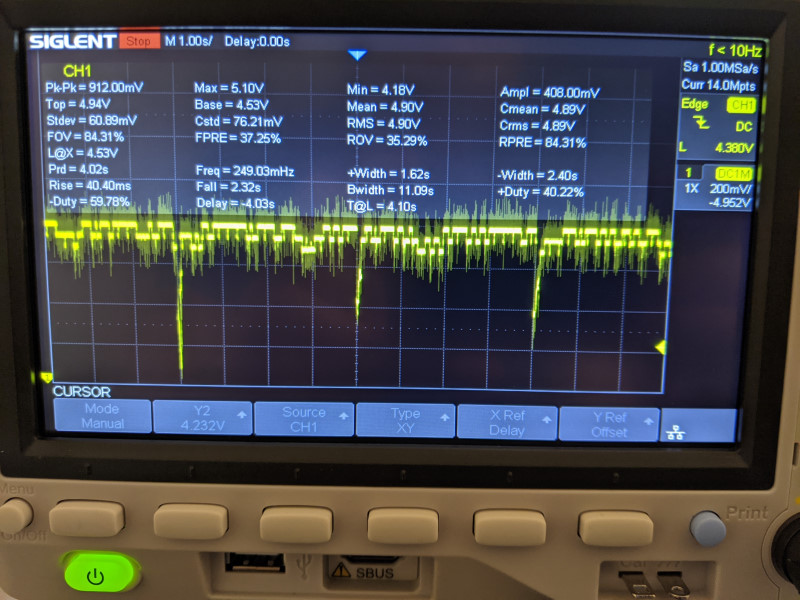
However, the SGP30 approximation can be off by a bit, and the calculation of the humidity value to give the sensor is a bit gnarly (https://github.com/jfim/air-quality-monitor-firmware/blob/ma...). It's also pretty obvious that the SGP30 has a hardcoded floor of 400 ppm CO2eq and that it won't ever return a value lower than that.

Re:AirGradient: DIY Air Quality Monitoring with Open-Source ... by ahaucnx on Tuesday May 11, 2021 @09:54PM (#27125803)
Sometimes even the loose estimates are totally off because most of the time the eCO2 correlates with the TVOC measurement. For example I triggered a TVOC sensor with suncream smell in a very low CO2 room and the CO2 wenth through the roof.
Re:AirGradient: DIY Air Quality Monitoring with Open-Source ... by the_pwner224 on Tuesday May 11, 2021 @08:02PM (#27125125)
Those basically measure VOCs and use that to guess what the CO2 concentration is (the two are often correlated, or something like that). So the 'CO2' reading they give is often inaccurate, and can be heavily manipulated by the presence of certain gases/VOCs. The one that AirGradient has chosen is a true CO2 sensor, AFAIK.