It's not hard to imagine a government rather fancying getting a tax receipt from extraction companies, particularly if it is seen as green. Who would presumably lobby rather hard against it. This suggests the absence of pricing at source is to some extent a result of successful lobbying.
Sure they would make less money off corporation taxes with lower exports, but as those receipts are generally low anyway the tradeoff going to carbon tax would likely be favourable.
Main problem is figuring out how to incorporate emissions into price signals.
It didn't really work out so far, otherwise we wouldn't be talking about an emergency.
1. Electrify everything possible 2. Shift all electricity production to renewables, massively increase power output with nuclear nuclear nuclear. 3. Carbon capture.
Sometimes I wonder, as a mind experiment, how close we could get to practical carbon burial with a process based on sinking polymer blocks in the ocean: the specifics of the polymer blocks wouldn't matter at all as long as the surface doesn't degrade into spreading microplastics and total density would be high enough to sink, and they could be shaped like standard containers for easy logistics. The result of the mind experiment is always the same, even that could not possibly compete with leaving fossils underground.
Additionally, carbon capture does not necessarily mean we are burning "fossil" fuels. Carbon capture could be using the Sabatier process to create methane from the CO2 in the air, which you then use to power rocketships/jets/etc, which we are still not very close to electrifying.
Why? What is wrong with capturing carbon the way trees naturally do? (Honest question)
The closest thing we have today to those "eternal tree corpses" are peat bogs were decomposition is kind of broken even today (and guess who discovered that dried up peat can burn, even if it's a very dirty fire? Humans. We just love oxydating carbons).
https://www.sciencenewsforstudents.org/article/recycling-dea...
Though word is in the air that the previous assessments might have been very optimistic.. although that will probably only be discussed in 2022 when the 6th assessment report is to be published. Which presses the issue only further.
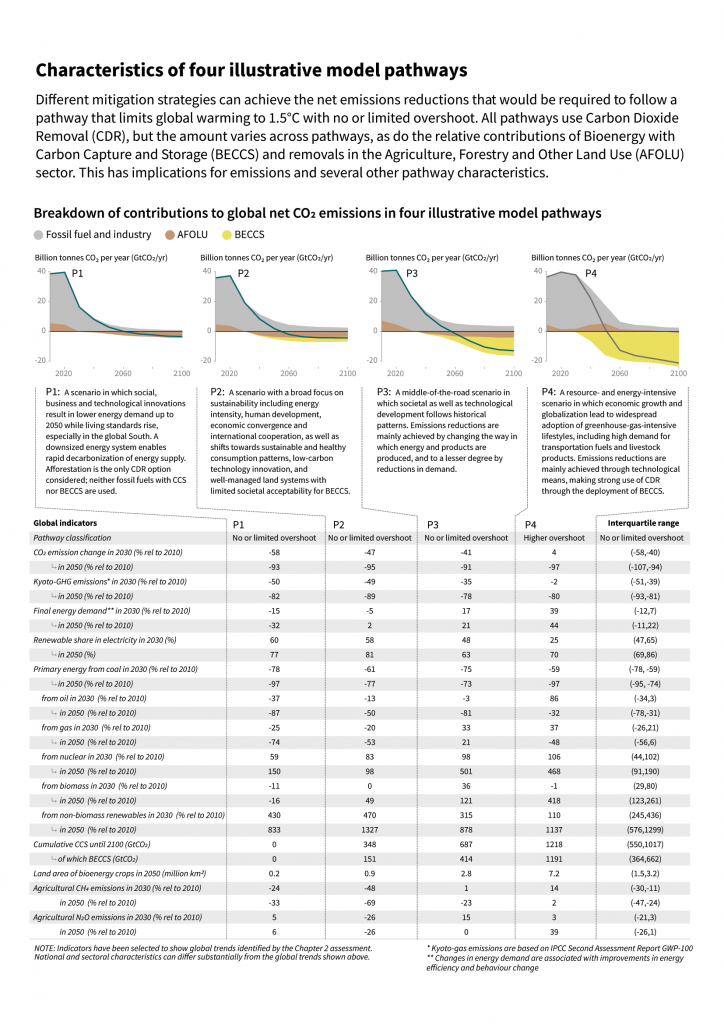
[0] https://www.ipcc.ch/site/assets/uploads/sites/2/2019/02/SPM3...
With green energy, digital gold is a lot more green than physical gold. Bitcoin is like electric cars – not super green right in this moment when the grid is still dirty, but all it takes to make it greener is to green up the grid.
Meanwhile the classical banking system: uses all forms of transport which green up slower (armored cars, planes, etc), requires crazy amounts of construction (I don't even want to guess how much cement has been used in the construction of physical banks all over the world), all those buildings use energy for AC/lighting/etc, require huge amounts of manpower to manage trust in the system (people definitely aren't green), and also need their own datacenters anyway. And I'm sure I'm forgetting some things, where as with BTC pretty much all consumption is baked into mining, which again just gets greener automatically as the grid gets greener. Nobody is running a Bitcoin mining operation off of diesel generators. If you did the math (impractical given the breadth of the existing banking system), I think you'd find Bitcoin is already far greener than the existing banking system, by a huge margin.
And cryptos like Ethereum have the potential to 10x/100x/1000x that with things like PoS vs. PoW as well as the fact that Ethereum smart contracts can not only replace banking but probably other industries as well, such as title companies and various other middlemen.
It's been 13 years now and nobody's done it, because that's a terrible idea. The reason lawyers exist is that all contracts have ambiguity and require a human to review and consider. All contracts have circumstances that aren't captured. Just ask the DAO folks.
Middlemen exist for a reason. Efficiency, conflict and ambiguity resolution, and so on.
Blockchains are only useful for things that are entirely captured within the blockchain. As soon as you interface the blockchain with the outside world you have to trust something to enter and capture that data accurately - garbage in, garbage out. Once you're trusting someone, you don't need a blockchain, just fire up and RDS instance and save everyone the headache.
And with tokens that are tied to real-life things, the benefit is that once you've used real-world trust systems (e.g. real-life contracts / lawyers / courts / etc) to tie something to the blockchain, you can (going forward) hand everything over to the trustless and secure system. i.e. You tie your property to the blockchain once, and from then on you don't need to involve all those inefficient systems, you just transact the tied token directly on the blockchain.
Just because it hasn't been done successfully yet doesn't mean it's not viable. How long did the internet exist before [thing that is taken for granted on the internet now] was successful?
Finally, Ethereum launched in 2015, not sure where you're getting 13 years from.
But I see your point.
We should make a pyramid/MLM scheme where you're promised rewards for planting trees, segregating waste, cleaning up in any potential wildlife habitats, and reducing/reusing stuff in general.
Panic is rarely useful. It might lead you to move at high and low velocity.
A lot of human progress is result of human actions but not planning. Centralized planning around "climate change" would 100% be a recipe for disaster and a monumental failure about which future generations will write for 100s of years just the way we talk about slavery today.
Your use of carbon makes my existence on the planet a bit risky and hence you should pay me some compensation. But how much ? That is an impossible task for anyone and not just for the centralized government systems but even for highly efficient private players looking at very small problems. This is something that even outright climate change deniers like me admit.
Moving the lifecycle of a piece of furniture from 3-5 years closer to 20 is highly worth it; even if I no longer need it I prefer to leave it on the curb for someone else than have to shove it into the trash can. And these metal shelves will last longer than I will - and can move to the garage if I no longer need them.
Last time I moved I found that thrift stores are very picky about what furniture they accept.
Heirloom furniture is in some ways less sustainable than Ikea products. I am not sure there would be enough sustainable hardwood in the world to meet demand at the scale of Ikea.
People have different furniture needs than they did decades ago, and in terms of weight, logistics, material use, Ikea are quite efficient.