Your usage of dollars indicates you live in the US. I hate to tell you but your definition of "economic" is probably not sustainable. Your price of electricity would probably double or even triple when switching to (cheap) renewables.
Finally someone who recognized that renewables are a magnitude more expensive instead of the usual "muh, renewables are cheaper!" fallacy. Look at the typical price per kWh in Germany (around 32ct/kWh) and tell me again how that is cheap...
I guess in warm climates / seasons that is probably a net benefit, but I've noticed our electric co-op also promotes highly-insulated electric water heaters instead of heat pump water heaters.
Not sure what I think of it all. We have an electric water heater and at first I was grumpy about the relative cost to run relative to natural gas, but I've come to terms with it. It's about the simplest device possible, and that has some value I think.
A heat pump would use some of that energy to capture some more from a heat source (outside air, or geothermal, ground temperature). It gets less efficient as the heat source becomes cooler, so it might not be such a good idea in very cold climates. Theoretically, though, it shouldn't get lower than 100%, and efficiencies can reach 300% pretty easily.
I haven't done an extensive search on the topic, here is one of the first sources I found with the kind of graph I wanted: https://www.nordicghp.com/2017/01/heat-pump-effective-temper...
I read about 270% at -4°C (25°F). 1 watt of electricity in, 2.7 watts of heat out, not bad. The same graph reads about 480% at 18°C(65°F), and 150% at -20°C (-5°F). I know that gas heat pumps exist as well, and some systems are hybrid, so it sounds like a no brainer to me. On the flip side, they can be quite expensive, so do your calculations relative to the temperature history, and hourly electricity hours. It would be more efficient to heat when the air is warmer during the day (assuming air pump), and combine that with a well-insulated house.
Solar (thermal or electric) is pretty interesting too, I wonder what kind of efficiency one can get with photovoltaic + heat pump (photovoltaic is more versatile, being more useful during summer).
Correct. Every heat pump water heater I've ever seen has the heat pump directly on top of the water tank. It's possible they make ones that tie into an external heat pump, but I've never seen one.
Heat pumps make little sense if you don't have access to a thermostatic source, or indeed any "free" heat source.
Generally utility rooms in houses have a decent amount of waste heat anyway from being near the furnace, so it probably does work out decently a lot of the time.
My in-laws have a heat pump water heater and it makes their basement noticeably colder in the summer, which is pretty nice.
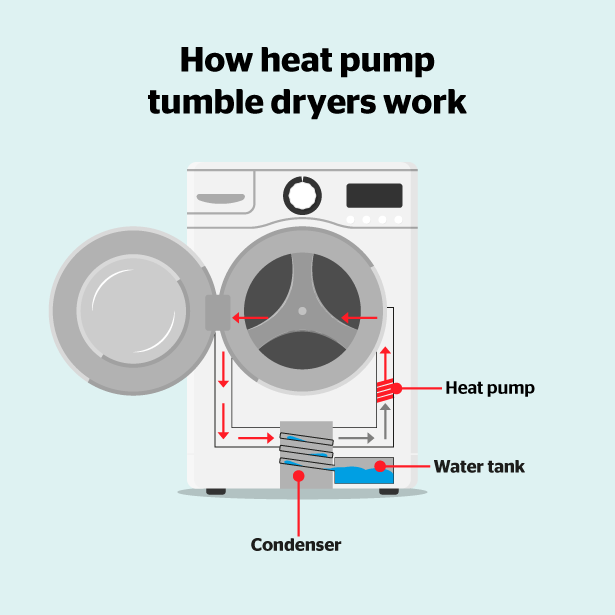
It's because they are cooling air to dehumidify it (the drying part), then they pump the heat back into the same air to circulate back into the wet clothes.
Units that have the radiator/compressor outside are 3-5x the price, and are hard to find.
[0] https://www.rheem.com/products/residential/water-heating/hyb...
I know many utilities in my area have a program you can sign up for where they will cycle through the registered AC units to balance out peak load in the summer. I'm not entirely sure how they manage that, I suppose they have to have some sort of sensor switch they install in your circuit.
This is inefficiently attempting to solve the problem in the same way while trying to maintain that flat electric rate. We need to get past the idea that electric rates must be flat.
I'm not aware of anyone that does minute to minute electricity pricing, but I know for many utilities you can sign up for alternate price schedules that have different rates based on the time of day.
I would guess as much as anything it's a metering issue.
That's better than 24/7 flat, but is not a solution for dealing with spikes in demand or fluctuations in supply. Minute-by-minute spot pricing is the solution for that. With the ubiquity of the internet, and low cost for IoT, it's feasible, practical, efficient, and effective.
Based on the website it looks like Griddy is something you can just sign up for and then your bill will be routed through them somehow? How does that work? Who maintains the infrastructure?
By your description it sounds you guys in Iowa have a regulated market. There you have a vertically integrated electric utility company who does everything from generation to line maintenance and billing with oversight from a public regulator.
In a deregulated electric market you have separate generator companies who sell wholesale electricity to retail energy suppliers who sell it on to end customers. Transmission companies maintain the grid infrastructure and they are paid by the other participants for this service. This scheme when it works right can result in more competition and thus better efficiencies.
This page seems to explain it quite nicely: https://infocastinc.com/market-insights/solar/regulated-dere...
Would you consider electric showers an exception? They only heat whatever water you're using. I've lived in houses with no hot water in the taps for months, but could still take a hot shower whenever.
Burn gas at the plant to heat water to run steam through turbine to get electricity ... and then use electricity to heat water again? Just use gas at the end point.
Getting heat from fuel (or sun) is easy and efficient. Converting it to electricity isn't.
If electricity comes from a non-fossil-fuel source - it is even more expensive/valuable.