Frankly, this is a stupidly obvious idea, and in retrospect we'll all be baffled why this wasn't routine years ago.
1. Consumer electric rates were set by law
2. Utilities were obliged by law to provide whatever electricity consumers demanded at that rate
This meant that utilities had no choice but pay whatever Enron demanded and resell to consumers at a massive loss. This ridiculous catastrophe was entirely a construction of the electric regulatory framework.
It doesn't have any resemblance to what I proposed. What I propose is more akin to how gas pump prices vary every day. Note that there are no laws setting the price or distribution of gas. When there were (back in the 70's) the result was LOOOONG gas lines. The Enron fiasco and the gas line fiasco are prime examples of what happens when government tries to centrally plan pricing and distribution.
With gasoline, you can wait and shop around; if a station tries to gouge you you can see if you can get a lower price down the block. The power grid has to be balanced on a continuous basis, and if it's out of balance, the grid operator has to obtain power immediately.
The power grid requires careful management. Call that "regulation" if you like, but it isn't optional.
Note that Reagan's first act as President was to repeal all oil and gas price and distribution controls, and the gas lines evaporated literally overnight. Yes, I was there and remember it :-) We've had a number of oil crises since, but no gas lines.
Many places that enable spot price electricity contacts for consumers have other kinds of contacts available too. Consumers who choose spot do it if they trust it's on average a win. There are also hybrid models where there is a price ceiling or other hedge.
Ironically they were the ones who set up think tanks that preached putting faith in the market to solve our problems for us - at least until they started getting undercut.
[0] - https://aemo.com.au/Energy-systems/Electricity/National-Elec...
We don’t need to live half our existence in “low power mode”, if we just made some simple rational decisions.
https://savings.austinenergy.com/rebates/residential/learn/m...
> What Is the Power Partner Program?
> The Power Partner Program is a community-wide coordination of air conditioning usage that allows Austin Energy to manage energy use during peak summer days when it matters the most.
> During a Power Partner event Austin Energy will adjust the temperature setting on your Internet-connected thermostat. Temperature adjustments up to four degrees reduce usage when the energy and cost savings are needed the most community-wide, yet do not significantly impact comfort.
It's not market-based in the way you're talking about (real-time price being pushed through to the consumer), but it may be market-based in a different way. The same page goes on to say it "helps lower the overall cost of electricity in the community". So I assume the utility uses it to reduce how much electricity it has to buy at peak prices.
Another complicated bit of clumsy silliness is cap-and-trade. The straightforward way is just tax the carbon.
They do even much more than what you describe like providing electricity realtime from the best supplier depending on various factors like price and climate friendliness in a given time.
That's good. This can be objectively determined with things like a tax on emitted pollution, which goes into the price of electricity provided, and then the utility can simply buy the cheapest.
Gas prices at the pump is pretty bad example. Varying electricity prices are build on shifting demand by few hours. Gas prices are unpredictable and you cannot really shift demand much, and prices swings can last years.
> calling it “battery”
I did put it in scare quotes, because although it is not an actual battery because it does not store/release charge, it serves the purpose of one.
Your plan could still work, but I think that the water heater is its best target, and that much of the savings goes away once you factor in that constraint.
I think that there are many opportunities to improve by thinking along those lines though. For instance, I always thought it was weird that the grocery store I worked at ran the refrigerator compressors even when it was cold outside.
That's the beauty of using price as a signal. People's self interest does the rest.
Markets are far too complex to be coordinated by central planning.
Not sure if it is still available.
Edit: it is, but requires special meters at the premises.
I live in a country with a struggling national power grid as people have come online faster than the utility could service old and build new powerstations. The blackouts or load shedding are not as frequent as a decade ago but we've learned to live energy cheap.
I don't know how efficient a houseful of IOTs can be, but I don't want one.
Second question: what's to keep my neighbor(s) from ignoring efficiency in favor of demand. So I'm doing without lights while they party on. (Please don't say regulations.)
The Nest thermostats come to mind.
> what's to keep my neighbor(s) from ignoring efficiency in favor of demand
He gets to pay the price for it. It's the same thing that prevents him from buying fuel guzzling cars. (Note that sales of guzzlers inversely track pump gas prices.)
Price fixing by the government has the perverse effect of continually causing demand to outstrip supply - rolling blackouts, shortages, rationing, etc.
Your usage of dollars indicates you live in the US. I hate to tell you but your definition of "economic" is probably not sustainable. Your price of electricity would probably double or even triple when switching to (cheap) renewables.
Finally someone who recognized that renewables are a magnitude more expensive instead of the usual "muh, renewables are cheaper!" fallacy. Look at the typical price per kWh in Germany (around 32ct/kWh) and tell me again how that is cheap...
I guess in warm climates / seasons that is probably a net benefit, but I've noticed our electric co-op also promotes highly-insulated electric water heaters instead of heat pump water heaters.
Not sure what I think of it all. We have an electric water heater and at first I was grumpy about the relative cost to run relative to natural gas, but I've come to terms with it. It's about the simplest device possible, and that has some value I think.
A heat pump would use some of that energy to capture some more from a heat source (outside air, or geothermal, ground temperature). It gets less efficient as the heat source becomes cooler, so it might not be such a good idea in very cold climates. Theoretically, though, it shouldn't get lower than 100%, and efficiencies can reach 300% pretty easily.
I haven't done an extensive search on the topic, here is one of the first sources I found with the kind of graph I wanted: https://www.nordicghp.com/2017/01/heat-pump-effective-temper...
I read about 270% at -4°C (25°F). 1 watt of electricity in, 2.7 watts of heat out, not bad. The same graph reads about 480% at 18°C(65°F), and 150% at -20°C (-5°F). I know that gas heat pumps exist as well, and some systems are hybrid, so it sounds like a no brainer to me. On the flip side, they can be quite expensive, so do your calculations relative to the temperature history, and hourly electricity hours. It would be more efficient to heat when the air is warmer during the day (assuming air pump), and combine that with a well-insulated house.
Solar (thermal or electric) is pretty interesting too, I wonder what kind of efficiency one can get with photovoltaic + heat pump (photovoltaic is more versatile, being more useful during summer).
Correct. Every heat pump water heater I've ever seen has the heat pump directly on top of the water tank. It's possible they make ones that tie into an external heat pump, but I've never seen one.
Heat pumps make little sense if you don't have access to a thermostatic source, or indeed any "free" heat source.
Generally utility rooms in houses have a decent amount of waste heat anyway from being near the furnace, so it probably does work out decently a lot of the time.
My in-laws have a heat pump water heater and it makes their basement noticeably colder in the summer, which is pretty nice.
It's because they are cooling air to dehumidify it (the drying part), then they pump the heat back into the same air to circulate back into the wet clothes.
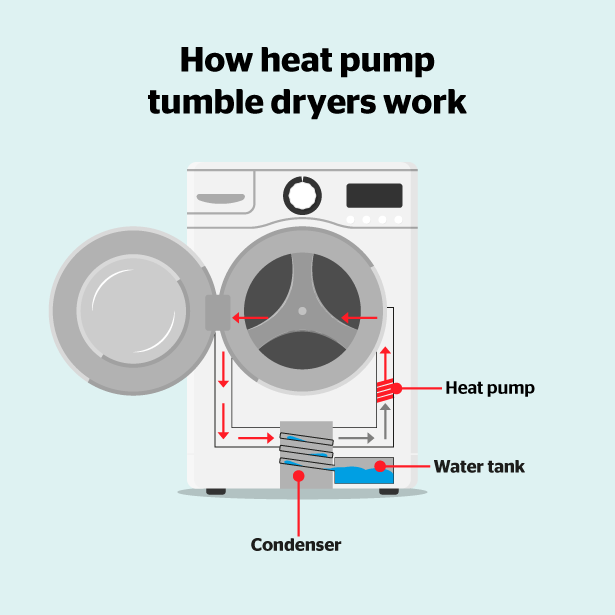
Units that have the radiator/compressor outside are 3-5x the price, and are hard to find.
[0] https://www.rheem.com/products/residential/water-heating/hyb...
I know many utilities in my area have a program you can sign up for where they will cycle through the registered AC units to balance out peak load in the summer. I'm not entirely sure how they manage that, I suppose they have to have some sort of sensor switch they install in your circuit.
This is inefficiently attempting to solve the problem in the same way while trying to maintain that flat electric rate. We need to get past the idea that electric rates must be flat.
I'm not aware of anyone that does minute to minute electricity pricing, but I know for many utilities you can sign up for alternate price schedules that have different rates based on the time of day.
I would guess as much as anything it's a metering issue.
That's better than 24/7 flat, but is not a solution for dealing with spikes in demand or fluctuations in supply. Minute-by-minute spot pricing is the solution for that. With the ubiquity of the internet, and low cost for IoT, it's feasible, practical, efficient, and effective.
Based on the website it looks like Griddy is something you can just sign up for and then your bill will be routed through them somehow? How does that work? Who maintains the infrastructure?
By your description it sounds you guys in Iowa have a regulated market. There you have a vertically integrated electric utility company who does everything from generation to line maintenance and billing with oversight from a public regulator.
In a deregulated electric market you have separate generator companies who sell wholesale electricity to retail energy suppliers who sell it on to end customers. Transmission companies maintain the grid infrastructure and they are paid by the other participants for this service. This scheme when it works right can result in more competition and thus better efficiencies.
This page seems to explain it quite nicely: https://infocastinc.com/market-insights/solar/regulated-dere...
Would you consider electric showers an exception? They only heat whatever water you're using. I've lived in houses with no hot water in the taps for months, but could still take a hot shower whenever.
Burn gas at the plant to heat water to run steam through turbine to get electricity ... and then use electricity to heat water again? Just use gas at the end point.
Getting heat from fuel (or sun) is easy and efficient. Converting it to electricity isn't.
If electricity comes from a non-fossil-fuel source - it is even more expensive/valuable.
Some "batteries":
1. hot water heater
2. HVAC system
3. EV charging
4. Some lights (like yard lights) can be dimmed or shut off during rate spikes
5. Same for street lighting
6. Computers can switch to low power mode
7. Refrigerators
8. Dryers
This is far better than the "rolling blackout" bureaucratic solution.
Note that the pump price of gas varies daily. This is the market reconciling constantly shifting supply & demand, and it works great.