The problem is that there is no coordination of the people to actually change the status quo. Too many people are still content with it. From both sides movements like BLM, Antifa, Occupy, the Tea Party, the alt-right, etc represent at most a tenth of the nation. And by-and-large the other 80% not participating in political activism at all largely either A. don't believe in the ability to organize a movement for change or B. don't want it at all.
This is not to say it would not be in the self interest of a vast supermajority of Americans to seek such change - for example, universal public healthcare would be a tremendous boon to like 4 in 5 people at least. Better elections, with election day being a public holiday, universal mail in voting, and any of the myriad alternatives to first past the post voting would all improve the conditions of like 95% of the country. The problem is that most people were taught and conditioned to be non-participatory and largely will not become so no matter what anyone else does or says . Even if things did get bad. Even if there were tangible impacts to their day to day experience. Conditioning is an extremely potent force and a combination of American corporate news, American public education, the cultures of swathes of the country raise their kids on, the material conditions you live through and your life experiences within them, etc all contribute to the apathy and attitude.
Thankfully the dial is moving in a positive direction, I think. Anyone under the age of 40 to greater and greater degrees was unable to grow up in an isolated microcosm of Americana that conditioned them into non-participation. The numbers still aren't great, but they are getting better, and unless we see systems collapse take us all offline it will hopefully keep improving moving forward, albeit centralized private social media has done a lot last decade to stymie progress.
I believe America is desperately in need of voting reform. And I believe the only way to achieve that is by voting against the establishment. I won’t be voting left or right this election. I’ll either be voting third party or writing in a strong left/right P/VP ticket.
Which is exactly why it will never happen - both major parties enjoy their power duopoly. The powerful always resist democracy because it takes their power and gives it to the people, be they monarchs, corporations, or political parties.
BS. Americans will happily send half their disposable income to Amazon in the name of convenience.
There is such a thing as coordination, and it's not always easy.
We don't have strong enough democratic social and labor movements that can move the needle yet. If we abandon the individualistic frame, we begin to see the necessity of joining political groups and regularly discussing our problems and how we can try to solve them, sometimes by coordinating with coalitions of groups to increase power.
Grainger. Especially if you're doing commercial shopping and need stuff to actually idk maybe do what it says and not be counterfeit.
I know i know they seem like a dinosaur, their catalog is a disaster and it seems impossible to find a real price. Thats all true, but theres a reason they obfuscate themselves. They’re a walled garden but once you're in its living in the future where this whole amazon problem has already been solved going on decades now!!! Its kinda like walmart to sams or target to costco. But grainger isnt owned by amazon, theyre direct competition and I’d wager if the hn crowd had our way and put consumer pressure on them to expand their market and made them know of our capabilities in helping them expand that vision, that grainger would pivot in a heartbeat to be more common consumer friendly. ... and then maybe we could have a little bit of peace.
But seriously their worth checking out.
That's why I like advocating for it in local elections - it leads to a more wide awareness of the advantages of the system in the minds of electorates.
As an Australian, it makes perfect sense to me.
1. It's held up that it would disenfrancbise voters
2. Tradition (essentially) something being unconstitutional in the US has morphed into an extremely radical idea in the minds of most Americans - the electoral college is established in the constitution, but the US has revised that a bunch of times over it's history including the "undo" amendment (the 21st)
Do you see a possible path for something like IRV nationwide?
That being said, the major issue with relying on states to do this, is that the first states to do this will probably lose out. In a parallel universe with orange and green parties, if, say, the orange state decides to move to proportional electoral college but the green state does not, then the green party will benefit because they get both split votes from the yellow state and the total votes for the green state.
I'd really like to see the US have regional and balancing seats in congress - the former tied to districts and the latter allocated to maximize the correctness of the representation - so maybe the Purple wins all the races in Maine but Green had 40% of the vote in both races - Green would gain a non-regionally tied house seat[1] while purple gets both of the regional seats.
1. Potentially seats depending on how national elections go
The problem with doing it with proportional voting is that you need every single state on board; any state still doing winner-takes-all has much greater power.
Additionally, as long as that proportion is significantly high enough (say above the 66% mark) the two parties that were partially disenfranchised would still be left sharing a strong majority in the house between them and, if something similar happened with the senate, they could coalition up and force through a congressional amendment that would bring the remaining portion of the country in line for the next election.
The Interstate Voting Compact couldn't be precisely similarly applied to congressional elections, it'd need more momentum behind it, but there is a way for the math to work out.
All that said, IANAL and I have no idea if the legal shenanigans used to make the IVC binding could also be utilized for a similar movement around the house and senate.
I would love to see IRV in both places though as it would be nice to see something other than a Liberal or Conservative PM. Near miss with the NDP a few years back.
Canada once had at least 18 active parties, and is now down to five, even with a system that encourages more coalition-building than its neighbor to the south. Eventually it will become two.
As a Canadian - Canada is slipping into a two party system. There are, weirdly, regional variations of parties - that tends to lead toward the appearance of wider representation. I'm in BC and our conservative party is the Liberals while our liberal party is the NDP - with the greens eeking out a few seats on the sunshine coast and occasionally vancouver island in most elections - it's basically a two horse race provincially between the Liberals and the NDP. Since the Conservatives have essentially no chance of winning all their voters jumped on the Liberal bandwagon and made that party conservative (as evidenced by the pro-life Liberal candidate who recently described contraception as a form of eugenics).
BQ is an interesting party that mostly exists because QC still kinda wants to be independent, and the greens essentially don't exist. The same is essentially true of the NDP when it comes to the national elections - please just look at these results[1] with the Liberal party at 157, the conservatives at 121 and the next most represented party at 32 (up 22 seats over the last election) - Canadian elections are essentially a two horse race and a lot of Canadians that aren't already in "safe" NDP, BQ or Green districts end up voting strategically for Conservatives or Liberals - whichever they hate less.
Oh also there's the PPC but honestly they're a joke - I still think they should have a few MPs though (technically, five seats) - they did carry 1.62% of the national vote in a country where an MP represents .3% of the country. Here's a graphic demonstrating the full skew of voting in Canada, it's not nearly as minor as you might think[2].
1. https://en.wikipedia.org/wiki/2019_Canadian_federal_election
2. https://www.fairvote.ca/wp-content/uploads/2019/12/Canada-vo...
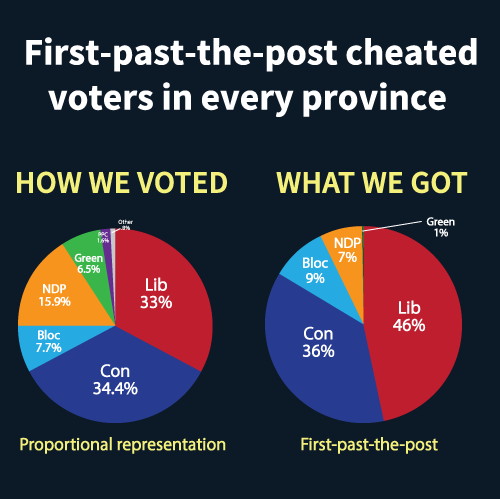
The Canadian system has you pick your local representative for your riding (MP) and the party with the most MPs, traditionally™, gets to make their leader the Prime Minister. The popular vote is irrelevant because the popular vote is not how Canadian elections are 'scored.' At all, really. Each race is a race for your specific representative. That it's correlated with the PM-ship is ancillary, since even a plurality of seats doesn't guarantee your party ends up picking the PM. A coalition of two smaller parties can band together and unseat a plurality party for the PM role. A Conservative-NDP coalition (haha) could have installed Scheer as PM after the last selection. A Conservative-Bloc coalition could have done so too. And a Liberal-NDP coalition could have installed Trudeau as a majority leader in the last election.
In the US, they have FPTP voting specifically for their head of state, which is where the rub lies. You have a poll for who should be in charge, but you weight the votes differently depending on which state those voters happen to reside in, and throw some of them away (via FPTP). This is intentional, to ensure that rural states have outsize representation. A good idea? Maybe not, but it's no mistake.
[edit] Re: the BQ, they've started campaigning not on separatism but on social issues, it's cool to see honestly.
If you instead awarded EC votes proportionally, you'd largely wind up aligning with popular vote entirely. It'd also make more states more competitive, since it is much easier to move the margin on one electoral vote rather than say 55.
No, it doesn't. The US has indirect elections for the head of state, but the body which directly elects the head of state literally does nothing else.
The results are passed on via electors, but most electors are bound by law to vote alongside the popular vote of the state. Even when not bound, they have almost exclusively done so, making this particular fact more of a technicality.
An indirect analogy based on the Canadian system, for instance, would be whichever party in the House has the most seats gets to put their leader in the President role. I would consider that to be "indirectly."
Canadians are never asked "Who should be Prime Minister: Justin Trudeau, Andrew Scheer, Jagmeet Singh, Elizabeth May or Yves-François Blanchet?" Parliamentary procedure dictates that.
They don't, though, they vote for (mostly, there's a few exceptions) statewide slates of electors.
> Americans are picking on the ballot between "Trump" or "Biden," not "Republican Elector Steve Ruralson" vs "Democrat Elector Bill City-Slicker."
But that's because the ballot is a lie.
The distinction you're highlighting is a very important piece when it comes to discussing election reform, but I think it's better to classify it as an inaccuracy in the manner in which the electorate votes for the head of state - rather than as the electorate not voting for a head of state.
https://www.cbpp.org/research/state-budget-and-tax/a-punishi...
The problem is corruption and collusion between the parties to maintain the two party tyranny.
You can educate everyone to a PhD in political philosophy or political science for free and it would not noticeably change things unless they're willing to coordinate to vote for a third party (assuming that they can get the votes to change the system everywhere, which they probably can't) or pick up a rifle to break up the two party tyranny by threat (or enactment, should the powers that be not go peacefully) of force.
Do I need more proof that defunding education was a bad thing?
(mine doesn't for a different reason since I'm a foreign citizen)
That's the idea at least, and I think it's worth considering. But yes, speaking as someone looking in to the US from outside, a more proportional voting system would also do wonders for your democratic legitimacy.
The average IQ is 100 - do you consider the capabilities of a person with less than 100 IQ (half the population) to be capable of being informed by your definition of informed? Does a person with less than 100 IQ want to be educated by your definition of educated?
---
Alternative theory regarding power/politics:
The only thing that's happened in the last 100 years as far as I can tell, is introduction of new ideas has outpaced the human birth/death cycle in most places on earth.
When this happens, people who utilize new ideas to gain power are at odds with people who already have power but aren't ready to transfer it using the natural birth/death cycle.
This causes a great deal of friction. If you don't want the friction to be lubricated by human blood, those who have power need to have the humility to step down and let the younger generation utilize new ideas to keep things moving.
American politicians are incredibly arrogant, they think the populace is going to put up with another 4-8 years of 70+ year old dinosaurs and their dinosaur friends in Washington fine dining their country to irrelevancy. Hopefully we don't end up using human blood to resolve this friction like we've done historically.
If one would accept this description, and I think that it's appropriate from a literal reading of democracy, then wouldn't the structure you're describing where you can only have power if you're a millionaire and you are incentivized not to use it to express the power of the many, lack the emergent attribute of being democratic?
Over last few decades the democratically elected government has been retreating from providing public goods and services. It may or may not have been meticulously engineered but the US is now at a point where just about every aspect of services and goods has been privatised.
It is assumed, at least as per the PR, that free markets are more effective and efficient than elected government in discharging public goods and services. And the government's role has reduced to maintain the quality of the USD currency. Housing, , health, transportation, education, law enforcement, national security and military, public safety -- just to name a few -- have all either been fully privatised or almost there.
Given this, to what extent can public influence the way things are run? The public get one chance in five years to choose a government which has anyway privatised much of its functions. To add to that the political parties get non-trivial funding by these private corporations.
1) You'd be surprised by what people want. As a background principle, Americans don't like government and don't like government regulation: https://news.gallup.com/poll/243662/americans-worry-less-gov.... The percentage of people who want more regulation "of business and industry" hovers around 25%. Even during most of the George W. Bush presidency, those who wanted less regulation substantially outnumbered those who wanted more. Folks who wanted less regulation outnumbered those who wanted more 2:1 in Obama's first term.
The percentage of people saying the federal government has "too little power" has been under 10% over the last 20 years. Since 2005, a majority has said the federal government has too much power.
2) People might want something in the abstract, but that doesn't mean they support a specific implementation with specific trade-offs.
As of 2007, a majority of Americans said they wanted government to guarantee healthcare: https://www.nytimes.com/2007/03/02/washington/02poll.html. but look at the question more carefully: "Americans showed a striking willingness in the poll to make tradeoffs to guarantee health insurance for all, including paying as much as $500 more in taxes a year and forgoing future tax cuts." $500 is just 1.5% of the median individual income. That's not nearly enough to actually pay for European-style universal healthcare.
Unsurprisingly, support for the Affordable Care Act started out well under 40%: https://www.wsj.com/articles/recent-warmth-toward-affordable.... Opposition to the law didn't outweigh support until 2017. And as a result of Democrats pushing through the ACA, Republicans gained 63 seats in the House (a gain bigger than the 2016 "blue wave"). Democrats started out with large majorities of the Senate and House in 2008, and by 2014 Republicans had flipped the situation, with Democrats losing 13 Senate seats and 69 House seats.
In another example, if you asked people in 2008, most Obama voters would have said they wanted clean power. But they don't actually want to pay more at the pump or a higher electric bill. Hence Obama taking credit for fracking a major achievement of his administration: https://apnews.com/article/5dfbc1aa17701ae219239caad0bfefb2
3) Americans really hate taxes: https://news.gallup.com/poll/268295/support-government-inche.... Even in 2019, when 39% of people say they support "socialism" just 25% want a combination of "more [government] services" and "more taxes." (This is an all-time high! It didn't clear 20% from 1993 to 2013.) Meanwhile, 42% want "less services" with "less taxes."
4) People don't necessarily want the same things. Just because 55% of Americans want A and 58% want B, that doesn't mean there is a voting block comprising a majority that wants both A and B.
5) People who agree on a problem don't necessarily agree on a solution. The majority of Americans think income inequality is a problem: https://www.pewsocialtrends.org/2020/01/09/most-americans-sa.... But people don't necessarily agree on what causes income inequality and what the solution should be. Democrats want a big government to redistribute income. Republicans want to earn their money, and think that big government creates opportunities for the super-rich to earn income unfairly.
6) America is a Republic, not a Democracy. Elected representatives must balance (1)-(5) to give people what they want, not what they say they want. America makes way more sense if you realize that the government we have is what we can achieve with how much we're willing to pay (not that much) and how much we trust the government to do the right thing (not that much).
The republic versus democracy point is relevant here for a practical reason, not an ideological one. In a direct democracy, citizens can vote on each issue independently of the others. In a republic, they have to pick representatives that don’t necessarily have the exact same mix of preferences, and those representatives are organized into parties. That produces compromises that don’t need to happen in a direct democracy. For example, a major cleavage line in American politics is race. That splits the working class vote between Democrats and Republicans. And it also splits the religious conservative vote. For example, likely voters support the Hyde Amendment (which bans federal funding of abortions) by a 20-point margin: https://slate.com/news-and-politics/2019/06/joe-biden-hyde-a.... But Joe Biden now supports federal funding of abortions. Thats because the social conservative block is split between the two parties. Conservative Hispanic and especially Black people often vote Democrat for other reasons. In a referendum, federal funding of abortion would be easily defeated. But in a system of representative government, it could become law.
Many other issues split this way. Over 60% of people support eliminating qualified immunity (which shields police from lawsuits) and limiting police union power. In a direct democracy, these issues would win easily. But support for these policies is split between the two parties. Moreover, the parties vigorously disagree about how city mayors handled the protests and riots this summer. So discrete issues like these where there might be bipartisan agreement get sucked up into a larger ideological dispute about when violent protests are justified in reaction to police brutality.
https://www.cnbc.com/2018/08/28/most-americans-now-support-m...
https://www.kff.org/slideshow/public-opinion-on-single-payer...
https://fivethirtyeight.com/features/medicare-for-all-isnt-t...
Also it's not like those old farts in the congressional seats lift their pens to write laws. They have a team of policy wonks that do that for them. They just present it in the respective chambers to play along with the charade. If you email your senator directly, it's going to be a staffer that fields the email, addresses your concerns, types up a response, and signs the senator's name in the signature.
Anyone who has lived on the Hill for any amount of time know what really makes this country churn, and it isn't the public faces.
I know people on both far-left and far-right who are just as Thompson describes: upset about any concentration of power, whether political, commercial, or religious. Does that mean they refuse to buy internet service or take medicine? The connection you draw seems nonsensical.
I, personally, loathe concentrated power. I, personally, pay an egregious sum of money for a half-terabit internet connection. That price, and my lack of options, is one symptom of the very issue at hand! Since I alone am unable to change the status quo, I pay what is required of me and grumble about it using that very service.
You describe the status quo as evidence that not one single person fits the description, then go on to demonstrate that you yourself seem to fit the description.
As far as hatred of monopoly being a long trend in America, the original birth of this country had avoiding aying tea in Boston Harbor to setting up three distinct branches of government, the rejection of monopoly and concentrated power was, as Thompson reminds us, a habit and tradition.
A significant portion of American's would find this too close to socialism and with too much government involvement for their tastes, even though they would be far better off with these perks. It's depressing how much worse off they would rather be than to have these regulations and government controlled benefits.
> control the flow of every single bit of information we see and hear online
That has to be a gross hyperbole, right? Realistically I highly doubt it even comes close to 50%
Singapore, for what it's worth.
In what country does the author live?
Americans are so used to concentrated power that they don't bat an eye when they need to pay $100/mo for DSL, $2500 for an ambulance ride, or 1000%+ retail cost on lifesaving medication. Or when their boss (usually acting in the capacity of a multi billion dollar conglomerate) insists they pee into a cup or be constantly tracked and spied on in their workplace. Or when a single company siphons 100+ basis points off their tax payment (Lockheed, military budget). Or when we allow a handful of private companies to put human beings into prison. Or when five companies own nearly all television output. Or when three companies decide arbitrarily whether we can participate in the financial system (credit ratings). Or when 2% of every single transaction goes to one of two companies (Visa or MasterCard). Or when billions of dollars are spent each election cycle by only a handful of players. Or when a handful of individual bankers destroy the entire country's pensions and retirement funds, and are rewarded millions of dollars for it. To Americans, ceding power to a entity controlled by a half dozen stupendously wealthy shareholders is as natural as breathing.
Or, yes, when two companies (for most, just one company) control the flow of every single bit of information we see and hear online (Facebook or Google). Our allergy to concentrated power is the same one that a patient dying of AIDS would have against influenza. Though, let's be fair: HIV is a pre-existing condition.
This lawsuit probably sputter, though, because it doesn't adhere to the working legal definition of monopoly. Which itself suffers from the same blindness to power shared by the super-majority of Americans.
New laws for a new era? Look at who is on the judiciary. Look who is writing laws. Look at -- oh who am I kidding. We have made our choice the past few decades, and we are making our choice now.