Canada once had at least 18 active parties, and is now down to five, even with a system that encourages more coalition-building than its neighbor to the south. Eventually it will become two.
As a Canadian - Canada is slipping into a two party system. There are, weirdly, regional variations of parties - that tends to lead toward the appearance of wider representation. I'm in BC and our conservative party is the Liberals while our liberal party is the NDP - with the greens eeking out a few seats on the sunshine coast and occasionally vancouver island in most elections - it's basically a two horse race provincially between the Liberals and the NDP. Since the Conservatives have essentially no chance of winning all their voters jumped on the Liberal bandwagon and made that party conservative (as evidenced by the pro-life Liberal candidate who recently described contraception as a form of eugenics).
BQ is an interesting party that mostly exists because QC still kinda wants to be independent, and the greens essentially don't exist. The same is essentially true of the NDP when it comes to the national elections - please just look at these results[1] with the Liberal party at 157, the conservatives at 121 and the next most represented party at 32 (up 22 seats over the last election) - Canadian elections are essentially a two horse race and a lot of Canadians that aren't already in "safe" NDP, BQ or Green districts end up voting strategically for Conservatives or Liberals - whichever they hate less.
Oh also there's the PPC but honestly they're a joke - I still think they should have a few MPs though (technically, five seats) - they did carry 1.62% of the national vote in a country where an MP represents .3% of the country. Here's a graphic demonstrating the full skew of voting in Canada, it's not nearly as minor as you might think[2].
1. https://en.wikipedia.org/wiki/2019_Canadian_federal_election
2. https://www.fairvote.ca/wp-content/uploads/2019/12/Canada-vo...
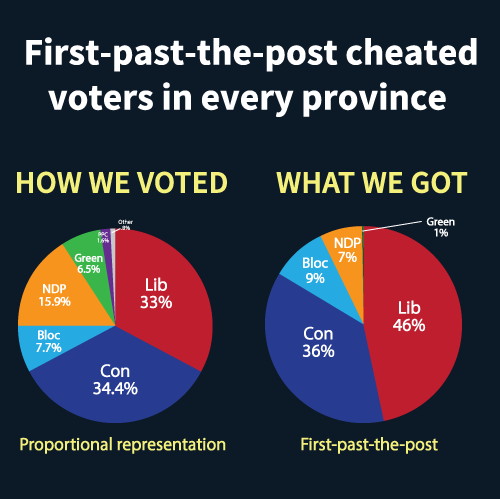
The Canadian system has you pick your local representative for your riding (MP) and the party with the most MPs, traditionally™, gets to make their leader the Prime Minister. The popular vote is irrelevant because the popular vote is not how Canadian elections are 'scored.' At all, really. Each race is a race for your specific representative. That it's correlated with the PM-ship is ancillary, since even a plurality of seats doesn't guarantee your party ends up picking the PM. A coalition of two smaller parties can band together and unseat a plurality party for the PM role. A Conservative-NDP coalition (haha) could have installed Scheer as PM after the last selection. A Conservative-Bloc coalition could have done so too. And a Liberal-NDP coalition could have installed Trudeau as a majority leader in the last election.
In the US, they have FPTP voting specifically for their head of state, which is where the rub lies. You have a poll for who should be in charge, but you weight the votes differently depending on which state those voters happen to reside in, and throw some of them away (via FPTP). This is intentional, to ensure that rural states have outsize representation. A good idea? Maybe not, but it's no mistake.
[edit] Re: the BQ, they've started campaigning not on separatism but on social issues, it's cool to see honestly.
If you instead awarded EC votes proportionally, you'd largely wind up aligning with popular vote entirely. It'd also make more states more competitive, since it is much easier to move the margin on one electoral vote rather than say 55.
No, it doesn't. The US has indirect elections for the head of state, but the body which directly elects the head of state literally does nothing else.
The results are passed on via electors, but most electors are bound by law to vote alongside the popular vote of the state. Even when not bound, they have almost exclusively done so, making this particular fact more of a technicality.
An indirect analogy based on the Canadian system, for instance, would be whichever party in the House has the most seats gets to put their leader in the President role. I would consider that to be "indirectly."
Canadians are never asked "Who should be Prime Minister: Justin Trudeau, Andrew Scheer, Jagmeet Singh, Elizabeth May or Yves-François Blanchet?" Parliamentary procedure dictates that.
They don't, though, they vote for (mostly, there's a few exceptions) statewide slates of electors.
> Americans are picking on the ballot between "Trump" or "Biden," not "Republican Elector Steve Ruralson" vs "Democrat Elector Bill City-Slicker."
But that's because the ballot is a lie.
The distinction you're highlighting is a very important piece when it comes to discussing election reform, but I think it's better to classify it as an inaccuracy in the manner in which the electorate votes for the head of state - rather than as the electorate not voting for a head of state.
I would love to see IRV in both places though as it would be nice to see something other than a Liberal or Conservative PM. Near miss with the NDP a few years back.