News for hackers. Stuff that matters.
Re:Einstein's description of gravity just got much harder to... by jb775 on Saturday October 03, 2020 @01:33AM (#24669794)
During brainstorming sessions, I often think about why/how medieval artists couldn't quite grasp how to depict depth in their paintings (as a lateral thinking technique). Being humans living in the world, they obviously experienced and understood that depth existed all around them, but had a hard time grasping the concept as a whole. I feel like we're kind of in a "medieval depth" phase of gravity/spacetime understanding...it's literally all around us, we know something is there, but we can't quite grasp what it even is we're looking for.
Re:Einstein's description of gravity just got much harder to... by nestorD on Saturday October 03, 2020 @05:54AM (#24670877)
As others have said, I believe the lack of depth in medieval art is much more a matter of conventions than a matter of lack of theory or physical abilities (see [0]).

The one thing that convinced me of that is the sudden jump in realism in Egyptian art during the reign of Akhenaten (Amarna period, see the famous Nefertiti bust for a great example). The new king asked for more realism and he received it, it just took a reset in conventions.

[0]: https://en.wikipedia.org/wiki/Perspective_(graphical)#Early_...

Re:Einstein's description of gravity just got much harder to... by henriquemaia on Saturday October 03, 2020 @07:11AM (#24671204)
Don't take this personally. Your comment just gave me an itch I had to scratch.

There are some words in people's explanations that always bother me. These are 'just', 'mere', merely' and the like. Why? Because they're not explaining, but explaining away. It's like saying: x is trivial, so it's not as important as you think.

But reality is much more complicated than that. For even simple things are hard to fathom for those not knowing how simple it is.

Now, back to the topic: no, medieval painters' lack of knowledge on how use perspective was not just matter of being stuck at conventions. When everyone is expecting to see a certain thing and you're payed to do that thing, it's not 'just' up to the painter see outside her/his perspective. What I'm saying is that takes a huge leap to break away from all that.

Beware of just explaining away phenomena.

Re:Einstein's description of gravity just got much harder to... by Kednicma on Saturday October 03, 2020 @08:58AM (#24671747)
To expand on this, Pirsig tears apart "just" as a completely useless word which reaffirms the speaker's belief but also trivializes the listener's inability to understand. "just" comes from ancient Latin "ius" and it means "I swear" or "I believe". When somebody says "I was just doing something", they are swearing a light oath that they were doing something.

Back in context, what the parent is saying is that the grandparent provided a "just-so" story: The parent finds it easy to believe that history happened in a way which neatly lines up with the story that they are telling. Did earlier humans know about perspective? Grandparent believes that it's obvious.

Re:Einstein's description of gravity just got much harder to... by nestorD on Saturday October 03, 2020 @09:38AM (#24672013)
The word "just" in "it just took a reset in conventions" was intended as ironical (but it might not come across clearly in the text). A change of conventions is a large change that is no trivial matter to undertake.
Re:Einstein's description of gravity just got much harder to... by niho on Saturday October 03, 2020 @03:44AM (#24670349)
> I often think about why/how medieval artists couldn't quite grasp how to depict depth in their paintings (as a lateral thinking technique).

The explanation for that is generally agreed on to have more to do with the aesthetics of early Christianity influencing Medieval practices, more than changes to human perception (source: I have a masters degree in Art History).

Re:Einstein's description of gravity just got much harder to... by bsaul on Saturday October 03, 2020 @03:46AM (#24670361)
could you give more on that ? i can imagine how religious dogmas can influence a lot of things, but representation of depth ??
Re:Einstein's description of gravity just got much harder to... by alpha_squared on Saturday October 03, 2020 @04:12AM (#24670453)
Not OP, though mild experience with art history and Christian history, but I suspect OP is talking about the intersection of art and the prevailing religion in Europe at the time (Christianity). Early Christian art was intentionally unrealistic in style specifically because the intent was often symbolism and representation rather than realism (this still holds true today for most Orthodox Christian art[0]). In fact, making it realistic would even border on idolatry (see Iconoclastic Controversy[1]).

That said, up until the European middle ages, nearly all art was that which was commissioned by the church. The style of the time permeated the art that wasn't commissioned by the church. As more non-religious art was commissioned, there was little need to remain working in that style and realism was embraced. I could be wrong, and probably am, but I think Catholicism is the only large Christian denomination that adopted realistic art.

I think depth was already understood by this point, though (see sculptures[2]). Again, I'm not OP, and I'm sure OP will have a more thorough explanation.

[0] https://orthodoxartsjournal.org/topics/iconography/

[1] https://www.britannica.com/event/Iconoclastic-Controversy

[2] https://en.wikipedia.org/wiki/Victorious_Youth

Re:Einstein's description of gravity just got much harder to... by lloeki on Saturday October 03, 2020 @05:10AM (#24670685)
Good point. There’s also, to me, a perception of style and technique: there were a lot of stone-based art, made specifically to endure time. Bas-relief, a very fit approach of art for stone-based material had this specific style that got aesthetically and technically translated to paintings and stained glass, for an overall quite consistent style whatever the medium.

You can see the intent on many religious sculptures in medieval churches around e.g France: the technique is precise, so it’d be really easy for a sculptor to just compare and match to a living and breathing model, therefore they chose not to. Contemplating how churches tell stories through imagery, you can see how they used this style for emphasis on specific physical features to elicit strong emotional response instead, not entirely unlike those TVs in stores cranking up contrast to completely unrealistic levels.

Re:Einstein's description of gravity just got much harder to... by ajuc on Saturday October 03, 2020 @06:40AM (#24671078)
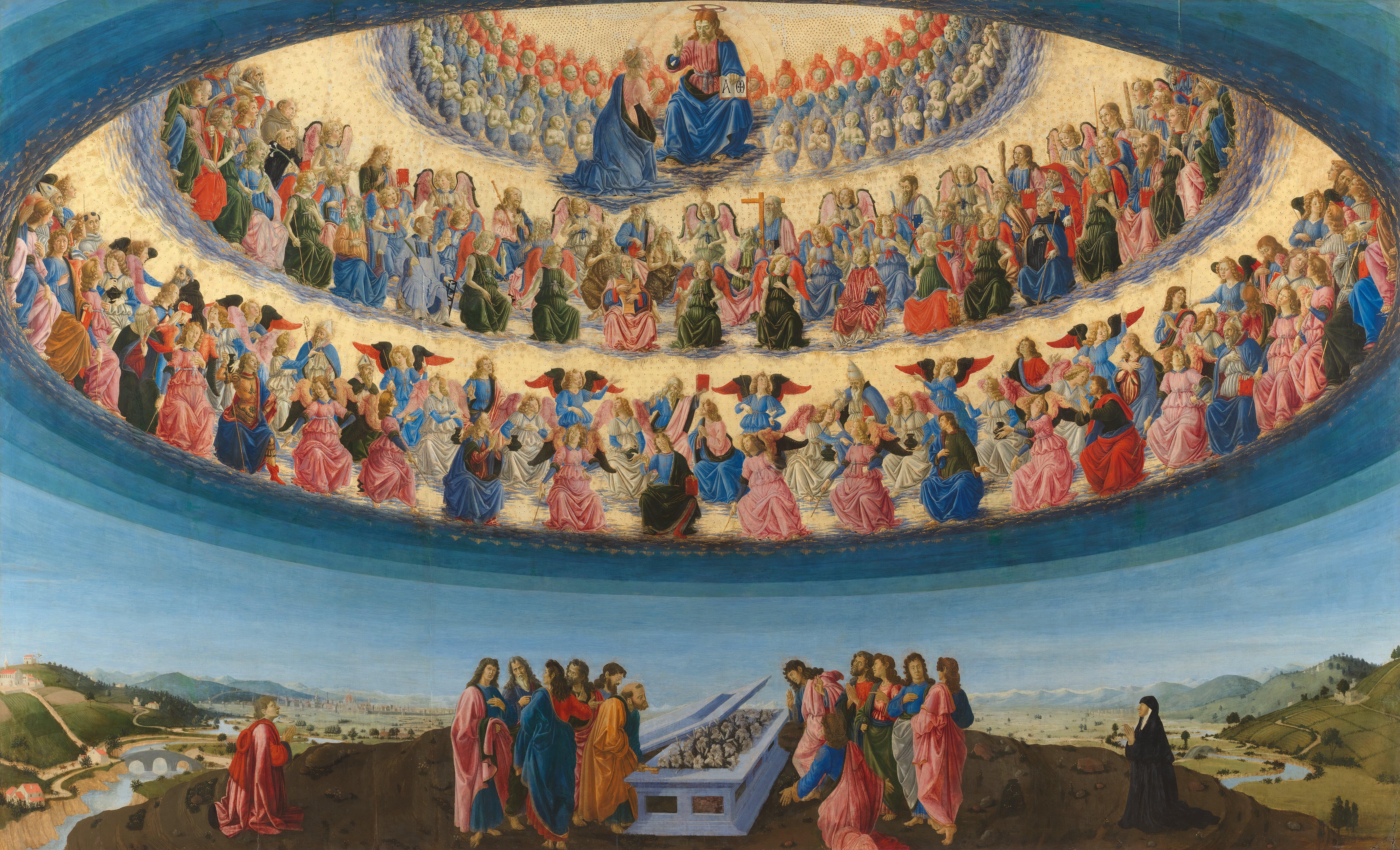
This [1] is a painting from 1476. Notice how architecture and landscape has depth, but people are all +- the same size except for Mary and God.

You wouldn't want to draw mere mortals bigger than saints just because they happen to be closer. Peasants (which couldn't read and were the main target of these paintings) could get wrong ideas.

https://upload.wikimedia.org/wikipedia/commons/f/ff/Francesc...
Re:Einstein's description of gravity just got much harder to... by hoveringhen on Saturday October 03, 2020 @07:50AM (#24671349)
Not exactly what they mentioned, but check this out [1]. It talks about the perception of time in the middle ages, and how merchant time slowly substituted the impractical notions of church time. A professor of mine who was talking about medieval paintings and their ideas of space and time suggested this paper.

[1] https://journals.sagepub.com/doi/10.1177/053901847000900411 - Church Time and Merchant Time in the Middle Ages - Jacques Le Goff

Re:Einstein's description of gravity just got much harder to... by scotty79 on Saturday October 03, 2020 @05:16AM (#24670710)
I think that art is just overwhelmed by fads. Artists are copying styles off of each other. It's true for any era. Egyptian drawings, medieval paintings, manga or holywood movies or internet memes.

Mimicking reality is rarely the goal that art is optimized for. It's mostly converging to local optimum of one of the current fads.

Re:Einstein's description of gravity just got much harder to... by ry454 on Saturday October 03, 2020 @03:18AM (#24670250)
Here's a possible explanation that I'd seen somewhere. Up until very recently, humans had had weak ability to think, especially abstract thoughts, and the phrase common today "just think about it", would be meaningless just a few centuries ago. Perhaps the concept of depth in those times would be similar in complexity to 4-dimensional structures today.
Re:Einstein's description of gravity just got much harder to... by imtringued on Saturday October 03, 2020 @04:44AM (#24670570)
That's completely wrong. Humans were just as smart 3000 years ago as they were today. The difference between today and back then is that people were much poorer and didnt receive an education. Their jobs were farming which didnt require things we consider essential like reading or writing which meant they stay unchallenged for their entire life. When you look at the rich elite or rich cities in the past then you see how small the difference between us and the people 3000 years ago is. They were just as smart but there were fewer of them. Nowadays everyone is educated and "rich".

You can still find people who are just as "unchallenged" as a medieval peasant today. Look in rural places of countries like china.

Re:Einstein's description of gravity just got much harder to... by GuB-42 on Saturday October 03, 2020 @07:42AM (#24671323)
Another big factor, I think is communication. Today, discoveries spread almost instantly, all over the world. But back then you had hard to copy manuscript and people had to meet in person using slow and dangerous transportation.

So I think ancient discoverers wasted a lot of time rediscovering things.

Re:Einstein's description of gravity just got much harder to... by cft on Saturday October 03, 2020 @05:01AM (#24670639)
This is a nice theory, but what is the proof? Were people just as smart 30,000 years ago? What about 300,000 or 3 million years ago? How do you set the time scale? When was the boundary when people became smart?
Re:Einstein's description of gravity just got much harder to... by tsimionescu on Saturday October 03, 2020 @07:08AM (#24671195)
We don't know exact dates of course, but looking at the works of mathematics and philosophy that have survived, we know for sure that humans were capable of abstract thought at least as far back as 4-5000 years ago (for example, during the construction of the Great Pyramid of Giza), and very likely even 12-13000 years ago (during the construction of the megaliths at Gobekli Tepe, for example). Furthermore, we can assume that some time must have passed between the first threads of abstract thought and any achievements due to it that would stand the test of time, though I don't think we can put any hard estimates on this time.
Re:Einstein's description of gravity just got much harder to... by PeterisP on Saturday October 03, 2020 @03:05PM (#24673989)
We can look at the genetic changes and timeframe of them, and how certain mutations have spread - novel changes in our species are not that frequent on the historical timescale. People 3000 years ago are the same with respect to their biology, so they have to be "just as smart"; hominids 300,000 years ago are different in some aspects so for them we can't really know how "smart" they were, perhaps they were as smart, perhaps they were not.
Re:Einstein's description of gravity just got much harder to... by roomey on Saturday October 03, 2020 @03:33AM (#24670308)
Plato? Socrates? Pythagoras?

I was an artist for a while. It wasn't that artists couldn't depict depth. Fashion, religious instructon, and to a lesser extent materials, is what decided which paintings and frescoes lasted the test of time.

Re:Einstein's description of gravity just got much harder to... by PeCaN on Saturday October 03, 2020 @05:40AM (#24670835)
Humans were actually incapable of abstract thought until hacker news invented it.
Re:Einstein's description of gravity just got much harder to... by lenkite on Saturday October 03, 2020 @06:09AM (#24670933)
There are mathematics texts from 8th century BCE: https://en.wikipedia.org/wiki/Baudhayana_sutras