I think Western Digital just made a year's worth of profits off of people who don't read spec sheets, and they have a plausible interpretation that would unfortunately will probably survive a court challenge. Western Digital has clearly taken the position that '5400 RPM' has always been a statement of disk I/O performance, never a statement about other characteristics, and so by saying '5400 RPM Class' they only mean the drive's I/O performance, not any of those other secondary characteristics that led to the uproar we're discussing.
Western Digital is in the wrong here — not for repricing 'cool and quiet' drives, but for communication — and should have just openly said:
"We're ending production of quiet-cool 5400 RPM drives in our consumer product lines. If cost is of most concern to your installation, our consumer products will continue to meet your needs. If heat and noise are of most concern to your installation, our professional products with WhisperDrive(tm) will continue to meet your needs."
EDIT: I also think WD should be publishing thermal characteristics, not just "watts used".
Exactly. The difference can be huge, even if the number of "dB" measured are the same, to the point that one would not recognize the noise of one running HD, whereas another could be extremely irritating.
There is an exact reason why: the curve of perception limits of our ears is not a horizontal line but a curve, where the higher power of the tone is needed when moving to the lower frequencies.
See: https://en.wikipedia.org/wiki/Equal-loudness_contour
Knowing that: 5400RPM == 90Hz; 7200RPM == 120Hz
The proper reporting of the noise levels would therefore be a noise histogram, or at least should include the frequency of the peak level and not be just a single number if one'd want to compare how irritating the noise is. And even a single histogram can miss the time component, as the noise with the main peak level at some frequency can also come in the waves, making it even more irritating, basically, the histogram of the histogram could also be needed to tell you what's going on.
Moreover, the said "equal-loudness contour" is not exactly the same for different listeners, and as a result different listeners could hear the same noise sources differently. E.g. my girlfriend and I hear the same noise sources (emitting different levels of noise over different frequencies) completely different.
In short, not having precise histograms and analysis simple "is it 5400 RPM" was a really useful information to know the expected noise characteristic of a HD. It's not an accident that these two became two different speeds with the expected use in different environments.
I've intentionally bought 5400RPM disks whenever it wasn't for some servers locked in the server rooms.
Edit (answering "floatingatoll"'s comment below): All the above should be an argument that: "“are they essentially silent from a few feet away”, which is often simple to answer given a drive to test" is not something that has the same answer for everybody. If I'm hearing the lower frequencies better than you, what is "essentially silent" for you can be very annoying for me, and that's why I'd need 5400RPM where you could tolerate 7200RPM. It's also an argument that the proper measurement could indeed be made to know what will be irritating for which person, but it's not common to be present even in the reviews, even less in the specs of the manufacturer. Which is again not surprising, as the frequency histograms sadly aren't common even in the reviews of the music equipment. Common consumers indeed prefer some simple "yes/no" verdicts ("is it quiet" enough), like the one "floatingatoll" below proposes. But such statements just aren't the answer usable for everyone -- that's anyway why the number for noise level is reported. But it's not enough. I know it firsthand, as I personally do hear better low level sounds than many people around me. What's "quiet" for them is "irritating noise" for me.
It's not regardless:
5400RPM == 90Hz
7200RPM == 120Hz
The human perception curve shows that the humans hear much better the sounds at 120Hz than at 90Hz,
https://en.wikipedia.org/wiki/Equal-loudness_contour
That means that for the same reported noise level of e.g. 30dB a 5400RPM drive is much more quiet for humans than a 7200RPM drive.
That is how the people recognized that these HDs aren't 5400RPM -- they sounded "too loud" so they took the sample of the noise and drawing the histogram they proved that the peak was at 120Hz.
As far as I know, nobody managed to produce a 7200RPM drive which does not have a peak at 120Hz. If you know some that doesn't have such characteristic, please write, everybody will celebrate that achievement.
Congratulations: Your idea is both technically possible and completely useless in practice.
Just like how internet speeds are advertised ("Up to 300 Mb/s").
Turns out that consumer protection laws are pretty useful.
Perhaps, with tongue in cheek, we could call this the p0 speed — as in it doesn’t make sense and it’s guaranteed that 0% of customers achieve it.
It's really really difficult to predict this statistically.
OTOH, there's a guaranteed minimum speed the ISP has to deliver.
If anyone wants to have an unfettered pipe then call up a Tier 1/2/3 ISP and ask for a commercial connection via a single-mode fibre, and be ready to pay quite a bit for it.
Such rules are not within the American Overton window for the usual reasons.
[0] https://www.broadbandchoices.co.uk/ask-our-expert/broadband-...
You might be surprised to find it surprisingly affordable. Cheaper than colocation, even.
Assuming you can easily get hooked up at a residential address. Perhaps if you live in an apartment/condo tower, then fibre may have already been run:
* https://www.fibrestream.ca/locations
Some random house, on some random street? Unlikely.
The community of Ammon, ID, built their own municipal fibre network because of this:
> It all began about seven years ago when the city government, suffering from horrible upload speeds, wanted a dedicated 100Mbps circuit between City Hall and the Public Works building, less than a mile apart. Qwest (now CenturyLink) didn't want the project, while Cable One offered to do it for a start-up fee of $80,000 plus $1,000 a month, Patterson said.
* https://arstechnica.com/information-technology/2016/06/what-...
At this year's (virtual) NLNOG there was presentation from a fellow who was fed up with slow Internet options in his rural Michigan county and so setup his own ISP by having fibre optic pulled to his house and then redistributing service to his neighbours:
If you get half a rack or less, that tends to be (quite a bit) cheaper.
Now, I absolutely would love to see it mandated by law that somewhere upfront in ISP info to consumers it's required to have a standardized SLA. A consumer-level SLA for sure, but still have it formalized and cover all of the basics. So not just absolute max bandwidth, but 90%/50%/whatever bandwidth, any guaranteed floor, 90% latency, any data caps, any throttling criteria, etc. All categories the same and measured in a mandated standardized way so universally comparable. I don't expect data center level SLAs at all, but there isn't any reason there can't be that level of clarity.
But residential/SOHO and such service inherently has more uncertainty and more compromises and capacity multipliers to meet lower prices. I think that's ok, just that it should be laid out and not buried in some fine print or support page in the disused lavatory defended by a leopard either.
I think the biggest reason they say "up to" is because a lot of poeple get a cheap $40 router that can't support that the advertised speed. Heck, I just moved into a new place that gives symmetric gigabit speeds. I had to replace my router to actually get one that can handle the advertised speeds (I had an APU1d4 with realtek ethernet ports that saturated at 300 Mb/s). My older laptop does not even have wired nor wireless speeds that can handle the connection.
So while I am no fan of a lot of ISPs, I completely understand why they say "up to", they don't want to deal with folks who say they don't get their advertised speeds while using a $200 laptop and a $40 router.
When I was on ATT gigabit fiber in San Jose, it was hard to confirm the speeds, but they would vary a lot more. I think most of the time at peak I would only see 400 Mbps down, but closer to the line speed off-peak. Upstream was more consistent.
https://transition.fcc.gov/oet/mba/images/2018/chart1.png https://www.fcc.gov/reports-research/reports/measuring-broad...
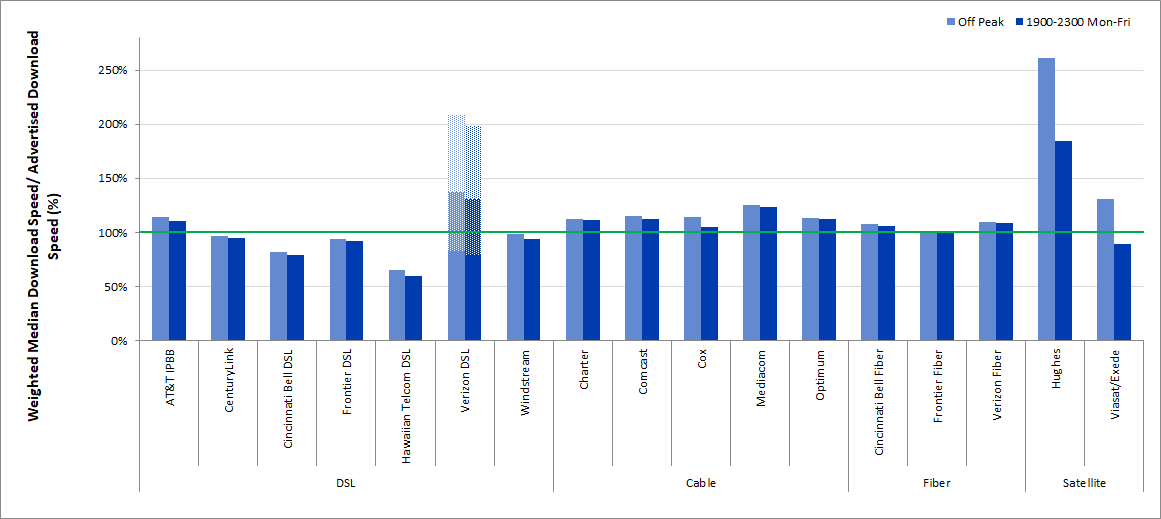
Granted, before my current router I was only hitting just over 50% of the rated speed. But that turned out to be the router I was using, its CPU was not fast enough or something. With a new router and all wired connections between me and the 'net, I get the speeds I pay for.
Sonic gigabit in SF. I’d say that’s within margin of error. I see 900s on the early AM. Plus my WiFi can’t go that fast so I’m ok with it.
Long ago an ISP sold me on VDSL for the office as "up to 55/3 Mbit/s". After install I notice they had deployed ADSL equipment with a theoretical maximum throughput of 12/1.3 Mbit/s. They claimed that this was ok and tried to hide behind the "up to" clause.
And if you're buying products with Energy Star certification, they have to meet a specific output requirement to claim an equivalent wattage: https://www.energystar.gov/products/lighting_fans/light_bulb...
If you're buying no-name brands off Amazon with no certification, they may very well be lying to you. But "60W equivalent" is still a metric with a specific meaning, whether or not a particular shitty company is lying to you about it.
Maybe we need an independent "this spec sheet isn't full of bullshit" certification for hard drives.
Only in the fine print do they disclose how many actual lumens.
The conclusion on page 4 of the above thread:
> Non-Pro RED = 5400rpm according to data sheet
> Pro Red = 7200rpm according to data sheet
> Internal both 7200rpm and 120Hz.
> Apparently all WD / HGST helium plates have real 7200rpm, no matter what it says.
Simply absurd, if true. Here, for example, is a screenshot of WD's WD100EFAX store page: https://imgur.com/HseW9Pa
No mention of an RPM "class". The spec sheet does refer to it as "5400 RPM Class", but with no further description of what the term means: https://media.flixcar.com/f360cdn/Western_Digital-3805661149...
What a world when you can't even trust the spec sheet. What's next, 10 watt class drives that pull 20 watts? 3-year class warranties?