As an example, we let the guilty go because of lack of evidence, where authoritarian regimes don't.
After 9/11, there was a lot of reporting about the NYPD and others profiling Muslims without any reason.
As someone from Europe, it seems to me like the U.S. "exports democracy" all around the world, with often terrible results, without ever stopping to examine whether its own is still holding and if it really can be held as an example for the world to emulate.
You don't punish an entity simply for where their founders were born. Not in a democracy anyway. If there's credible evidence to suggest TikTok is doing something nefarious, we can have a discussion, but until then it should not be banned.
You don't start torturing, just because you want someone to be able to blame and fast. You don't block markets to someone because someone else on the same land mass pissed you off.
It may seem "unfair" because the CCP has blocked many Western platforms, but you don't have values unless you're willing to uphold them in the most difficult of situations.
I mean, that's one theory. Here's Eric Posner:
http://volokh.com/2009/11/18/why-has-holder-decided-to-try-k...
> the Obama administration has decided to offer a two-tiered system of justice. We might call them the “high-quality” (civilian) tier and “low-quality” (military) tier. The high-quality approach offers greater accuracy; the low-quality approach offers less accuracy. The Obama administration will use the high-quality system against people when it has a strong case, and the low-quality system against people when it has a weak case.
> This approach makes sense. Endless detention without trial is no longer a politically viable option. The government will make a judgment as to whether a suspect is dangerous or not. If the case is good, the high-quality system will be used. If the case is bad, the low-quality system will be used. In this way, the government can ensure that people it thinks are dangerous will be locked up.
> This system is superior to the two possible one-tier systems. A pure low-quality system (military commissions only) suffers from credibility problems. People will not believe that all the people who are convicted are guilty. A pure high-quality system (civilian courts only) would result in too many acquittals. People who the government believes are dangerous will be back on the streets. The two-tiered system allows for credible convictions when credible convictions are possible, and (non-credible) convictions when credible convictions are not possible.
----------
Personally, I don't see how a system of "we'll try you according to the maximum standard of evidence by which we can 100% guarantee that we find you guilty" can be considered "credible", "reasonable", or really anything other than a "gross miscarriage of justice", but let's not just ignore what other people think.
I'm not sure why this would override prudence.
> If there's credible evidence to suggest TikTok is doing something nefarious, we can have a discussion, but until then it should not be banned.
Why wouldn't a nation mitigate risk? Countries compete and work together, but there is a pattern to US and Chinese sanctioned actions. Ignoring the history in the interest of a manufactured principle is foolish.
A lot of your examples (ie "you don't") do happen all the time all over the world and have throughout history. Shockingly enough, these acts are effective motivators and solutions to underlying problems, in many circumstances. Pretending that they are useless or counterproductive is probably accurate, for some circumstances as well. Not sure why that matters, other than to muddy the conversation.
So would Kissinger, I would bet.
I think the distinction between "Capitalism" as a philosophy and "US Capitalism" (ie economic ties to the US) is being confused here.
Extreme take of your stance would be to say that we should hold to a higher standards and not strike back if an enemy attacks us because we are peaceful. We should strive to be peaceful, but when time comes, the response should be appropriate to the threat posed.
China should be excluded from the WTO if they don’t want to play a fair game with others.
I admire your righteousness though.
If you read the suit, in this instance, it appears TikTok claims it is indeed a U.S. company, and thereby protected by the Constitution, safeguarded by due process, and not immediately subject to IEEPA or CFIUS actions.
I personally think they are no where near being a U.S. company, but that is a crux of their argument and we will see if the judge clarifies their position.
The barrier to move HQs and the like is so insanely low for large corporations that companies will gladly do it for even the most marginal tax benefits - a company might even consider hosting a "beauty contest" where they try to get cities to outbid each other in a sick game that deprives everyone of their tax revenue. Of course such an act (both on the company's side, and on the side of cities who decide to participate) is a clear signal of moral bankruptcy - but that's no surprise since America considers cheating other people to be the greatest virtue.
So why is so much tech stuck on the west coast then?
If it were that simple they'd have all moved (moved their operations and headcount) to lower tax areas by now.
This applies only to actual goods value (and doesn't look at capturing out-of-band transactions like online orders of virtual goods) but it's a really dead simple and easy to enforce law that'd kill a lot of tax dodging dead.
The real issue isn't that it's hard to tax these companies - it's that there isn't a significant political will in taxing these companies.
1. A voluntary international accord (that could be broken by any dissenting voices)
2. A single country setting the rules for corporate residency and enforcing them (i.e. the unilateral we don't need no diplomacy approach).
Instead I think the whole idea of primary residence for corporations is utterly unenforceable - I think what countries need to start doing is levying appropriate VAT taxes on added value to companies and possibly force all domestic activity to be executed by domestic labour only. I think, if we actually fixed the loopholes around international tax dodging, we'd be in a position where countries would be quite aware of how much value they have over a given company (i.e. Apple might derive 60% of their value from the US) and then use that proportionality to leverage political pressure on companies as needed.
And, just to clarify, this is essentially the road the CCP has taken and precisely why they seem to have such an outsized amount of control over companies - every country other than China is voluntarily declining to flex their muscles.
This, honestly, is the correct approach. For example, it's hard to see otherwise why the NBA is banning anyone affiliated with them from supporting Hong Kong.
2. On the contrary, it is very easy to see why the NBA is cautious. The Chinese care about it and so the NBA does not want to spark any more controversy. Can you explain how this isn't just common sense re: operating in a foreign country? Are international companies operating in the US "compromised" if they don't comment on US affairs?
> if they don't comment on US affairs?
should be:
> If they ban their associates from commenting on US affairs
Various fans have been banned - https://www.buzzfeednews.com/article/skbaer/hong-kong-nba-fa...
Daryl Morey (disputed) - https://qz.com/1730643/china-asked-nba-to-fire-daryl-morey-f...
There was also Adrian Wojnarowski but I'm not sure about counting that because there were other factors in play. There may be others that I have missed.
> Can you explain how this isn't just common sense re: operating in a foreign country?
The fact that China makes it in their financial interests to restrict people on being able to comment on matters of international importance is exactly the problem, because this is a classic chilling effect. And, as pointed out, given our lax privacy laws, now China has all of the info they do. Given that they're happy to roll out, e.g. facial recognition and social credit scores, this isn't something to be happy about.
China is a beautiful country with many wonderful people. But I doubt I'll ever visit it as long as I could end up locked up for an old internet comment, like say, this one.
> Are international companies operating in the US "compromised" if they don't comment on US affairs?
You'll find no shortage of criticism of the US government from foreign companies and their workers in private capacity. To make this comparable, imagine if we had CFIUS rules whereby nobody operating in a foreign-owned company (including yours truly, a US citizen) could criticize, say, Trump or any other part of the government without risking their ability to do business.
I don't think anyone would say that it's "common sense" that I can't criticize Trump or the US government while working for a foreign-owned company subject to CFIUS rules, would you?
I think there would, rightfully, be a backlash if Trump tried to change these rules and the companies were put under a chilling effect. So I don't see why Xi should get a pass for that.
> You'll find no shortage of criticism of the US government from foreign companies and their workers in private capacity.
Aren't we talking about a public capacity?
I don't think it's fair to say there is no chilling effect in the US currently. I'd expect some severe US backlash if some foreign company was very publicly opinionated about gun control. There is an implicit understanding that certain topics are taboo. Does it really matter whether this effect arises from the local population or the local government?
edit: I don't even agree with the people/government distinction in this case. The Chinese people largely support their government's stance against HK.
With regard to fans, I haven't seen other political slogans restricted in any comparable way. The NBA, for example, is very happy to say that Black Lives Matter and I've never heard of anyone getting kicked out a ballgame for wearing, say, a MAGA hat despite both slogans causing some very strong political sentiments. So the fact that HK is somehow more of a concern to the NBA than these hot-button American issues seems like something that demands an explanation.
> Aren't we talking about a public capacity?
I think bans can be troublesome in either capacity, honestly, but I'm more disturbed by restrictions that hit people in their private capacity, even if either realm can create a chilling effect.
> I'd expect some severe US backlash if some foreign company was very publicly opinionated about gun control.
For the record, that has actually happened (I think it was MasterCard restricting certain gun sales & some sporting goods stores dropping guns, e.g. Dicks), but it wasn't government-driven and there was backlash. That's a wholly separate issue and may touch on monopoly concerns. I think some of it got shot down due to running afoul of banking regulations, but I don't know the precise details.
Moreover, i would not be able to enter an arena with a MAGA, Trump, or a Biden poster (altough there was one incident with someone with a MAGA hat), so to imply that these one off incidents are actions that are due to the extensions of the CCP is very much in line with the propagandic rallying cry that we are seeing against China right now.
I agree with OP, this is much more of a financial issue to the NBA, than the NBA being an extension of the CCP which you are trying to imply right now.
The western concepts of 'trust' by default does not apply in a nation that is inherently, even internally for domestic affairs, is primarily based on the distrustful corporate affairs.
I've audited about 200 suppliers in China in last 10 years, it is a repeating motif to 'distrust by default' from small to large companies. Yes, they're not big corporations but the idea that we should treat Chinese companies and German companies in identical trust-worthy fashion, especially when it comes to engagement with the CCP, is an extremely deluded, out-of-touch and misinformed stance.
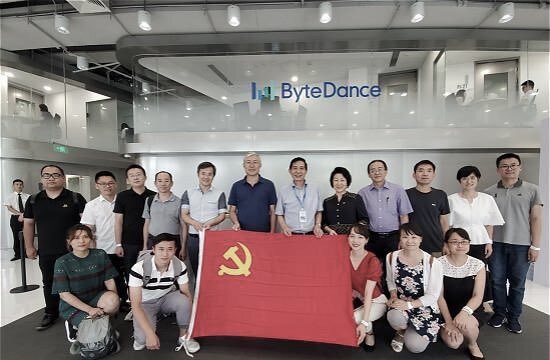
EDIT: oh that's the flag of the Chinese communist party: https://en.wikipedia.org/wiki/Chinese_Communist_Party
For some reason I expected that they would just use the Chinese flag itself, since there's no plurality.
fotoforensics.com/analysis.php?id=ffaac5beff95e49e8bd59097ac36afb61e83086c.59039&show=ela
The woman in red on our right also doesn't seem to be holding it. It's perhaps a cardboard sign or something? Maybe the picture of the flag was put over it?
Again, I'm no expert but it looks off to me.
[1] from https://www.jenniferzengblog.com/home/2020/8/5/bytedance-hea..., which also has archive links for the page in question and additional circumstantial evidence.
So often I tell people something and they say “source” and I tell them why a source is not possible or spell out the exact limitations in data collection and then downvoted to oblivion with a pile-on of why this worldview is irrelevant
This is not a feature of these kind of websites, it is absolutely a flaw
I would say most of the world is not google-able, if you are doing anything of consequence that affects others politically or financially or legally.
The comment you’re replying to links to a news article from Reuters that is apparently based on discussions with company officials. That’s probably as good as we are going to get.
By at least pretending it is valid and understanding that the reasons a source can't be provided is completely rational and having a discussion on that worldview instead of arguing flaws. This is a chronic issue on the internet: arguing flaws for no reason.
But saying you don't remember is a fair response, too.
Link found via Google: https://www.google.com/url?sa=t&source=web&cd=&ved=2ahUKEwic...
No, I don’t have a source.
I think this has more to do with our ignorance of how their system works than China having a truly ruleless society. Even the Mafia has rules governing their behavior despite not being a democratic organization.
> "Companies in China, including foreign firms, are required by law to establish a party organization, a rule that had long been regarded by many executives as more symbolic than anything to worry about."
I think after the Snowden leaks we’ve been shown to have similar opaque government compelling private company scenarios. There are also the opaque national security letters. After 9/11 we traded a lot of our freedom for security in much the same way “communist” regimes like China operate. At this point we practice most of the same things, which is probably why we know that China does what we do (perhaps even more).
> I think this has more to do with our ignorance of how their system works than China having a truly ruleless society. Even the Mafia has rules governing their behavior
I'd have to agree, "rule of law" is one of those concepts that people are happy to agree is VERY IMPORTANT without worrying about whether they agree on what it means.
For example, Jigsaw is GOOG's geopolitical "think/do tank". Jigsaw CEO Jared Cohen is a Bush-era State Dept alum and current Council on Foreign Relations senior fellow. Jigsaw Director of Policy Scott Carpenter is currently on the board of the infamous National Endowment for Democracy. The NED in turn uses federal resources to back regime-change efforts in foreign countries, primarily through public media campaigns.
These are but two "Wikipedia-tier" examples and should be deeply concerning to those who purport to care about this issue from a libertarian values perspective as opposed to one of vindictive geopolitical poop-flinging.
When it's Facebook which is subject to scrutiny of many major democratic governments and press, we gives it no slack.
Ironic and funny.
And Tiktok, despite their US arm being a US company, essentially is facing the execution of their business at the hands of the US government unless they do a fire sale under duress.
We are not giving a slack to a company that supports a totalitarian regime, if you see this as support, you can say that Apple is supporting Chinese totalitarian regime too.
The thing is though, the unit members are also still your employees with access to internal information. Since they serve two masters, the company can be tempted to elevate their status internally to improve how they represent the CCP on the other side. And the opposite can happen - employees can be hired with high CCP ranks so that when they join the unit their influence for the company will be stronger.
"One senior executive whose company was represented at the meeting told Reuters some companies were under “political pressure” to revise the terms of their joint ventures with state-owned partners to allow the party final say over business operations and investment decisions."
Information on how this actually works is scarce since relative to the US there is much weaker rule of law/discovery, and fewer independent journalists, considering how tightly China controls and polices which journalists are allowed in and what they write about.
"Companies in China, including foreign firms, are required by law to establish a party organization, a rule that had long been regarded by many executives as more symbolic than anything to worry about."
https://www.reuters.com/article/us-china-congress-companies-...