Note no value judgement on any of this, it's just a paradox that has been amusing my brain a bit re: social justice. Righting wrongness almost by definition involves more wrongness. "Killing a killer" might be a good summary of the paradox.
There is a similar issue in the theory of just resource distribution, where it can be shown that a more egalitarian resource distribution can sometimes only be achieved by temporarily allowing transfers that are not Pareto optimal. In other words, to make a society juster in terms of overall resource distribution you might sometimes have to make everyone worse off for some time. (If you don't allow such transfers, you'll be forced to call a society with a Gini index close to 1 "just", which would be absurd.)
On a side note, since that was mentioned by others, there is no such thing as "personal justice". Justice always concerns society as a whole, since it concerns the effects that the actions of members of society have on each other.
If anything it seems to be growing in scope and prevalence.
Take for example, the New York times calling to end blind orchestra auditions, and take race into account for making hiring decisions: https://www.nytimes.com/2020/07/16/arts/music/blind-audition...
[Citation needed]
Secondly, it (not-)temporarily disadvantages everyone of a specific gender or race, no matter if they were advantaged in the first place.
Do you have any proof that unfairness against a group mostly harms those with advantage?
For instance if white men are over represented as professors, it may seem fair to discriminate until the numbers are equal. But if you broke the group of white men up into young and old, you'd find it's the young who are being punished for the success of the old.
Suddenly by redrawing the groups it's gone from being fair to unfair. Who divides up the groups?
Is it even possible to be fair to groups without being unfair to individuals?
When fair participation has been reached among equally skilled and trained participants. A lot of progress has been made. Women and black people are allowed to vote now, for example. People in wheelchairs can to some extent travel on their own and even enter their workplace. That used to be impossible in the 60s.
More members of disadvantaged groups are in better positions in society than in the past. There was even one black president in the US among 45. It still seems impossible for a woman to become president, though.
By "temporary" I meant 50-100 years or so. It also depends on the willingness of people like you.
> Do you really see diversity and inclusion departments, speakers and writers declaring success and dissolving their departments and jobs?
Let's just say they will have almost nothing to do any more, similar to the fact there is no longer a need for meetings of the suffragette movement nowadays.
> For instance if white men are over represented as professors, it may seem fair to discriminate until the numbers are equal.
Yes. That seems fair.
> But if you broke the group of white men up into young and old, you'd find it's the young who are being punished for the success of the old.
Nobody is punished for anything. The goal is to help people who are at a systematic disadvantage due to sheer bad luck when they otherwise have the same skills and qualifications.
I'm not saying that relative quotas are the solution to all problems of society, but I do argue they sometimes make sense - within reasonable limits, of course, which are always contestable.
> Suddenly by redrawing the groups it's gone from being fair to unfair.
Yes, there can be cases of trading a local optimum for a better global optimum, and these can create temporary local unfairness. That was the point of my analogy to the role of Pareto optimality in theories of resource distribution. None of these problems are unsolvable. There are only finitely many disadvantaged groups anyway, and the goal is not to create perfect justice, but to improve society a little bit step by step.
> Is it even possible to be fair to groups without being unfair to individuals?
Fairness primarily concerns the state of society.
I believe that what is going on in reality is that the people who attempt to find arguments against fairer treatment of under-represented groups do that very often based on selfish motives. For example, some privileged white male might think he's treated unfairly if an equally qualified woman is hired instead of him because there are not enough female professors in the department. As a white male academic, I understand the personal feeling. I just don't think it's justified upon sincere reflection.
If a group is privileged and at a systematic advantage, members of the group will tend to consciously or subconsciously resist giving up that advantage. But reaching a fairer state of society is not unfair, even if it may feel like that for individuals.
Suffrage is clearly defined, "fair participation has been reached among equally skilled and trained participants" is extremely fuzzy.
Given blank slatism and any difference in outcome, there's an infinite retreat using a "God of the gaps" argument saying any difference must be due to systematic racism.
Even with blank slates it'll never work. If innate ability was equally distributed, but preference is given to a group in university entry, or job opportunities, then that group will have lower innate ability for a level of training or job position. The non-preferenced group would then do better on average!
>> Nobody is punished for anything
In a zero sum game (like competing for a job) giving some an advantage is the same as giving others a disadvantage.
You are suggesting giving someone a penalty, not for something they have done, but because of what group they belong to.
>> privileged white male
Are all advantages unearned privilege?
I chose my mate carefully, worked hard, spent less than I earn and spend time educating my kids. If I give them an advantage in life, should they be handicapped back down to average?
I'm a piece of replicating DNA, and I work hard, delaying gratification so my DNA does well in the future. Society is an artifact built on top of this reality.
Similarly, my ancestors sacrificed for me. They picked mates with care, followed laws, built societies... They both built a society for themselves, and were shaped by that society. All that work to make me do well, and you want to make us all equal? Why bother working hard or sacrificing for the future?
>> members of the group ... resist giving up that advantage
You admit above it can "create temporary local unfairness".
Then you wonder why people resist it! Especially when they disagree that it's temporary!
It is really easy to say that overcompensation for a mistake is a bad thing when you are on the side who did the initial mistake. A white man in tech, or a citizen of a 1st world industrialized country which grew as an economic behemoth by polluting the world without thinking of the consequences for 50 years. People gets easily, really easily used to their good conditions and privileges, especially if their real cost is somehow hidden and at the expense of others. It is part of the human nature in the end, but that doesn't mean it is "right".
How? I can see a reasonable argument that its not a fiting metaphor, but i don't see how you can say its absurd, since there clearly exist countries that use capital punishment for homocide.
Edit: Also to be clear, reductio ad absurdum is a positive thing to say about someone's argument. It is not a fallacy.
Otherwise you could argue that prison is not the right answer to certain crimes because there could be death penalty for a atrocious enough crime.
That's not what reductio ad absurdum (fancy latin for basically proof by contradiction) means. You're claiming that the comparison is inapropriate. reductio ad absurdum means that the comparison is good, but the thing being compared to is rediculous, and since the rediculous thing is the same as the main thing, the main thing must also be rediculous, and therefor false.
> Taking away benefits cannot be compared with taking away a life.
Why not? I don't see anything inherently contradictory in doing so. Whether or not the comparison is compelling is a separate question.
> Otherwise you could argue that prison is not the right answer to certain crimes because there could be death penalty for a atrocious enough crime.
Yes you could. Lots of people do. I don't support the death penalty myself, but there certainly exist people who do and its a practise that is still extant in some parts of the world.
Claiming that overcompensation can be brought to the extreme of justifying death penalty to me is absurd, that's why I said that. But I understand that I may be wrong so, definitions a part, to me it's still comparing apples to oranges. And while oranges may be acceptable, apples definitely are not.
They don't? Well, then they are hypocrites who want other people to subsidize their fantasies.
The general premise i have usually heard is something along the lines that selection in the work environment often involves nepotism, networking, "cultural fit" and other under-handed ways of biasing the results. This is both unfair and a self-perpetuating prophecy. The explicit action of forcing a selection criteria will hopefully break the cycle and "reset" the system to an equal playing field.
While I can understand the resistance to selection criteria if it removes more nuanced decisions necessary in building a team, I can't think of a better way to offset those biases you describe. Those biases are extreme and clearly, left to our own devices, we do a bad job addressing or recognizing them.
And it boils down to "what's unfair", doesn't it? Is a different life expectancy a signal of unfairness? A different wealth or education level? A different rate of depression, mental illness, or suicide? There's a lot of picking and choosing when it comes to picking the data to consider when evaluating unfairness, I believe.
To address your examples, the state should try to help people with abnormally low life expectancy achieve higher life expectancy, try to equalize different wealth and education levels by making education available/affordable to everyone, by severely limiting wealth distribution by inheritance, and so on, and help people with mental illness to lead a normal life as others (which could include all kinds of measures from tax-funded mental health care to changes in work law).
I don't really want to defend luck egalitarianism here, although I personally consider it a reasonable position. It's an example to point out that relative to a theory of fairness the solutions can be fairly clear. The "picking and choosing" is rather the result of disagreement about the respective theory of justice.
The largest inequality I see in real life is between first-born women and their younger siblings. First-born women are often hyper competitive and earn way more than their siblings, including brothers.
Should we discriminate against first-borns in university admissions?
Of course, why shouldn't we help people who are second, third, or fourth born if they are at a systematic disadvantage according to robust data?
AFAIK, many societies have changed hereditary law over the past centuries to compensate for former advantages of first-borns in favour of other family members.
But we don't, and that's generally accepted, isn't it? There's a strong (and recent!) difference between male and female life expectancy, but we accept that, because "men" aren't one of the chosen minorities.
The issue is exactly what you mentioned there: "abnormally low life expectancy". Once we declare something normal, we're done, no more intervention necessary. We could just do the same with poor people and only help those that are abnormally poor. But we don't, because reasons.
I have to disagree. If at all, the people who make the decisions whom to help and whom not to help are Prioritarians (due to the popularity of Rawl's famous book), which is exactly the position you describe. I have inadvertantly slipped into Prioritarian language when I used "abnormally."
What I had in mind and you criticize is Luck Egalitarianism. That's a fringe position that I've never heard from any politician or decision maker. Larry Temkin defends it, for instance, in case you're interested in the actual reasons rather merely dismissing them with a phrase like "because reasons." There are good reasons for it, and I personally find luck egalitarianism more compelling than Prioritarianism.
(Note: Not disagreeing with bringing it into balance quicker, or making statements that it should be done this way)
If we pick 20 marbles (to avoid rounding errors) then you expect to see ten blue, eight red and two white. But you actually see 17 blue, one red and two white. Your processes tell you you've found the best candidates. But statistics tells you that you could probably have done better.
The blue marbles might not be happy about that: they know they're obviously more able to do the work than the red marbles, because they passed all the interviews. Bringing in "less able" red marbles feels like a bad thing. But the key here is that they're not less able to do the work, they're less able to demonstrate they can do the work.
Much like the other problems in the article, there's no obvious villain, and it's a long process to change a deeply flawed system.
I believe especially the unknown biases are a problem. Many companies don't know why they hire less diverse, so they either deflect it (e.g. by blaming universities) or they introduce quotas. Quotas might be the best thing in this situation but ultimately, only finding and rooting out biases can lead to a truly fair process. Especially since quotas only work in large numbers. Hiring for upper management, in niche roles or in small companies cannot be accomplished fairly with quotas.
This is the classic "equality of outcome" vs "equality of opportunity" debate. Persons who have been disadvantaged by circumstances of their birth (color, nationality, poverty, etc.) have had their opportunities curbed as a result. How do you bring them back at par with their privileged peers?
One simple way is to remove inequalities in opportunity. However this is very hard in practice and does not help those who are already in a bad position.
The other solution is to ensure equality of outcome (make sure your employees are exactly 50% men and 50% women, for example) by setting hiring quotas. As is clear, this will be highly unfair to the advantaged class.
I don't know what is a just solution for this.
The issue I have with that is that is by far the worst inequality is coming from your social class, not your skin color or your gender.
Those quotas are thus trying to transform a social problem into a diversity problem.
Additionally, I prefer policies which attack the source of the problem (social inequality) than the symptoms (hiring). Of course that's harder to do and it cost much more money but that's really solving the problem instead of putting some rubber band onto it.
Economic class has big impact and can be objectively measured.
Might net team productivity per cost be greater with another white marble rather than a red marble due to culture fit even if the individual red marble is better?
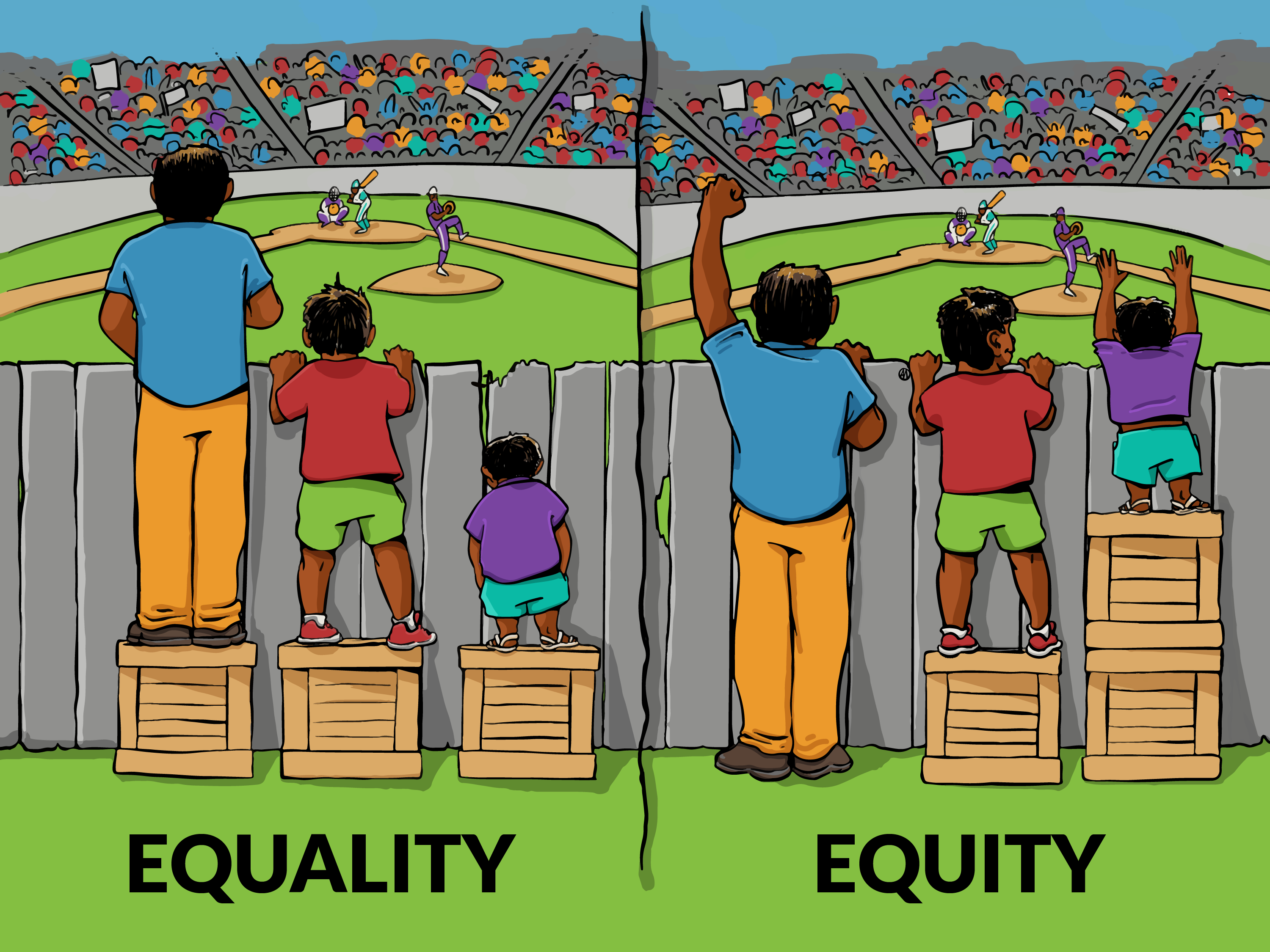
It's a little exaggerated, or at least what we mostly have/want in practice is 'access to' - since in reality the dad doesn't stand on a box for the sake of it, and he probably holds his smaller child rather than place him precariously on two.
As a foreigner, I am trying to understand this statement.
You've got a bag with 100 marbles. 50 blue, 40 red, 10 white. HR needs to pick 15 marbles. Does the HR try to pick all marbles equally? So 50% of whites, 10% of blues, 12.5% of reds is chosen. Doesn't seem fair to blues and reds.