Contrast that to a modern F-150 with a touch screen and also climate control on a matrix of identical wee little switches with labels so small you can't read them from driving position. What rubbish. Trying to hit just one of those switches while driving a rough road without gloves on is nearly impossible. With snowmobile gloves, you might as well just mash your hand on the whole panel and hope for the best.
Why? Just looking at more stuff makes you nervous? Ever been to a library? Ever cooked a meal? Ever walked outside your house? The world is full of complex "UI". This is a total bullshit minimalism case designers make to satiate their own personal taste.
I would like to see data that proves that "seeing" more stuff impedes the ability to operate something. Hiding stuff is detrimental, I would argue. The hierarchy of menus is equally as complicated as a dashboard of logically laid out "containers", each box decidated to a specific group of functions. It is exactly the same! Your vision system scans through the top level hierachy (Climate Control, Radio, Vehicle Settings, Navigation), then focusing in on individual controls (akin to sub-menu items). The benefits are massive - immediate control, haptics feedback, muscle memory, etc. Negatives a minor and can be addressed - cost, reliability and durability (wearing off labels for example). The problem is - if you look at ALPS catalog of encoders, they are rapidly going up in prices because automotive manufacturers are ditching them and they don't have enough volume to sustain production and keep costs down. If we had invested in this industry, we would have kept the costs down too. The sad thing is, they are discontinuining a lot of physical controls.
> Do you really think that putting your grandmother into a car that resembled that F-15 cockpit would be a safer option? What happens if she forgets where the button is to, say, turn on the A/C compressor? Is she going to read every single label while cruising down the highway at 75 mph?
Actually yes. Thank god we have knobs and buttons left for A/C controls. Why didn't hide that in the menus? Apart from a few cars, most cars have physical controls for climate and radio.
Grandma's kitchen is probably 10x complicated than car UI. She does just fine.
Edward Tufte made a career out of writing books that essentially argue this for data design: information density is good. Low information density means you're wasting people's time.
Our visual systems are extremely good at creating and navigating hierarchies, at rapidly switching between levels of detail, and at actively filtering irrelevant information. You don't have to hide stuff, you just have to make the user determine it's irrelevant for the task at hand, and their brain will just filter it out.
(See also: banner blindness.)
I wonder how much would it cost to run a medium scale study around this on Mechanical Turk? $50 to unroot popular choices and get data to prove otherwise? I would not mind spending it.
The sad thing is that there is so much momentum around minimalism aesthetics in UX/UI that it is impossible to make a point even with data - people will always find problems in the aforementioned study just to go about their ways.
I think it made me think about an important point - frequency of use. It has to be taken into account.
I'm fine with some operations being harder. For example, my remote has a dedicated button for entering the size of your room, which adjusts acoustics. How often am I supposed to change that, really? But it still made it harder for me to mute a blaring ad.
Applied to a car, it means that operations performed while driving should have physical buttons placed front and center, while other operations should be hidden away in order to make the former easier to find.
I drive a cheap car that appears to follow this philosophy. Here's how the dashboard look like: https://www.automotiveaddicts.com/wp-content/uploads/2015/05...
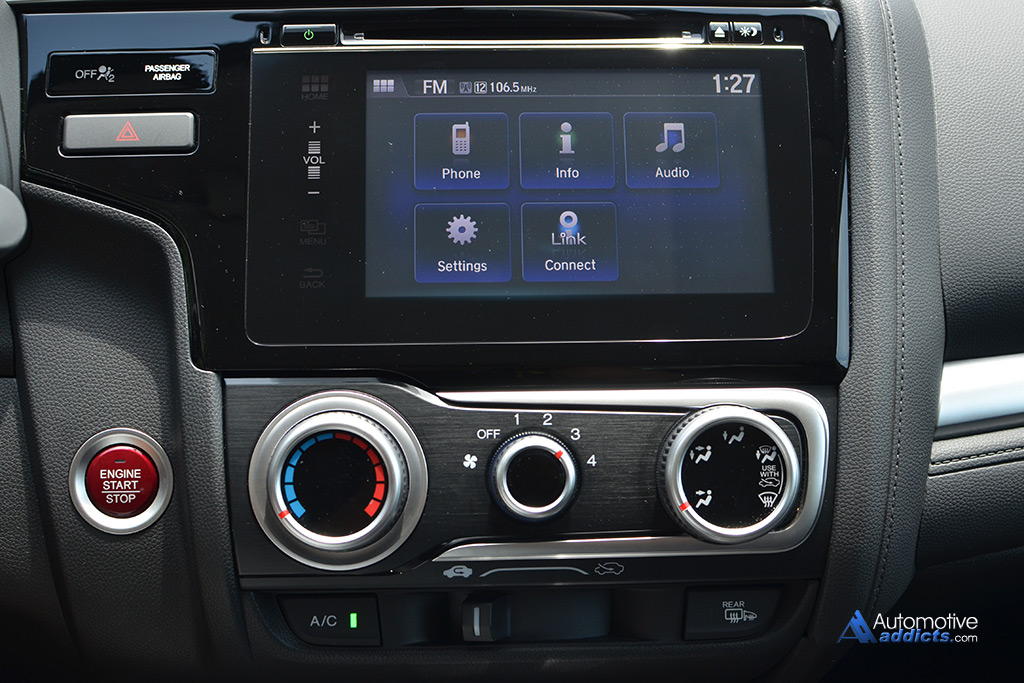
I can control the airflow without looking because it's the only knob of that size on the entire dashboard. Before looking at the picture above, I couldn't tell you where the emergency lights button was because I use it so rarely, but every time I needed to use it in a pinch I was able to find it almost instantly because it's basically the only button on the entire dash.
Replacing the touchscreen with a bunch of physical buttons that I never use while driving would be massively detrimental IMO.
(Note: the driver has dedicated volume buttons on the steering wheel, which is why there's no volume knob; the touch slider is for passenger use.)
How about just leave them there, and the most important buttons and controls in a dedicated area at the top of the remote? Perhaps in a red blaring border box?
I think this is a layout problem, no need to hide stuff.
A quick look at the screenshots will give you an idea of the sheer number of settings. Can you fathom the sheer size, and awful daily usability, of a TV remote that would expose physical controls for all these settings?
Cars are becoming this way too. One example is ambient lighting customization in newer luxury cars.
You can't have physical buttons for all this stuff. It just doesn't scale.
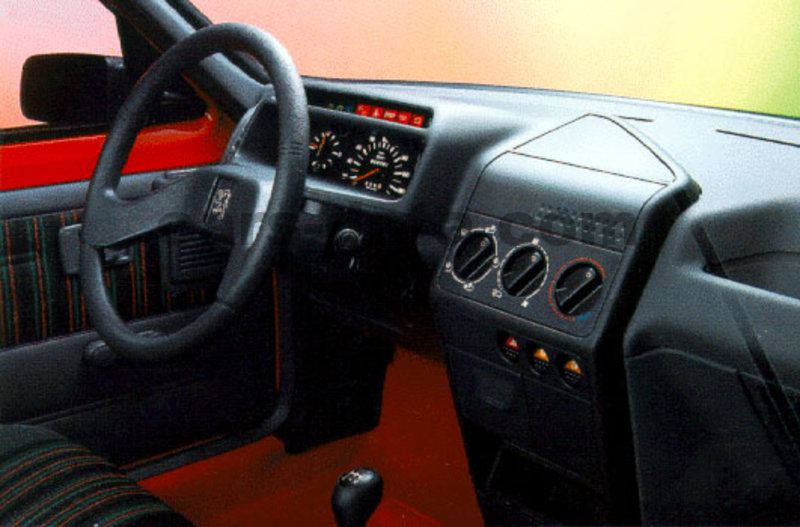
Edit: I feel we were stuck for a decade in this worst-of-both-worlds situation where the number of features were exploding but could still be crammed into a 50-button TV remote or car dashboard [1]. Now that features have grown even beyond that, manufacturers are forced to move less-frequently used features into an alternate interaction mechanism. For cars, that's often a touchscreen; for TVs, that can be a remote that doubles as a pointer, allowing to control a TV like a mouse controls a computer. Thanks to that, my current car that I linked earlier [2] looks much closer to the very simple and usable car I drove as a teenager [3], both of which are IMO much more usable for an untrained user than [1]. This doesn't mean I think the Mercedes dashboard is bad; it's an AMG car, so targeted to enthusiasts who may appreciate having a physical button for traction control. But I don't think it would make sense to expose this button in an entry-level commuter car like mine.
[1] http://www.seriouswheels.com/mno/Mercedes-Benz-G-55-AMG-Dash...
[2] https://www.automotiveaddicts.com/wp-content/uploads/2015/05...
[3] https://www.cars-data.com/pictures/peugeot/peugeot-205-cabri...
> You can't have physical buttons for all this stuff. It just doesn't scale.
Definitely. Like in the F-15 video, the controls near the elbows were rarely used (essentially "hiding" them out of sight). So may be a good compromise is pick 50 most used features, create buttons for those and then leave the rest of the 150 features in the menu system.
I haven't used a modern TV in over 10 years, I hope the remotes still have decent number of buttons.
[1] car appears to do everything right. [2] is worse because it feels like what you see is just the tip of the ice-berg. [3] had to be like that because there was nothing more to be done. It didn't need more controls.
Unrelated: A turn signal stalk is a brilliantly designed UI control. If famous designers we know - say Jony Ive - and if they don't know what a car is and you ask them to design a dashboard, not in a million chance that they would come up with a dangling stick behind the steering wheel that translates LEFT/RIGHT signal > DOWN/UP stalk movement > ANTI-CLOCKWISE/CLOCKWISE steering movement. It is totally genius and not obvious at all unless you've seen a steering wheel and a turn signal stalk before.
So originally, the UX wasn't UP/DOWN = RIGHT/LEFT (which btw is reversed on RHD cars). There was a V shaped set of contacts with an arm that pointed to the right or the left and was held there by magnets until you turned the steering wheel.
So it's more likely that someone worked out that mounting the switch on the steering column would save circuitry and expense than it was a UX/UI design decision.
That's the key though: almost everything in life except random websites is operated by users with various degree of training - either through frequency (TV remote) or explicit lessons (cars, planes). If you have to use a tool more than a few times, this minimalist trend is making the experience worse.
Is it because physical buttons are expensive to make?
Or is it because a camera with fewer buttons is easier to use for untrained users?
My opinion is that it's mostly the latter.
It would also be easier to type vowels on a 5 key keyboard with only vowel keys, but then you'd be limited to only typing vowels.
I have one of those awful ~10 button remotes, and it takes about 10 key presses to "add a show to my list" on Amazon, because the remote hides the "green" button behind a soft menu. It was also definitely not "easier" to find that button the first time.
Degrading functionality to make certain functions "easier" or "more obvious" is a bad trade-off far more often than many UX designers seem to assume.
In an interface you're intimately familiar with (like your TV remote, your car, or a plane if you're a pilot), you should spend zero time finding things, because you already internalized where everything is. Low information density interfaces prevent gaining familiarity and remembering where things are.
Airplanes are much easier than cars in that regard - once you’re airborne there’s not much to hit!
Also, neither a car nor a fighter jet assumes an untrained operator. We can't forget that you get a few dozen hours of practical training before you're allowed to drive unsupervised, and that's more than enough to familiarize yourself with the user interface.
So the question boils down to: does the interface facilitate operating without looking at it, or not? Physical buttons do. Non-shit touchscreen UIs could, but they don't exist. Touchscreens used in practice don't.
That sounds easy: if it's your car, so you'll soon familiarize yourself with where the physical controls are, so you won't need to take your eyes of the road for more than a moment (if you need to at all).
If it's not your car, a physical switch is no worse than a touchscreen. Navigating a screen forces you to take your eyes of the road for an extended period of time, since you need to use them to target your touch to the right part of the screen, even if you're already familiar with the UI.
In short: for controls that may be used while driving, physical controls are at a minimum no worse than a touchscreen and typically much better.
The only place where screens have an advantage is for extremely rarely used controls, like configuration settings. Even then, I'd argue that physical controls (like the F-15's castle button) are better for controlling the screen than using a touchscreen, since they allow a user to memorize key-press sequences.
Touchscreens really only make sense on extremely small devices like smartphones.
But apparently a long press of “FLIR FOV switch” pushbutton on the thrust lever to press with the ring finger of your left hand does the same thing.
Since your left hand normally rests on the thrust lever in flight, you don’t need to move your torso or even an arm at all, but the switches are just there in your hand, so when you think you might do it and tension your muscle, it’s already done.
Compare that to touchscreen menus...
The reason this type of user interface exists in fighter jets is simply because the situation requires it. It only works as well as it does because the pilots undergo thousands of hours of training to familiarise themselves with the interface.
The only reason everything is laid out into single function button and knobs is not because it provides a better experience, it's because pilots are in a unique position where their lives might depend on decisions and actions performed in a fraction of a second. It's not really a concept that is transferable to other types of interfaces and shouldn't be glorified as good UX either.
Pilot errors are far too common which is directly related to the complexity and cognitive load imposed by the aircraft interfaces.
These are well documented on several scientific publications. Look up Hossini and Kahneman (some of his stuff has been proved wrong but mainly his motivation ideas).
I agree that putting controls which you need to use while driving behind a touchscreen is not an optimal choice.
https://www.theverge.com/2019/8/11/20800111/us-navy-uss-john...
https://features.propublica.org/navy-uss-mccain-crash/navy-i...
How are either of these things solved by hiding features behind touch screen menus? Have you ever seen a 75 year old use a computer? I think physical switches are more intuitive to someone that age.
It is like saying a touchscreen is thousands of switches just because it has that many sensor points.
Huh? This is such a bad counter analogy. Allow me to expand and prove my point.
First, let's clarify what type of an input a keyboard switch is? It is Single Pole Single Throw or SPST. It is also momentary (meaning you have to keep the key pressed to close the circuit). 104 keys on a keyboard, each key is a momentary SPST switch representing the ASCII character set (let's simplify).
On a touch screen, if it had 104 boxes, each representing a monentary SPST, then it is identical as far as the interaction is concerned. The finger went down, pressed inside a box or a key, and a character appeared on the screen. They are identical (in logical sense). The circuit element is the same, see the symbol for SPST here [1].
You're comparing 104 individual options for character input to a pixel on the touchscreen? Why? I don't follow and what point are you trying to make? The action is taken as a press of a finger in a specific area, not a single pixel.
[1] https://en.wikipedia.org/wiki/Switch#Contact_terminology
The comparison with cockpits is meaningless because keyboards are not "104 switches", but a single method to deliver input text (for the most part). The same way touchscreens are a method to deliver input, not an interface on itself.
In my new 2020 car, I couldn't tell you where it is, but I don't need it because I just keep the climate control in "auto" mode and twist the temperature dial to 68 degrees and let the car decide if it needs to turn on the AC or not.
I'll be there within a few years, Dog willing, and don't expect to have any problems.
Here is one: https://www.driving.co.uk/news/apple-carplay-android-auto-wo...
How do you interact with a touchscreen responsibly while driving? You can’t.
How many people in their 70s or 80s do you know that are on the side of touchscreen controls for vehicles? People I have known in that age range like their iPads and iPhones but drive cars with buttons.
The big reason for physical controls is you can find them without looking by feel and spatial location. Provided you have some experience.
https://features.propublica.org/navy-uss-mccain-crash/navy-i...
This sounds very smart and serious, which must be why someone makes the same point in literally every discussion of a control interface for some kind of vehicle - but I challenge you to provide evidence that fixable UX problems in modern automobiles have led to an increase in accident rates.
In fact, most modern vehicles use touchscreens to solve the very problem that you are supposedly concerned about. Rather than a complicated cockpit full of individual buttons and switches to control every single function, most modern cars have a few easy-to-find buttons and switches for functions you might want to access while driving (i.e. radio volume, climate temperature, fan speed), and use the touchscreen to hide all the more complicated and lesser-used settings out of the way!
Do you really think that putting your grandmother into a car that resembled that F-15 cockpit would be a safer option? What happens if she forgets where the button is to, say, turn on the A/C compressor? Is she going to read every single label while cruising down the highway at 75 mph?