News for hackers. Stuff that matters.
Re:What You'll Need to Know in 2020 That You Don't Know Now ... by aripickar on Monday May 04, 2020 @12:50PM (#23070336)
I think it's interesting how one prediction that they made was that 1,000,000,000 would be starving. However, the massive reduction in extreme poverty[1] that the world has made, especially since 2000, is amazing and under-covered. That's one prediction that I am glad they got wrong.

[1]https://ourworldindata.org/extreme-poverty

Re:What You'll Need to Know in 2020 That You Don't Know Now ... by hedora on Monday May 04, 2020 @08:36PM (#23075055)
> Globally, there are 821.6 million people that are considered undernourished or starving.

https://www.statista.com/statistics/269924/countries-most-af...

Sorry to be a killjoy.

Re:What You'll Need to Know in 2020 That You Don't Know Now ... by aripickar on Monday May 04, 2020 @08:55PM (#23075183)
Undernourished != starving, and 821.6 million != 1 billion. While there is plenty of work to do left, theres a lot of progress that has been made so far and its important to recognize that.
Re:What You'll Need to Know in 2020 That You Don't Know Now ... by Lammy on Monday May 04, 2020 @09:07PM (#23075276)
Feel free to mentally substitute “has access to anything less than enough food” and round up slightly, but I don’t see much of a difference.
Re:What You'll Need to Know in 2020 That You Don't Know Now ... by ccvannorman on Tuesday May 05, 2020 @01:48AM (#23076905)
"round up slightly" by >100 million humans?

You don't see a difference?

The point being made is that human civilization is making leaps and bounds globally because that number isn't a billion, and most importantly it has a strong, predictable trajectory downwards, towards zero.

"I don't see a difference" is like saying "we were going 80 mph towards the wall, and we braked, but now we're going 50, and I don't see much difference, it's practically 80 if you just round up." Are you not interested in the fact that we're continuing to brake?

Re:What You'll Need to Know in 2020 That You Don't Know Now ... by mettamage on Tuesday May 05, 2020 @03:00AM (#23077270)
FWIW, I see the difference. I agree that rounding up by 180 million is not rounding up but changing the numbers. I also agree that "undernourished or starving" is not the same as "starving".

But I do agree that perhaps it isn't an as strong victory as aripickar claimed.

Re:What You'll Need to Know in 2020 That You Don't Know Now ... by smaudet on Tuesday May 05, 2020 @02:25AM (#23077101)
I think the point is that the gains are largely irrelevant. Sure, its great 100 mil less people are hungry, but if you look at the trend, we've gone almost nowhere. Not helped by the fact that, there seems to be a variability of about 50 mil. Why? Are we under-reporting? Are we not addressing the right problem?

If you have variability of 50 mil and only 100 mil gains, its really hard to make the case that you qualitatively improved anything, it could be nothing more than a statistical anomaly (maybe there was more rainfall or less competition from local wildlife), and whatever you're doing is not working at all - assuming you are doing anything.

This is pretty different from 50 mph vs 80 mph - that's a ~40% improvement, and we can point at something to show the improvement.

We have added quite a few billion since 2000, so there's an argument to be made that we are making more food, but the ~1 bil number staying fairly stable to me points to a systemic issue, not merely a problem with food distribution.

Re:What You'll Need to Know in 2020 That You Don't Know Now ... by Lammy on Tuesday May 05, 2020 @05:38PM (#23085387)
The global population has gone from 4-and-a-half to almost 8 billion humans within my lifetime. No, I don't see a difference :)
Re:What You'll Need to Know in 2020 That You Don't Know Now ... by shadowprofile77 on Tuesday May 05, 2020 @10:25PM (#23087378)
All the more reason to be impressed that less people starve today then in 2000 and that the trajectory continues to move downward. Also, the world does not have an overpopulation problem. It has a (in most ways highly political) access to adequate resources that are actually available problem for marginalized populations. The overpopulation and population control narrative is not only based on bad assumptions, it's also implicitly racist in favor of western, prosperous societies because, guess which parts of the world have the higher child birth rates for the time being? (and those dropping too by the way).
Re:What You'll Need to Know in 2020 That You Don't Know Now ... by samoa42 on Tuesday May 05, 2020 @01:55AM (#23076941)
thing is, you won't see much of a difference if you hit a wall with 80 or 50 (mph/kmph)
Re:What You'll Need to Know in 2020 That You Don't Know Now ... by ldb on Tuesday May 05, 2020 @02:30AM (#23077124)
Figure 3.3 in [1] suggests that a belted driver has a 40% chance of survival in a full frontal crash at 50 mph. At 80 mph the survival changes are close to zero.

[1] https://nacto.org/docs/usdg/relationship_between_speed_risk_...

Re:What You'll Need to Know in 2020 That You Don't Know Now ... by tomp on Tuesday May 05, 2020 @04:32AM (#23077795)
Bad analogy. the difference between 800m and 1b is 20%. The difference in energy between 50 and 80 is 156% (kinetic energy is relative to velocity squared).
Re:What You'll Need to Know in 2020 That You Don't Know Now ... by virgilp on Tuesday May 05, 2020 @02:07AM (#23077000)
You absolutely will. In a modern car, at 50kmph you'll be largely ok. At 80kmph (50mph), not so much, but maybe you'll survive. At 80mph, you won't survive.
Re:What You'll Need to Know in 2020 That You Don't Know Now ... by StandardFuture on Tuesday May 05, 2020 @03:23AM (#23077394)
This entire sub-thread should be deleted. But to those replying "there is a difference between crashes at 50 and 80!", while that may be true, please just realize that the casual parent comment was simply not being very articulate in what they were trying to say.

Using the actual numbers from the discussion we would create an analogy of crashing at 100 or crashing at 83, in which case there actually would be very little difference in the distribution of outcomes.

I really wish HN would take a moment to try to be more intellectually honest in our commenting. sigh

Re:What You'll Need to Know in 2020 That You Don't Know Now ... by cassiet on Monday May 04, 2020 @11:45PM (#23076276)
Are those words actually weighted with the assumption you are making, or are you just trying to feel better about 800 million people going hungry? The nuance between English words aren’t really apparent in poverty statistics. Because I doubt there was a survey where they all agreed it wasn’t enough, but just enough that aripickar doesn’t feel as bad about 800 million going hungry.
Re:What You'll Need to Know in 2020 That You Don't Know Now ... by aripickar on Tuesday May 05, 2020 @12:10AM (#23076394)
I meant that there was a group of people the size of the population of brazil that were expected to be hungry, but are not. That should be celebrated. Its easy to lose the sheer size of the difference between 800 million and 1 billion, but in reality thats a huge difference.
Re:What You'll Need to Know in 2020 That You Don't Know Now ... by smaudet on Tuesday May 05, 2020 @02:31AM (#23077127)
Again, its very easy to cherry-pick statistics, and point at a big number and say "oh this is great we helped people". True, but if you didn't actually fix the root cause it doesn't mean much. Contextually for ~30 years the number has stayed pretty stable, despite 2 billion in growth. So we clearly are capable of producing tons of new food, but we're pretty bad at managing that growth - or by the numbers the extra 1.9 billion we managed to feed would have more than covered the billion gap, no?
Re:What You'll Need to Know in 2020 That You Don't Know Now ... by mouzogu on Tuesday May 05, 2020 @02:05AM (#23076989)
Central African Replublic being number one on that list for hunger says much more but how much we've not progressed in some ways. It's one of the most resource rich countries on Earth and yet has the most hunger, hmmm, makes you wonder why.
Re:What You'll Need to Know in 2020 That You Don't Know Now ... by nindalf on Tuesday May 05, 2020 @02:30AM (#23077125)
It's not surprising. There's a theory which says that having resources that can be extracted from the ground makes it less likely that a country will develop on any axis - economically, in education, health, democracy etc.

There are many theories about why this happens [1] but the one that I agree with the most is the one found in the book The Dictator's Handbook - it's simply not in the interest of the ruler of such a place to develop the country. Here's a trailer of that book by CGPGrey - https://www.youtube.com/watch?v=rStL7niR7gs

[1] - https://en.wikipedia.org/wiki/Resource_curse

Re:What You'll Need to Know in 2020 That You Don't Know Now ... by shadowprofile77 on Tuesday May 05, 2020 @10:30PM (#23087403)
So why do countries like Canada, the U.S.A or Norway have persistent long-term prosperity? Furthermore why do many other middle-income countries have natural resources but still manage to incrementally see their overall quality of life improve?
Re:What You'll Need to Know in 2020 That You Don't Know Now ... by Can_Not on Tuesday May 05, 2020 @10:45PM (#23087469)
We pay the dictators, they give us raw materials and our fair share of the surplus value from their slave's labor. The dictators enjoy glorious wealthy lifestyle and we get goods manufactured cheaply. Everybody wins.
Re:What You'll Need to Know in 2020 That You Don't Know Now ... by shadowprofile77 on Wednesday May 06, 2020 @02:29AM (#23088380)
I specifically mentioned three countries that are just what the comment above described, resource rich nations that gained a significant portion of their initial or long term wealth creation from the materials they extracted from their own soil, but somehow managed to remain relatively well administered, fairly free and mostly democratic. Your criticism has it's valid aspects but it's secondary to the point I was making.
Re:What You'll Need to Know in 2020 That You Don't Know Now ... by Can_Not on Wednesday May 06, 2020 @08:49AM (#23090307)
We do a really good job of outsourcing slavery to colony nations.
Re:What You'll Need to Know in 2020 That You Don't Know Now ... by hkai on Saturday May 09, 2020 @01:14PM (#23126487)
And 200 million added because of lockdowns. So it's 1 billion now.
Re:What You'll Need to Know in 2020 That You Don't Know Now ... by Balgair on Tuesday May 05, 2020 @11:21AM (#23080957)
FWIW, I'm getting a paywall on that site.

Also, the issues of global abject poverty are complex.

Some data indicate that abject poverty is falling: https://borgenproject.org/wp-content/uploads/ourworldindata_...
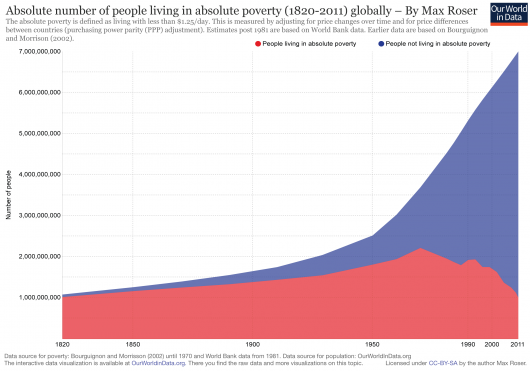
While others indicate that even collecting such data is fraught with difficulty: https://www.econtalk.org/jerven-on-measuring-african-poverty... (its long, yes, but a great start into the data on Africa and the troubles getting it)

Other indicators of poverty show that global poverty is waning: https://www.gapminder.org/tools/#$chart-type=bubbles ( go ahead and play with some data yourself, its kinda fun)

In general, it seems that global poverty is falling and that life is getting better for most people. Again, it's a complex issue.

Re:What You'll Need to Know in 2020 That You Don't Know Now ... by jkingsbery on Monday May 04, 2020 @01:13PM (#23070648)
Agreed, although they aren't (necessarily) mutually exclusive - you can reduce the percentage in poverty while still having 1 billion.

An interesting thing with these predictions is that they tend to focus on technology, when a lot of the reasons for problems like poverty aren't a tech issue, they are because we haven't figured out how to build functional institutions yet that overcome mismanagement and corruption, changing incentives to make education more common, ensuring supply chains that go through remote areas are safe.

Re:What You'll Need to Know in 2020 That You Don't Know Now ... by dcolkitt on Monday May 04, 2020 @01:42PM (#23070999)
> when a lot of the reasons for problems like poverty aren't a tech issue, they are because we haven't figured out how to build functional institutions

I would argue that is still mostly a technology issue. Just social technologies, instead of physical technologies. Democracy is a social technology. Gender equality is a social technology. Market economies are a social technology.

And like regular technologies, social technologies are often simple in theory but deceptively difficult to implement well. Over time, we learn the pitfalls and improve the engineering. That lowers the cost, increases the quality, and widens the distribution. Liberal democracy is a 300-year old idea, but the percentage of the world's population living under it has drastically increased in just the past 30 years.

Also over time, we learn which social technologies are dead-ends. Marxist-Leninism is clearly a horrendously destructive social technology.

Re:What You'll Need to Know in 2020 That You Don't Know Now ... by IAmEveryone on Monday May 04, 2020 @02:38PM (#23071649)
You're just calling all sorts of things "technology". Yes, you can make that definition fit, somewhat hazharzously: maybe ideas, concepts, ideologies are, in a certain light, "tools" to use to get some result.

But how does that help? You're just throwing away whatever nuance is captured by the existing terminology. Are people more likely to rationally use and improve liberal democracy if you frame it in technological terms? If you believe so go ask emacs users what they like best about vim...

Re:What You'll Need to Know in 2020 That You Don't Know Now ... by igorkraw on Monday May 04, 2020 @02:46PM (#23071757)
I'd argue framing these things as technologies removes some of the mental blocks we have in them. Capitalism and socialism as ideologies can endlessly be argued about, but as technological solutions to the problem of control of the means of production that are stable and efficient you can evaluate their performance calmly. Moralistic thinking of how "people deserve their own world reward/a fair share" has it's place, but it's not a very tolerant one.

A moral code that has some "higher" purpose is not something you can evaluate and discuss. A tool is evaluated only in the context it's in. This is a more flexible and pragmatic framing

Re:What You'll Need to Know in 2020 That You Don't Know Now ... by TheOtherHobbes on Monday May 04, 2020 @06:54PM (#23074338)
Your "calm" performance metrics will be chosen subjectively, almost certainly on the basis of a moral code which guides your decisions but which you're not objectively aware of - because you consider it so correct it would never occur to you to question it.

In fact we already do this with finance and economics. Neither are even remotely calm, unbiased, or objective.

And if someone says that in fact you can evaluate moral codes on objective criteria - not least long-term species survivability and the dimensions of the collective predictive horizon and strategic IQ - how can you be sure that alternative criteria you might prefer are any better?

Re:What You'll Need to Know in 2020 That You Don't Know Now ... by smaudet on Tuesday May 05, 2020 @11:04AM (#23080765)
As others have stated you're not really tearing down metrics. Pick any you like, metrics are just tools we use to evaluate tools. You can pick some ones which do get results or ones which don't.

I think this is where the concept of the selfish gene comes to the rescued - metrics, traits, tools, which work best tend to re-inforce each other and 'win'. Say what you will about 'morals', I doubt I will find you making a moral argument for the rights of phages over your own happiness.

So it doesn't really matter which criteria you pick - long-term species suitability might be good, if there are better they will arise.

Re:What You'll Need to Know in 2020 That You Don't Know Now ... by philwelch on Monday May 04, 2020 @10:02PM (#23075591)
> Your "calm" performance metrics will be chosen subjectively, almost certainly on the basis of a moral code which guides your decisions but which you're not objectively aware of - because you consider it so correct it would never occur to you to question it.

This is exactly what makes social and political systems a technology. People choose between different technologies based upon their personal judgments and preferences about acceptable trade-offs. Different people, and even different groups of people, will make different decisions because they have different preferences.

Re:What You'll Need to Know in 2020 That You Don't Know Now ... by igorkraw on Tuesday May 05, 2020 @12:33AM (#23076525)
Yeah, but you will have to state them at least. You need to state your goal. "Capitalism/socialism is immoral" is fuzzy and works for both. "Capitalism/socialism ensures maximum efficiency of exploitation of resources" can be checked and doesn't work for both.

"But why do we want to maximally exploit resources" is then a question we need to answer separately, and here your subjective things come into it.

Re:What You'll Need to Know in 2020 That You Don't Know Now ... by philwelch on Monday May 04, 2020 @02:48PM (#23071776)
Liberal democracy is just a technology that has to be adopted as a standard in order to work, like TCP/IP or AC power. Some country might have a mixed-member proportional elected parliament just as another country might have 120V mains power. And in that respect, there are technologies much more widely standardized than any political system.

I think it helps as a reminder that all of these things are human inventions that are intended to solve problems.

Re:What You'll Need to Know in 2020 That You Don't Know Now ... by TheOtherHobbes on Monday May 04, 2020 @06:45PM (#23074255)
Liberal democracy is not "just" a technology, and creating a mixed member proportional elected parliament isn't a guaranteed magic solution to political or social problems.

Politics is hard. Really, really hard. Much harder than technology. Because politics is part social psychology and part evolutionary psychology. And while we understand enough about both to have some idea how to manipulate them, we don't understand them well enough to manipulate them - and ourselves, and each other - wisely.

Re:What You'll Need to Know in 2020 That You Don't Know Now ... by philwelch on Monday May 04, 2020 @09:59PM (#23075566)
No technology is a guaranteed magic solution to any problem. That's what makes it technology rather than magic.
Re:What You'll Need to Know in 2020 That You Don't Know Now ... by jkingsbery on Tuesday May 05, 2020 @12:58AM (#23076670)
I would buy your first and last paragraph, but I'd quibble with your second.

> And like regular technologies, social technologies are often simple in theory but deceptively difficult to implement well.

I think this is where having the two categories separate is useful. There's a lot behind Hayak's quote "the curious task of economics is to demonstrate to man how little they really know about what they imagine they can design." It is true that many more people live under democracy, and that's a great thing. But I think we've also seen over the past 30 years experiments in instituting democracy where they had not previously been that have not been as successful. We've also seen the trappings of democracy usurped by those looking to add legitimacy to their autocratic regime.

> Marxist-Leninism is clearly a horrendously destructive social technology.

I agree fully, but it still seems to be sticking around, and I hear similar rhetoric without people understanding the lessons behind why it was such a failure ("We're not Leninist, we just want to remove the profit motive, limit what people earn to what we think should be enough, and have the central government plan around all the hard problems in society...").

I'm skeptical we can plan for these things the same we do things in engineering, but that doesn't mean when we try to predict the future we shouldn't look at their importance.

Re:What You'll Need to Know in 2020 That You Don't Know Now ... by Can_Not on Tuesday May 05, 2020 @11:19PM (#23087607)
> and have the central government plan around all the hard problems in society..."

this is nonsense, consider Walmart, the US military, and nuclear power. Walmart is proof that centralized planning can have extremely successful results. The US military has no publicly known catastrophes in nuclear power. Nuclear power plants are too expensive (both upfront costs and insurance) for private enterprise and even small municipalities.

Consider the Hoover Dam. Panama Canal. Both "capitalist" US and "communist" USSR planned their way through the space race.

Planning is _good_. Everyone who is smart does it. It's how big things happen.

What's important is to keep democracy on top of the plan. Walmart is heavily authoritarian.

Marxist-Leninists believe in extending democracy to include the workplace and the economy.

If you think that's "clearly destructive", I'd have you take a peek at climate change, deforestation, sweatshops, migrant toddler concentration camps, Flint Michigan, Tulsa Massacre, etc.. The USSR might not have been a utopia, or even good, but don't strut around like you're better than them and hand-wave away a rising-in-the-US ideology so frivolously.

Re:What You'll Need to Know in 2020 That You Don't Know Now ... by jkingsbery on Thursday May 07, 2020 @12:11AM (#23099646)
It's away from the original point, but I think it's important to highlight the factual inaccuracies from your claims. This is meant charitably, I hope you will take it as such.

1. "Walmart is proof that centralized planning can have extremely successful results" - "Central planning" means something specific, and does not mean "having a plan," even a potentially large plan. It doesn't just mean planning by a rather large entity. From https://www.economicshelp.org/blog/glossary/central-planning..., "a Centrally planned economy can overcome market failure and achieve equality of distribution." Walmart is therefore not an example of this since it does not fit the definition, and makes use of a competitive market for labor, real estate, and the goods it sells. The US had a plan for Apollo, but it still had to deal with a free market for the newly invented integrated circuits that made up its electronics - the government couldn't simply dictate that the desired number were produced.

2. "Nuclear power plants are too expensive (both upfront costs and insurance) for private enterprise" - A list of US Nuclear power plants (https://www.nei.org/resources/statistics/us-nuclear-plant-ow...) shows several owned by private enterprises. According to https://www.world-nuclear.org/information-library/country-pr..., the world's first large scale nuclear power plant was owned by a government, but was built and operated by a private company.

3. "Planning is _good_... It's how big things happen." There are lots of things that happen without central planning. No one does a survey of how many computers the US needs and then tells Intel to make a certain amount of processors. Likewise for food, clothing, pencils, or whatever other goods we may need. Plans often make assumptions that prove unrealistic, and centrally planned governments have often proven unable to adjust, leading to famine unheard of in capitalist countries.

4. "Marxist-Leninists believe in extending democracy to include the workplace and the economy." In a Marxist economy, a bureaucrat figures out how much of a thing is needed, and tells people when they need to work to produce that thing, and how much of that thing they can get. There is no input from "the people," except for nominally the person who figures this out for everyone represents the people. Compare this to a capitalist economy, which may be imperfect, but allows everyone to vote on what's important for society to provide through spending preferences.

5. "don't strut around like you're better than them" - the claim was not that capitalist countries are perfect, but rather communist countries were/are a failure. The only one that has seen any lasting success in China, and that was only after it started adopting capitalist practices in some areas. The implication is also not that anyone is better than anyone else. In many locations in Eastern Europe, the same people with the same resources had vastly different qualities of life depending on whether they were on the west or east side of the Captialist-Communist border. The implication is only that communism is a terrible system and was a failure everywhere it was attempted.

Re:What You'll Need to Know in 2020 That You Don't Know Now ... by igorkraw on Monday May 04, 2020 @02:48PM (#23071778)
Very much agree. The only difference is that physical technologies and social technologies take much longer. There is a book called "law's for a flat world" (or maybe rules for a flat world) that discusses the Social technology of law and how we could drastically increase both the adaptivity and accessibility to this technology
Re:What You'll Need to Know in 2020 That You Don't Know Now ... by JeremyNT on Tuesday May 05, 2020 @08:27AM (#23079244)
I think looking at the specific numbers in that prediction misses the bigger point. The first world countries would never altruistically provide their advanced technology to the third world, and so most of the technological breakthroughs envisioned in the piece remain inaccessible to huge portions of the world's population.

> For Lanier, the most heartbreaking scenario is festering in the third world, where, he believes, the current generation of children— lacking food, lacking skills, lacking aid, lacking education— will be lost in the next techno-revolution.

Re:What You'll Need to Know in 2020 That You Don't Know Now ... by philwelch on Monday May 04, 2020 @02:41PM (#23071685)
Yeah, a lot of the predictions gave me classic “I was promised flying cars!” feeling but that’s far more important.
Re:What You'll Need to Know in 2020 That You Don't Know Now ... by wayoutthere on Monday May 04, 2020 @10:33PM (#23075783)
Just give it a few months; 2020 ain't over yet.