Not sure what's wrong with that? That looks pretty amazing actually. I live in a unit that looks similar to that near downtown Chicago. My unit is north facing, and even so, there's more than enough sunlight.
Obviously there's nothing wrong with an apartment or microhouse, but it makes the quoted rent less impressive.
Also, keep in mind the height of the house. People tend to build up here rather than wide -- at least in family areas in central Tokyo. My current house, while slender is almost obscenely tall. It's four floors including the rooftop deck. In comparison, my childhood house back in midwestern America, seems much less spacious.
I live in a pretty well to do family oriented neighborhood in central Tokyo, and this is a very common design. Although I’m not sure about mortgages, but rents definitely ain’t just $850. But as the parent post said, it’s all about location. Prices nosedive once you leave the center of Tokyo or are off the main train lines.
For anyone living in one of the equivalent world cities (say, NyC, London, Shanghai, Paris, San Fran- you may quibble with me in the exact list but you know what I mean) these prices aren’t even remotely plausible.
(The one possible exception might be Berlin but that info could be dated)
This is the sort of thing that markets solve really well. If you want a dwelling unit with those properties, pay for it. If they're less important to you than cost, don't. If one is $300,000 and the other $600,000, it's very reasonable to choose affordability and go to a park.
Overall, the market for apartments seems to be supply constrained. The main factors:
1. Government approval is required to build large apartment buildings. In general, this seems to lag behind demand.
2. Large buildings take a long time to build
3. There have been a number of years of high immigration, especially in and around the CBD.
All of these factors combine to cause high prices. In a high price environment, many residents are stretched for cash. They essentially have to pick the lowest price apartment available. It's not uncommon to have multiple people sharing a room in order to decrease costs. This creates a high price floor. Mid range apartments don't tend to be much more expensive, simply because many residents are already super stretched financially and unable to afford the extra marginal cost.
As a property developer in a high floor, low marginal payoff environment your financial incentive is now to build as many low cost apartments as possible.
>> The majority of Victoria’s newest apartments are so small they would be considered unliveable in Sydney…More than three-quarters of new one-bedroom apartments built across the state are 50 square metres or less, which means they probably would have been illegal in Sydney, London and Adelaide. [1]
Making these apartments meet a reasonable minimum standard could only be less than 5% of the total cost [1]. To achieve this governments have tried to intervene by increasing minimum standards [2].
What concerns me the most is the longer term impacts. When demand drops off (as covid is pointing to), you have a massive supply of low quality apartments. Is the end result of this many vacancies and people living in shoe boxes when they could've been somewhere nicer?
There are a few long bows there, but as someone who lives in a relatively sunny but not quite sunny enough apartment that is my take.
[1] - https://blogs.crikey.com.au/theurbanist/2015/05/18/apartment... (great blog for planning issues)
[2] - https://architectureau.com/articles/victorias-draft-apartmen...
I have less experience in the high end of the market, as it's firmly out of my price range. Perhaps that alone is the answer? If while earning ~2x median pay, I don't consider staying somewhere more livable it would suggest prohibitively high prices. I'm unsure if the price is dictated more by the aforementioned undersupply or the higher quality. It probably reveals something about inequality in society.
I can't be certain the motivations of the developers choosing to build smaller apartments, the reasons I alluded to in the parent comment were an attempt at an educated guess. There is however an obvious ground truth that apartment sizes are shrinking (47m2 2014/44m2 2015 for 1 bedroom -10% in one year!) [1]
- [1] https://www.afr.com/property/melbourne-new-apartment-sizes-s...
The difficulty that I see is that housing prices in America are so high that it's unrealistic for moth people to create enough value to purchase a residence at even that basic level of quality.
I'm not convinced that these are values worth respecting.
A house or a place to live? There's not enough physical land adjacent to places of business for each person who wants one to own a single-family home. They're an awfully inefficient use of space -- see the entire western half of San Francisco.
> This cannot happen while also respecting the idea of properties as investments...
Property can't be affordable and a good investment. Those two are mutually exclusive. An investment goes up relative to inflation. Affordability by definition goes down relative to inflation. You can't have something that goes up as it goes down.
> ...the wealthy wanting to be able to purchase disproportionately large places in multiple desirable locations...
You can, if you do something along the lines of what Singapore does with the HDB. Some 90% of Singaporeans live in government homes built by the HDB, and the remaining 10% is available to the wealthy to play.
> ...and the idea that so many people may desire to live in a city that the city cannot possibly take them all.
They city can absolutely take them all if you allow building up. There's no excuse for down-town San Francisco north of market limiting buildings to 6 stories when downtown Hong Kong has 118 story buildings.
I'm not sure this is that important a criterion for most people. Pre-lockdown, I'd leave the house before the sun came up, and got home barely in time to catch the sunset. If I wanted sunlight, I could walk a block in either direction.
I actually have a preference for living in shadier (as in shade, not crime) parts of town, especially neighborhoods with tree-lined streets/boulevards.
Out of curiosity, what is your reasoning behind this belief?
[1] At least until we arrive at some sort of Star Trek level of technology, no society is going to do this perfectly, so when I say "functioning society" I mean one that more or less provides for the vast majority of its citizens and provides some sort of safety net/second chance for people who do fall through the cracks.
[2] This is much more "wishy washy" and hard to quantify, but I'd say that in a functioning society everyone would be able to, in a general sense, live the sort of life that they want while providing for themselves and their family. I mean this in broad strokes such as wanting to live in a cosmopolitan city/near the beach/near mountains or wanting to be able to seriously practice art/music/sports (although not necessarily as one's day job).
Invest in public transportation (and potentially restrict private transportation in city centers) so that we can expand how far out someone can live and still have a reasonable commute.
Where appropriate, allow people to work from home so that commute is less of an issue.
Build more and in some cases higher density affordable housing so that more people are able to live in desirable areas.
Invest in infrastructure (both practical infrastructure such as high speed internet and "aesthetic" infrastructure such as parks and public works of art) in order to make more places desirable.
Living in a city which city center was (re-) build between the 16th and 17th century, the 30 years till worthless puzzles me.
Even the house I live in is over 100 years old and in excellent condition.
Why do houses loose their value so rapidly in Tokyo?
It's something I wondered about too until I looked at descriptions and photos of >30-year-old houses on real estate sites.
I've never been to Japan, but I imagine that a bad Japanese neighborhood is incredibly safe compared to a bad U.S. neighborhood. In a bad U.S. neighborhood one has to regularly take precautions in order to not be physically assaulted or even killed by other people.
>your house will most likely look like this: https://www.ii-ie2.net/dat/5ba1164d.jpg
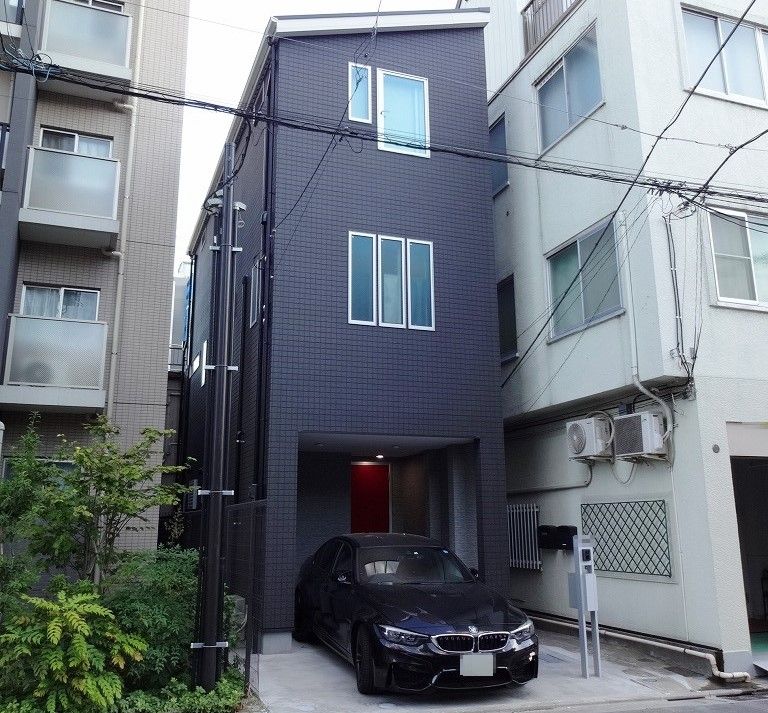
Looks pretty amazing for less than $1000/month.
That said, of course I'm not thinking that Japan is some paradise. What I hear/read about their justice system and their stifling conformist culture doesn't sound very good to me.
$300k for new construction is ludicrously cheap for most coastal California cities. I was told to budget $150-250k for permits when I considered buying land and building my own house in Santa Barbara.
Both my current and my previous house would be illegal to build today because they are too large (even though both houses comfortably fit the frontage requirements, there is an additional X square feet of livable space per Y square feet of lot; in all R-1 zones, the calculation is such that a single-story house can usually hit the dwelling-space limit, so most 2 story houses in town would be illegal to build today).
Santa Barbara is significantly cheaper than bay area in terms of renting or buying real estate.
The 2br apartment I'm currently renting in SB is $2.6k/mo. A very similar apartment in Redwood City is over $4k/mo.
One thing to consider is that Tokyo is a prefecture, not a city. There are rural areas of Tokyo (like really rural), though most of it is very suburban. Anybody who has lived in the suburbs in western countries would probably be fairly comfortable in most parts of Tokyo prefecture.
It is true that in quite a few areas of Tokyo it takes a long time to get to central Tokyo. 2 hours is at the extreme, though. I live in very rural Shizuoka prefecture and I can get to Tokyo station in 2 hours if I time the bus and shinkansen perfectly. If you are on the train line, most places are no more than an hour away. It's pretty comparable to living in satellite cities in London, but the train is much better :-)
If you are not on the train line, though, it can take quite a long time. Roads in Japan are very slow, especially in rural areas. It's not unusual for it to take me over an hour to drive 30 km or so if I need to go through several towns. So you definitely can find houses in Tokyo that will be 2 hours away from the city center, but I don't think anyone working in central Tokyo would buy those houses.
I honestly don't think the example picture is representative of houses you'll find in Tokyo prefecture. They definitely exist in areas that are desirable, though. I think saying that you're probably looking at either a 1 hour commute by train or your are going to get a house jammed in wherever it will fit is correct. But it's not both at the same time.
I don't often go to Tokyo, but I occasionally go to surrounding areas. Probably if I was looking at houses for commuting to central Tokyo, I would probably look at places in Kanagawa, Chiba and Saitama as well as Tokyo. There is actually quite a lot of choice.
The video linked in the article is well worth watching (as is anything from "Life Where I'm From" if you are interested in Japan) and is extremely balanced IMHO. Compared to other big city centers around the world, Tokyo and the surrounding area is quite affordable. Compared to Silicon Valley it's almost comically so, but Silicon Valley is really right at the other extreme.
On the other hand, rural (so cheap) areas are less packed so sunlight is less of an issue.
[1] https://www.zillow.com/homedetails/116-Route-9h-Hudson-NY-12...
1. yes you might get a house at this price but it's either 1-2 hours out of the city center (which is fine, just saying Tokyo is large.) Or alternatively it's in bad neighborhoods. (bad is relative if you are from the US)
2. your house will most likely look like this: https://www.ii-ie2.net/dat/5ba1164d.jpg
Sayonara sunlight, hello neighbor.
here are listings: https://www.homes.co.jp/smp/kodate/shinchiku/tokyo/list/
there are nice ones in the list. I am just saying that this is the eastern country side of Tokyo (check the map) when the title probably makes everyone think something different.