Downtown Athens and most of the suburbs are filled with ancient and byzantine ruins, despite the damage that wars, christians and muslims did.
I've watched plays in millennia old theaters. This is damn powerful.
London, sort of continuously inhabited since Roman times, wouldn't pass the test even if an ancient Roman inhabitant was standing on a street following the line of a Roman road and looking direct at the foundations of the London wall. Even the river course would be unfamiliar.
EDIT: a word
I'm from Italy and here we are taught a linear history shooting like a bullet from the Romans to Renaissance (mostly glossing over the Middle Ages), and that has important political consequences in what it means to identify as an Italian.
In other words one can say that history, as it is taught in school, is instrumental in constructing a national identity and as such it is wielded as a tool by the political and cultural élites.
As a Frenchman I have always found Italians identifying so strongly to Romans a bit creepy. I've had very heated conversations with people who wouldn't balk from the notion that « they » had conquered Europe at a time « we » lived in trees (notwithstanding Gaul having cities upwards of 40k inhabitants). Italy hasn't been Roman for much longer than Spain or Gaul and the entire peninsula nearly had a civilization « hard reset » with the utter ravage of the Gothic wars and Justinian's plague.
Things might have been simpler if we had kept the medieval demonym and referred to Italians as « Lombards ».
In all seriousness though, the 8th of May is still celebrated with victory parades throughout the country.
You can't just deny France also has some trouble remembering their history. Think of how long Kubrick's Paths of Glory was banned...
About France remembering its history, it's true that for a long time some things were hidden, but in 1995 (I think) the then President Jacques Chirac said that France should own the crimes commited by the Vichy government.
I am not saying that every bad deed done by France is not hidden somewhere, but some efforts were made by the French to reconcile with their history.
Thus said I'm not denying that in most places a decently educated person knows about the darker side of history of their country. My point is just that history as it is taught in high schools is a narrative that is (also) used to justify a sentiment of national pride.
Italy has ancient Rome and the Renaissance, Greece has ancient Greece, Ukraine has Kievan Rus', and just like those France has its own founding myths, be it Charlemagne, Napoleon, De Gaulle, or the Republican ideals...
Lots of nuance.
https://www.nytimes.com/interactive/2020/01/12/us/texas-vs-c...
DNA doesn't matter. How you choose to live your life does.
By the way, in settlements were people are living for thousands of years, they usually build on top of what there was already there.
[1] - https://cdn.theculturetrip.com/wp-content/uploads/2016/08/10...
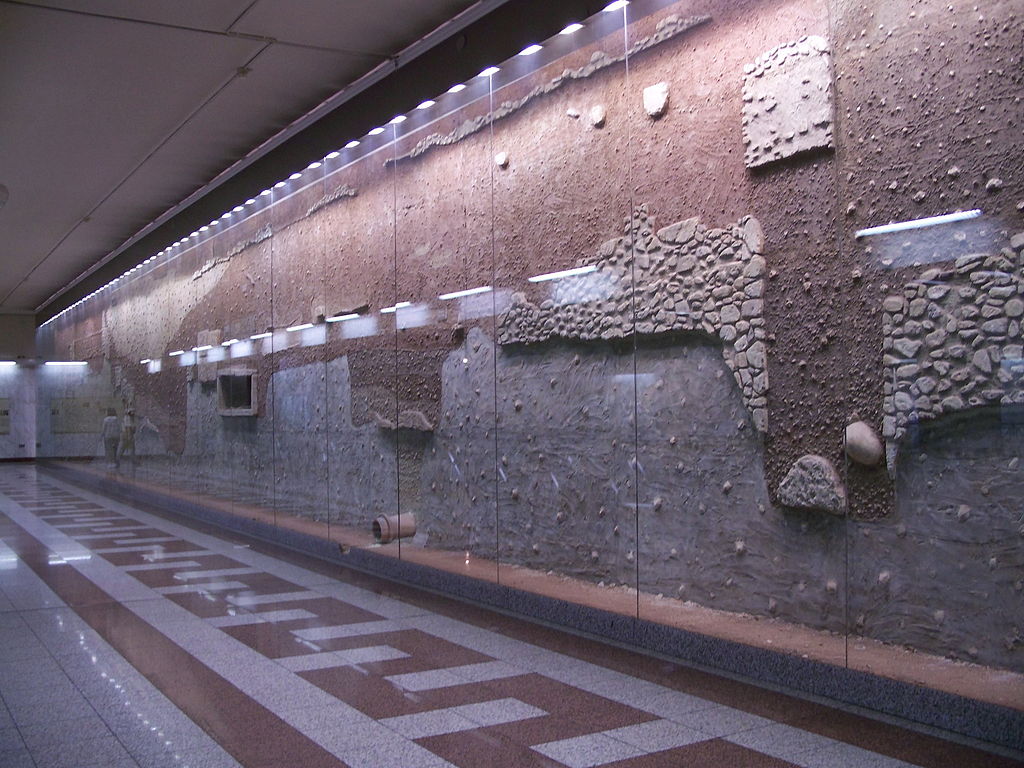
There is a museum near the Acropolis where they put a glass floor in and you can look down and see the ruins they've uncovered.
It's really remarkable. Buildings from the past were demolished and new buildings were built on top. It's interesting to look around and realize that you're walking over 30 ft worth of ruins everywhere.
The most ancient structures are from 9kya, and the city existed in a lot of forms since that point. I believe the current city streets are from the Roman period, and probably date to the iron age or older.
What fascinates me about the site is the architectural similarity between the oldest city (the 9kya, neolithic city) and Çatalhöyük of the same period. These are the oldest known cities, and predate the oldest known "empires" by a lot.
This hints at a neolithic (and perhaps even ice age) cultural exchange over very large distances.
It's complete so you can still walk the entire 4 sides of the wall in one hike, or rent a bike and circle the entire city in ~1 hour or so.
When you're atop the city wall, there's definitely a sense of being in two different times, both ancient and modern, at the same time as the modern Xi'an skyline makes up the background while you trek on stones that are hundreds (thousands?) of years old.
For example in France, Marseille and Nice (both Greek colonies) are 2,600 and 2,300 years old, respectively. The first inhabitants would definitely recognise them immediately today from the unique landscape (like Yerevan).
As for Puning, it's not so much related to China's recent changes but to the landscape. Mountains are unique and don't change much or at all in 2,000 years. But in a plain there is nothing to distinguish the landscape apart from buildings.
I doubt someone would recognize Marseille at first sight. If they looked hard enough they might recognize the harbour having vaguely the same shape and some mountains outside the city being the same.
I actually annotated a drawing of Roman-era Marseille with the names of modern features a few years back [1].
The natural features were massively overbuilt or even erased (like during the 19th c. to make way for avenues), which made things level off somewhat. The same goes for every city. Go to Rome someday. The famed hills are now invisible, expect for the Capitol (although it would look far less remarkable if the Forum hadn't been excavated).

I'm thinking that the view looking to the south end of the city, with its striking hills, would be instantly recognised by any local from the Greek period.
I agree, though, that the harbour itself would most likely be unrecognisable, not only because of the extensive urbanisation but because the shape has been seriously remodelled.
Nice, in my opinion (I've only been there twice) has very little connection to the Nice of old. The geography is not very unique (travel the Mediterranean coast and I promise you you'll find plenty of places that look nearly identical.) It's cycled through plenty of languages and was even originally 2 different cities (Cemenelum and Nikaia.) Put an occupant of Cemenelum in modern day Nice and I doubt they would know it was the same place. The once large river Paillon is dried to a part of what it once was and covered up by concrete; the language is completely different (and has changed many times) - hell, Nice wasn't even part of France until the late 1800s!
In Marseille, sure, an ancient inhabitant would recognize it due to the islands if nothing else. But as much as I love Marseille (one of my favorite places in the world, actually) - I get much less of an "ancient" feeling there than anywhere in Armenia or Iran, for example.
Fascinating language (and alphabet) by the way.
(Again, similar things are true of English to a less extreme degree: The Canterbury Tales are a struggle to understand, but I can plod my way through them with the aid of heavy glossing. But I doubt if I could have a conversation with a time-traveling Geoffrey Chaucer.)
All the old town was blown up with dynamite within a few days during the 1940's...
Yerevan feels like 70% 1970s Soviet life, 20% ancient civilization, and 10% 2050 futurism. I'd love to find more places like it.
No shit?! I had no idea the greek empire(s) stretched up this far. Was it a peaceful colonisation?
Athens founded Phocacea (in modern day Turkey), which founded Marseille, which founded Nice. All were independent Republics.
My understanding is that it was peaceful, or mostly peaceful. The aim was settling a city to further trade, not military conquests. That came later with the Romans.
Another Armenian city https://en.wikipedia.org/wiki/Van,_Turkey, which is older than Yerevan, would match it too, but it's not included in the list on wikipedia. (Maybe because a large part of Van have been ruined and left uninhabited in ~1920s).
https://en.wikipedia.org/wiki/Straight_Street
On a tangent: I love it when an article shows up on HN that is already greyed out, meaning I've seen it before.
One of the city gates still stands, the throne hall of Roman Emperor Constantine (Basilica), the Amphitheater ruins, the large Roman baths (ruins), even the large Dome is built on top a structure Emperor Constantine built.
According to your definition if there are recognizable major natural landmarks ( "Mount Ararat", "river Hrazdan" ), then it means nothing has changed since people in the past would recognize it and be able to place themselves. So using your logic, any city near a major mountain, river, etc would be recognizable. So tokyo ( visible from Mt Fuji ) hasn't changed, manhattan hasn't changed ( hudson/east rivers ), seattle hasn't changed ( Mt Rainier ), etc.
It's out most of the summer.
Santa Fe also nearby and on the list but it's quite a bit more modern. Still it's the oldest capital city in the continental US.
In particular, I spent a day in Kutaisi and although it was a lovely little place I didn't find it super interesting.
I'll definitely be back though, I hadn't heard of Mtskheta and it seems really interesting, I'd like to check it out.
I assume you're Georgian, from the name :) Any other places you'd suggest to visit in Georgia? I personally prefer the really unusual/out of the way stuff myself.
Specifically, I find Yerevan very interesting. If someone from 2,000 years ago stood there today, they'd certainly realize it was the same city: the same Mount Ararat towering over the city, the same river Hrazdan running by the city, the name is pronounced very similar (pronounced Erebuni vs. now pronounced Erevan.) If you traveled a bit forward in time, to 400-something CE, then a modern inhabitant of Yerevan could even read the ancient writing in the city!
Compare that with cities like Puning, China (to quote Wikipedia: "The history of human settlement in Puning can be traced back to the Neolithic Age".) Rich history, but I guarantee that someone from 2,000 years ago would have no idea where they are. (That's certainly not all of China, though, many places haven't experienced that much change.)
Anyone know more of these cities, where it'd be obvious to the ancient inhabitants that it was the same city?