Say for example that your family operates a tiny tourism-related business in South East Asia. A prolonged shutdown of travel between China and your country could literally drive you into poverty, given how dependent some countries in the region have become on inbound tourism from China. Given your extremely remote chances of catching the virus, the risk of losing your entire family income is a much more significant risk to your health.
Because of this, it's important to be balanced in thought and decisions, and not just panic because of what could happen. Where there is evidence to support restrictions, keep them in place. Where there is not, remove them.
Outside of China this issue still remains far less serious than many other health-related risks. The "we need to do something" (anything!) mindset is actively harmful.
Not being a huge problem outside of China is a fact for NOW. Does not mean it won't happen in weeks. The question is: do we want to solve the problem now, or we want to postpone the solution for later. There won't be "deus ex machina" which just makes it disappear. Many people will die if we're going to ignore the existing facts and make fun of the situation with these stupid heat scans checks which do prevent nothing on the long term based on existing experiences.
What I see is because noone wants panic it prevents us calling the right moves. Because its "panicky".
If we can identify which restrictions are helping, and which are not, then we can remove the ones that are not. The point of my comment above is that the restrictions come with their own costs, in some cases severe.
> Not being a huge problem outside of China is a fact for NOW. Does not mean it won't happen in weeks.
It doesn't mean it will, either. We should be approaching this in a rational, evidence-based way, not just waving our hands and saying "many people will die" with no evidence.
> What I see is because noone wants panic it prevents us calling the right moves. Because its "panicky".
If you believe you have a better idea what the "right moves" are than experts who have spent their careers studying these events and preparing for them, then by all means step up. But you should expect to be asked for evidence for your claims. Panic is a significant cost on its own.
I think this is unfair on two fronts.
First, labeling it as “panic” is just dismissive. What constitutes panic vs. what is responding rapidly and vigorously to a critical emergency is in the eye of the beholder.
Secondly, it’s possible to trust the experts and also think that the proper measures are not being taken. The experts are the epidemiologists, virologists, doctors, public health officials, etc. who are working on this outbreak, and they seem pretty damn concerned. I’ve read very few statements that suggest this is likely to blow over, and many more that show a widespread opinion among the experts that containment is unlikely and that this is very serious. But the experts don’t run the world, politicians and bureaucrats and business leaders do. And they have different interests and incentives. There are also likely discussions behind the scenes that we don’t know about. The WHO could be urging countries to shut down all air travel but leaders are reluctant to do so for fear of the political backlash.
All you have to do is look at how China treated the doctors who reported on this back in December to see how “trust the people in charge” is not the same as “trust the experts”. If China had clamped down on this six weeks earlier than they did, we wouldn’t be in this mess.
It can be both. The actions of individual citizens in Singapore, HK and other countries with a small number of cases certainly seem to be panic: buying more instant noodles than they could eat in a year, buying every toilet paper roll available, buying so many face masks that rations are introduced, and so on. Some government actions also appear to be going beyond what is necessary to respond; for example banning travel from country A to country B, when country A has fewer cases than country B itself.
> Secondly, it’s possible to trust the experts and also think that the proper measures are not being taken. The experts are the epidemiologists, virologists, doctors, public health officials, etc. who are working on this outbreak, and they seem pretty damn concerned. I’ve read very few statements that suggest this is likely to blow over, and many more that show a widespread opinion among the experts that containment is unlikely and that this is very serious. But the experts don’t run the world, politicians and bureaucrats and business leaders do. And they have different interests and incentives. There are also likely discussions behind the scenes that we don’t know about. The WHO could be urging countries to shut down all air travel but leaders are reluctant to do so for fear of the political backlash.
The WHO, in fact, has mostly suggested a more measured approach to air travel restrictions than what many governments have decided to take. Most of the expert opinions I've read have presented a number of different paths this could take, and suggested a lot of uncertainty as to the likelihood of each. This is sensible. Meanwhile, most of the forum posts and comments that I've read have strongly emphasised the worst possible cases, and continued to do so as the worst path that previously could have happened (which they were implying was a virtual certainty), didn't.
> All you have to do is look at how China treated the doctors who reported on this back in December to see how “trust the people in charge” is not the same as “trust the experts”.
I'd be the last person to suggest trusting China's leadership, but neither am I inclined to assume that the measures taken by other governments in response to this are entirely based on expert advice or even entirely for health-related reasons.
> If China had clamped down on this six weeks earlier than they did, we wouldn’t be in this mess.
Maybe.
At this point I am not sure what is evidence for you. Do you need a mathematical paper on it with the conclusion of irreversible damage?
The experience is that it is still spreading. Yesterdays numbers < todays numbers out of China. Why is it not enough evidence? To me your argument is like we have to ruin all the possible ways we can so we can find out which is the least terrible way to do it.
We can't afford that!
Let me flip that question around and ask, what difference would it make? What can you as an individual do, that you are not already doing, when the totalitarian government of the most populous nation on Earth is determined to downplay it?
It’s not indifference, it’s resignation.
Way too many things/people depend on traveling. You can't stop the world for such a small thing. We should take precautions, probably more than what we do now, but stopping the world isn't going to work.
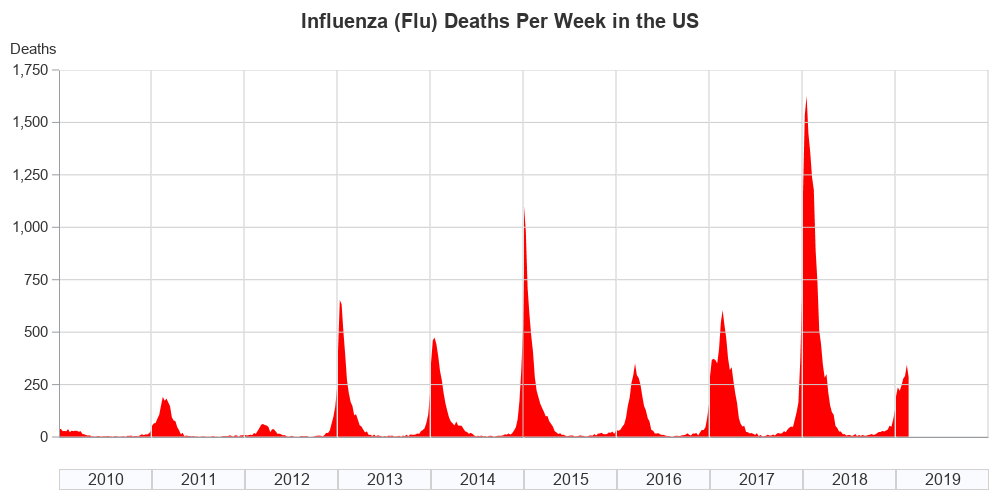
Don't fall for the fear mongering too, it kills less than the flu: https://blogs.sas.com/content/graphicallyspeaking/files/2019... and has a death rate of 2%. It's serious but not end of the world serious.
We’d survive but it wouldn’t be pretty. I really doubt that’ll happen here, but this is a serious risk.
Let's panic when it's time to panic, in the meantime it's business as usual. You add "virus" and "china" in the same sentence and people start to lose their shit way to easily. We had worse before, we'll be just fine.
I am wondering why the world still does not seem to care about it. Why do we have to wait until every city gets infected? Why we can't stop travelling? Eventually, when it spreads to a city, the quarantine must be the only way... but why we aren't preventing that ourselves? The politicians does not really seem to care (in the bunkers)? Individual, consumer society with no interest and without resources, civil routine and real impact to the events is crazy to me. Even a couple of days ago WHO was thinking about restarting the flights to China. It's just WTF to me.
In last days I can't even read any tech/HN news because it's not news to me compared to this unsolved terrible situation. I don't even understand how this topic is not more visible here in HN and on other places. We need to do something.