News for hackers. Stuff that matters.
Re:Japan Turns to Coal After Closing Nuclear Power Plants by jgwil2 on Friday February 07, 2020 @05:40PM (#22271910)
Same thing happened in Germany. This is a really hard problem. I consider myself pretty pro-nuclear but it can never be 100% safe. I can't blame Japan for wanting out after Fukushima, but at the same time there has to be some kind of approach that balances short-term safety against the long-term consequences of carbonization.
Re:Japan Turns to Coal After Closing Nuclear Power Plants by jeltz on Friday February 07, 2020 @06:01PM (#22272084)
No energy source is 100% safe. People die when working on windmills and hydroelectric disasters are way more deadly than nuclear disasters. I think 100% safe is an unreasonable requirement.
Re:Japan Turns to Coal After Closing Nuclear Power Plants by Swizec on Friday February 07, 2020 @06:37PM (#22272353)
Coal pollution kills more people per day globally[1] than all nuclear disasters combined[2] ever have. Pollution kills between 7500 and 52000 annually just in USA. The range is wide because it's hard to measure.

That's 20/day dead from pollution just in USA.

Nuclear disasters are verified at about 2400 deaths over 41 years. Around 1/week.

Yeah ... crazy hard to make a safe energy source.

1: https://www.scientificamerican.com/article/the-other-reason-...

2:

0 deaths for 3 Mile Island https://en.wikipedia.org/wiki/Three_Mile_Island_Nuclear_Gene...

142 deaths for chernobyl https://en.wikipedia.org/wiki/Chernobyl_disaster

2203 deaths for Fukushima (2202 of which were due to the evacuation itself) https://en.wikipedia.org/wiki/Fukushima_Daiichi_nuclear_disa...

PS: the "more per day than nuclear ever" bit comes from The Uninhabitable Earth: Life After Warming by David Wallace

Re:Japan Turns to Coal After Closing Nuclear Power Plants by ThinkBeat on Friday February 07, 2020 @06:55PM (#22272474)
The death from coal pollution is cumulative over time. By that, I mean that they absorb chemicals over time that is believed to have contributed to the dying.

20 / day are not killed in coal plant explosions ever day.

Yet the numbers you compare are from nuclear disasters. As far as I know, there are no numbers for the number of people killed in coal plant explosions and they certainly would not be 20/day

Now, how to count the number of people impacted by Chernobyl.

Do the numbers include the increase in cancer deaths in the north of Norway? The radiation in the moss that reindeer eat meant the meat could not be eaten for quite a long time and it is still not over.

I think that is more like comparing apples to apples, than explosions vs long term exposure.

Re:Japan Turns to Coal After Closing Nuclear Power Plants by thiagomgd on Friday February 07, 2020 @06:19PM (#22272240)
if a windmill falls/explodes, the area wouldn't be unliveable and contaminated for centuries...
Re:Japan Turns to Coal After Closing Nuclear Power Plants by imgabe on Friday February 07, 2020 @06:37PM (#22272351)
If a dam fails the area below it can be unlivable for quite some time.
Re:Japan Turns to Coal After Closing Nuclear Power Plants by keanzu on Friday February 07, 2020 @07:32PM (#22272725)
Banqiao Hydroelectric Dam, China, was breached Aug. 8 1975 killing more than 85,000 people that day. A study conducted by eight Chinese water science experts who probably had access to censored government reports, estimated the number of total dead — from flooding and the resulting epidemics and famine — at 230,000.

https://www.ozy.com/flashback/230000-died-in-a-dam-collapse-...

Re:Japan Turns to Coal After Closing Nuclear Power Plants by nicoburns on Friday February 07, 2020 @06:13PM (#22272190)
I'd much rather be involved in a hydro-electric disaster than a nuclear one though...
Re:Japan Turns to Coal After Closing Nuclear Power Plants by zetazzed on Friday February 07, 2020 @06:21PM (#22272257)
Hydro disasters can be dams bursts and are no joke! Thousands dead, towns wiped away, stuff like that. https://en.wikipedia.org/wiki/1979_Machchhu_dam_failure

Luckily not that common especially with well-maintained dams. But it was a huge fear with the Mosul dam in Iraq, which was expected to put over a million lives at risk during the ISIL insurgency: https://en.wikipedia.org/wiki/Mosul_Dam

I'm not anti-hydro at all! But it's important to understand how powerful these dams are...

Re:Japan Turns to Coal After Closing Nuclear Power Plants by usrusr on Friday February 07, 2020 @07:30PM (#22272709)
GP was saying, I think, that they'd prefer a quick violent water surge over slow radiation poisoning. You can say good bye, but you might have to do nothing else but saying good bye for an awful low of time (perhaps to similarly doomed people).

I don't have data but I assume that most immediate dam breach deaths are from acute force trauma (and then drowning) rather than from just drowning. Less similar to the slow death of being without a boat in the middle of an ocean than to the hypothetical of getting stomped by the Terry Gilliam foot in Flying Circus.

Re:Japan Turns to Coal After Closing Nuclear Power Plants by entropyneur on Friday February 07, 2020 @06:23PM (#22272274)
https://en.wikipedia.org/wiki/Banqiao_Dam

Suddenly, Chernobyl doesn't sound that bad anymore.

Re:Japan Turns to Coal After Closing Nuclear Power Plants by willis936 on Friday February 07, 2020 @06:34PM (#22272335)
When you consider that the elephant’s foot nearly contaminated the water table, it sort of does.
Re:Japan Turns to Coal After Closing Nuclear Power Plants by Mythanar on Friday February 07, 2020 @06:19PM (#22272241)
Are you really? If you’re involved in nuclear accident, you get to live anywhere from days to months to years to decades. Even in the worst of the worst cases (you literally touched the fuel rod), you will have time to say farewells to the family, perhaps even write a will.

With hydroelectric accident you drown. The end.

Re:Japan Turns to Coal After Closing Nuclear Power Plants by nicoburns on Saturday February 08, 2020 @07:17AM (#22275376)
I'm not scared of dying. I am scared of dying slowly and painfully as I burn from the inside out.
Re:Japan Turns to Coal After Closing Nuclear Power Plants by joshvm on Friday February 07, 2020 @05:52PM (#22272000)
Safety is not necessarily the concern, though clearly important. It's also the huge task of decommissioning afterwards. Even "safe" nuclear power stations require the disposal of all sorts of irradiated mundane things like PPE. Contrary to popular belief its not all spent fuel rods. When you dismantle it's even more difficult because you have to use specialised equipment to take buildings apart room by room. We're still not good at decommissioning, it's an active research area (lots of funding though) and it's going to be like this for decades.
Re:Japan Turns to Coal After Closing Nuclear Power Plants by clSTophEjUdRanu on Friday February 07, 2020 @05:54PM (#22272027)
There is also the fact that no country on Earth can truly guarantee they can properly store the waste for the timelines required.
Re:Japan Turns to Coal After Closing Nuclear Power Plants by joshvm on Friday February 07, 2020 @06:01PM (#22272088)
A common argument used to be that at least the amount of uranium is finite, so we can simply plan where to put it. Another interesting aspect is that we only have a few centuries of nuclear power left at current reserve and consumption rates. Uranium is absolutely a non renewable fuel.

This could change with breeder reactors or the various fancy things being researched, but I think there is a public perception that uranium is unlimited.

Re:Japan Turns to Coal After Closing Nuclear Power Plants by anon4242 on Friday February 07, 2020 @06:31PM (#22272321)
TerraPower claims that their Traveling Wave Reactor could "sustain 80% of the world's population at U.S. per capita energy usages for over a millennium" by using the global stockpiles of depleted uranium [1]. The other upside would be that the new nuclear waste would be dangerously radioactive for a much shorter time.

[1] https://en.wikipedia.org/wiki/Traveling_wave_reactor

Re:Japan Turns to Coal After Closing Nuclear Power Plants by munk-a on Friday February 07, 2020 @06:09PM (#22272157)
Uranium mined on earth is a finite quantity - but I think the carve-outs you included in your statement are quite wide. We may find a way to artificially produce a high energy substance to use in place of Uranium, and other high number elements may provide alternatives for the primary fuel - additionally space may be an option to find new sources of Uranium if we really want to stick with it.

"Peak oil" has been a vague concern for a great many years, with the deadline around the corner but that goalpost was repeatedly moved back as previously uneconomic sources became viable - like tar sand extraction. Similarly the available volume of natural gas was increased drastically with refined fracking techniques. All of these things are finite in quantity, but, if we're reliant on it, then efficiency of extraction and conversion will go up - it's actually an interesting contrast to fission, there really isn't that much research going on since the economic investment of each plant is so heavy.

Re:Japan Turns to Coal After Closing Nuclear Power Plants by joshvm on Friday February 07, 2020 @09:04PM (#22273239)
Absolutely, the key phrase is "current usage and reserves". There will almost certainly be ways developed to stretch or augment or displace uranium as a nuclear fuel.

Thorium salt reactors look promising. But unfortunately there has been lack of political will to fund research and it's only recently that its being investigated seriously again. And this is a common story with virtually all the interesting nuclear technologies. Sounds great, but who's paying for the fundamental research?

My point is that people often compare nuclear and coal as if radioactive ore - which today does mean uranium - is some infinite resource, just because it isn't made of fossils.

The idea of "oh well, we'll just mine more as it gets economic to do so" isn't a sustainable solution to clean energy.

Re:Japan Turns to Coal After Closing Nuclear Power Plants by smegger001 on Friday February 07, 2020 @06:20PM (#22272254)
there are other fission fuel sources, thorium for example is a relatively abundant possible fuel
Re:Japan Turns to Coal After Closing Nuclear Power Plants by munk-a on Friday February 07, 2020 @06:25PM (#22272288)
And actually, to this point, molten salt reactors[1] are one of the reactor search paths that looks pretty promising for better safety outcomes. Especially when compared against boiling water reactors[2].

1. https://en.wikipedia.org/wiki/Molten_salt_reactor

2. https://en.wikipedia.org/wiki/Boiling_water_reactor

Re:Japan Turns to Coal After Closing Nuclear Power Plants by jodrellblank on Friday February 07, 2020 @06:01PM (#22272087)
Unlike coal power plants, where every country guarantees the radioactive, planet harming, human health harming, output is safely stored for as long as necessary, in a single place we can all easily avoid... right?

https://www.scientificamerican.com/article/coal-ash-is-more-...

Re:Japan Turns to Coal After Closing Nuclear Power Plants by xxgreg on Friday February 07, 2020 @06:46PM (#22272412)
The same thing did not happen in Germany. The increase in renewables more than made up for the decrease in nuclear.

https://www.cleanenergywire.org/sites/default/files/styles/g...

Also interesting, between 2000 and 2010, before Fukushima, Japan had a large increase in coal use.

Re:Japan Turns to Coal After Closing Nuclear Power Plants by lispm on Friday February 07, 2020 @06:02PM (#22272089)
> Same thing happened in Germany.

Germany turned to coal? It didn't happen. Germany actually turned to renewables.

https://en.wikipedia.org/wiki/Electricity_sector_in_Germany#...

Re:Japan Turns to Coal After Closing Nuclear Power Plants by shawndrost on Friday February 07, 2020 @06:24PM (#22272283)
It did happen. Germany has shut down most of its nuclear power generation and is phasing the rest out by 2022. So far, 'researchers [..] found that nuclear power was mostly replaced with power from coal plants, which led to [..] about a 5 percent increase in emissions.'

https://www.wired.com/story/germany-rejected-nuclear-poweran...

Re:Japan Turns to Coal After Closing Nuclear Power Plants by imtringued on Saturday February 08, 2020 @08:22AM (#22275580)
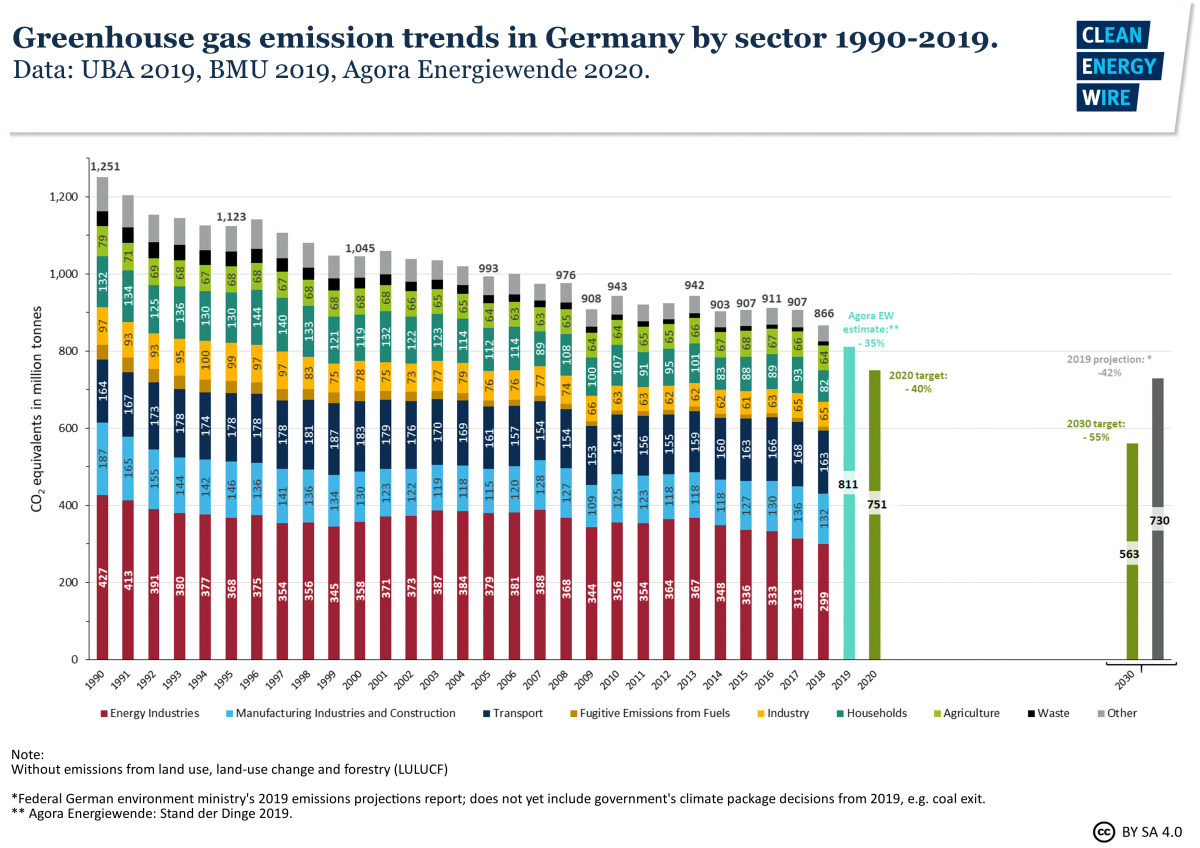
Is this supposed to be a joke? How could you make an article about a 5% increase in 2020 when Germany has had the largest drop in emissions since a decade in 2019? It managed a 6.5% drop in total emissions even though the only thing that dropped were the CO2 emissions in the electricity sector. Just think about it. A rising population (influx of refugees), increased emissions in transport, industry, agriculture and somehow they almost managed a 7% drop while simultaneously increasing emissions by 5% in the electricity sector? No, the reality is that emissions dropped massively thanks to the introduction of renewables. Not as fast as many Germans want but it did happen.

That article is just pure bullshit that isn't backed by any numbers. If they had picked 2015-2018 then maybe it would make sense but 2019? That's either pure incompetence or there is an agenda behind the article.

https://www.cleanenergywire.org/sites/default/files/styles/g...
https://abcnews.go.com/Business/wireStory/rising-carbon-pric...

https://www.cleanenergywire.org/news/transport-and-heating-t...

Re:Japan Turns to Coal After Closing Nuclear Power Plants by xxgreg on Friday February 07, 2020 @07:17PM (#22272621)
Phrase it how you will, but this chart shows it clearly.

https://www.cleanenergywire.org/sites/default/files/styles/g...

Re:Japan Turns to Coal After Closing Nuclear Power Plants by lispm on Friday February 07, 2020 @06:42PM (#22272388)
Here are numbers:

Renewables 2019: 46%

Renewables 2000: 6%

Coal + Gas 2019 40%

Coal + Gas 2000 59%

Re:Japan Turns to Coal After Closing Nuclear Power Plants by xnmaaa on Friday February 07, 2020 @06:47PM (#22272426)
Are the obnoxious wood pellets that spread fine dust included in the renewables?

Give me nuclear any day.

Re:Japan Turns to Coal After Closing Nuclear Power Plants by lispm on Friday February 07, 2020 @06:52PM (#22272454)
wood pellets are basically not used for electricity production in Germany.
Re:Japan Turns to Coal After Closing Nuclear Power Plants by imtringued on Saturday February 08, 2020 @08:23AM (#22275581)
Those are used for heating.
Re:Japan Turns to Coal After Closing Nuclear Power Plants by yongjik on Friday February 07, 2020 @06:26PM (#22272298)
"Turned to renewables" while burning 36% coal according to your graph.

Yes, if they've always been using coal, I guess technically they didn't "turned to" coal, but how is it better?

Meanwhile neighboring France, with its 70%+ energy generated from nuclear, generates about half as much CO2 per capita as Germany. Right now, and in the foreseeable future.

Re:Japan Turns to Coal After Closing Nuclear Power Plants by lispm on Friday February 07, 2020 @06:45PM (#22272406)
Germany sits on a huge pile of coal as its main domestic energy source. France doesn't.

Germany's industrialization has largely been driven by coal.

> Meanwhile neighboring France, with its 70%+ energy generated from nuclear, generates about half as much CO2 per capita as Germany. Right now, and in the foreseeable future.

In the foreseeable future France is reducing its share of nuclear and adds renewable. Reason: nuclear is too costly, too slow to build.

Germany has invested in renewable, since that scales better now and in the future. By investing into renewable Germany has also created a huge export market for this technology, that will have a large positive impact.

Re:Japan Turns to Coal After Closing Nuclear Power Plants by vkou on Friday February 07, 2020 @06:09PM (#22272150)
... And to Russian natural gas. [1]

For every MW of nuclear that was turned down, a MW of natgas was turned up.

[1] https://en.wikipedia.org/wiki/Energy_in_Germany#/media/File:...

Re:Japan Turns to Coal After Closing Nuclear Power Plants by lispm on Friday February 07, 2020 @06:13PM (#22272196)
Renewables 2019: 46%

Renewables 2000: 6%

Coal + Gas 2019 40%

Coal + Gas 2000 59%

Fact: Germany reduced fossil fuels coal+gas and increased renewables massively. Gas itself has increased.

Re:Japan Turns to Coal After Closing Nuclear Power Plants by fiter on Friday February 07, 2020 @06:35PM (#22272341)
The graph shows 36% coal and 13% natural gas for 2016, meaning coal and gas for 2016 is 49%.

There is the question of what this would look like if they didn't shut off their nuclear plants. It's my expectation that the nuclear would have replaced coal and natural gas.

EDIT: Changed incorrect 2019 reference to 2016.

Re:Japan Turns to Coal After Closing Nuclear Power Plants by xxgreg on Saturday February 08, 2020 @12:13AM (#22274067)
This assumes that the nuclear reactors could ramp up and down on a daily basis. Germany's reactors weren't capable of load following to the extent required.

In fact brokdorf was taken offline early due to a failure during a load following experiment. It was only ramping by a small percentage of load.

It's more likely that keeping the reactors online would have made the coal phaseout negotiations harder, and made it easier for the big four power companies to prevent renewables from being deployed.

In my view it's more important to build up industry capable of constantly deploying new zero carbon generation, and exporting this technology, than to keep the reactors running for more than 35 years (the phase out agreement).

Re:Japan Turns to Coal After Closing Nuclear Power Plants by lispm on Friday February 07, 2020 @06:39PM (#22272372)
https://strom-report.de/strom/

Share of electricity production in Germany in 2019:

Coal 19.5% + 9.5%

Gas 10.5%

19.8 + 9.5 + 10.5 = 39.8%

Re:Japan Turns to Coal After Closing Nuclear Power Plants by fiter on Friday February 07, 2020 @06:55PM (#22272478)
Interesting. The graphs on that website do not agree with the ones on Wikipedia. For example, for coal in 2016 Wikipedia says ~220 TWh but Strom says ~135 TWh.

EDIT: I see my mistake. I did not add both brown (~135 TWh) and black coal (~100 TWh) together (surprised to see those broken out, but it's a valid difference). In that case, the numbers still do not agree, but at least they are comparable.

[0] https://strom-report.de/strom/#stromerzeugung-deutschland-20...

Re:Japan Turns to Coal After Closing Nuclear Power Plants by xxgreg on Saturday February 08, 2020 @12:16AM (#22274079)
Another chart... Note some stats are percentage of consumption, others are percentage of generation. These differ due to imports and exports.

https://www.cleanenergywire.org/sites/default/files/styles/g...

Re:Japan Turns to Coal After Closing Nuclear Power Plants by lispm on Friday February 07, 2020 @07:03PM (#22272530)
I don't see it. Strom-report says for 2016:

150 TWh Braunkohle + 110 TWh Steinkohle. For electricity production.

> surprised to see those broken out

Braunkohle has domestic production, Steinkohle no longer.

Re:Japan Turns to Coal After Closing Nuclear Power Plants by imtringued on Saturday February 08, 2020 @08:27AM (#22275600)
Black coal is basically dead while brown coal might survive economically without carbon pricing.