News for hackers. Stuff that matters.
Re:Climate models are running red hot, and scientists don’t ... by derg on Monday February 03, 2020 @10:08AM (#22224738)
Can you even imagine how a Total War economy/society based on transitioning to greener energies, cutting emissions and pollutants, and working on improvements to housing and urban planning would end up looking?

Like ignoring the whole climate change thing for a moment (though we absolutely should not do that), just the quality of life improvements to our health and well being this kind of mobilization would bring would be astonishing.

Re:Climate models are running red hot, and scientists don’t ... by rayiner on Monday February 03, 2020 @10:54AM (#22225241)
> Total War economy/society > quality of life improvements to our health and well being this kind of mobilization would bring would be astonishing.

The impact on quality of life and society would be "astonishing," but they won't be improvements. The Soviets and Chinese tried similar "mobilization[s]" for food production. The idea was to direct society's efforts to producing enough food for everybody. Tens of millions of people died of starvation as a result. It turns out that governments are bad at running economies.

I don't know why so many people think that the same mechanism (a command-and-control economy) will lead to a different result just because you change the goal from food or industrial production to climate change mitigation.

Re:Climate models are running red hot, and scientists don’t ... by nesyt on Monday February 03, 2020 @11:23AM (#22225595)
Thanks for the straw man. American WW2 mobilization didn't kill ten million people - that's not an intrinsic attribute of a country focusing on something.

Think also new deal / public works projects like the Hoover Dam (many died working on the Dam but not because it was a government mobilization project). Just the government spending a bunch of money on environmentally focused projects could happen and could be good.

Re:Climate models are running red hot, and scientists don’t ... by nate_meurer on Monday February 03, 2020 @03:38PM (#22228745)
It's not a straw man, and your examples are no more apt than Rayiner's.

America's WWII mobilization is really nothing like the Green New Deal. The total cost of the U.S. war effort is estimated at around $300 B (adjusted for 2009 dollars) [1]. The lowest realistic estimates for the cost of an effective Green New Deal are around double that amount every year, and lasting for decades [2].

It's true that WWII cost far more relative to GDP (over a third, versus 2% for the New Green Deal estimate above), but expressing the cost relative to GDP is not very useful in this context; in 1945 the U.S. was poised to enter a period of ten percent annual GDP growth at a time that military spending was plunging. The situation now is completely opposite; the U.S. will possibly never sustain greater than 2% GDP growth, and the Green New Deal proposes to pull money out of that for decades to come.

The character of WWII spending was also completely different. That money was largely spent on things that were pretty much guaranteed to help the war effort; materiel, industrial infrastructure, and troops. There was little risk of misallocation.

In contrast, the Green New Deal is fraught with misallocation risk. In that way, I suppose that a comparison to modern military spending is actually quite appropriate.

1 - https://eh.net/encyclopedia/the-american-economy-during-worl...

2 - https://newleftreview.org/issues/II112/articles/robert-polli...

Re:Climate models are running red hot, and scientists don’t ... by adrianN on Monday February 03, 2020 @01:07PM (#22227015)
At least it didn't kill ten million people unintentionally.
Re:Climate models are running red hot, and scientists don’t ... by harryh on Monday February 03, 2020 @01:07PM (#22227019)
American WW2 mobilization didn't kill ten million people

Um, sure it did? Killing a lot of people was, in a sense, the goal.

Re:Climate models are running red hot, and scientists don’t ... by viklove on Monday February 03, 2020 @11:28AM (#22225666)
> It turns out that governments are bad at running economies.

Extrapolating a general theory from just two examples seems like a mistake.

Re:Climate models are running red hot, and scientists don’t ... by gmueckl on Monday February 03, 2020 @11:33AM (#22225733)
Well, what other experimental data is there? If these incidents are the only data points, then that's the natural extrapolation, even though it is only weakly supported.
Re:Climate models are running red hot, and scientists don’t ... by claudeganon on Monday February 03, 2020 @12:01PM (#22226092)
As someone else pointed out, the New Deal, which gave us massive infrastructure projects that we still rely on and helped set the stage for postwar prosperity.
Re:Climate models are running red hot, and scientists don’t ... by rayiner on Monday February 03, 2020 @12:33PM (#22226524)
The impact of the New Deal on post-war prosperity is debatable, but I want to focus on two different points. First, the New Deal mobilization is small in comparison to what has been proposed in the context of the "Green New Deal." From 1930 to 1940, total government spending (at all levels), jumped from 12% to 18%. That's 6% of GDP, or about $1.17 trillion annually. It's unclear what folks who use the phrase "total war mobilization" mean. If you're talking about the Green New Deal's proposal of hitting 0 carbon emissions within a decade, that's not close to enough: https://www.factcheck.org/2019/03/how-much-will-the-green-ne...

> Pollin, however, strongly disagrees with the resolution’s aim of getting to net zero with just a decade of investment. “I think it’s completely unrealistic and it’s not worth costing out,” he said of the Green New Deal.

$1 trillion is the price tag of a much more conservative approach that puts a much longer timeline on carbon reduction:

> Edward Barbier, an economist at Colorado State University, agrees that a strict timeline isn’t realistic. He advocates jump-starting the transition by investing about 5 percent of GDP over five or so years. GDP was $20.5 trillion in 2018, according to the Bureau of Economic Analysis, so that’s a little over $1 trillion a year. “That would push us on a path to clean energy, and a path that permanently lowers carbon emissions,” he told us.

The second point I want to make is that we have much less headroom to do a "New Deal"-style project than we did in 1930. We are actually already far in excess of New Deal-era government involvement in the economy. (See my link above.) Today, government spending is at around 35% of GDP. We are in fact closer to the "total war mobilization" of World War II (where spending peaked at 45%) than to the New Deal era 18%.

Re:Climate models are running red hot, and scientists don’t ... by claudeganon on Monday February 03, 2020 @12:47PM (#22226723)
This demonstrates nothing other to me that the complexity of Capitalist economies and their industries grows over time in such a way that requires further state intervention and support to undergird them. This is true across most of the developed world and in regimes like China and likely will only expand in the future. Especially if Capitalism is to possibly survive the destructive consequences of its externalities.
Re:Climate models are running red hot, and scientists don’t ... by jschwartzi on Monday February 03, 2020 @02:00PM (#22227631)
You’re referencing The Great Leap forward right? Because if so you’re completely ignoring the details in an attempt to use it to bolster your point. The reason tons of people died in The Great Leap Forward has nothing to do with food production per se. Rather, the Chinese government declared several animals to be pests and commanded everyone to eradicate them to protect the harvest. Among those animals were sparrows. Sparrows are minor agricultural pests, but they are fantastic at eating bugs. And so, having hunted sparrows nearly to extinction the Chinese were unpleasantly surprised when a huge plague of Locusts descended on their fields and ate nearly all of the harvest.

So the real lesson is not that command economies are bad but rather that unforeseen circumstances should be avoided. If they hadn’t killed the sparrows we would not now be hearing about how many died.

Re:Climate models are running red hot, and scientists don’t ... by nate_meurer on Monday February 03, 2020 @03:52PM (#22228926)
> If they hadn’t killed the sparrows we would not now be hearing about how many died.

The Four Pests Campaign is a great example of humans suffering the unintended consequences of their own stupidity and hubris. However the Great Famine had many proximal causes, and there is no evidence that simply sparing the sparrows could have prevented it.

Re:Climate models are running red hot, and scientists don’t ... by Udik on Monday February 03, 2020 @10:43AM (#22225093)
Total wars are not known to increase the quality of life. If a transition to a green economy guaranteed such massive economic gains (and no pains) don't you think that politicians of all colours would scramble to implement it? The first step to solving issues is to acknowledge all the difficulties that lie ahead: otherwise you end up in a delusional state in which solutions are obvious and easy and the only reason they're not adopted is that everyone else is evil.
Re:Climate models are running red hot, and scientists don’t ... by ourmandave on Monday February 03, 2020 @11:25AM (#22225629)
...don't you think that politicians of all colours would scramble to implement it?

You would hope, but sadly it depends on what lobbying group they're listening to and what industries are employing their constituents.

Re:Climate models are running red hot, and scientists don’t ... by microcolonel on Monday February 03, 2020 @10:47AM (#22225145)
The other sad conclusion to derive from this is that the "improvements to urban planning" bit is largely not happening, despite generally broad bipartisan support.

It signals to me that people like complaining about things, but do not participate in politics in any productive fashion. Right now it's just team sports, and most people can not name the candidate they are voting for, outside of the presidential election, until they read it off the ballot.

Re:Climate models are running red hot, and scientists don’t ... by KevinEldon on Monday February 03, 2020 @11:23AM (#22225601)
It may also be that people like the idea of 'improvements in urban planning' when they are intangible, but if those changes involved limiting their land use or bulldozing their inefficient homes and neighborhoods they balk; they may also not like moving those planning decisions from their local communities to some bureaucracy outside of their direct engagement.
Re:Climate models are running red hot, and scientists don’t ... by microcolonel on Monday February 03, 2020 @12:19PM (#22226315)
Don't need to bulldoze much of anything to do something though. The inefficiency of buildings is a tiny part of the problem, especially in temperate climates; more mixed use zoning, and the relaxing of single family dwelling zoning, will have a dramatic impact on excess travel.

Transport accounts for basically a third of U.S. energy use, though it has been hardly growing over the last few years, which is a good start.

The most efficient car, bus, or train, is the one that you didn't ride.

Re:Climate models are running red hot, and scientists don’t ... by KevinEldon on Monday February 03, 2020 @12:34PM (#22226535)
I think we agree. I meant inefficiency in building density not energy use. I was thinking about row houses in San Francisco and brownstones in New York City. Old short and inefficient buildings could be torn down and replaced with tall, dense, efficient structures; but people who own row houses, or rent apartments with high rents, or like the way their neighborhood is now don't seem to want this kind of transformation.
Re:Climate models are running red hot, and scientists don’t ... by Udik on Monday February 03, 2020 @12:51PM (#22226776)
And over what time period would you finally offset the excess co2 introduced in the environment by tearing down and rebuilding existing buildings? They're already medium-density buildings, with considerable historical and urbanistic value. Seems a crazy idea to me.
Re:Climate models are running red hot, and scientists don’t ... by KevinEldon on Monday February 03, 2020 @10:57AM (#22225275)
Germany had a Total War economy in WW2. North Korea has one today. The Russian Revolution might not be considered 'Total War', but was single-minded in its focus similar to what you're suggesting. None of these economies worked out well for their citizens. Even the US economy/society during WW2 was more than victory gardens and war bonds; personal freedoms were limited, there were interment camps, forced enlistment, war profiteering, and propaganda (along with the hundreds of thousands of deaths).
Re:Climate models are running red hot, and scientists don’t ... by adrianN on Tuesday February 04, 2020 @02:23AM (#22233218)
My point is that Americans were willing to pay that price even though the actual threat of Nazi Germany was not even in the same ballpark as the threat posed by climate change. I'm also reasonably sure that the switch away from fossil fuels can be done without hundreds of thousands dead.
Re:Climate models are running red hot, and scientists don’t ... by lacker on Monday February 03, 2020 @05:08PM (#22229810)
That's not how I imagine a total war. The point of "Total War" is that you start making every decision necessary to achieve your goal, that you weren't willing to make under a democratic process.

If we go to total war to prevent climate change, that means things like:

* Shutting down power and fuel supplies to poor countries that can't afford current solar or wind power

* Military conquest of uncooperative countries

* Bombing coal mines to shut them down

* Bombing oil fields so nobody can get the oil

* Slaughtering foreign civilians to reduce their carbon emissions

When I think of a "total war" caused by an emergency response to global warming, those are the sort of consequences I imagine. Let's hope we don't get to "total war".

Re:Climate models are running red hot, and scientists don’t ... by HenryKissinger on Monday February 03, 2020 @10:32AM (#22224986)
That would not be possible today.

The wartime World War Two economy we learn about in school was only made possible because of two factors:

1) A massive surge in federal government spending, financed by borrowing from public markets (incl. war bonds), to buy the materiel needed to fight a war on two fronts (in Europe against Germany and in the Pacific against Japan). Such spending caused the public debt as a share of GDP to surge to its highest historical level ever, from about 40% at the start of the war to 100% at its peak, as you can see on this graph: https://upload.wikimedia.org/wikipedia/commons/a/a7/US_Debt_... . Today, without such a total war effort, we are running trillion dollar deficits. To put it as shortly and bluntly as I could, trying the same thing today would bankrupt the government. Our debt levels are far higher than they were then, in relative terms, and increasing by over a trillion every year. We would be looking at 2 or 3 trillion dollar deficits. Deficits of that magnitude might shake investors' confidence in the U.S.'s ability to service its debt.

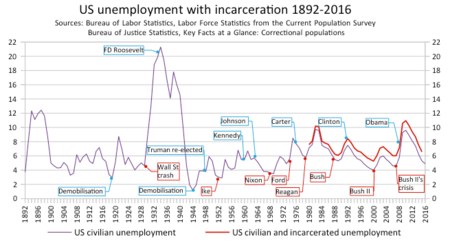
2) The United States was coming out of the Great Depression, and the unemployed labor pool was in the double digits, as you can see on this graph: https://upload.wikimedia.org/wikipedia/commons/thumb/6/68/Un... . In other words, there were a lot of unemployed people with nothing to do who could quickly be put to work to produce stuff for the war economy. This is not the case today. The economy is running at full employment. The large spare labor pool that existed then doesn't exist today.
Re:Climate models are running red hot, and scientists don’t ... by QuantumGood on Monday February 03, 2020 @11:21AM (#22225577)
https://www.nytimes.com/interactive/2019/12/12/business/econ...

America has a large shadow labor force. People who do not regularly apply to work are not counted as officially “unemployed.” Have to take this into account.