News for hackers. Stuff that matters.
Re:NOAA Satellites Helped Save a Record 421 Lives in 2019 by jxcl on Thursday January 23, 2020 @11:22AM (#22128770)
I have one of these beacons and take it with me most times I'm going out alone into the wilderness. I don't want to be the guy who had to cut his own arm off after it got trapped by a falling boulder.

That being said, this is an interesting spin on the number. I've been hearing from friends on Search and Rescue crews that an increasing number of people are going out hiking being completely unprepared for any possible emergency, thinking that they'll just use their cell phone if anything goes wrong. I wonder if any of these beacon carriers fall closer into that camp than true serious conditions, though I suspect that simply carrying a beacon puts you in a higher preparedness bracket than the cell-phone only crew.

Re:NOAA Satellites Helped Save a Record 421 Lives in 2019 by thaumaturgy on Thursday January 23, 2020 @03:17PM (#22131452)
I'm in search and rescue near the Tahoe area.

So far we've had good luck with beacon call-outs. The cases we've responded to have almost entirely been folks that were legitimately stuck or lost, and yes, they were somewhat under-prepared for the situation they were in, but that's just the modern reality of outdoor play and it makes no more sense to expect all recreationists to be perfectly prepared than it makes to expect all software developers to build some idealized unit-tested software.

I have heard from other SAR groups that the beacons have been a mixed bag, and they're getting too many call-outs from people who just got tired and want a ride home. Those people deserve a verbal chewing-out from the local coordinator, but on balance I'd still rather everyone go out with beacons and have a good time and hit that button if they need to.

Re:NOAA Satellites Helped Save a Record 421 Lives in 2019 by biggc on Thursday January 23, 2020 @05:53PM (#22133179)
> I have heard from other SAR groups that the beacons have been a mixed bag, and they're getting too many call-outs from people who just got tired and want a ride home. Those people deserve a verbal chewing-out from the local coordinator, but on balance I'd still rather everyone go out with beacons and have a good time and hit that button if they need to.

Agreed. Recognizing that you're in over your head and calling for help before a life-threatening situation is an incredibly difficult call to make. A story I've heard is of someone struggling on a trip with friends deciding not to make the call for rescue, and then falling to their deaths from an exposed part of the trail.

The other argument for calling for help when you're in over your head in a non-critical situation (e.g dehydrated and exhausted and a ways out) is that it's hopefully lower risk for the rescuers than other SAR situations.

Re:NOAA Satellites Helped Save a Record 421 Lives in 2019 by alfalfasprout on Thursday January 23, 2020 @07:52PM (#22134233)
What are your thoughts on two-way communicators eg; inReach? I've largely replaced my PLB with an inReach (though when in a group I have another person carry the PLB) because in an emergency situation I can communicate with rescuers about the exact nature of the emergency.

Eg; if I need an air evac vs. I broke my leg and can't walk out. Or if I can get medical advice from a rescuer. Similarly I can communicate dangers the rescuers may face.

Re:NOAA Satellites Helped Save a Record 421 Lives in 2019 by cameldrv on Friday January 24, 2020 @01:57AM (#22135983)
The InReach is far superior. You can communicate with rescuers, but you can also communicate with anyone with a phone number or an email address. This is extremely useful if you have a minor emergency and just need a friend to pick you up at a road somewhere or you just need more food or water. On the other hand, you can also tell rescuers that you need a helicopter immediately and not wait for people to hike to where you are.

The InReach also has tracking, so if you go missing and don't activate the beacon, they'll have a very good idea of where to look for you. I've also found it very useful for arranging pickups/meetings if I'm behind schedule or plans change.

The device itself is about the same price as a PLB, but there is a service charge. The basic plan is $15/mo, but you can turn it on and off at any time, so if you only go on a couple of trips per year, the price isn't overwhelmingly more than a PLB.

Re:NOAA Satellites Helped Save a Record 421 Lives in 2019 by thaumaturgy on Thursday January 23, 2020 @08:05PM (#22134326)
LOVE InReach and we recommend 'em to anybody that can handle the sticker shock.
Re:NOAA Satellites Helped Save a Record 421 Lives in 2019 by tlrobinson on Thursday January 23, 2020 @04:48PM (#22132559)
> I have heard from other SAR groups that the beacons have been a mixed bag, and they're getting too many call-outs from people who just got tired and want a ride home.

It seems like charging people for the cost of the rescue would solve that problem.

Re:NOAA Satellites Helped Save a Record 421 Lives in 2019 by thaumaturgy on Thursday January 23, 2020 @06:27PM (#22133492)
SAR and Mountain Rescue Association groups are almost entirely opposed to any form of pay-for-rescue, including the kind of "negligence fines" that a few agencies like New Hampshire's Fish and Game department levies.

It's not just a theoretical possibility that people will hesitate to call for rescue if they think they'll be charged for it, it's something that has already happened in a lot of cases. When people delay a call for rescue, it complicates search and rescue efforts and may even further endanger rescuers.

A great example of this is injuries that worsen to the point that they require evac by helicopter. Helicopters are an over-used tool in SAR and they are extremely dangerous. It's much safer for us if we can just hike out to you, triage a minor injury, and escort you out on foot or by litter if necessary. If we arrive and you're delirious with pain, exhaustion, or dehydration, those options have just gone off the table.

Another really unfortunate related issue is the number of people that think they have to wait a certain period of time before reporting someone overdue or missing. That's not at all the case, especially where children are involved. We would much rather get out while the potential search area is only a few square miles than get called when it's gone up to 30 or more square miles, even if it means we more frequently get woken up in the middle of the night only to get a "disregard, subject located" notification 20 minutes later.

I have a number of statements available from various SAR groups and other articles on this subject if anyone's interested.

Re:NOAA Satellites Helped Save a Record 421 Lives in 2019 by pyromine on Thursday January 23, 2020 @06:37PM (#22133586)
Just as an anecdote I received a fairly significant injury while on a multi-day climb in the French Alps this past summer and my climbing partner and I had a significant discussion regarding the cost of a rescue that definitely factored in to our decision whether or not to keep climbing.

I bought rescue insurance the next day.

Re:NOAA Satellites Helped Save a Record 421 Lives in 2019 by greatpatton on Friday January 24, 2020 @01:30AM (#22135869)
In France mountain rescue is provided free of charge by the french state (only exception is when you are skiing on an official ski run). In Switzerland it’s not free, and almost all the population is a member of the 2 main associations that will cover the costs.
Re:NOAA Satellites Helped Save a Record 421 Lives in 2019 by dsfyu404ed on Thursday January 23, 2020 @07:55PM (#22134256)
I agree in the general case but NH has a special situation since most of the people falling down ravines trying to take the perfect selfie are from outside their taxing jurisdiction (so it's not like they're footing the bill at the end of the day) and much of their government operations are funded by fees at/near the point of service (as opposed to from taxes) so having a "rescue fee" kind of makes sense for them.
Re:NOAA Satellites Helped Save a Record 421 Lives in 2019 by briandear on Friday January 24, 2020 @01:58AM (#22135990)
> SAR and Mountain Rescue Association groups are almost entirely opposed to any form of pay-for-rescue

However, people that spend much time away from civilization ought to have Global Rescue or something similar. I support government and non profit rescue efforts and funding, but ultimately people participating in relatively risky adventures should bear some responsibility for having rescue insurance — and such insurance is pretty cheap. I’ve seen hikers with $300 hiking poles, $300 hiking boots, expensive GoreTex and yet they scoff at paying for insurance to cover the very expensive costs for rescue. A helicopter can cost $1000+ per hour to operate and people going into the backcountry are assuming a level of risk that they ought to be responsible for insuring.

Re:NOAA Satellites Helped Save a Record 421 Lives in 2019 by alach11 on Thursday January 23, 2020 @05:55PM (#22133208)
Adding negative consequences to "false calls" could have a chilling effect on real calls. You don't want people to have to weigh whether they should try to tough it out and risk heat stroke vs. risk a charged rescue. On balance, it's probably better to have false positives here than false negatives.
Re:NOAA Satellites Helped Save a Record 421 Lives in 2019 by mjevans on Thursday January 23, 2020 @05:20PM (#22132896)
How about if a judge gets to decide if they are required to be force-enrolled in to a class that teaches safety in similarly fitting situations and/or some quantity of community service from a list of activities that are fitting of rehabilitation and improving the commons.
Re:NOAA Satellites Helped Save a Record 421 Lives in 2019 by thaumaturgy on Thursday January 23, 2020 @07:12PM (#22133914)
I'm pleased to say that a handful of past search subjects have gone on to become SAR volunteers themselves, so some people already do this without needing a judge's involvement.
Re:NOAA Satellites Helped Save a Record 421 Lives in 2019 by 1123581321 on Thursday January 23, 2020 @10:49PM (#22135242)
Those would enormously prohibit calling in, more than money for many people due to the potential public embarrassment, let alone the time, extra required PTO and potential cognitive load from the legal situation.
Re:NOAA Satellites Helped Save a Record 421 Lives in 2019 by mjevans on Sunday January 26, 2020 @09:08PM (#22156338)
If it's embarrassing there is already an EXTREMELY high chance some local news agency will cover it sooner or later already. Yes, even more so if those in need don't call and end up dead.
Re:NOAA Satellites Helped Save a Record 421 Lives in 2019 by munificent on Thursday January 23, 2020 @12:33PM (#22129602)
Risk compensation [0] has been studied and gets a lot of press because it tickles that combination of psychology + counter-intuitive result + play into narrative that people suck.

As far as I know, though, most modern studies show that while there is some amount of risk compensation (people engage in riskier behavior after adopting a safety apparatus), the compensation is less than the benefit of the safety measure.

With beacons in particular, a potential compounding factor is that many people may not have gone out into the wilderness at all before beacons became available. So maybe there is a net increase in beacon usage but it could be because of an even greater increase in outdoor participation.

I think it's a net good for people to spend time in the outdoors, both for them personally and because it encourages society as a whole to prioritize preserving the environment. So if that results in more people needing to be rescued, it may still be worth it.

[0]: https://en.wikipedia.org/wiki/Risk_compensation

Re:NOAA Satellites Helped Save a Record 421 Lives in 2019 by tialaramex on Thursday January 23, 2020 @01:45PM (#22130399)
Risk Compensation has its worst effects when the prior risk itself is concealed by the technology. IIRC anti-lock braking doesn't drive up accident rates for those who grew up with it (all cars they drive have ABS, that's just how cars work as far as they're concerned) but it did for those for whom it just made loss of control mysteriously vanish in their new car. They would think "I guess I'm just good at driving" and engage in behaviour which the car was now compensating for with ABS, not realising that this mean they were outside the safe performance envelope.

AEB deliberately is a scary experience to prevent this mistake. If your car's AEB triggers you'll be suddenly and violently brought to a complete halt in order that the feeling is "Oh shit, I fucked up, is everybody OK?" not "Wow I'm a great driver".

With a beacon the experience is likewise not great. It's not "Activate beacon, rescuers magically teleport in and save the day". There's zero real feedback, so most people will be worried that it hasn't been effective, nobody is coming. After an hour, or two, or more, rescuers may show up looking for you. That's a long time to be lost or injured in the middle of nowhere.

Re:NOAA Satellites Helped Save a Record 421 Lives in 2019 by myself248 on Friday January 24, 2020 @12:05PM (#22140142)
> There's zero real feedback

That's why Return Link Messages in the Galileo network are so interesting. Basically, there's a super low bandwidth message channel embedded in the GNSS data stream. Its sole purpose is to tell beacons "We saw your beacon and we're responding to it".

Re:NOAA Satellites Helped Save a Record 421 Lives in 2019 by PopeDotNinja on Thursday January 23, 2020 @02:48PM (#22131098)
I certainly do things now that I wouldn't have done before having ba smartphone. The most common thing is driving into the middle of nowhere without a backup plan. Usually it's fine. Occasionally I get stupid lost. One time I got stuck in mud with no cell phone reception, so I walked to a random person's house, knocked on the door, and asked for help.
Re:NOAA Satellites Helped Save a Record 421 Lives in 2019 by reaperducer on Thursday January 23, 2020 @12:57PM (#22129899)
I've been hearing from friends on Search and Rescue crews that an increasing number of people are going out hiking being completely unprepared for any possible emergency, thinking that they'll just use their cell phone if anything goes wrong.

This is so true.

I live in the desert, and it's amazing the number of people who simply don't take the natural world seriously.

The dead and rescued are almost always tourists. And for some reason, almost always from Europe (I suspect because my observation has been that Asians tend to travel in large groups on air conditioned buses). They drive rental cars into deep sand and get stuck and die. They run out of gas and get stuck and die. They never bring enough food or water and don't know what to do in an emergency.

I was at a hotel on the Navajo Reservation (Arizona/New Mexico/Utah) about a year ago and there was a British couple arguing with the manager that of course their cell phone should work, they bought it in San Francisco. I tired to explain to them that the whole reason people visit places like this is to get away from technology. Even though I'm sure there are remote places in Europe, they had no concept that there are places in the world where there's no cell service.

A couple of years ago there was an article in the newspaper about a German guy who decided to rent a Harley Davidson and drive through the desert like some kind of David Hasselhof fantasy. It was 115° and he was in full-on black leather gear. They found him dead on the side of the road, still sitting on his motorcycle with his helmet on.

--:--

Editing to add the results from a four-second Google News search:

authorities in California launched a search for Pi-Wei Hung, 40, early Sunday afternoon... the woman’s vehicle was discovered stuck in the sand on the shoulder... and then died in the heat as she tried to walk out of the area. The high temperature that day was 113 degrees.

a 60-year-old tourist from Germany died from heat exposure... not far from his where his motorcycle was parked, upright and in working order, in the 118-degree heat.

...two French tourists got their car stuck in loose sand... no one knew their specific travel route, and they were out of cellphone range in temperatures above 110 degrees.

Re:NOAA Satellites Helped Save a Record 421 Lives in 2019 by rhcom2 on Thursday January 23, 2020 @01:11PM (#22130027)
A good read about being unprepared for the desert is "The Hunt for the Death Valley Germans" which is an amateur's search for answers on how a German family of tourists abandoned their van in Death Valley and then disappeared.

https://www.otherhand.org/home-page/search-and-rescue/the-hu...

Re:NOAA Satellites Helped Save a Record 421 Lives in 2019 by tdons on Thursday January 23, 2020 @02:10PM (#22130681)
This website cost me a weekend once :-)
Re:NOAA Satellites Helped Save a Record 421 Lives in 2019 by sneak on Thursday January 23, 2020 @09:02PM (#22134705)
That and the website of the desert hunter who found the crashed SR71 should come with some rabbit hole warning labels. :)
Re:NOAA Satellites Helped Save a Record 421 Lives in 2019 by mattkrause on Friday January 24, 2020 @11:18AM (#22139546)
I think it's the same person!

(I would check, but I've stuff to do and I've already been down that rabbit hole once.)

Re:NOAA Satellites Helped Save a Record 421 Lives in 2019 by japhyr on Thursday January 23, 2020 @01:24PM (#22130162)
Yes, that is such a great read!
Re:NOAA Satellites Helped Save a Record 421 Lives in 2019 by davidw on Thursday January 23, 2020 @01:11PM (#22130024)
> I'm sure there are remote places in Europe

There are a few, here and there, but it's just completely different. Everywhere in Italy (I lived there a number of years) there are people. It might just be a little mountain hut, or a cabin or something, but there are pretty much always other people around.

Here in Oregon, I can ride my bike to places where I almost won't see other people all day.

Re:NOAA Satellites Helped Save a Record 421 Lives in 2019 by wongarsu on Thursday January 23, 2020 @03:30PM (#22131616)
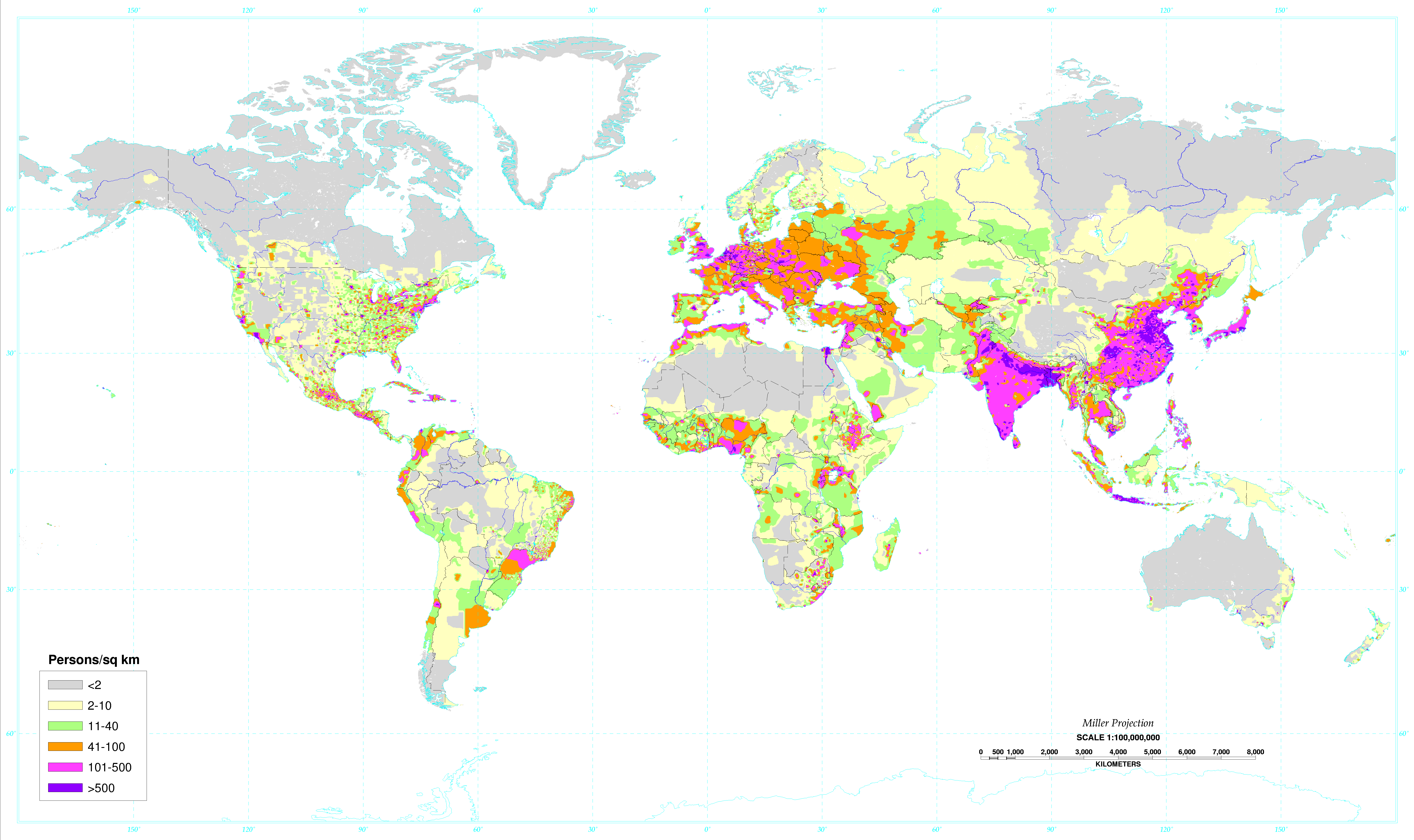
For further context, [1] is a map of worldwide population density. Except for the Nordic countries and Spain there are no places without people.

1: https://upload.wikimedia.org/wikipedia/commons/6/67/World_po...
Re:NOAA Satellites Helped Save a Record 421 Lives in 2019 by lucb1e on Thursday January 23, 2020 @04:46PM (#22132543)
Wow, I had no idea the USA is so sparsely populated.

As someone from a purple region on that map (having lived near Aachen and Amsterdam), I can't imagine what it's like to be more than a few minutes driving away from the nearest occupied house or named road. The most alone I've ever been was probably in a German forest and that was almost certainly still within hearing distance from other people, if not immediately then almost certainly within 30 minutes of me wanting to reach someone.

Not sure if it would frighten me or if I'd be fine to be actually unreachable for a few hours.

Re:NOAA Satellites Helped Save a Record 421 Lives in 2019 by Enginerrrd on Thursday January 23, 2020 @05:10PM (#22132801)
It's a pretty interesting and important point. I think that it plays a central role in individual beliefs on politics as well:

If you live in an area of high density, people are your problems and it probably makes sense to you to generally limit their freedoms in favor of government control and general law and order.

If you live in an area of low density, you're immediate problems are generally not people, may be more survival related, and you are used to operating with MUCH greater independence, freedom, and self-reliance.

Applied to issues like gun control, government assistance programs, and taxation, it aligns pretty well.

Personally, I'm from an area where I routinely work in areas that are hours from cell reception or any form of help. I drive a big 4wd truck and a dirty 2-stroke chainsaw out of necessity. And, I carry a concealed pistol with me in the field.

This is often unfathomable to people that live in the bay area or Europe and I face criticism for my truck, for embracing individual rights to firearms, and I'm constantly faced with disdain from urban folks who like to insinuate that rural people are just stupid and ignorant. These people have never stared down a mountain lion 20 feet away, crouched and ready to pounce, lived without power or running water, nor faced a road wash-out that cut them off from civilization for weeks, or faced dozens of other situations I can recount where things like having the right to carry a loaded rifle in their truck might make a lot of sense. Nor can they understand the thin margins and lack of cash-flow people have to survive on in these places.

Very different worlds, and unfortunately it seems tough for people in different areas to acknowledge that they each have different needs.

Re:NOAA Satellites Helped Save a Record 421 Lives in 2019 by lucb1e on Friday January 24, 2020 @04:04PM (#22142446)
This may be the first comment I've read from someone speaking in favor of general gun ownership that I've upvoted.

Interesting thought, I had not considered the more vs less regulating thing in this way before.

Specifically about gun ownership, perhaps rather than a general allowance or prohibition on gun ownership, maybe it makes sense to allow those that work in rural areas to carry? Or just that you need some sort of license? It's not as if there exist no guns in Europe: there are gun clubs where people go to, uh, shoot I guess? Not even sure. They have a license and can keep all sorts of guns at the club, at home, and (locked away) on the direct way from and to there. Hunters carry hunting guns into the forest. And of course police that brings guns where ever. Edit: Oh, and look at Norwegian gun ownership. While that's hunting guns that are somehow different, they don't seem to have the issues that the USA has with guns there. /edit. So we also just adapt the rules to whatever is practical, it's not an outright ban on anything with gunpowder.

From what I read about research/statistics on general population gun ownership, generally it's better not to allow it, but that does not mean I can't understand that you carry one in your situation or that I think there shouldn't be an exception for that.

> I'm constantly faced with disdain from urban folks who like to insinuate that rural people are just stupid and ignorant.

I was thinking about this a bit, trying to figure out if I may have that bias as well. Sure, those who work with their hands are typically less educated, but generally working in a rural area (without saying whether you work some physical labor job)... for all I know it's a high tech job building wind turbines or whatever. But then, I guess we don't have so many "rural people" so I wouldn't know it from real life. I do know of the stereotype from books that have "backwards villages".

Some interesting thoughts, thanks for sharing!

Re:NOAA Satellites Helped Save a Record 421 Lives in 2019 by ghaff on Thursday January 23, 2020 @05:08PM (#22132777)
>if I'd be fine to be actually unreachable for a few hours.

More like days or more in vast areas of the US. Mind you, most people don't go to those places. But, even within popular national parks, you can go to places--albeit probably not without high-clearance 4WD and ability to use it or on foot--where you probably won't happen to run into anyone for a long time.

Unreachable for a few hours+ is absolutely the norm in many many places in the western US and even in some other areas like Maine.

Re:NOAA Satellites Helped Save a Record 421 Lives in 2019 by davidw on Thursday January 23, 2020 @06:01PM (#22133252)
Last summer I went camping on Steens Mountain

https://en.wikipedia.org/wiki/Steens_Mountain

The "town" at the base of it is called Frenchglen: https://en.wikipedia.org/wiki/Frenchglen,_Oregon - it has a little store and hotel.

From there it's about an hour to the nearest town with any kind of services like a hospital https://en.wikipedia.org/wiki/Burns,_Oregon - there are about 5000 people in the area.

From there it's another 2.5 hours, roughly (in good weather) to where I live which is a town of nearly 100K.

https://www.google.com/maps/@42.9351809,-119.0716963,10.06z/...

Re:NOAA Satellites Helped Save a Record 421 Lives in 2019 by vkou on Thursday January 23, 2020 @06:21PM (#22133443)
I have my doubts about the accuracy of this map. According to it, a huge chunk of central Russia is 'peopled' - yet there are many parts of it where you can try to bushwack through the taiga for two weeks, without ever running into a soul.

I assume that the 'regions' that were painted in the map are oblasts (Russian equivalents to counties) - so if there's a giant oblast, with a medium-sized town at its center, but few people living in the outskirts, the entire region gets painted orange.

Re:NOAA Satellites Helped Save a Record 421 Lives in 2019 by dmurray on Thursday January 23, 2020 @05:25PM (#22132943)
This is a very interesting map, but the political boundaries look wrong. Germany is shown as two countries, though they unified in 1990. But the USSR is shown post-breakup, at least looking in the Baltic, though that breakup only happened in 1991.
Re:NOAA Satellites Helped Save a Record 421 Lives in 2019 by wongarsu on Thursday January 23, 2020 @05:35PM (#22133032)
The map is from 1994, which helps explain the weird borders. They are still wrong, but inaccuracies in then-recent developments that are not the map's focus can be forgiven imho.

One should keep in mind that the map is 25 years old, meaning it doesn't really show the post-soviet development of Eastern Europe or the population growth of Asia and Africa. But I don't think that the distribution of "empty" (less than 10 people per square km) has changed much, so for this purpose the map is perfectly adequate.

Re:NOAA Satellites Helped Save a Record 421 Lives in 2019 by dmurray on Thursday January 23, 2020 @06:11PM (#22133351)
I have a lot more questions about the map: that's just the start of my picking at its legitimacy.

There are areas of grey (less than 2 people/sqkm) around the coasts everywhere. A processing artifact, or some indication of low water marks? I don't think the tidal area can ever be 20 km wide, but it's very sloppy if it's just bad drawing. (There's already a cyan outline for the coast! Why add grey areas too?)

Then I'm certain there are areas in Wicklow, Ireland with less than 2 residents/sqkm [0]. But the whole area is shown not one but 4 levels more populated, at 100+ residents/sqkm, comparable to Las Vegas and ahead of Buenos Aires which is shown at 41-100 residents/sqkm.

The resolution of the map appears to be at the 10km level, but I think this is misleading and in most of the world it's actually based on data at the country level or one level below.

One of the most surprising things to me about the map before I looked closely was the lack of wilderness in Turkey. If it's that dense all the way through, it should be a massive power. But aren't there mountains and deserts? Probably just the map being lazy again.

[0] https://maps.app.goo.gl/cktt79N4FDLegF7a6 - not the most egregiously incorrect measurement on the map, but one I know personally

Re:NOAA Satellites Helped Save a Record 421 Lives in 2019 by xattt on Thursday January 23, 2020 @08:09PM (#22134352)
That map is missing data. Thunder Bay, Ontario is a densely populated area, yet not represented on the map.
Re:NOAA Satellites Helped Save a Record 421 Lives in 2019 by pvaldes on Thursday January 23, 2020 @05:09PM (#22132787)
> there are pretty much always other people around

This can be deceptive and sometimes add new dangers also. there are areas in Europe close to towns but with thousands of illegal waterholes hidden under grasses or a shrub. You just step over a grass and fall before seeing it.

Re:NOAA Satellites Helped Save a Record 421 Lives in 2019 by paranoidrobot on Thursday January 23, 2020 @07:18PM (#22133963)
We have a similar problem with tourists in Australia and people (even from the US) underestimating quite how large the country is, and how you can very quickly find yourself on roads not meant for campervans and regular cars, and on roads that rarely get travelled.

Last year about a few hours drive south of Sydney I found a very young German couple who were on a otherwise completely deserted and unpatrolled beach. They walked down from the parking spot to the beach and spent a few minutes wading around in the water.

After speaking to them, I found that they'd flown into the country the previous day, rented the van that morning and this was the first beach they had found. They said the only thing that kept them from swimming out was a worry of sharks. I had to spend a few minutes educating them about rip currents, and pointed out that they'd just been wading in what looked like the biggest one on the beach.

Re:NOAA Satellites Helped Save a Record 421 Lives in 2019 by Thlom on Thursday January 23, 2020 @05:10PM (#22132797)
This is interesting, cause we have the same situation with tourists in Norway underestimating the wilderness. Last few years the stone formation “Trolltunga” has been pretty popular among tourists, but what the Instagram posts doesn’t tell you is that it is a 8 hour hike on regular old paths up a mountain. We’ve seen tourists walking in flip-flops, with no water, no food, starting too late in the day or too early in the season when there’s still snow large parts of the way and so on. The voluntary search and rescue team had a few pretty rough years.

Perhaps the issue is that tourists in general are very unprepared for other countries wilderness?

Re:NOAA Satellites Helped Save a Record 421 Lives in 2019 by shpongled on Thursday January 23, 2020 @05:26PM (#22132957)
Even in San Diego, we have people get stuck and even die while out on recreational hiking trails. Some people just have no idea what they're doing outside - I see them carrying a single Dasani water bottle on a 7mi hike while I have about 4L of water on my person
Re:NOAA Satellites Helped Save a Record 421 Lives in 2019 by rconti on Thursday January 23, 2020 @03:49PM (#22131839)
I found cell reception to be alarmingly bad in the UK outside of populated areas. Entire stretches in Wales with no coverage. Days on 3G (if you're lucky!)

Iceland had stunningly good coverage; no matter how remote you were, it seemed like full service everywhere. (granted, I did't cross the center of the island).

Had no cell coverage on the Rallarvegen in Norway, which surprised me.

But yeah, it's all nothing like the US.

Re:NOAA Satellites Helped Save a Record 421 Lives in 2019 by lucb1e on Thursday January 23, 2020 @04:21PM (#22132244)
> I live in the desert, and it's amazing how many...

Okay yeah but that's very anecdotal. Just because there is a lot of people getting stuck that assume technology would just work, does not mean there weren't a lot of people getting stuck with no backup plan whatsoever. And I wouldn't trust memory either, besides that it is very fallible people also see the past as better than today (from various studies).

I would be interested if you have news (Google-branded or otherwise) that reports it has gone up since cell phone coverage became ubiquitous in many countries, corrected for things like plane ticket prices and car rental availability near a desert (i.e. more people trying it rather than actually a higher percentage of unprepared people).

Re:NOAA Satellites Helped Save a Record 421 Lives in 2019 by AWildC182 on Thursday January 23, 2020 @12:12PM (#22129365)
Carry one as well. This is obviously anecdotal and may be because of the people I hang around with but everyone I know who carries also never hikes without a bunch of other standard safety kit and is very experienced.

I suspect that being willing to buy a $200 beacon means you're aware enough of the risks and of what safety gear is out there to seek extra protection when possible.

Re:NOAA Satellites Helped Save a Record 421 Lives in 2019 by ghaff on Thursday January 23, 2020 @05:10PM (#22132798)
At some level, I don't love the always connected idea. But if I were to do serious solo backpacking at this point (or were regularly going into remote areas by car with or without a companion), I admit it would probably be prudent for me to carry a beacon.
Re:NOAA Satellites Helped Save a Record 421 Lives in 2019 by rmcpherson on Thursday January 23, 2020 @05:25PM (#22132947)
It’s really not always connected in the way of internet or satellite two way communication. The beacon’s are only there if you need them for emergencies and do not allow people to contact you. There are some like the Spot devices that allow 2 way text via iridium satellites, however.
Re:NOAA Satellites Helped Save a Record 421 Lives in 2019 by ghaff on Thursday January 23, 2020 @05:29PM (#22132979)
It's connected in an emergency--which is what really matters. Though TBH, I'd probably get one of the messaging devices if I got one so I could do "All going well" to people who might care especially if I were running late.
Re:NOAA Satellites Helped Save a Record 421 Lives in 2019 by vegardx on Thursday January 23, 2020 @11:30AM (#22128864)
I'd love to see some actual statistics on this. This assumes that people knowingly do something dangerous and are choosing to ignore it because they think someone can just come and save them. I would argue that this is unlikely, unprepared people are unprepared in all aspects of it. Carrying a cellphone doens't mean they thought of it as some kind of security measurement. People just rarely go somewhere without it. They simply don't know any better.
Re:NOAA Satellites Helped Save a Record 421 Lives in 2019 by jxramos on Thursday January 23, 2020 @12:08PM (#22129308)
I heard some organizations try to collect fees from repeated offenders who tax search and rescue operations too frequently. Others collect under situations of negligence.

https://www.outsideonline.com/1986496/search-and-rescue-publ...

Re:NOAA Satellites Helped Save a Record 421 Lives in 2019 by bluGill on Thursday January 23, 2020 @12:26PM (#22129517)
I've heard of some organizations rejecting this because if it wasn't for all the unprepared people heading out and getting in over their head they would have to pay someone to go out an pretend to need rescued for training purposes. Having someone who really needs help is much better training than a planned mission - even if they shouldn't have needed help.

Your mileage may vary, each rescue team has different situations. In some areas they get too many calls (remember a call takes the rescuers away from their family and other thing they would do instead) and should do something about those who didn't make at least some attempt to be prepared.

Re:NOAA Satellites Helped Save a Record 421 Lives in 2019 by japhyr on Thursday January 23, 2020 @12:41PM (#22129716)
I've been involved in mountain rescue for almost 20 years now. The main reason I've heard over the years for not charging for rescue is that it causes people to delay asking for help. This results in more high-risk calls for rescuers, and worse outcomes for people in need of rescue.

In most situations, the cost of a rescue is not nearly as significant as media accounts portray. People love to cite the cost of helicopters in USCG rescues. USCG pilots need to fly a certain number of hours; those hours can come from missions or training sessions. When they fly more missions, they reduce their training hours.

Creating a rescue policy for really high-traffic areas like the most popular national parks is a different story. Those are outlier situations, and we shouldn't have the same policy for SAR in average rural areas that we do for popular national parks.

Edit: I meant to add another reason for not charging for rescue. I have been on missions where we reached the missing person, and the person initially refused our help because they thought we were going to charge them. The same conversation played out on the mountain that we're seeing play out in the comments here. In the end, these people are very happy to receive the assistance they needed; they were not going to get out of the mountains on their own.

Re:NOAA Satellites Helped Save a Record 421 Lives in 2019 by ISL on Thursday January 23, 2020 @01:21PM (#22130133)
Colorado has an interesting approach to these concerns.

https://www.colorado.gov/dola/search-and-rescue-fund

The state has set up a voluntary contribution system where hikers and other recreationalists can purchase a search-and-rescue card. Hunting/fishing licenses, off-highway vehicle permits, and other similar permits also contribute to the fund.

These cards are not mandatory for rescue, but rather, if a card/permit-holder is rescued, the localities' rescue costs are defrayed by the state fund.

Re:NOAA Satellites Helped Save a Record 421 Lives in 2019 by MayeulC on Thursday January 23, 2020 @12:30PM (#22129573)
Well, that is an interesting take, but if collecting such a tax really helped reduce the number of people going out unprepared, thus needing help, it would really be a no-brainer to do so, as it could avoid people getting hurt or killed in the first place.
Re:NOAA Satellites Helped Save a Record 421 Lives in 2019 by bluGill on Thursday January 23, 2020 @02:21PM (#22130807)
Problem is people who know about the tax will refuse rescue if they think they can get out without paying it - thus killing more people because they refused the rescue.
Re:NOAA Satellites Helped Save a Record 421 Lives in 2019 by JarlUlvi on Thursday January 23, 2020 @11:47AM (#22129056)
It only takes one trip/slip/fall, one rock slide, one sprain, one break, one break, one deadfall, one snake, one asthma attack, one sting, or one rabid animal to turn an outdoor trip into a potential life or death situation.

99.99% of the times I've spend in the forest and desert has been "safe". It is the .01% and .001%s that get you.

Re:NOAA Satellites Helped Save a Record 421 Lives in 2019 by sneak on Thursday January 23, 2020 @09:04PM (#22134720)
That’s why I have two PLBs. Two is one and one is none.
Re:NOAA Satellites Helped Save a Record 421 Lives in 2019 by japhyr on Thursday January 23, 2020 @12:10PM (#22129336)
I've been an active member of a search and rescue team in southeast Alaska since 2002. This has been a really interesting period to be involved in SAR. When I started, very few people had cell phones or GPS devices. Then came a period where almost everyone had a cell phone. Then people had cell phones with embedded GPS. Now we're seeing many people with GPS-enabled mapping software such as Gaia on their devices.

I haven't analyzed the data, but these trends have definitely changed our callout pattern. We used to get regular calls for people who were overdue, and the only communication was with the person who reported them overdue. When cell phones first came out, it seemed we got a few more calls from people who had gone less prepared. But we're a coastal community, and handheld VHF radios played the role of a cell phone in our community before cell phones came out, so basic communication didn't change drastically at first.

I think things started to change once everyone had a phone, and there were enough towers to have decent coverage throughout our mountainous area. We get far fewer callouts where there's been no direct communication with the missing person. Now we tend to have direct communication with the person, or we are talking to a reporting party who has had some direct communication with the missing person. We are responding to known locations more often - the person is lost, but we know where they are and our mission is to reach them, and guide them safely out. Or they're injured/ immobile, and we go right to them and evacuate them.

Now we're starting to see people who are following others' routes using apps like Gaia, and getting in over their heads. People see a route on Gaia, and they think it's a trail or a clear route. In our mountains, experienced people are often bushwhacking through steep terrain where there's only one route that works, and if you don't know how to navigate that terrain you can get into dangerous cliffed-out areas quickly. And once you get off route, it can be really hard to get back to a safe place because there's no safe direct route back to the GPS track.

All of this has been exacerbated by the local effects of climate change. We're in a rainforest, and the vast majority of our days used to be overcast with drizzle. A good deal of our callouts were for people who went out in a break of clear weather, then got stuck when the clouds rolled back in and they couldn't see where to go. We get much longer periods of clear weather - weeks and months instead of hours and days - so people are going out in clear weather and coming back in clear weather. We also have ice fields and glaciers that are receding, leaving behind blue ice that's much more difficult to navigate than old snow, and loose silt and rocks that's much easier to slide on than exposed, weathered dirt with vegetation.

The interaction of people and wilderness is always going to be there, and the tools available are always going to influence how people interact with the wilderness. It's not always getting better or worse. People adapt to the tools available, and sometimes use them to get into more dangerous situations, and sometimes use them to avoid and get out of dangerous situations.

Re:NOAA Satellites Helped Save a Record 421 Lives in 2019 by jxcl on Thursday January 23, 2020 @12:55PM (#22129877)
Thank you so much for taking the time to write your experiences up! I have found SAR fascinating for a long time, and am kind of interested in getting involved, but it seems like an insurmountable commitment.
Re:NOAA Satellites Helped Save a Record 421 Lives in 2019 by japhyr on Thursday January 23, 2020 @01:20PM (#22130115)
Where are you located? Getting involved in SAR looks a lot different depending on where you are. In my community most people spend some time outdoors, but there isn't any one focus like rock climbing or kayaking or anything. So we'll take just about anyone who's interested and has reasonable judgement, and find ways they can contribute. You can take someone brand new and have them stand at a trailhead and interview anyone who's coming off the trail, and brief anyone who's heading out onto the trail.

There are some communities where it's competitive to get onto a SAR team. This typically happens in large urban areas right next to popular outdoor locations. If there are 10k rock climbers in an area, there might be so many people interested in climbing SAR that they have limited spots available. That's pretty unusual, though.

SAR is usually administered through the local sheriff's department, although it can differ. Here in Alaska the state troopers are responsible for SAR, but our team is based at our local volunteer fire department. I would encourage you to get in touch with the people responsible for SAR in your area, and ask what it takes to get involved. Often times there are many different ways you can contribute, and it's a tremendously satisfying endeavor. It's also a really nice balance for sitting in front of a screen much of the day!

Re:NOAA Satellites Helped Save a Record 421 Lives in 2019 by jxcl on Thursday January 23, 2020 @02:58PM (#22131218)
> There are some communities where it's competitive to get onto a SAR team. This typically happens in large urban areas right next to popular outdoor locations.

Yep, I'm in Denver, CO. D:

Re:NOAA Satellites Helped Save a Record 421 Lives in 2019 by stopads on Thursday January 23, 2020 @11:33AM (#22128900)
This is really cool, I had no idea these exist and are somewhat affordable. For example: https://www.amazon.com/Resqlink-PLB-375-Personal-Locator-Buo...

I'm going to pick something like this up before my next Wyoming adventure.

Re:NOAA Satellites Helped Save a Record 421 Lives in 2019 by linsomniac on Thursday January 23, 2020 @11:49AM (#22129099)
I've had the ResQLink for 3.5 years, haven't had to use it for anything other than the test cycle, and have been happy with it. I wrote more details in a reply to the parent.
Re:NOAA Satellites Helped Save a Record 421 Lives in 2019 by scarejunba on Thursday January 23, 2020 @05:11PM (#22132813)
Almost all the reviews for these are "haven't had to use". Look at this product https://www.amazon.com/ACR-ResQLink-400-Buoyant-Personal/dp/...

13 5-star ratings - everyone should have one, I haven't had to use mine but it gives me peace of mind

1 1-star rating - gave it to my son because he jet skis. After a while it was rusted. Gave it a shot, didn't work.

Reminds me of this xkcd https://xkcd.com/937/

Re:NOAA Satellites Helped Save a Record 421 Lives in 2019 by tialaramex on Thursday January 23, 2020 @06:28PM (#22133508)
That's a fair point, and historically it was very hard to arrange to test a unit unless you were the manufacturer. So even a serious reviewer couldn't say "The FooCorp RescueMax failed after just six minutes in our ice water bath" or "Our testers weren't able to understand the orientation instructions for the FooCorp RescueMax and test transmissions were not received in the canyon test area" because they weren't supposed to try the actual function of the beacon at all.

I believe COSPAS SARSAT and the relevant US authorities got it together so that it is now possible to arrange a test carve out, agree with everybody when and where the units will be tested and not cause helicopters of annoyed rescuers to arrive so long as you stay in the agreed area and only test in the agreed time frame. But it can't be made trivial, so chances are only really hardcore survivalist outfits will do that work.

Re:NOAA Satellites Helped Save a Record 421 Lives in 2019 by alfalfasprout on Thursday January 23, 2020 @07:56PM (#22134272)
In the ResQLink manual it literally has you test it several times per year to verify correct operation. FWIW I've had mine 7 years and it's been through several battery replacements at the factory and been through several rough longer expeditions. No problems at all with the GPS test cycle.
Re:NOAA Satellites Helped Save a Record 421 Lives in 2019 by scarejunba on Thursday January 23, 2020 @08:39PM (#22134550)
Thanks for that. Is this the model you bought? https://www.amazon.com/ACR-ResQLink-400-Buoyant-Personal/dp/...
Re:NOAA Satellites Helped Save a Record 421 Lives in 2019 by ineedasername on Thursday January 23, 2020 @06:06PM (#22133296)
I'd be extremely reluctant to go to any wilderness or hiking area and rely on my cell phone. Sure, coverage is much better than years ago, but even a few weeks ago I was driving a few hundred miles. I checked ahead of time to see about possible stops along the way, cell coverage, etc. because some of the route went through the middle of nowhere. Cell maps said I had full coverage the whole way, but there was a hundred mile stretch where every few minutes I'd lose coverage for a mile or two.
Re:NOAA Satellites Helped Save a Record 421 Lives in 2019 by ChuckMcM on Friday January 24, 2020 @02:53AM (#22136237)
After reading about a CNET employee dying on their way home in the mountains because they were out of cell service on winter roads and were stuck I got one. We are on our second one, the new ones are even smaller than the originals, and carry it with us when ever we travel, especially in the back country.

It is the best/cheapest insurance one can buy.

Re:NOAA Satellites Helped Save a Record 421 Lives in 2019 by Analemma_ on Thursday January 23, 2020 @12:08PM (#22129312)
Some Search and Rescue organizations now bill you if they determine you had to be rescued because of gross negligence (if you were prepared and simply unlucky, it's still free). This can be tens of thousands of dollars if they had to use helicopters and the like.
Re:NOAA Satellites Helped Save a Record 421 Lives in 2019 by btashton on Thursday January 23, 2020 @12:18PM (#22129440)
There is a lot packed into the pay for search and rescue model. One of the last things I want someone to be doing in an emergency situation is to be thinking can I afford help right now or should I just try harder to get off this cliff with a broken ankle. Then there is the question of what really is the cost. If a helicopter is involved frequently the operation cost if figured in, but these in the US are almost always military helicopters and they count these operations towards training hours. I would much rather have those hours spent to helping someone in danger than burning fuel for no emergency.