https://www.otherhand.org/home-page/search-and-rescue/the-hu...
(I would check, but I've stuff to do and I've already been down that rabbit hole once.)
There are a few, here and there, but it's just completely different. Everywhere in Italy (I lived there a number of years) there are people. It might just be a little mountain hut, or a cabin or something, but there are pretty much always other people around.
Here in Oregon, I can ride my bike to places where I almost won't see other people all day.
1: https://upload.wikimedia.org/wikipedia/commons/6/67/World_po...
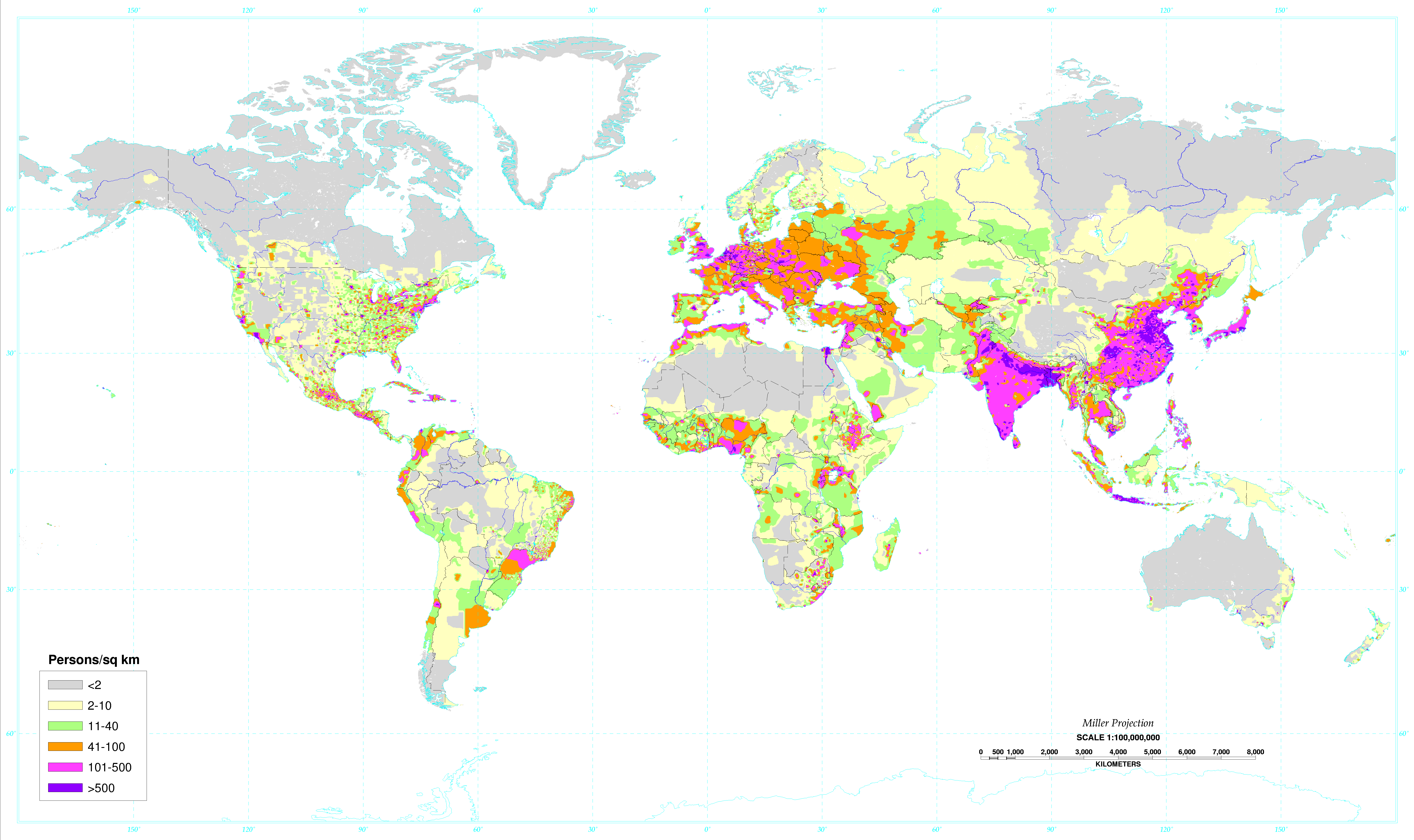
As someone from a purple region on that map (having lived near Aachen and Amsterdam), I can't imagine what it's like to be more than a few minutes driving away from the nearest occupied house or named road. The most alone I've ever been was probably in a German forest and that was almost certainly still within hearing distance from other people, if not immediately then almost certainly within 30 minutes of me wanting to reach someone.
Not sure if it would frighten me or if I'd be fine to be actually unreachable for a few hours.
If you live in an area of high density, people are your problems and it probably makes sense to you to generally limit their freedoms in favor of government control and general law and order.
If you live in an area of low density, you're immediate problems are generally not people, may be more survival related, and you are used to operating with MUCH greater independence, freedom, and self-reliance.
Applied to issues like gun control, government assistance programs, and taxation, it aligns pretty well.
Personally, I'm from an area where I routinely work in areas that are hours from cell reception or any form of help. I drive a big 4wd truck and a dirty 2-stroke chainsaw out of necessity. And, I carry a concealed pistol with me in the field.
This is often unfathomable to people that live in the bay area or Europe and I face criticism for my truck, for embracing individual rights to firearms, and I'm constantly faced with disdain from urban folks who like to insinuate that rural people are just stupid and ignorant. These people have never stared down a mountain lion 20 feet away, crouched and ready to pounce, lived without power or running water, nor faced a road wash-out that cut them off from civilization for weeks, or faced dozens of other situations I can recount where things like having the right to carry a loaded rifle in their truck might make a lot of sense. Nor can they understand the thin margins and lack of cash-flow people have to survive on in these places.
Very different worlds, and unfortunately it seems tough for people in different areas to acknowledge that they each have different needs.
Interesting thought, I had not considered the more vs less regulating thing in this way before.
Specifically about gun ownership, perhaps rather than a general allowance or prohibition on gun ownership, maybe it makes sense to allow those that work in rural areas to carry? Or just that you need some sort of license? It's not as if there exist no guns in Europe: there are gun clubs where people go to, uh, shoot I guess? Not even sure. They have a license and can keep all sorts of guns at the club, at home, and (locked away) on the direct way from and to there. Hunters carry hunting guns into the forest. And of course police that brings guns where ever. Edit: Oh, and look at Norwegian gun ownership. While that's hunting guns that are somehow different, they don't seem to have the issues that the USA has with guns there. /edit. So we also just adapt the rules to whatever is practical, it's not an outright ban on anything with gunpowder.
From what I read about research/statistics on general population gun ownership, generally it's better not to allow it, but that does not mean I can't understand that you carry one in your situation or that I think there shouldn't be an exception for that.
> I'm constantly faced with disdain from urban folks who like to insinuate that rural people are just stupid and ignorant.
I was thinking about this a bit, trying to figure out if I may have that bias as well. Sure, those who work with their hands are typically less educated, but generally working in a rural area (without saying whether you work some physical labor job)... for all I know it's a high tech job building wind turbines or whatever. But then, I guess we don't have so many "rural people" so I wouldn't know it from real life. I do know of the stereotype from books that have "backwards villages".
Some interesting thoughts, thanks for sharing!
More like days or more in vast areas of the US. Mind you, most people don't go to those places. But, even within popular national parks, you can go to places--albeit probably not without high-clearance 4WD and ability to use it or on foot--where you probably won't happen to run into anyone for a long time.
Unreachable for a few hours+ is absolutely the norm in many many places in the western US and even in some other areas like Maine.
https://en.wikipedia.org/wiki/Steens_Mountain
The "town" at the base of it is called Frenchglen: https://en.wikipedia.org/wiki/Frenchglen,_Oregon - it has a little store and hotel.
From there it's about an hour to the nearest town with any kind of services like a hospital https://en.wikipedia.org/wiki/Burns,_Oregon - there are about 5000 people in the area.
From there it's another 2.5 hours, roughly (in good weather) to where I live which is a town of nearly 100K.
https://www.google.com/maps/@42.9351809,-119.0716963,10.06z/...
I assume that the 'regions' that were painted in the map are oblasts (Russian equivalents to counties) - so if there's a giant oblast, with a medium-sized town at its center, but few people living in the outskirts, the entire region gets painted orange.
One should keep in mind that the map is 25 years old, meaning it doesn't really show the post-soviet development of Eastern Europe or the population growth of Asia and Africa. But I don't think that the distribution of "empty" (less than 10 people per square km) has changed much, so for this purpose the map is perfectly adequate.
There are areas of grey (less than 2 people/sqkm) around the coasts everywhere. A processing artifact, or some indication of low water marks? I don't think the tidal area can ever be 20 km wide, but it's very sloppy if it's just bad drawing. (There's already a cyan outline for the coast! Why add grey areas too?)
Then I'm certain there are areas in Wicklow, Ireland with less than 2 residents/sqkm [0]. But the whole area is shown not one but 4 levels more populated, at 100+ residents/sqkm, comparable to Las Vegas and ahead of Buenos Aires which is shown at 41-100 residents/sqkm.
The resolution of the map appears to be at the 10km level, but I think this is misleading and in most of the world it's actually based on data at the country level or one level below.
One of the most surprising things to me about the map before I looked closely was the lack of wilderness in Turkey. If it's that dense all the way through, it should be a massive power. But aren't there mountains and deserts? Probably just the map being lazy again.
[0] https://maps.app.goo.gl/cktt79N4FDLegF7a6 - not the most egregiously incorrect measurement on the map, but one I know personally
This can be deceptive and sometimes add new dangers also. there are areas in Europe close to towns but with thousands of illegal waterholes hidden under grasses or a shrub. You just step over a grass and fall before seeing it.
Last year about a few hours drive south of Sydney I found a very young German couple who were on a otherwise completely deserted and unpatrolled beach. They walked down from the parking spot to the beach and spent a few minutes wading around in the water.
After speaking to them, I found that they'd flown into the country the previous day, rented the van that morning and this was the first beach they had found. They said the only thing that kept them from swimming out was a worry of sharks. I had to spend a few minutes educating them about rip currents, and pointed out that they'd just been wading in what looked like the biggest one on the beach.
Perhaps the issue is that tourists in general are very unprepared for other countries wilderness?
Iceland had stunningly good coverage; no matter how remote you were, it seemed like full service everywhere. (granted, I did't cross the center of the island).
Had no cell coverage on the Rallarvegen in Norway, which surprised me.
But yeah, it's all nothing like the US.
Okay yeah but that's very anecdotal. Just because there is a lot of people getting stuck that assume technology would just work, does not mean there weren't a lot of people getting stuck with no backup plan whatsoever. And I wouldn't trust memory either, besides that it is very fallible people also see the past as better than today (from various studies).
I would be interested if you have news (Google-branded or otherwise) that reports it has gone up since cell phone coverage became ubiquitous in many countries, corrected for things like plane ticket prices and car rental availability near a desert (i.e. more people trying it rather than actually a higher percentage of unprepared people).
This is so true.
I live in the desert, and it's amazing the number of people who simply don't take the natural world seriously.
The dead and rescued are almost always tourists. And for some reason, almost always from Europe (I suspect because my observation has been that Asians tend to travel in large groups on air conditioned buses). They drive rental cars into deep sand and get stuck and die. They run out of gas and get stuck and die. They never bring enough food or water and don't know what to do in an emergency.
I was at a hotel on the Navajo Reservation (Arizona/New Mexico/Utah) about a year ago and there was a British couple arguing with the manager that of course their cell phone should work, they bought it in San Francisco. I tired to explain to them that the whole reason people visit places like this is to get away from technology. Even though I'm sure there are remote places in Europe, they had no concept that there are places in the world where there's no cell service.
A couple of years ago there was an article in the newspaper about a German guy who decided to rent a Harley Davidson and drive through the desert like some kind of David Hasselhof fantasy. It was 115° and he was in full-on black leather gear. They found him dead on the side of the road, still sitting on his motorcycle with his helmet on.
--:--
Editing to add the results from a four-second Google News search:
authorities in California launched a search for Pi-Wei Hung, 40, early Sunday afternoon... the woman’s vehicle was discovered stuck in the sand on the shoulder... and then died in the heat as she tried to walk out of the area. The high temperature that day was 113 degrees.
a 60-year-old tourist from Germany died from heat exposure... not far from his where his motorcycle was parked, upright and in working order, in the 118-degree heat.
...two French tourists got their car stuck in loose sand... no one knew their specific travel route, and they were out of cellphone range in temperatures above 110 degrees.