In other words, a worker is richer if they can buy more and better stuff even without any rise in their wage.
The fact that everyone can afford a smartphone, including those with jobs that “suck”, does not reconcile with “only a very small number of people are capturing the wealth that it is generating.“
Yes technology has made cool gadgets for consumption, but that isn't what wealth is about. From Wikipedia: "Wealth is the abundance of valuable financial assets or physical possessions which can be converted into a form that can be used for transactions."
The average worker hasn't seen a real pay ride in 40 years, and their ability to build wealth through savings has been greatly diminished.
https://en.wikipedia.org/wiki/Household_income_in_the_United...
Between 1979 and 2011, gross median household income, adjusted for inflation, rose from $59,400 to $75,200, or 26.5%. This compares with the Census' growth of 10%.[19] However, once adjusted for household size and looking at taxes from an after-tax perspective, real median household income grew 46%, representing significant growth.[20]
https://en.wikipedia.org/wiki/Household_income_in_the_United...

Instead of looking at nominal income (which was a smaller part of peoples’ wages decades ago), look at real wage growth (https://www.pewresearch.org/fact-tank/2018/08/07/for-most-us...). If we take in all the benefit cuts, the fact that college has become a necessity, pensions are dead, and healthcare inflation is insane, real housing inflation has been substantial, then you can begin to understand the situation. Income is only part of the equation. Yes, income has gone up, but we traded it for the mother of all benefit cuts.
https://aneconomicsense.files.wordpress.com/2015/02/going-fr...
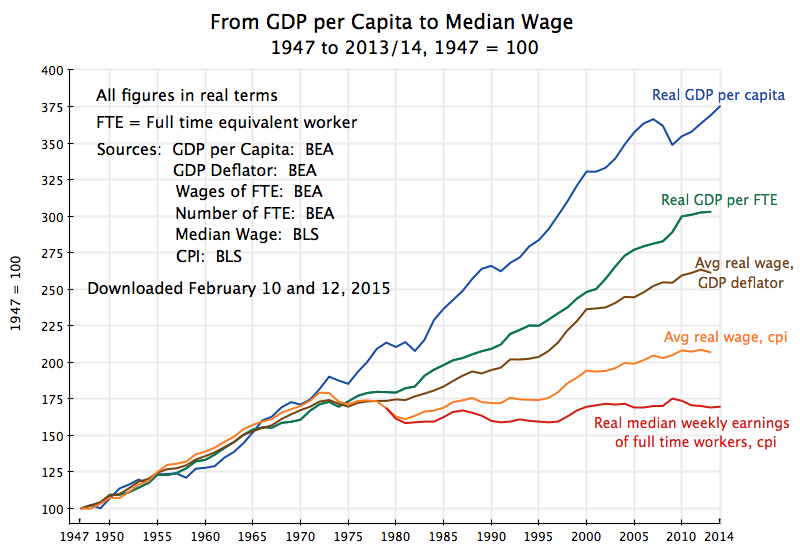
> The average worker hasn't seen a real pay [rise] in 40 years
to
> So basically, improvements in productivity are only benefitting people in areas where productivity has improved?
?
Worker productivity has increased enormously in the last decades.
https://www.minneapolisfed.org/article/2008/where-has-all-th...
40% of Australia's population live in either Sydney or Melbourne, and these two cities are among the top 5 least affordable in the world [1].
1 - https://www.afr.com/companies/financial-services/australian-...
- There is a ballpark estimate that sum of all physical money in the world is 90.4$ trillion, let's distribute it equally to all 7.53 billion people: we get 12k$ per person. This is not enough to buy an apartment in most parts of the world.
- There is an estimate that 1% has 303.9$ billion, let's distribute it equally to US population of 327.2 million people: we get 928$ per person. Barely enough to buy status smartphone.
So I don't see how wealth distribution can solve anything. Even if we equalize wealth and prices at a same time, free market will quickly spiral down to similar pricing that we have today (things are barely purchasable, or not at all).
Could you explain how you got to that conclusion? It does not seem logical to me at all.
Current prices are in part a result of high inequality: It makes economic sense to sell a house for 10x the median income because they are still groups of people so high above the median that they can afford to pay that price - and of course as a business you'd very much like to sell to those people if in any way possible.
In a society with more equal income, the highest price for which you could find a buyer would likely be a lot closer to the median.
I wouldn't even be sad about the money I'd no longer be making, because right now a good chunk is going into rent, and an even larger chunk is going into savings so I can buy a home at NYC prices. So it's not like I get to spend it on other things. If I didn't have the money but I also didn't have to spend that money on housing, I'd be equally well off.
(And all of this is leaving aside that other people would be better off, which is net good for society, etc. etc. Even the first-order effects alone are selfishly valuable.)
- [0] https://www.businessinsider.com/the-1-percent-dont-know-what...
The world could make do with very little money if it could move faster. Quantity of money times velocity of money times unit of time gives you the total monetary transactions over a time period; if you increase the velocity, then you can decrease the quantity, and nothing else would change.
However, the total value of the S&P 500 (which is probably about half the world stock markets value) is about $26 trillion, so that is about $3400 per person or maybe double or triple for a family. And the dividend of 1.75% means an income of $60/year if you hold on to the stock.
So I think doing this redistribution would result in everybody to whom $3400 is a lot immediately selling (assuming they were allowed to). I'm not sure what the distribution of capital would end up being. Someone would buy, say "Barren Wuffet" who fortunately had all their investments in cash, bonds, and small cap stocks. So ownership would end up being concentrated again, but maybe not as concentrated.
Anyone who has a lot of money saved for retirement in a large-cap fund would be unhappy, but why should you be better off than an average citizen of the world?
It seems like a fine experiment to me.
Edit: but just to spell it out, obviously politically impossible given the consequences for first world people who are relatively privileged but don't think of themselves that way. The median IRA balance (note, not the average that is skewed by the rich) is somewhere around $20-30K, so redistribution would affect those people like a 90% market crash.
If your boss said you're not getting a pay rise this year but that's OK because you'll still be able to buy more would you accept that as a fair and reasonable argument?
No?
Don't use it as an argument to keep poor people's wages low then.
I don't see everyday life improving several billion times from 1970 even though the number of switches I control in my laptop are several billion times (at least) larger than the number of switches that existed in the world in 1970.
Only that they are fully captured by a small class. It says nothing about the relative amount, and doesn't change anything about the wealth disparity picture, for those smartphones are cheaper for everyone but one group has a lot more to spend AND smartphones are cheaper for them
Because wealth is defined by claims on other people's productivity, not by the ownership of one particular consumer good.
If you'd said "Everyone now gets a significant proportion of their income from investments and uses some of it to buy a smartphone" you might have had a point.
If you try to look at how much much of societies gains go to which wealth bracket and how much they actually do for it, this gap widened considerably during the last century and has become a real threat to these western values of liberty and democracy, especially because the rules of civilization and democracy exclude those on top.
One doesn’t really have to be a marxist in order to want to go back to a resonable wealth/wage gap. One doesn’t have to be a marxist to demand the rich should pay their taxes and follow the rules. I’d argue that every conservative in the very sense of the word should stand behind this as well.
Many cannot afford these smart phones and gadgets but will take loans or buy them with plans that on the surface looks cheap.
Loans from pretty much fully automated ”banks” working on-line only. Send an sms and get $500 to buy that phone!
Further increasing the gap in the process...
In the 1990s and early 00s, automation happened mostly in manufacturing. The low productivity growth stats that stupid (mainstream) "economists" like Krugman cite to argue against people like Yang or Musk measure all labor. But manufacturing makes up less than 1/5 of the US economy. If you look at the labor productivity in the manufacturing sector alone, it's congruent with the automation argument [1].
Productivity numbers are lagging because investments in new tech need time to bear fruit. Automation of the service sector has already started and will show in the numbers soon enough. Given that the service sector is four times the size of manufacturing in the US, it will be even better for GDP and even worse for people if again nothing is done and people keep listening to those intellectual frauds who call themselves "economists."
_______________________
Clearly, if the latter would happen, and we are on that path right now, we are bound for a distopian future.
Old economic models don't work anymore, we need radical changes. If we don't plan them, they will come in the form of either revolution, or brutal repression (ala China).
In the limit the only beneficiaries are shareholders, who now own all the wealth and capture all of the productivity.
You now have a choice between a neofeudal dystopia where a small percentage of the population lives like emperors while everyone else is relegated to a shanty economy where they fight over scraps, or you stop the nonsense and set up a humane economy where all productivity is redistributed and humans automatically have economic freedom as a birthright without having to work for it or inherit it.
Currently we're on our way to the first option. But the second is the only viable long-term outcome - because in the limit the wealthy will continue to play status games with wealth, and the circles of distribution will become smaller and smaller until eventually literally everything is owned by a small handful of individuals and - perhaps - their immediate families.
That's been the case for most of human history. I don't see why this isn't a viable option again. High technology does not mean a humane society. For the majority of the last 10,000 it was pretty much the reverse. Egalitarianism meant primitive, starvation and deprivation meant wealth.
Of course one only need read what happened to monarchs for most of the period. Being king is good, less so when you become furniture for the next king.
Also, you're wrong. Egalitarianism has meant a lack of luxury relative to what was possible at the time, but a better baseline for the population as a whole.
>Egalitarianism has meant a lack of luxury relative to what was possible at the time, but a better baseline for the population as a whole.
[[citation needed]]
The population of China was larger than any of the time and the majority lived in poverty so great the Europeans who visited were shocked by it.
For example, people throw around the low labor productivity stat all the time to prove that no automation is happening, not realizing that GDP is the numerator of that stat. Well, GDP is a pretty terrible gauge of who is benefitting from technological innovation, as it is distributed incredibly unevenly, probably more so than income even. The problem with automation isn’t that it’s not happening, it’s that only a very small number of people are capturing the wealth that it is generating. Also, it is generating a small number of professional jobs, but mostly the jobs it is generating suck (Uber driver, AMZN warehouse worker, etc).