https://en.wikipedia.org/wiki/Household_income_in_the_United...
Between 1979 and 2011, gross median household income, adjusted for inflation, rose from $59,400 to $75,200, or 26.5%. This compares with the Census' growth of 10%.[19] However, once adjusted for household size and looking at taxes from an after-tax perspective, real median household income grew 46%, representing significant growth.[20]
https://en.wikipedia.org/wiki/Household_income_in_the_United...

Instead of looking at nominal income (which was a smaller part of peoples’ wages decades ago), look at real wage growth (https://www.pewresearch.org/fact-tank/2018/08/07/for-most-us...). If we take in all the benefit cuts, the fact that college has become a necessity, pensions are dead, and healthcare inflation is insane, real housing inflation has been substantial, then you can begin to understand the situation. Income is only part of the equation. Yes, income has gone up, but we traded it for the mother of all benefit cuts.
https://aneconomicsense.files.wordpress.com/2015/02/going-fr...
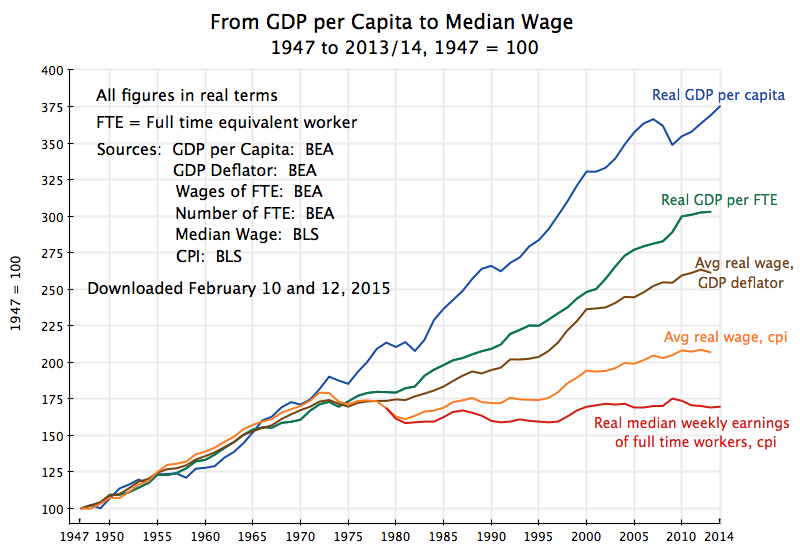
> The average worker hasn't seen a real pay [rise] in 40 years
to
> So basically, improvements in productivity are only benefitting people in areas where productivity has improved?
?
Worker productivity has increased enormously in the last decades.
https://www.minneapolisfed.org/article/2008/where-has-all-th...
Yes technology has made cool gadgets for consumption, but that isn't what wealth is about. From Wikipedia: "Wealth is the abundance of valuable financial assets or physical possessions which can be converted into a form that can be used for transactions."
The average worker hasn't seen a real pay ride in 40 years, and their ability to build wealth through savings has been greatly diminished.