News for hackers. Stuff that matters.
Re:Keeping Top AI Talent in the United States [pdf] by thorwasdfasdf on Tuesday December 17, 2019 @03:48PM (#21818645)
What's wrong with developing AI talent within the US? It doesn't necessarily have to come from other countries. The US has over 300 million citizens and your telling me they're all too dumb to learn AI? Even, if just 10% could become AI specialists, I think that would be several orders of magnitude more then enough. Just teach it in high school, and develop some college majors that specialize in AI.

I think we have general tendency to underestimate what hard working people are capable of. All we need to do is guide them in the right direction and make sure the majors required are available.

Re:Keeping Top AI Talent in the United States [pdf] by Darkphibre on Tuesday December 17, 2019 @03:57PM (#21818740)
>In fact, international students are responsible for basically all growth in AI-related grad programs at US universities in the past decades.

>Or, in other words: there were as many American citizens getting CS/EE grad degrees in 2016 as there were in 1990.

The push for STEM has been incessant for extremely real concerns. Our population is just. not. entering. the STEM graduate courses. Yes, this needs to change, but it's a cultural problem, not an availability problem.

Re:Keeping Top AI Talent in the United States [pdf] by jjoonathan on Tuesday December 17, 2019 @06:03PM (#21819931)
A cultural problem? No, it's an economic/policy problem. PhDs are effectively being compensated with green cards instead of money. This compensation package is much more attractive to foreign students for obvious reasons.

I'll never forget the day in lab meeting when it came out that I was a US citizen. I thought my accent and appearance would have made it obvious, but evidently my coworkers had assumed otherwise, and the response was an astonished "Then what the hell are you still doing in academia?" followed by looks of pity when I admitted to loving research. This was a biomedical lab at Carnegie Mellon about a decade ago and I was the only one doing ML work, so their astonishment was in part due to an underestimation of the market value of my degree, but on the other hand their intuition was likely accurate with regard to the STEM PhD market outside of AI.

Those PhDs are worth $pittance + green card, but not worth $pittance.

Re:Keeping Top AI Talent in the United States [pdf] by datlife on Tuesday December 17, 2019 @07:21PM (#21820557)
As recent grad student, I can relate this comment. Unless the school provides competitive compensation to attract US citizens to pursue PhD, it does not make sense economically for a US citizen to not enter industry instead.

I trippled my compensation by deciding to work in industry.

Re:Keeping Top AI Talent in the United States [pdf] by codingslave on Tuesday December 17, 2019 @07:02PM (#21820427)
This is what no one wants to talk about
Re:Keeping Top AI Talent in the United States [pdf] by opportune on Tuesday December 17, 2019 @04:55PM (#21819350)
STEM graduate programs are for the most part immigration programs for India and China. Going to STEM graduate school for Americans who don’t need to jump through immigration hoops quite often has negative expected value, not to mention the stress and lack of career options in academia.

And not only that, but the push for STEM imo has more to do with lowering wages and getting more software engineers (especially for S and M, I don’t think there is any real critical lack of PhDs. In fact a very large amount of physics and math phds just go into data science or software engineering). It’s entirely an economic problem, if it’s even a problem at all.

Re:Keeping Top AI Talent in the United States [pdf] by stevenwoo on Tuesday December 17, 2019 @05:08PM (#21819477)
One of my American classmates who loved science got a masters in physics said all the jobs they could get were either joining PhD programs or building instruments so they switched to programming in 1990!
Re:Keeping Top AI Talent in the United States [pdf] by commandlinefan on Tuesday December 17, 2019 @04:06PM (#21818838)
Isn't that the exact opposite of what people say when somebody points out underrepresentation by women in tech? That it doesn't have anything to do with ability or interest, but a hostile environment that's keeping them out?
Re:Keeping Top AI Talent in the United States [pdf] by geoalchimista on Tuesday December 17, 2019 @04:34PM (#21819125)
Cultural problem seems to be playing no small part in this. In average high schools, being interested in STEM is just not considered something cool.
Re:Keeping Top AI Talent in the United States [pdf] by cgy1 on Tuesday December 17, 2019 @05:43PM (#21819766)
If my experience from high school is still relevant, showing interest in much of anything besides the opposite sex, drugs, and music was considered uncool and being a tryhard.
Re:Keeping Top AI Talent in the United States [pdf] by Spooky23 on Tuesday December 17, 2019 @11:55PM (#21821923)
Why would you pursue a masters or PhD?

I was an undergrad in the late 90s, and even then there was no point. It made sense if you wanted to pursue an academic career (barely) and it made sense for immigration purposes. Personally, I’m an advocate for very open immigration, instead of creating weird niche paths to citizenship.

Re:Keeping Top AI Talent in the United States [pdf] by geebee on Tuesday December 17, 2019 @05:50PM (#21819824)
Partly. But I also think that targeted immigration programs have allowed these fields to staff up without raising wages to levels that educated people who don’t need visa sponsorship can find in law, business, and medicine.
Re:Keeping Top AI Talent in the United States [pdf] by scottlocklin on Tuesday December 17, 2019 @08:49PM (#21821022)
>Our population is just. not. entering. the STEM graduate courses.

Probably because they import so much cheap labor it's a lot easier and more sane/lucrative to do something else.

Re:Keeping Top AI Talent in the United States [pdf] by nopinsight on Tuesday December 17, 2019 @08:48PM (#21821015)
We know that the productivity of the very top researchers is not just some incremental percentage over others, it is often multiple times higher.

Check out the list of names under departments with publications in top AI conferences in the last three years. A large percentage, maybe even most, were not born in the US.

http://csrankings.org/#/fromyear/2017/toyear/2019/index?ai&v...

(Although the number of publications in top conferences is not a perfect measure, it is a pretty good one and correlates with most other measures one would think of as important.)

The world is also catching up. Among the “top 20” departments, according to this measure between 2017-2019, 10 are in the US, 9 in Asia (7 China, 2 Singapore), 1 in Israel.

Also note how many top researchers in sciences and engineering, not only AI, who helped build the US into the technological powerhouse in many fields, over the last century, were born in another country. It is not a coincidence. World population is 7.8 billion or > 20 times US population.

.

Another major issue is math skills. Given that there are many technological specialties that require excellent math training and aptitude, it is possible that there are too few people growing up in the US who received that training and supportive environment during their formative years.

A conversation among many Asian students is how easy American math curriculum is. It is estimated to be 2 or 3 years behind the same grade level of many countries in Asia. The PISA 2018 results also show some concerning evidence:

https://www.oecd.org/pisa/PISA-results_ENGLISH.png
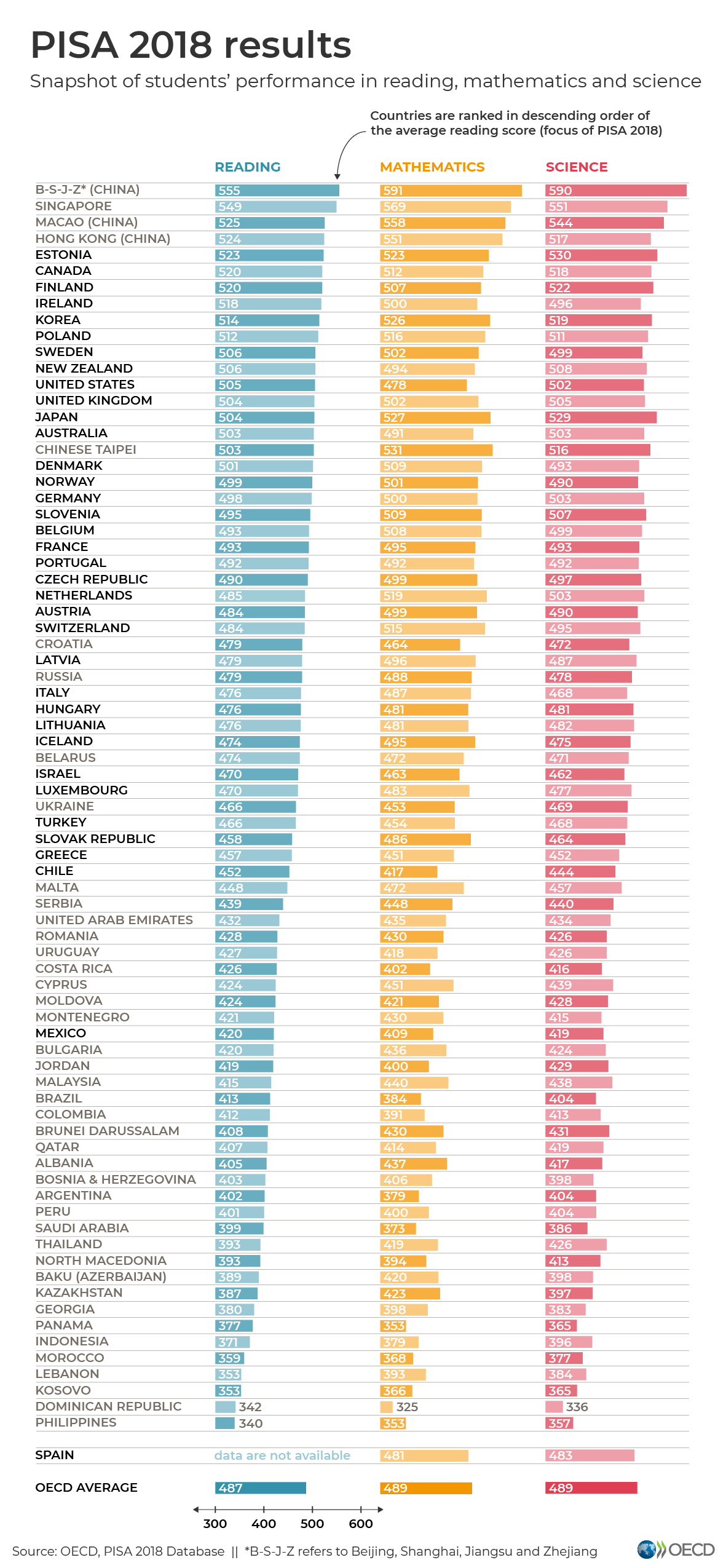
https://hechingerreport.org/what-2018-pisa-international-ran...

“In math, the U.S. ranks 36th out of the 79 countries and regions that participate in the test.”

“Today’s [US] scores in reading and math aren’t statistically different from when PISA started testing the subjects in the early 2000’s.”

Re:Keeping Top AI Talent in the United States [pdf] by Aperocky on Tuesday December 17, 2019 @03:57PM (#21818746)
10% of general population? You’d be blessed if 10% manage to take CS101 and successfully wrote Hello world.
Re:Keeping Top AI Talent in the United States [pdf] by monksy on Tuesday December 17, 2019 @04:37PM (#21819158)
Side rant about these coding bootcamps.

I would find 10% to be wayy over-estimated.

Re:Keeping Top AI Talent in the United States [pdf] by osipov on Tuesday December 17, 2019 @03:54PM (#21818716)
100% agree. I am especially bothered by the implicit agism in the study. PhD students tend to be in their early to mid-20s. There is a much larger pool of older engineers in the United States who can be re-trained as AI specialists. Instead of a call to keep AI talents in the United States, we should be re-training existing talents in AI technologies.
Re:Keeping Top AI Talent in the United States [pdf] by woah on Tuesday December 17, 2019 @08:23PM (#21820892)
Why are these older engineers not training themselves already, and who should be training them? If people in one of the highest demand and best paid professions out there cannot take some time to keep their skills up to date, why does it fall to some nebulous "we" to apply re-training to them?

If there's some geopolitical reason that it's a good idea for the government or someone to offer them free training programs, I'm all for it, but I'm not understanding the moral argument.

Re:Keeping Top AI Talent in the United States [pdf] by arminiusreturns on Tuesday December 17, 2019 @04:19PM (#21818950)
The unsaid part is they don't want to pay them competitively...
Re:Keeping Top AI Talent in the United States [pdf] by yellow_postit on Tuesday December 17, 2019 @09:04PM (#21821086)
PhD programs are just not competitive from a pay or work/life balance that by implicit design they tend to deter people older with industry experience from starting along the path.
Re:Keeping Top AI Talent in the United States [pdf] by __s on Tuesday December 17, 2019 @05:50PM (#21819831)
300 million isn't that big a number

You want a network effect to collect talent from anywhere & then tax it. Children growing up in this culture will be more prone to tap into this. Immigration laws insulate this process. Eventually the talent will be collected somewhere less insulated, & then the American talent will be moving there

If I want to steal your jobs, I don't need a visa. I do it well enough from Vancouver, along with all the other employees who are in between visa issues. Canada will accept our taxes in the meantime

Re:Keeping Top AI Talent in the United States [pdf] by madiathomas on Wednesday December 18, 2019 @08:01AM (#21824357)
US residents have to compete with prospective students from other countries. Some of those countries rank better than the US when coming to STEM subjects. They end up getting admission ahead of US residents.

Solution is to improve teaching of STEM subjects at primary and high school level. The problem will sort itself. Second option is protectionist in nature. Favour US residents ahead of international students, even when international students are way better. Second option will only drop the quality of PhD graduates coming from those colleges.

Re:Keeping Top AI Talent in the United States [pdf] by nitwit005 on Tuesday December 17, 2019 @06:49PM (#21820337)
A lot of programs have started teaching various forms of AI. They just aren't graduate programs, which is what this was looking at.
Re:Keeping Top AI Talent in the United States [pdf] by acchow on Tuesday December 17, 2019 @05:16PM (#21819502)
> Even, if just 10% could become AI specialists

How did you come up with this number and what reasoning and data can you provide to rationalize it?

Re:Keeping Top AI Talent in the United States [pdf] by thorwasdfasdf on Tuesday December 17, 2019 @06:58PM (#21820406)
the point is, there is more than sufficient population in the US to fill any all employment demands for AI, as long as their sufficiently trained.
Re:Keeping Top AI Talent in the United States [pdf] by StandardFuture on Tuesday December 17, 2019 @08:29PM (#21820926)
It is because this has nothing to do with US security. It is a continuation of the propaganda started in the 1980s-1990s of cheap labor in the sciences.

Actually, training and allowing these people to work (in potentially very advanced technologies) is ANTI-security.

But it is monetarily beneficial for the shareholders of companies who will benefit from the research conducted by "cheap but smart Asians". Fundamentally, this article should be considered treasonous because it is anything but pro-American.

We have a massive issue in this country of certain elites feeling entirely negated from any responsibility towards their fellow citizens.

Re:Keeping Top AI Talent in the United States [pdf] by mulmen on Tuesday December 17, 2019 @11:42PM (#21821864)
I don’t see the problem with attracting smart people from around the world and turning them into smart Americans. That appears to be how we built this country.
Re:Keeping Top AI Talent in the United States [pdf] by StandardFuture on Wednesday December 18, 2019 @02:13AM (#21822597)
Strawman rebuttal. No one has a problem with actually smart people becoming Americans. And I never made any mention of the historical complexity of America.

> That appears to be how we built this country.

You do realize that the Native Americans would consider this a very racist remark. There did exist advanced civilizations in the Americas before "immigrants" came to try to rule it all.

Also, the slaves that helped build this country were not brought here because they were well-educated abroad and driven.

And the poor Chinese that helped build this country were not well-educated abroad and driven to build railroads elsewhere in the world.

This country was built by driven people, many of whom were very intelligent, but this simplistic view you are proposing is not only not true it is actually degrading to all those in the history of this country that contributed a lot without being considered "smart" by the elite.

Perhaps, we should avoid overly simplistic conclusions and viewpoints?