> stuff...
> I really don't get this desire to outlaw cars.
That's not the point, it's that in this case the infrastructure cost to clean up cities is astronomical. Forgetting air pollution, noise pollution, deaths from traffic collisions, congestion - you also have to consider the shear infrastructural costs that _already_ go into maintaining road surfaces, traffic control, policing, etc. And that's without tunnel boring.
> I like walkable cities, but I also like the comfort and
> privacy of car transport.
I think we just have to look at the practicality of private transport in cities.
> I still don't enjoy being squeezed in with thousands of
> other people.
Perhaps this is where public transportation can be innovated on.
> Does that mean that people like me have to be reeducated
> and/or forced to see the error of their ways?
Most likely - it's simply the march of progress. As horses were mostly outlawed/discouraged from cities, I suspect cars will be too.
I think I will pass. If you outlaw driving in cities without a good alternative, I will just not live in a city anymore. But let me guess: you want to outlaw that too...
I think the point is indeed to provide good public transportation as a suitable alternative.
> I will just not live in a city anymore
And why not? That's an entirely legitimate choice
If your aim is "Reduce pollution caused by cars" then changing people from car-owning city-dwellers into car-owning suburb-dwellers might increase total pollution.
For example, if a family with one car turns into a family with two or three.
It could be managed by GPS trackers in vehicles, with the ability to charge different amounts in different locations and time of day (i.e. driving in cities or during rush hour should be discouraged), level of congestion, vehicle type (weight, length, self-driving or not), and selective emission controls (e.g. high polluters banned from city centres).
Fuel taxes are a simple, proportional way to target carbon emissions (effectively a carbon tax). However things like this should all be done with care (see gilets jaunes).
Just let people who don't want to live in density pay for the externalities of low density living (require EVs, higher cost for infra, etc).
I am relaying the science on global warming which indicates that if we continue down this path then we are absolutely screwed.
Density is not my idea. Density is what you get if you want (a) 7 billion people and (b) anything remotely resembling a sustainable society. If you also want a not dense society, then tell me which of (a) and (b) you want to eliminate.
If you're saying you want to ween us off of our rapidly worsening fossil fuel addiction then I don't know what to tell you but I do have several bridges to sell you.
Density might still have a chance in developing nations if they can avoid developing around the idea of the car; TBD.
We need to stop subsidizing suburban and rural living yesterday.
Unlikely. America has enough wealth that aside from coastal areas, life won't change that much unless agriculture collapses entirely.
> Electric vehicles are not going to fix much when our electricity is still mostly made by fossil fuels.
Coal is rapidly declining in use in the US for electrical generation. Natural gas will eventually be replaced by overbuilt renewables and battery storage (and EVs are a component of that). Electrifying transportation would be a huge step forward for moving off of fossil fuels compared to natural gas generation currently in play [1].
All of the above is possible without density or everyone moving to urban areas. American politics are built around equality of votes between dense cities, the suburbs, and rural areas. That is not changing in the foreseeable future. You're going to have to rely on market forces to drive out the remaining fossil fuels used.
Everyone can buy an EV or renewable power though to send market signals to ramp production capacity of both. Same with insulating your home and ensuring you're using as little energy as possible to condition your home spaces. And batteries. We need as many batteries as we can make.
[1] https://flowcharts.llnl.gov/content/assets/images/energy/us/...

Not only, it might be considered the precise sought after effect.
Cycle lanes, especially protected ones, are there to encourage cycling.
Of course it’s also totally reasonable to suggest that the harm to others is so small that it doesn’t justify the erosion of personal liberty.
Point being, the question warrants reasonable consideration rather than immediate dismissal.
Sure, but it takes quite a bit of negatives to override the obvious and glaring benefits of anyone being able to transport oneself, one's family, one's stuff, at a moments notice, to any destination, in (almost) any weather, at an average speed of 30-60miles per hour, all at an amortized cost of approximately 50cents per mile.
The willingness and readiness of some people to disregard the large personal, societal, and economic benefits of having functioning automotive infrastructure - in concert with other methods of transit - quite frankly bewilders me.
The current discussion mostly centers on banning cars in cities or large agglomerations. In no city you'll reach average speeds even approaching 30 miles an hour - something around 20km/h is a more reasonable number to expect. That's btw. easily reachable with an electric bicycle or public transport. I can call a cab or a transport for larger goods at pretty much a moments notice, there's even car sharing services that have some parked in the street.
Also, you're disregarding that cars in cities have massive externalities - the current estimate for Berlin is that infrastructure for cars (roads and parking spaces) cost about 30% of the cities surface area at substantial cost to society (increased rent and building costs, maintenance etc) which is paid by the majority of people not owning a car. Not all of that could be recouped if private car usage is reduced, but substantial chunks could. Not to speak of noise and other pollution, risks of accident and injury etc.
So you're overplaying the advantages and disregarding the very real cost that other people shoulder for a minority driving.
Realistically, IMHO the switch from private transport will happen no sooner than there is a real, proper, easy to use at any time on a whim alternative that is same cost (ideally cheaper due to subsidies) than owning and using a car. Things are improving greatly, but we're not there, practically anywhere (apart maybe from Netherlands and Denmark, but even that not for many use cases). Proof - people driving everywhere.
1.1 mio cars in Berlin * ( 1.8 = size of household ) = 2 mio households own a car.
I think everybody would appreciate a city without cars as long as there is a sufficient cheap fast and comfortable transport (which is not a car) available. If it were the case for Berlin then there wouldn't be 1.1 mio cars there.
In general if there are externalities then it's better to impose taxes that amount to the cost of that externality (plus the cost difference between enforcing the tax and enforcing the ban) rather than ban. That way if people really really want/need to use something like a car (e.g. the are mostly disabled and commute in from a country house) they still can.
After all, cars, especially when moving just one person, heavily overuse shared and scarce resources like space and environment. It's all too fair that they pay a higher share to public resources.
Maybe you will still use your car, accepting to pay a higher price for it, but other people will switch, making the world a better place also for you.
Jokes aside, come see gas and parking prices in Europe.
That said, I believe that road space has different rules than housing space, so it is hard to compare them directly.
I am Italian and live in Belgium, in case this gives more strength to my argument. I also have a car and pay European prices for it. Of course, I try to use it as little as possible, which is good.
With current and mid-term-future tech, high-frequency bus- and smalltrain/metro-lines are much more efficient for city-plus-suburbia-scale mass-transportation. Depending on topography and climate, add (electric) bicycles and similar to the mix.
The problem is with bootstrapping: A high-frequency public transportation network is expensive, especially if the demand is low since everybody (who can afford it) is driving by car because the current public transport is bad because setting up a good high-frequency public transportation network is expensive, especially if the demand is low since... To break this circle, we have politics and law - but of course only few cities want to outlaw cars.
My personal opinion: While I really like driving my nice, expensive car, I would actually prefer taking the bus; as long as (1.) it's not more expensive [easy] and (2.) doesn't affect my travel time significantly [difficult] and (3.) is as reliable as going by car. Right now getting to the office by bus takes 40m instead of max. 10m by car, is unreliable (missed connections add 15m and leave me waiting in 2 to 5 degC) and god forbid there is a chance of snow, then I'm stranded. I'm leaving out recent strikes, which shut down public transportation in my city for 2 weeks, because I think as much as people should have a good public transportation, the people WORKING in public transportation deserve a proper payment.
Trying to solve some problem should start from understanding it not from the assumption what everyone has the same lifestyle as you.
But you are right that there will not be a unique solution to the transportation problem. In warmer climate we already have (electric) cargo bikes that are nice for moving kids around in the city, but we'll need more innovation for colder climate and longer distances. And that was exactly my point.
For 30 years, I have heard from environmentalists that electric cars will need to have short range and shitty performance, but we have to outlaw ICE cars anyway for the greater good.
There comes Tesla and builds a car that is just objectively better in every metric than an ICE car. Now my next car when my 13 year old Prius gives up the ghost will be a Model 3.
For public transport it is similar. Offer me something that is better in every way than a car (on demand, point to point, with privacy), and I will happily use it instead of a car. A self-driving taxi fleet with dedicated right of way, as envisioned by the boring company, would fit the bill.
If the boring company plans don't work out, a high frequency electric bus system with dedicated rights of way would fit the bill, with something like trackless trams (http://theconversation.com/why-trackless-trams-are-ready-to-...) for the very high demand parts.
But don't try to sell me a tram as the best 21st century solution for transit and then try to outlaw all the alternatives...
For meaningful energy savings the transportation model itself has to change. Here is one example for Hamburg, Germany, showing over 80% decrease in CO2 emission by shifting to public transport: http://www.mobilitaet-in-deutschland.de/pdf/infas_Vortrag_if... p.18)
Also, have you looked at the energy consumption of light or suburban rail? It might look somewhat attractive if you assume that the rail cars are packed, but in reality where they often drive almost empty at night and during off hours, the numbers are actually pretty bad.
Electric buses are much better, but even they have the huge downside that they run according to a schedule, don't go where you want to go, and offer no privacy.
The energy source is an orthogonal topic. Public transport is far easier to convert to renewable sources because the number of stakeholders is usually in the single digits.
> Also, even a tesla is not 2500kg
A model X is 2500kg, a model S is 2100 kg.
> many people with family rarely drive with a single occupant.
For Europe, the average is 1.4 people per car: https://www.eea.europa.eu/data-and-maps/indicators/occupancy...
> Also, have you looked at the energy consumption of light or suburban rail?
Yes, and I've even linked a source showing that energy used per passenger mile is 8 times higher with cars :)
Edit: That light rail is more efficient also makes sense if you look at weight and capacity of trains: The local commuter trains around here have a weight of about 105t, so about 50 teslas. But they fit up to 500 people. Power is 2400kW - you can transport 500 people for the power equivalent of 10 Tesla model S. https://de.wikipedia.org/wiki/DB-Baureihe_423
It is also about twice as big as a typical European car. Even a model 3 is on the big side. The most produced electric car by tesla is the model 3, which is much lighter. 1611kg, not even that much heavier than my Prius.
> For Europe, the average is 1.4 people per car
For the people (families with young kids) that are most in need of a car, the average occupancy is much higher.
> Edit: That light rail is more efficient also makes sense if you look at weight and capacity of trains: The local commuter trains around here have a weight of about 105t, so about 50 teslas. But they fit up to 500 people. Power is 2400kW - you can transport 500 people for the power equivalent of 10 Tesla model S. https://de.wikipedia.org/wiki/DB-Baureihe_423
So light rail/commuter rail is more efficient than an electric car when you assume that the car is single occupant and the light train is fully packed. That is a way of tipping the scales, but not an honest argument.
Trains are never fully packed except maybe during rush hour. Besides, traveling in a fully packed train is horrible. I know, I frequently have to take Munich public transport with exactly the 423...
But obviously they are dwarved by the single commuters, or else the average wouldn't be 1.4 persons per car.
> So light rail/commuter rail is more efficient than an electric car when you assume that the car is single occupant and the light train is fully packed. That is a way of tipping the scales, but not an honest argument.
Let's look at the numbers again. To not disadvantage the car, we assume 20% capacity, which is the minimum possible for a car.
A single instance of the named train at 20% capacity accomodates 100 people while needing 2400kW. A single Tesla at 20% capacity accomodates 1 person at lets say 175kw if it is model 3. That is 24kW per person for the train and 175kW for the car. A factor of 1:7.
To reflect the real world data, we'll assume 1.4 persons per car from the souce above, which would mean a capacity of 28%. The train equivalent is 140 persone, meaning a factor of a bit more than 1:7 in favor of the train.
In my area the actual train during communiting hours is at least 70% occupied, BTW.
I'm not trying to win internet points here; there just is no way around the fact that electic cars are not in any way a meaningful solution to our climate problem.
Well, 1.4 persons per car is already quite a bit higher than your original claim of "at least 2500kg of material to move 1 person".
> Let's look at the numbers again. To not disadvantage the car, we assume 20% capacity, which is the minimum possible for a car.
Yes, OK, let's look at some actual numbers about kWh per 100 passenger km, averaged over all times and not just rush hour. Here is something I could find: https://www.forschungsinformationssystem.de/servlet/is/34223... https://www.forschungsinformationssystem.de/servlet/is/34223...
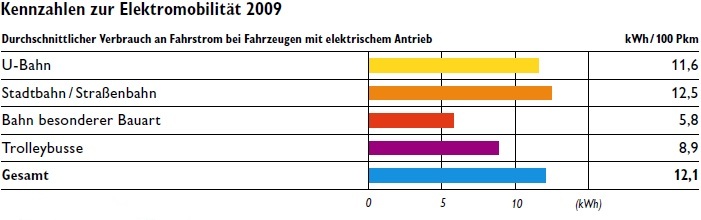
So a subway car or a commuter rail car gets 12.5 kWh per 100 person kilometers. That is still better than a tesla model 3 of 160 Wh / km or 16 kWh / 100km. But not by much.
https://insideevs.com/news/347916/tesla-model-3-epa-energy-c...
If you assume 1.4 people on average, you get 11.4 kWh / 100km / person, so basically the same.
And if you have 3 or 4 people, the model 3 is significantly more efficient than the average commuter rail.
> In my area the actual train during communiting hours is at least 70% occupied, BTW.
But trains also go outside commuting hours. That is the whole problem with a system that has large units and is not on demand.
> I'm not trying to win internet points here; there just is no way around the fact that electic cars are not in any way a meaningful solution to our climate problem.
Neither am I. I was doing back of the envelope calculations about what it would take to do a battery powered commuter rail for the relation I frequently use, and was genuinely surprised how inefficient commuter rail is on average.
We can also take into account the cost of accidents, which we could probably assign an energy value to avoiding.
The past 100 years of history have made it abundantly clear that cars are made completely unaffordable to the middle class, most of them will be on the road with only one occupant. A rare few will have two.
For some reason, families rarely have to commute to the same place, and lone drivers aren't super keen on carpooling with strangers.
Wait, what? I can think of many metrics where Teslas are not "objectively better" than ICE cars, one of which is price. Why buy a Model 3 when you can buy a used Prius or Corolla, and spend the money you save on energy saving measures around your home?
If you live someplace where you take the shared tram for the vast majority of trips, then what you propose can work for the few trips where you the tram doesn't work. How often do you really need the private space? If it is all the time you have agreed to forever live in suburban sprawl, with potentially long commutes.
I still don’t enjoy the global mean temperature getting higher and causing flood and famine, but I guess your personal comfort is more important.
I think what the poster wanted to say is that cars are abused, and just like any other abuse or addiction, it should be regulated.
But USA have a problem regulating dangerous stuff: gas, cars and guns.
There's a climate change coming and people in USA really are still debating if it's a "personal freedom" issue?
We are 7 billion, they are 300 millions, I think it's time they understand what good citizenship means...
I really don't get this desire to outlaw cars. I like walkable cities, but I also like the comfort and privacy of car transport. I live in a place (Germany) with good public transport. I used to live in cities with very good public transport. I still don't enjoy being squeezed in with thousands of other people. Does that mean that people like me have to be reeducated and/or forced to see the error of their ways?