Beautiful. I'm stealing that, with your permission?
- cranky new lisper
The first good implementation I'm aware of is Egil Möller's from 2003 (https://srfi.schemers.org/srfi-49/srfi-49.html). My independently researched prediction in 2017 was that no one will ever discover a place where parens or other visible syntax is needed. That sets up an easy proof by contradiction (and I've built a database of over 10k languages so far, looking for a single scenario where you would need them, and haven't found one yet). Here are 19 demo languages covering lots of scenarios demonstrating utility without parens (https://github.com/treenotation/jtree/tree/master/langs). A glaring hole though, now that I think about it, is that I don't have a good Lisp-like Tree Language. I think a Bel Tree Language would be an excellent example project (and I'm happy to assist anyone who wants to make an attempt, and if no one has the bandwidth and it's not done by next year perhaps I'll find the time to give it a go).
> They are the structure that supports Lisp's simplicity and consistency, which is what all the good things come from.
I agree with this, but would say they are "one" structure, not "the", and that there are other options (I have one idea in tree notation, but not ruling out that there are more, perhaps better ones).
> If you take them out, it gets complicated and isn't worth it.
I agree with this, but think there is a future tipping point related to tooling. Tree Notation was quite terrible 2 years ago, but now with type checking, syntax highlighting, autocomplete, I hate to use Lisp and other languages (everything feels unfinished, because I know the syntax characters can be removed).
I think we'll hit a tipping point where the tooling for Lisp without parens is good enough that the benefits of dropping them make dropping them a no-brainer. Could I be wrong? Sure, it's a forecast/prediction. But I want to encourage people to invent new alternatives, to try everything under the sun, and not to settle that they are somehow needed. We can make it better.
Any such tooling tipping point would likely make the syntax of the underlying representation irrelevant. What to view the logic in tree notation? Or how about with the parens? Or the parens, but so faint you can't see them? Or collapsing aspects of the code you're not currently concerned with? What gets eventually transformed into the 1s and 0s executed by the machine, and its various representations along the way are really not the concern of the person writing at the top of that stack, at least not most of the time.
Personally I find the added vertical space by tree notation very distracting and that it breaks the scan of my reading. But that's my personal preference, and something that could be addressed with tooling. And that's the point: same thing can be said with the parens of lisp or other editing/IDE tooling.
I happen to like fine-tipped pens, while others enjoy the smoothness of thicker rollerballs. Is one better than another? Do the benefits of one make using it to the exclusion of others a no-brainer? Does my enjoyment of fine-tipped pens preclude others from developing new pen types or new writing implementations all together? Might my evangelism for fine-tipped pens turn people off from exploring the perfection that is the Uni-ball Signo UM-151 0.28mm (in blue-black ink, of course)?
To each their own. Find the medium that best helps you express your message. And that may not be the same for others. And that's okay.
> Is one better than another?
Rollerballs and fine-tipped pens are probably equivalent, on an order of magnitude scale. However, surely we can agree that both are far superior to feather or dipped pens?
I am forecasting the difference between parens free Lisp and status quo Lisp will resemble the chasm between dip pens and fountain pens.
Lots of Lispers say, "dip pens are fine! After a while you don't even notice you are dipping them." Whereas I see a future where a lot more can get done easier because we don't have to waste time dipping our pens.
In Lisp, you just have () and they are always in the same place, meaning the same thing.
I love Lisp and have gotten more good constructive feedback from the Lisp community than anywhere else (with the Haskell community being a close second), but I don't understand why there's only been a dozen or so serious attempts to do Lisp without parens (I-Expressions being the best so far, better than the subsequent Wisp, etc). There should be 1,000x attempts.
This should be the top priority of most Lisp researchers. I of course think my Tree Notation is the solution, but I could easily be wrong, and there could be a better way, but the () need to go!
Because Lisp is not about 'parens', but that code is written in a serialized form of Lisp data and that it can be both written as externalized textual data and as actual data (by calling functions which work directly over this data).
> dozen or so serious attempts to do Lisp without parens
MLISP, Lisp2, Logo, ML, Clisp, Dylan, RLISP, SKILL, CGOL, Julia, ...
> This should be the top priority of most Lisp researchers.
There are many more interesting areas for progress. A Lisp without s-expression-based syntax is not a main Lisp and will form a new language group - which has happened multiple times in the past - but it won't replace the main core Lisp languages.
> Because Lisp is not about 'parens',
Exactly, so why keep them around?
When you ditch the parens, things become easier. You no longer start your programs with a syntax error. You no longer even have syntax errors. Program concatenation is easier. Dictation of programs is easier: you speak "add 2 3" instead of "open parens add 2 3 close parens". Program synthesis is easier....
> A Lisp without s-expression-based syntax is not a main Lisp and will form a new language group
All I'm saying is put S-Expressions into normalized form (indented cleanly), drop the parens, and voila, everything can still work, and you've reduced things to their simplest form.
Because Lisp source code is written in a data-structure using nested lists and nested lists are written as s-expressions with parentheses. The same Lisp code can be executed by an s-expression-based interpreter.
> When you ditch the parens
Again, the parens are not what Lisp is about, it is the nested lists as source code: internally and externally. It just happens that the lists are written with ( and ).
What you propose is essentially not just getting rid of 'parens', but dropping the source code idea based on explicit list representation.
> , things become easier.
Code generation, manipulation and transformation becomes harder.
> You no longer even have syntax errors.
How so?
> Program concatenation is easier.
How so? Lisp actually makes many forms of source code transformations easy.
> All I'm saying is put S-Expressions into normalized form (indented cleanly), drop the parens, and voila, everything can still work, and you've reduced things to their simplest form.
But then we no longer have the 'Lisp code is explicitly written in a list-based data structure' idea, which is very powerful and still relatively simple.
Language with syntax based on textual representations already exist many and there is a place for a programming language which works slightly differently.
It's possible to drop the explicit s-expression syntax, as has been demonstrated many times over history, but then the has a different look and feel. It becomes something different then and loses basic Lisp features or makes them considerable harder to use.
One can say 'why keep the wheels around'? We can do that, but either the car won't drive very well or one would transform it into something else: a boat, a plane, a sled, .. It would lose its 'car nature'.
No, I keep the nested list representation of data (as does I-Expressions: https://srfi.schemers.org/srfi-49/srfi-49.html), you just ditch the enclosing parens in favor of whitespace (or, to be more precise, in favor of 3 syntactic tokens: atomBreakSymbol, nodeBreakSymbol and edgeSymbol; by convention space/" ", newline/"\n", and space/" ").
>> You no longer even have syntax errors.
>How so?
See for yourself: https://jtree.treenotation.org/designer/. Try to generate a syntax error, it's impossible. For the same reason you don't have syntax errors at the binary notation. I think this is a very, very important hint that there is something important going on here that ties into something in nature (I don't know what that is but seems like there is a fancy prize to the person who can explain that in mathy terms). However, using the openParenSymbol and closeParenSymbol style of delimiters, you do have syntax errors--unbalanced parens.
>> Program concatenation is easier.
> How so?
This one is mildly easier, but comes up all the time. We have a Tree Language called Grammar for building other Tree Languages (and yes, Grammar itself has an implementation in Grammar). We have a Tree Language called Hakon that compiles to CSS. And we have one called Stump that compiles to HTML. Want to build a new language called "TreeML" that has both? Just `cat hakon.grammar > treeml.grammar; cat stump.grammar >> treeml.grammar` and you are just about done (just concat your new root node). You don't have to worry about adjusting any parens at the tails. A minor improvement, but lots of little things like that add up.
> but then the has a different look and feel. It becomes something different
This might be true. It seems you are taking the stand that Tree Notation is something different than Lisp (which I actually lean to agreeing with), while most lispers have given me the flippant response "congratulations! you've reinvented lisp/s-expressions". I think both arguments have merit. We will see where it goes and perhaps although the differences with parens S-Expressions are slight, perhaps there will always be a separate niche for parens lisp.
Really? So if we dd some block of bytes from /dev/random, that is valid?
If so, that's not a very good requirement to have, I'm afraid.
That's not an EXPLICIT list representation, where the nesting is notated by explicit characters.
It's also harder to use in interactive interfaces like REPLs, debuggers, etc., where Lisp lists don't need to have vertical layout.
> you do have syntax errors--unbalanced parens.
if you use a structure editor for Lisp you don't have unbalanced parentheses. In editors with support for s-expressions, unbalanced parentheses are basically not an issue.
> cat hakon.grammar
Yeah, Lisp works very differently. It does not use grammars like that. Lisp uses procedures in readtables to read s-expressions. Parsing the code is then done by the evaluator traversing the source or by the compiler traversing the source, with an integrated source code transformation phase (macro expansion).
We load a bunch of macros into Lisp and they then are available incrementally.
There are syntax-based structure editors (for example they were in Interlisp-D), but they always have limits, since macros can do arbitrary source transformations on s-expressions and those are not based on grammars.
https://www.youtube.com/watch?v=2qsmF8HHskg
You are really looking for a very different language experience. Lisp with s-expressions works very different from what you propose.
That's why I say: it's not about dropping parentheses, you propose to get rid of some of the core parts of Lisp (how programs are represented, parsed, etc.) and give it a different user interface. That's fine, but it is no longer Lisp like we know it.
Other syntaxes and IDEs for those have been done several times in Lisp-based language implementation. For example the Sk8 multimedia development tool from Apple had implemented something like AppleScript on top of Lisp. The multimedia applications were implemented in an AppleScript like language (actually it was kind of the first AppleScript implementation) with an IDE for that - implemented in Lisp.
https://opendylan.org/_static/images/sk8.jpg
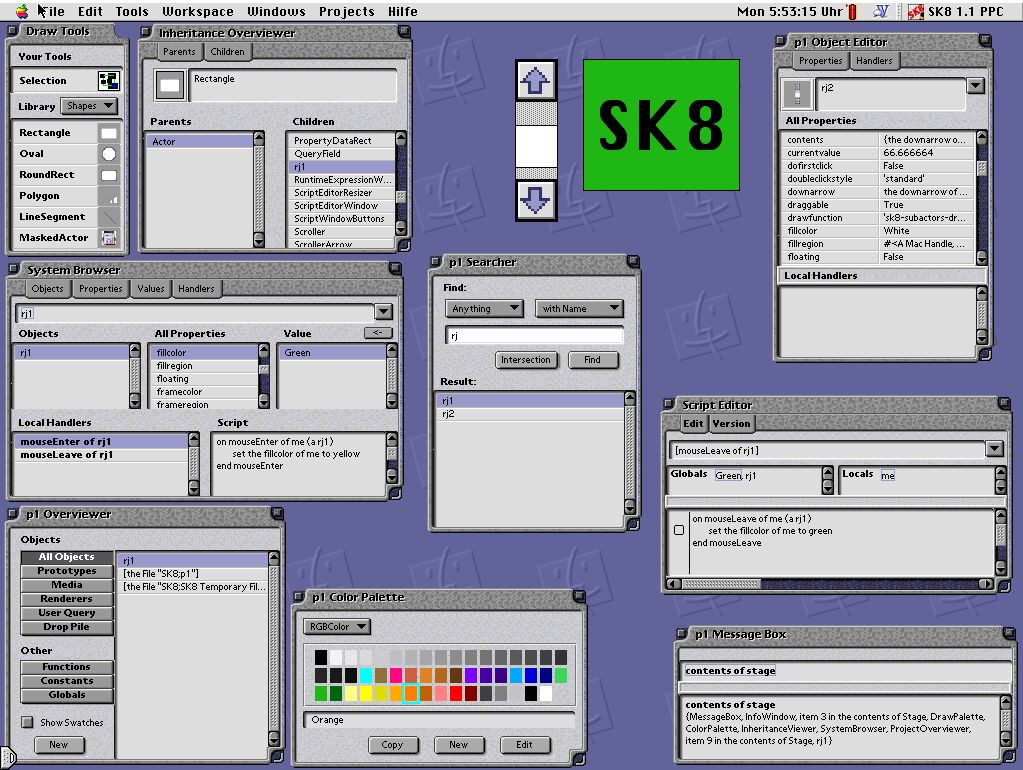
Apple Dylan had an IDE written in Lisp for infix Dylan.
https://www.macintoshrepository.org/_resize.php?w=640&h=480&...
https://www.flickr.com/photos/nda/4738803235
http://www.dylanpro.com/picts/dylanProjectBrowser.gif

https://pbs.twimg.com/media/D0KY_rGV4AAJfxH.png

The original dream of Lisp was to have algol-like M-Expressions and use s-expressions only for data inside M-expressions. But the internals of Lisp were implemented with s-expressions and M-expressions were manually translated into s-expressions. Breaking into a Lisp execution and looking into the interpreter state then revealed the s-expression representation of code to the developer.
Then the cat was out of the bag...
I think this is fine, and now I can direct future commenters who tell me we've just "reinvented lisp" to your thread.
Really helpful links, and I am looking forward to watching that youtube video later this week when I have a moment. Thanks so much for all the information.
For me, using parens is not a deal-breaker, as it's a relatively simple to use for dividing up things. Beats using invisible characters or many different characters.
There's no longer any parens matching.
And not 2 things to keep track of (notice how Bel is both using parens but also following a whitespace convention for readability--that is then stripped and ignored by the compiler).
And also, your program is never in a syntactic error state--such things no longer exist. Semantic errors are still there, of course, but a whole class of errors goes puff.
The solution is not to look at the parens. It's a bit like not listening to tinnitus, which is harder for some than for others. Tools help.